
TL;DR — Quick Summary
- The next consolidation wave is technology-driven, not volume-driven: In previous waves, acquirers paid for merchant count and processing volume. In this one, they pay for platforms, software penetration, and proprietary data. An ISO with 5,000 merchants on its own software commands a higher price than an ISO with 20,000 merchants it merely processes for. The asset being bought has changed, and most ISO owners have not updated their strategy to match.
- Winners own software, data, and embedded distribution; losers own a book of price-sensitive merchants: The ISOs that get acquired at a premium are the ones that built a platform, penetrated their merchants with software, and own operational data. The ISOs that get acquired as bolt-ons — or not at all — are processing-only shops whose merchants can be poached by the next rep who knocks on the door. The gap between these two positions is now the difference between a life-changing exit and a modest one.
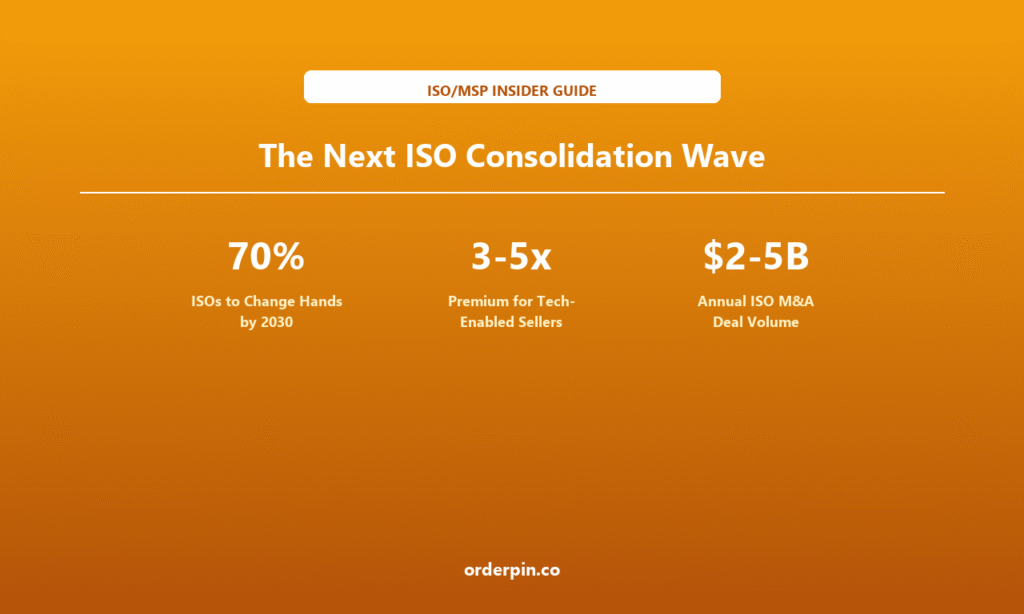
- The window is open now and narrowing: Analysts project that 70% of independent ISOs will change hands by 2030, and acquirers are paying 3-5x more for tech-enabled sellers today. But as more ISOs build software and the market saturates with “platform” stories, the premium compresses. The ISO that positions for a premium exit in the next 12-24 months captures the arbitrage; the one that waits competes in a crowded, discounted field.
by 2030
Enabled Sellers
Deal Volume
What Is Driving the Next Consolidation Wave
Payments has consolidated in waves before. The first waves were about scale — acquirers bought ISOs for merchant count and processing volume, rolling up books to hit a volume tier that improved interchange economics. The current wave is different, and the difference is the whole story. Acquirers are no longer primarily buying volume. They are buying technology, software penetration, and data — the assets that make a merchant book defensible and a platform extensible.
The catalyst is the same shift this entire series has documented: software is eating merchant acquisition. An ISO that acquired its merchants through reps and resells processing owns a book that any competitor can poach. An ISO that acquired its merchants through its own software, embedded in their operations, owns a book that is sticky, data-rich, and platform-extensible. Acquirers have noticed. The premium has moved to the second type — and the first type is being acquired as a bolt-on, if at all.
The numbers frame the stakes. Industry analysts project that roughly 70% of independent ISOs will change hands by 2030, and that annual ISO M&A volume now runs in the multi-billion-dollar range as strategic acquirers and private equity deploy capital into the category. The acquirers are not buying merchants — they are buying the technology and data that make those merchants worth keeping. For an ISO owner planning an exit, this is the single most important strategic fact of the decade: the price you get is now determined by what kind of asset you built, not how many merchants you signed.
This article lays out a winners-vs-losers framework: what acquirers are actually buying in this wave, which ISO profiles command the premium, which get left behind, and — most importantly — how to position your ISO for a premium exit before the window closes.
Change Hands by 2030
Tech-Enabled Sellers
Deal Volume
Retention (deal protection)
1. What Acquirers Are Actually Buying Now
Platforms, not processing: The core asset acquirers want is a payments-capable platform they can extend — embed into more ISVs, layer new products on, and use as distribution infrastructure. An ISO that owns a platform (or a white-label one under its brand) is buying the acquirer’s future growth, not just its past volume.
Software penetration, not merchant count: A merchant who runs your software is worth more than a merchant who merely processes with you. Penetration is the metric — what share of the merchant’s operations your software touches. High penetration means switch costs, data, and defensibility. Acquirers price the book on penetration, not headcount.
Data assets, not transaction logs: Proprietary operational data — multi-location performance, vertical-specific patterns, embedded usage — is what makes a book valuable to an acquirer building AI and embedded-finance products. Transaction logs are commoditized; operational data is not. The ISO that owns the latter is the one that commands the premium.
2. Winners vs. Losers: The Framework
Winners — platform owners: ISOs that run their merchants on owned or white-label software, with high software penetration, owned data, and embedded ISV distribution. These sell at 8-15x and are courted by strategic and financial buyers alike. They are the prize, not the bolt-on.
Losers — processing-only bolt-ons: ISOs that acquired merchants through reps, resell processing, and own no software or data. Their merchants churn at 15-25% and can be poached. These get acquired at 3-5x as volume additions — or passed over when the buyer already has enough undifferentiated volume.
The middle — the danger zone: ISOs with decent volume and a partial software story (a reseller agreement, a loose ISV referral) but no owned platform or data. They look tech-enabled on a pitch deck and get priced as processing-only in diligence. The gap between “has software” and “owns the platform” is where most exit value leaks.
3. Positioning for a Premium Exit Before the Window Closes
Own the platform, even if white-labeled: You do not need to build software from scratch. A white-label platform under your brand gives you the owned-platform position acquirers pay for. The key word is own — the merchant relationship and data must be yours, not the vendor’s.
Drive software penetration before you shop the book: Every merchant you move onto your platform — even partially — raises the multiple. Penetration is a leading indicator of exit price. The 12-24 months before a sale are the highest-leverage period to convert processing-only merchants into software-penetrated ones.
Build the data asset deliberately: Track operational metrics across your merchant base and consolidate them into a defensible data asset. Acquirers building embedded finance and AI products will pay for this; ISOs that never collected it have nothing to sell on that dimension.
Time the window: The premium compresses as more ISOs build platforms and the “tech-enabled” label saturates. The ISO that positions in the next 12-24 months captures the arbitrage; the one that waits competes in a crowded field where the premium has narrowed. The window is open; it is not permanent.
Who Gets Acquired at a Premium vs. Who Gets Left Behind
| Profile | Premium Seller (Winner) | Bolt-On (Left Behind) |
|---|---|---|
| Software Position | Owns platform (white-label OK) | Processing only, no platform |
| Software Penetration | High (operations embedded) | Low (payments only) |
| Data Ownership | Full operational data | Transaction logs only |
| Merchant Retention | 90%+ (switch-protected) | 15-25% annual churn |
| Acquirer Interest | Strategic + PE, courted | Volume add-on, if at all |
| Exit Multiple (EBITDA) | 8-15x | 3-5x |
How OrderPin Positions an ISO for a Premium Exit
OrderPin is a white-label POS platform that gives an ISO the owned-platform position acquirers pay a premium for — without building software from scratch. For an ISO planning an exit in the next consolidation wave, it is the fastest path from processing-only to platform-owned.
- Owned platform under your brand: Every merchant runs on the ISO’s branded OrderPin stack, so the ISO owns the relationship and the platform position — the exact asset strategic buyers want. Not a reseller badge; an owned platform.
- Software penetration you can drive before the sale: Moving processing-only merchants onto OrderPin raises penetration fast. Penetration is the leading indicator of exit price, and the 12-24 months before a sale are the highest-leverage window to convert the book.
- Consolidated data asset: OrderPin gives the ISO full operational data across its merchant base — multi-location performance, vertical patterns, embedded usage — the defensible data asset acquirers building AI and embedded finance will pay for.
- Out of the danger zone: The gap between “has software” and “owns the platform” is where exit value leaks. OrderPin closes that gap: the ISO owns the platform, the data, and the merchant — converting a processing-only bolt-on profile into a premium-seller profile.
Frequently Asked Questions
Is the consolidation wave real, or just analyst hype?
The wave is real and measurable. Analysts project that roughly 70% of independent ISOs will change hands by 2030, and annual ISO M&A volume now runs in the multi-billion-dollar range as strategic acquirers and private equity deploy capital into the category. The driver — software eating merchant acquisition — is observable in every vertical. Whether any individual ISO is acquired depends on its position; the wave itself is not hype.
I have 20,000 merchants but no software. Am I a loser in this framework?
Not necessarily a loser, but you are in the danger zone. Volume alone still sells — at 3-5x, as a bolt-on — but you are leaving the 8-15x premium on the table, and your merchants are poachable. The fix is actionable: move merchants onto an owned (white-label) platform, raise penetration, and consolidate your data. An ISO with 20,000 merchants that does this becomes a premium seller, not a bolt-on. The position is changeable; the window is what is time-sensitive.
Does “owning the platform” require building software?
No. A white-label platform (like OrderPin) gives the ISO an owned platform under its own brand — the merchant relationship, the data, and the platform position are the ISO’s. Building from scratch costs millions and years; white-labeling delivers the same acquirer-valued position for the cost of a partnership. The requirement is ownership of the relationship and data, not authorship of the code.
How much does software penetration actually move the multiple?
The framework range is 3-5x for processing-only versus 8-15x for software-enabled — roughly a 2-3x enterprise-value difference on the same EBITDA. Penetration is the leading indicator because it signals switch costs, data, and defensibility, which is what acquirers price. Moving even a meaningful share of your book onto owned software can shift the entire valuation bucket, not just add a small premium.
When is the right time to start positioning for exit?
Now, if an exit is contemplated within 3-5 years. The premium compresses as more ISOs build platforms and the “tech-enabled” label saturates the market. The ISO that owns the platform, drives penetration, and consolidates data in the next 12-24 months captures the arbitrage before the field crowds. Waiting risks competing for a thinner premium against a wave of similar “platform” stories.
What if I do not want to sell — does this still matter?
Yes. The same assets that command a premium at exit — owned platform, software penetration, proprietary data — also make the ISO more durable and more profitable while you own it. They raise retention, lower acquisition cost, and create defensible competitive moats regardless of whether you ever sell. Building them is good operating strategy first and a premium exit second; the exit is the bonus, not the only reason.
The next ISO consolidation wave is technology-driven, not volume-driven. Acquirers are paying for platforms, software penetration, and proprietary data — not merchant count and processing volume. The ISO that owns a platform, embeds software in its merchants’ operations, and controls operational data sells at 8-15x and is courted by strategic and financial buyers. The ISO that acquired merchants through reps and resells processing sells at 3-5x as a bolt-on, if at all. Roughly 70% of independent ISOs will change hands by 2030, and the premium for tech-enabled sellers is open now but compressing as the market saturates. The position is changeable — an ISO can move from the danger zone to the winner’s column by owning a platform (even white-labeled), driving penetration before a sale, and consolidating its data — but the window is time-sensitive. The ISO that positions in the next 12-24 months captures the arbitrage; the one that waits competes in a crowded, discounted field. OrderPin is a white-label POS platform that gives ISOs the owned-platform, data-rich, software-penetrated position acquirers pay a premium for — without building software from scratch — turning a processing-only bolt-on profile into a premium-seller profile before the window closes.
About OrderPin
OrderPin is a white-label POS platform built for ISO and MSP partners. We offer full data ownership, flexible pricing, and seamless API integrations to help you build a recurring revenue business under your own brand. Learn more about OrderPin’s white-label solution