
TL;DR — Quick Summary
- Investors no longer buy volume: Raw processing volume — total transaction dollars — tells you very little about the quality, durability, or defensibility of an ISO portfolio. Two ISOs with identical monthly volume can have radically different risk profiles, growth trajectories, and exit values. One is a platform business; the other is a reseller with a volume metric. Acquirers can tell the difference instantly, and they price accordingly.
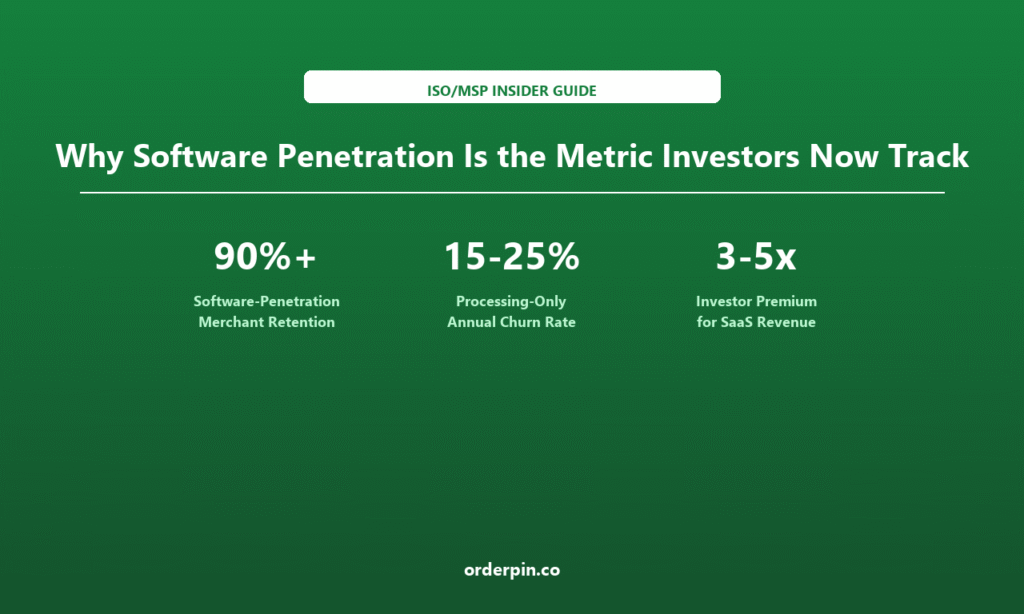
- Software penetration rate is the new valuation driver: Investors now evaluate what share of an ISO’s merchants runs on owned or embedded software — not just how much volume they process. High software penetration means switch costs, recurring revenue, proprietary data, and a moat that reps and competitors cannot easily replicate. An ISO with 90%+ software-penetrated merchants is valued on software-enabled metrics; one at 20% is valued on processing metrics. The spread is 3-5x on the same revenue base.
- The action is simple but urgent: Every merchant moved from processing-only to software-onboarded raises the portfolio’s software penetration rate, which raises the valuation multiple. The 12-24 months before a sale are the highest-leverage period for this conversion — and every month the penetration rate stays low is a month the portfolio is valued below its potential. ISOs that are still measuring themselves by monthly volume are speaking a metric investors no longer use.
Merchant Retention
Annual Churn Rate
for SaaS Revenue
What Is Software Penetration — and Why Does It Matter
For most of the ISO industry’s history, the primary performance metric was processing volume — total transaction dollars, monthly dollar volume (MDV), or annualized volume. It was the number in every sales deck, every broker’s valuation model, and every acquirer’s first-pass screening. It was also deeply misleading as a measure of business quality, but it was easy to count and easy to compare, so it became the default. That is changing, and the change is fast.
Investors and acquirers — both strategic and financial — have shifted their primary lens from volume to software penetration. Software penetration measures what share of an ISO’s merchant base runs on owned or embedded software platforms rather than simply processing payments through a terminal. High penetration means merchants are locked in by operational dependency, not price sensitivity. It means the ISO owns the data, controls the relationship, and has a recurring-revenue engine that compounds with adoption. Volume is a flow metric; software penetration is a quality-of-business metric.
The practical difference in valuation is not small. An ISO with 5,000 merchants on its own software platform — high penetration — is valued on software-enabled metrics at 8-15x EBITDA. An ISO with 20,000 merchants it merely processes for — low penetration — is valued on processing metrics at 3-5x. The revenue can be identical. The enterprise value is not. The rest of this article explains the mechanism, the metric framework, and the specific actions that raise software penetration before an exit.
Merchant Retention
Annual Churn Rate
SaaS-Based Revenue
Exit Multiple (EBITDA)
1. Why Volume Stopped Being the Right Metric
Volume is a flow metric, not a quality metric: Processing volume tells you what merchants spent last month. It tells you nothing about whether those merchants will be there next year, whether they are dependent on your service, or whether a competitor can poach them with a lower rate. Two ISOs with identical volume can have 15% annual churn or 90%+ retention — and the volume number is identical. The metric was never a quality signal; it was a scale signal, and scale without quality is not worth what it used to be.
Software penetration captures the quality that volume misses: A merchant on your software platform is locked in by operational dependency — switching means changing the system they run their business on. A merchant who only processes with you is locked in by price perception, which changes the moment a competitor makes a better offer. Software penetration is the metric that separates these two types of merchants, and it is what investors now use to price the difference.
Acquirers price the moat, not the volume: Strategic acquirers and private equity are not buying a number on a page — they are buying a business that will still be there in five years with the same or higher EBITDA. A software-penetrated portfolio has a defensible moat (switch costs, owned data, embedded distribution) that makes the five-year projection credible. A processing-only portfolio is priced as a declining asset: the same merchants who can be poached today can be poached tomorrow, and the acquirer knows it.
2. The Three Dimensions of Software Penetration Investors Measure
SaaS attachment rate: What share of merchants pays a recurring SaaS or software fee, not just a per-transaction rate? SaaS attachment converts variable processing revenue into predictable recurring revenue — the kind that justifies higher multiples. An ISO with 70% SaaS attachment has a fundamentally different revenue quality profile than one at 10%.
Operational embedding: What share of merchants uses your software for inventory, ordering, loyalty, or analytics — not just payments? Deep embedding means the software touches multiple parts of the merchant’s operations, making it structurally costly to switch. A merchant who only runs payments through your terminal has one reason to stay; one who also runs ordering and inventory has three.
Data ownership: What operational data does the ISO own that no competitor can replicate? Proprietary data — multi-location performance, vertical-specific patterns, real-time usage — is the third dimension that converts a merchant book into a platform asset. Data owned is data that compounds in value over time, and it is what acquirers building AI and embedded-finance products will pay for.
3. How to Raise Software Penetration Before the Exit
Move processing-only merchants onto the platform: The highest-leverage conversion is existing merchants who currently only process — not yet on any software. Onboarding them onto your POS or software platform raises penetration immediately and visibly. Every merchant converted improves the portfolio’s penetration rate and, therefore, its exit multiple.
Layer SaaS products onto every new merchant from day one: Stop selling processing and offering software as an add-on. Start selling the software platform and including processing as a feature. The shift in framing — software-first versus processing-first — changes the penetration rate of every new merchant from the moment of signing.
Target high-embedding verticals: Restaurants, multi-location operators, and service businesses have natural points of operational dependency that make deep embedding easier to achieve. Start new merchant acquisition in verticals where you can achieve 3+ software touch points per merchant, not just payments.
Measure and report the right number internally: Stop running the business on volume. Run it on software penetration rate, SaaS attachment rate, and data-ownership score. These are the numbers that tell you where the business actually stands, and they are the numbers acquirers will ask for in diligence. If you are not tracking them, start now — the data compounds in your favor every month.
Processing Volume vs. Software Penetration: What Investors Actually See
| Dimension | Software-Penetrated Portfolio | Processing-Only Portfolio |
|---|---|---|
| Revenue Predictability | SaaS recurring + processing | Variable, transaction-dependent |
| Merchant Retention | 90%+ (switch-protected) | 15-25% annual churn |
| Competitive Moat | Owned data + switch costs | Price-sensitive, easily poached |
| Acquirer Interest | High — platform asset | Volume-add, price-sensitive |
| Exit Multiple (EBITDA) | 8-15x | 3-5x |
How OrderPin Lets ISOs Raise Software Penetration Before the Exit
OrderPin is a white-label POS platform that gives ISOs a software platform under their own brand — the direct tool for raising software penetration rate, SaaS attachment, and data ownership across the portfolio. For the ISO targeting a premium exit, it is the fastest path to a software-penetrated book.
- Owned software platform from day one: Every merchant runs on the ISO’s branded OrderPin platform, immediately lifting software penetration from the moment of onboarding. No reseller agreement — the ISO owns the platform and the relationship.
- Multi-module SaaS attachment: OrderPin supports POS, ordering, loyalty, inventory, and analytics as integrated modules — giving the ISO multiple SaaS touch points per merchant and raising the embedding depth that investors measure.
- Proprietary operational data: Full merchant performance data across the ISO’s portfolio — multi-location, vertical, real-time usage — builds the data asset acquirers pay a premium for in embedded-finance and AI due diligence.
- Fastest path to a software-penetrated book: A 20,000-merchant ISO moving those merchants onto OrderPin converts a processing-only portfolio into a software-penetrated one — raising penetration rate, retention, and the exit multiple in the 12-24 months before a sale.
Frequently Asked Questions
What exactly is software penetration rate?
Software penetration rate measures what share of an ISO’s merchants runs on owned or embedded software platforms rather than merely processing payments. A merchant running your POS, ordering, and analytics software has a high penetration rate. A merchant with only a payment terminal has a low penetration rate. Investors use this ratio — not raw volume — to assess business quality, retention risk, and competitive moat.
Why do investors prefer software-penetrated portfolios?
Because software-penetrated merchants are retained at 90%+ annually versus 15-25% for processing-only merchants — they are locked in by operational dependency, not price. This makes the five-year EBITDA projection acquirers need credible. Software-penetrated portfolios also own data and have embedded distribution, which are platform assets rather than merchant books. These qualities make the business durable, compounding, and defensible — exactly what a premium multiple reflects.
I already have a lot of processing volume — does that not matter anymore?
Volume still matters — it is real revenue — but it is priced differently depending on what kind of merchants produce it. Processing volume from software-penetrated merchants commands a premium; volume from processing-only merchants commands a processing multiple. The goal is not to reduce volume; it is to increase the share of your volume that comes from software-penetrated merchants, which improves the quality of the revenue you already have without sacrificing the top line.
How long does it take to meaningfully raise software penetration?
The highest-leverage moves happen fastest: onboarding existing processing-only merchants onto the software platform can happen at the next renewal or upgrade cycle. New merchant acquisition should be software-first from the first meeting. A meaningful shift in penetration rate is achievable in 12-18 months, and it is visible in the metrics during that time — which is important if an exit timeline is approaching.
Does raising software penetration require building software?
No. A white-label platform partnership (like OrderPin) delivers an owned software platform under the ISO’s brand without the build cost or timeline. The key is ownership of the platform relationship and data — not authorship of the code. The ISO presents OrderPin as its own brand, owns the merchant relationship, and collects the data, which is exactly what software penetration means operationally.
How much does raising penetration actually move the exit multiple?
The framework shows a 3-5x EBITDA multiple difference between processing-only (3-5x) and software-enabled (8-15x) portfolios. On a $5M EBITDA business, that is a $17.5M enterprise value difference at the software-enabled end. The multiple does not shift linearly with each merchant converted — it shifts in buckets, as acquirers reclassify the business from “processing” to “software-enabled” at a certain penetration threshold. Crossing that threshold is the goal.
Investors evaluating ISO portfolios have shifted from measuring volume to measuring software penetration — the share of merchants on owned or embedded software, SaaS attachment, and data ownership. An ISO with 90%+ software-penetrated merchants is valued at 8-15x EBITDA; one at 20% is valued at 3-5x on the same revenue. The two numbers tell radically different stories about quality, durability, and competitive moat — and acquirers can tell the difference instantly. The action is not to abandon volume; it is to convert processing-only merchants to software-onboarded merchants, acquire new merchants software-first, and track penetration rate as an internal metric. The 12-24 months before an exit are the highest-leverage window for this conversion — and every month penetration stays low is a month the portfolio is valued below its potential. OrderPin is a white-label POS platform that lets ISOs raise software penetration rate across their entire portfolio without building software — owned platform, multi-module SaaS attachment, full data control, deployed under the ISO’s brand for the fastest path to a software-penetrated, premium-valued book.
About OrderPin
OrderPin is a white-label POS platform built for ISO and MSP partners. We offer full data ownership, flexible pricing, and seamless API integrations to help you build a recurring revenue business under your own brand. Learn more about OrderPin’s white-label solution