
TL;DR — Quick Summary
- Vertical SaaS is not coming — it has arrived: Toast has reshaped restaurant POS, Jane App dominates therapist and health provider scheduling, ShopWare has scaled across auto repair shops. These platforms do not compete on payment rates; they compete on workflow ownership, and they are systematically replacing the merchant relationships ISOs have spent decades building. What looked like niche software is now a coordinated, multi-vertical threat to the entire ISO model.
- Workflow ownership beats rate competition every time: When a merchant runs their business on Toast or Jane App, the payment is embedded in a workflow they depend on — scheduling, ordering, inventory, clinical notes. The payment is invisible to the merchant, and the ISO is invisible to the relationship. Switching the payment processor means switching the operating system. Merchants will not do that for 5 basis points. The ISO has already been disintermediated; the only question is whether the ISO realizes it.
- The ISO response must be pre-emptive and workflow-first: Waiting for a merchant to be propositioned by Toast or Jane App is waiting too long. The window to own the workflow is before the merchant adopts it — and once lost, it is structurally difficult to reclaim. ISOs that deploy white-label POS platforms, specialize in workflow-embedded verticals, and build deep operational integrations before vertical SaaS arrives will hold the merchant relationship. The ones who wait will be competing for whatever is left.
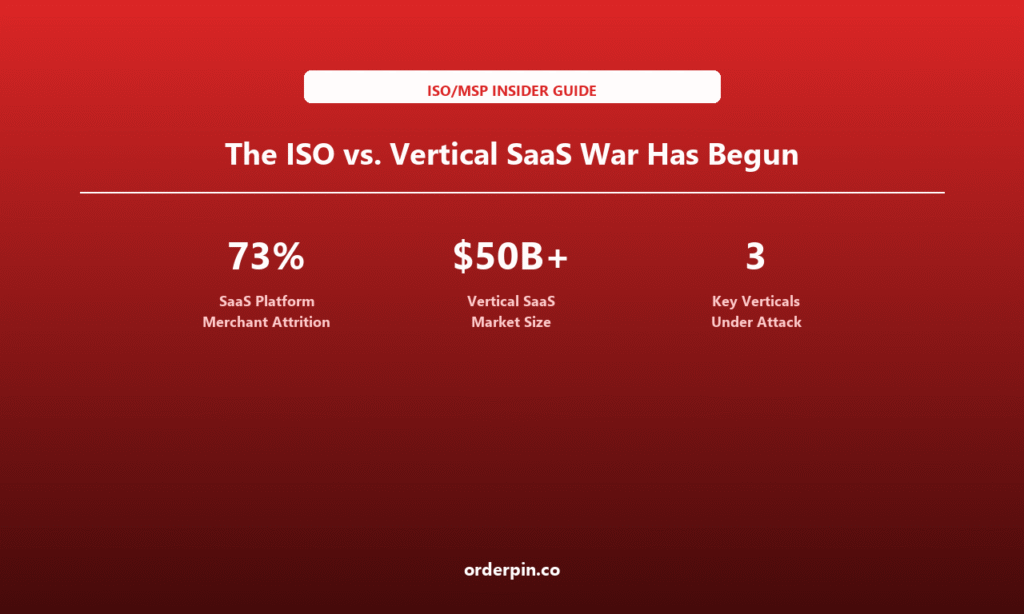
Merchant Attrition Rate
Total Addressable Market
Under Active Attack
What Is the Vertical SaaS War — and Why Is It Happening Now
For most of the ISO industry’s history, competition was horizontal: ISOs competed with each other on processing rates, service quality, and terminal availability. The competitive battlefield was the same regardless of the merchant — restaurant, retailer, service business — and the switching cost was low because the relationship was defined by a rate, not by a workflow. That structure is breaking apart, and the force breaking it is vertical SaaS.
Vertical SaaS platforms are industry-specific software companies that embed payments into a workflow merchant already uses. Toast owns the restaurant’s ordering, kitchen display, and inventory system — and processes payments as a feature of that workflow. Jane App owns the therapist’s appointment scheduling, clinical notes, and client billing — and handles payment as part of the booking flow. ShopWare owns the auto repair shop’s job tracking, parts ordering, and invoicing — and collects payment when the invoice is generated. None of these companies started as payment companies. They started as workflow companies that made payments invisible by making them automatic.
The result is a form of competitive disintermediation that rate competition cannot counter. A restaurant owner who runs Toast does not think about their payment processor — they think about their POS system. The payment is embedded in a workflow the merchant depends on for daily operations, which means switching the payment processor requires switching the operating system. The switching cost is no longer 5 basis points — it is the entire operational infrastructure of the business. ISOs that have not yet been affected by this dynamic are not in a safe position. They are in a waiting position.
Who Never Compare Rates
Addressable Market
Simultaneous Attack
Workflow Dependency
1. The Three Verticals Under Active Attack
Restaurants — Toast has already won this battle: Toast is not trying to win the payment processing market from the outside. It won by owning the restaurant workflow — table management, kitchen display, online ordering, inventory — and making payment a feature of that system. A restaurant on Toast does not shop for a payment processor; they use the system they already run their business on. Toast’s embedded payments now process billions in volume annually, and the ISO that was previously the restaurant’s payment provider is a distant second — or gone. The lesson from restaurants is not that ISOs lost. It is that they lost because they never owned the workflow.
Healthcare and wellness — Jane App and the scheduling lock: Therapist, counselor, and health practice scheduling platforms have followed the same playbook. Jane App, SimplePractice, and similar platforms own the appointment scheduling, client intake, clinical notes, and billing workflow for tens of thousands of health providers. When a therapist books a session through Jane App, payment is collected as part of the booking flow. The provider never thinks about their payment processor — they think about their scheduling system. ISOs serving health providers are experiencing the same disintermediation dynamic as restaurants, just on a slower timeline. The timeline is not an excuse. The same structural logic applies.
Auto repair and trades — the job-costing invasion: Auto repair shops and trades businesses — HVAC, plumbing, electrical — are being targeted by vertical platforms built for their specific workflows. ShopWare and similar platforms offer job costing, parts ordering, work order management, and invoicing — and embed payment collection in the invoice. The merchant who manages their entire job in the platform has no reason to use a separate payment processor. This vertical is earlier in its SaaS adoption curve than restaurants or healthcare, which means the window to own the workflow before a vertical SaaS incumbent does is still open — but it is closing.
2. Why Workflow Ownership Beats Rate Competition Every Time
Rate competition assumes the merchant is shopping for rates: The entire ISO sales model — identify a merchant, propose a rate, win the business — is predicated on the merchant actively comparing payment processors. Vertical SaaS platforms eliminate this behavior by making payment invisible. A merchant on Toast does not compare payment rates because they do not experience payment as a separate decision. It is a feature of their scheduling and ordering system. The competitive dynamic that ISOs have optimized for — rate selling — does not exist in a vertical SaaS relationship, which means ISOs selling on rate are optimizing for a market that is shrinking.
Switching cost is no longer 5 basis points: In a rate-competition world, the switching cost is low — the merchant finds a better rate, signs new paperwork, swaps a terminal configuration, and done. In a workflow-ownership world, the switching cost is the entire operational infrastructure of the business. Switching payment processors in Toast means switching POS systems, re-entering menu items, retraining staff, and rebuilding the kitchen display configuration. A merchant who saves 10 basis points by switching to a different processor still has to run their restaurant. They will not do it. The ISO that was competing on rate has already lost the moment the merchant adopted the vertical SaaS platform — they just have not sent the cancellation notice yet.
The ISO is disintermediated before they know it: What makes the vertical SaaS threat so dangerous is that the ISO may not realize they have been disintermediated until the damage is structural. A merchant may continue to use the ISO’s processing for months after adopting a vertical SaaS platform, which creates a false sense of relationship security. The ISO’s volume is stable, the merchant is nominally active, and there is no immediate crisis. Then, at the next renewal, the ISO discovers that the merchant has embedded the vertical SaaS payment into their workflow — and the renewal conversation is not about rate. It is about switching an operating system. By then, it is too late.
3. The ISO Response: Pre-Emptive Workflow Ownership
Own the workflow before vertical SaaS does: The most effective defense against vertical SaaS disintermediation is to be the platform that owns the merchant’s workflow before a vertical SaaS competitor arrives. This means deploying a white-label POS and software platform — not just a terminal — at the point of merchant onboarding. The ISO who owns the platform owns the relationship, the data, and the switching cost. Merchants who run their operations on the ISO’s platform do not shop for Toast or Jane App because they are already running their business on a system that does everything they need.
Prioritize verticals where the window is still open: In restaurants, the window for ISOs to own the workflow is narrow — Toast has already won significant market share. In healthcare and auto repair, the window is wider but closing. ISOs should conduct a vertical-by-vertical assessment of where vertical SaaS incumbents have already achieved workflow lock, where they are gaining, and where the field is still open. The open fields — early-adoption verticals, underserved industries, emerging market segments — are where pre-emptive workflow ownership has the highest return.
Convert existing processing-only merchants before they are approached: For the existing processing-only merchant base, the priority is accelerating the move onto the ISO’s software platform before a vertical SaaS vendor makes contact. This is a sales motion — not a renewal conversation — and it requires a different pitch: not “save on rates,” but “build the operational infrastructure of your business with a platform that grows with you.” The ISO that brings a merchant onto their platform in Q1 owns that merchant’s workflow for the next three to five years. The ISO that waits for the merchant to be approached by a vertical SaaS company in Q3 is already behind.
Specialize in vertical-specific integrations: ISOs that serve healthcare merchants should have integrations with the scheduling and practice management systems their merchants use. ISOs serving restaurants should have ordering, inventory, and kitchen display integrations. ISOs serving auto repair should have job-costing and parts database integrations. The ISO that integrates deeply into the vertical-specific workflows that merchants depend on is the ISO that cannot be easily disintermediated — because the switching cost includes not just the POS but also the integrated systems that run the business.
ISO vs. Vertical SaaS: How the Competitive Dynamic Differs
| Dimension | Traditional ISO | Vertical SaaS Platform |
|---|---|---|
| Primary Value | Competitive payment rates | Workflow ownership + payments |
| Merchant Switching Cost | Low — swap terminal config | High — switch operating system |
| Merchant Engagement | Rate-aware, actively comparing | Payment is invisible — workflow is the product |
| Relationship Depth | Rate-level — at the surface | Operational — embedded in daily use |
| ISO Disintermediation Risk | High — rate is all the merchant sees | Low — ISO owns the workflow |
How OrderPin Gives ISOs the Workflow Platform to Fight Vertical SaaS
OrderPin is a white-label POS platform that gives ISOs a workflow-owned platform under their own brand — the direct counter to vertical SaaS disintermediation in restaurant, healthcare, and service verticals. For the ISO competing against Toast, Jane App, and ShopWare, OrderPin is the pre-emptive platform that keeps the relationship before it is lost.
- Own the workflow from onboarding: Every merchant deployed on OrderPin runs their core operations — POS, ordering, scheduling, inventory — on the ISO’s branded platform from day one. The relationship is defined by workflow dependency, not by a rate sheet. Switching to Toast or Jane App means switching the entire system the merchant runs their business on.
- Vertical-specific module depth: OrderPin supports multi-module vertical configurations — restaurant ordering and kitchen display, appointment scheduling, job-costing for trades — giving ISOs the depth to serve verticals that vertical SaaS platforms target without requiring a separate vendor relationship.
- Embedded payments, not add-on payments: Payment processing is built into every OrderPin workflow — POS transaction, online order, appointment booking, invoice generation. The merchant experiences payment as part of their operational flow, not as a separate provider decision. This is exactly what vertical SaaS offers, delivered under the ISO’s brand.
- Protect the merchant relationship before it is lost: An ISO that deploys OrderPin across its merchant base in Q1 owns those merchant workflows for the next three to five years. An ISO that waits until a merchant has already been approached by Toast or Jane App is in a defensive position from day one. The window for pre-emptive workflow ownership is open now — and it closes faster than most ISOs realize.
Frequently Asked Questions
Is vertical SaaS actually a threat to my merchant relationships right now?
In restaurants, it is already here — Toast has significant market share and is not a future threat. In healthcare and auto repair, the adoption curve is less advanced but moving in the same direction. The question is not whether vertical SaaS will affect your merchant base — it is which verticals it will reach first and whether your relationships are protected by workflow dependency or by rate perception. Rate-perception relationships are already at risk.
Can I compete on rate against a vertical SaaS platform?
Rate competition against a vertical SaaS platform is ineffective because the merchant is not shopping on rate — they are operating a system. A merchant on Toast does not compare payment processing rates because payment is embedded in their POS. Saving 10 basis points requires switching the entire restaurant operating system. The math does not work for the merchant, so the merchant does not do it. Competing on rate against a workflow-embedded platform is competing in a market that no longer exists for that merchant.
What does it actually take to own the workflow — do I need to build software?
No. A white-label POS platform partnership — like OrderPin — gives the ISO a fully functional, branded software platform without building it from scratch. The ISO presents OrderPin as its own product, owns the merchant relationship, collects the data, and embeds payment processing as a feature of the workflow. This is exactly what Toast and Jane App do operationally — the difference is that with white-label, the ISO is the brand, not the reseller.
Some of my merchants are already using Toast or Jane App. Is it too late for them?
For merchants already deeply embedded in a vertical SaaS platform, the ISO is in a defensive position. The goal is to identify the next renewal or expansion moment and present an alternative before it arrives. In some cases, merchants who have outgrown a vertical SaaS platform — who need more locations, more integrations, or more flexibility than the platform provides — are actively looking for an alternative. The ISO that monitors merchant platform usage and identifies these inflection points has a real conversion opportunity that rate-selling would never create.
Which verticals should I prioritize first?
The verticals where vertical SaaS has not yet achieved workflow lock — and where there is a large base of merchants who have not yet adopted a vertical-specific platform. Auto repair, trades, and personal services are earlier in the adoption curve than restaurants or healthcare. The ISO that enters these verticals first with a workflow-owned platform has a significant first-mover advantage. The ISO that waits until ShopWare or a similar platform has already locked those merchants is in a Toast-like situation, just in a different vertical.
How do I know if my merchant relationships are protected or at risk?
Ask one question: does the merchant run any operational workflow on a platform other than your processing — scheduling, ordering, inventory, job-costing, clinical notes? If yes, the merchant has a workflow dependency that is not with you. The payment is already embedded in a system you do not own. The relationship is at risk. If the merchant runs all of their operations on your platform, the relationship is protected — but this is increasingly rare outside of white-label POS deployments. Most processing-only ISO relationships are at risk and the ISO does not know it yet.
Vertical SaaS platforms — Toast, Jane App, ShopWare — have entered the ISO’s competitive territory not by competing on payment rates, but by owning the merchant’s workflow. In restaurants, this battle is already largely over. In healthcare and auto repair, the window for ISOs to own the workflow before vertical SaaS does is still open, but it is closing faster than most ISO leaders realize. The ISO response is not to compete on rate — it is to own the workflow first. Deploying a white-label POS and software platform at merchant onboarding converts a rate-level relationship into a workflow-embedded relationship, which creates the switching cost that rate competition cannot overcome. The ISO that owns the workflow owns the merchant. The ISO that only owns the rate is waiting to be disintermediated. OrderPin is a white-label POS platform that gives ISOs the workflow-owned platform they need to compete against vertical SaaS in restaurant, healthcare, auto repair, and service verticals — owned brand, embedded payments, multi-module depth, under the ISO’s name before Toast or Jane App gets there first.
About OrderPin
OrderPin is a white-label POS platform built for ISO and MSP partners. We offer full data ownership, flexible pricing, and seamless API integrations to help you build a recurring revenue business under your own brand. Learn more about OrderPin’s white-label solution