
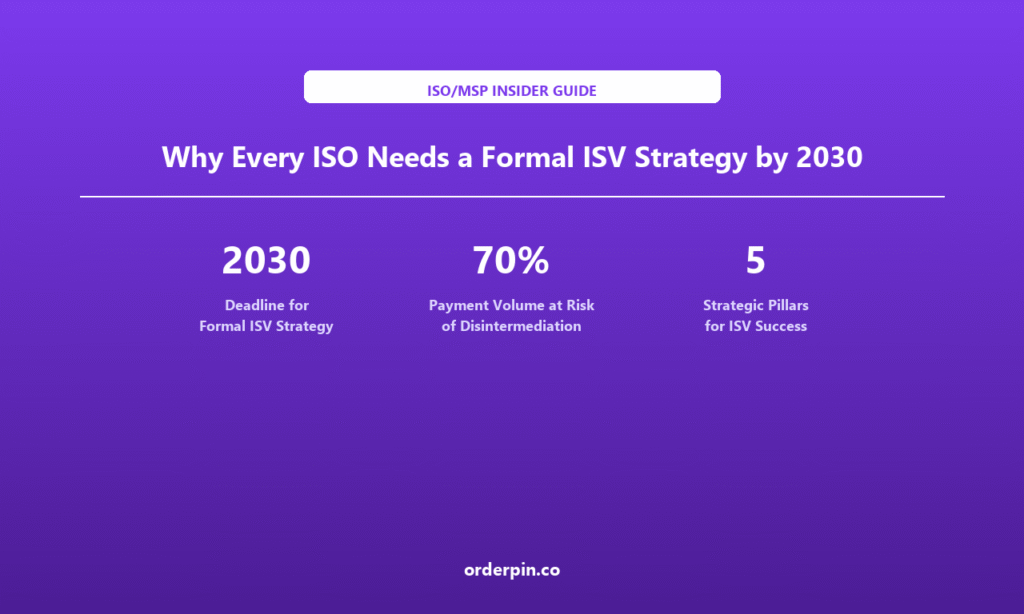
TL;DR — Quick Summary
- 2030 is not an arbitrary deadline — it is the structural tipping point: By 2030, embedded payments will account for the majority of new merchant acquisition in key verticals. Vertical SaaS platforms will have matured their distribution channels, locked workflow ownership in their target markets, and built payment revenues that are structurally uncatchable by traditional ISOs. The ISOs that have a formal ISV strategy in place by 2027-2028 will navigate this transition from a position of strength. Those that wait until 2030 to respond will find the distribution landscape already restructured without them.
- A formal ISV strategy is a documented plan — not a vague intention: It defines whether the ISO will build, acquire, or partner with software vendors; which verticals it will target; how it will embed payments into vertical workflows; what revenue model it will use; and how it will measure software penetration across its portfolio. An ISV strategy that exists only in the leadership team’s heads is not a strategy — it is a set of assumptions that will be tested by the market, usually unfavorably.
- The five pillars of an ISV strategy are actionable now: Vertical selection, platform decision (build/acquire/partner), payment embedding model, revenue diversification framework, and distribution channel ownership. Each pillar has specific decisions that can be made and executed within 12-18 months — which means a formal ISV strategy can be in place well before 2030, giving the ISO a multi-year head start on the restructuring that is already underway.
Formal ISV Strategy
of Disintermediation
for ISV Success
What Is a Formal ISV Strategy — and Why Does 2030 Matter
A formal ISV strategy is a documented plan that defines how a merchant services company will transition from a payment processing business to a software-enabled payments business. It specifies the verticals the company will target, the platform approach it will take (build, acquire, or partner), how payments will be embedded into software workflows, what revenue model will replace or supplement pure processing revenue, and how the company will measure and report its software penetration to investors, acquirers, and internal stakeholders. It is a strategic document — not a product roadmap — but it drives every product, sales, and partnership decision the company makes.
The 2030 deadline is not arbitrary. It reflects the convergence of three structural forces that are already reshaping the industry: vertical SaaS platforms with embedded payments are reaching scale in multiple verticals simultaneously; merchants are increasingly adopting software platforms that include payment processing as a feature rather than a separate procurement decision; and investors and acquirers are pricing ISOs on software penetration rather than processing volume. By 2030, these forces will have progressed far enough that an ISO without a formal ISV strategy will find its distribution channels, merchant relationships, and revenue model fundamentally altered — and not in its favor.
The practical implication is that the strategy needs to be in place by 2027-2028 to allow execution time before the market restructuring is complete. A strategy documented in 2028 and executed over 24-36 months gives the ISO a platform, a vertical focus, and a software-penetrated merchant base by 2030. A strategy first attempted in 2030 is a reaction to a market that has already moved — and the ISO will be executing from a position of weakness, not strength.
Point for ISOs
Without ISV Strategy
for ISV Success
Start Executing
1. Pillar One: Vertical Selection
Choose verticals where the ISO has existing merchant density and the vertical SaaS window is still open: The verticals an ISO targets should be selected based on two criteria: where the ISO already has merchant relationships that can be converted to software-onboarded, and where a vertical SaaS incumbent has not yet achieved workflow lock. Restaurants, healthcare, auto repair, personal services, and multi-location operators each have different levels of vertical SaaS penetration. The ISO should map its existing merchant base by vertical, assess the competitive landscape in each, and prioritize the verticals where it has the most head start.
Avoid verticals where the incumbent has already won: In some verticals — restaurants, for example — a vertical SaaS platform (Toast) has already achieved significant workflow lock. Competing head-on in these verticals is possible but resource-intensive and low-probability. The ISV strategy should focus on verticals where the ISO can be the platform that achieves workflow lock — not on verticals where it is trying to displace an entrenched incumbent. The goal is to be the Toast of a different vertical, not to catch Toast in its own.
2. Pillar Two: Platform Decision — Build, Acquire, or Partner
Build — the highest control, highest cost, longest timeline: Building a software platform from scratch gives the ISO maximum control over features, roadmap, and differentiation. It also requires the most capital, engineering talent, and time — typically 18-36 months before the platform is market-ready. For most ISOs, this option is not practical unless the ISO has access to significant development resources and a multi-year execution runway before the 2030 deadline.
Acquire — the fastest path to an owned platform, at a financial cost: Acquiring an existing vertical SaaS company gives the ISO an owned platform with an existing merchant base, proven product-market fit, and an engineering team. The acquisition cost can be significant — vertical SaaS companies trade at premium multiples — but the time-to-market is the fastest of the three options. For ISOs with access to capital and a clear vertical target, acquisition is the most efficient path to platform ownership.
Partner (white-label) — the pragmatic middle path: A white-label platform partnership gives the ISO a branded software platform without the build cost or acquisition premium. The ISO deploys the platform under its own brand, owns the merchant relationship, and embeds payment processing — but does not own the underlying code. This is the fastest and most capital-efficient path, and for most ISOs, it is the right one. The trade-off is less control over the product roadmap, but the benefit is a platform in market in weeks, not years.
3. Pillar Three: Payment Embedding Model
Payments must be invisible — embedded in the workflow, not sold alongside it: The core principle of payment embedding is that the merchant should never experience payment processing as a separate decision. Payment is collected as part of the POS transaction, the online order, the appointment booking, or the invoice generation — it is a feature of the workflow, not a product. This invisibility is what makes the payment relationship defensible: the merchant does not shop for a different processor because they do not experience the current processor as a separate vendor.
The embedding model defines the revenue quality: When payments are embedded in a SaaS workflow, the revenue is structurally different from standalone processing revenue. It is recurring (because the SaaS subscription is recurring), it is bundled (because the payment fee is part of a larger invoice), and it is protected by the switching cost of the entire workflow. The ISV strategy must specify how payments will be embedded in each vertical workflow — what the merchant experiences, what the pricing model is, and how the revenue is recognized.
4. Pillar Four: Revenue Diversification Framework
Processing revenue alone is a declining asset: Interchange compression, increased competition, and the shift to embedded payments are all pressuring pure processing margins. An ISV strategy must define how the ISO will diversify its revenue base beyond processing — through SaaS subscription fees, hardware margins, ancillary services (loyalty, gift cards, capital lending), and data monetization. The goal is a revenue mix where processing is one stream among several, not the sole source of enterprise value.
The framework must specify target revenue mix by 2030: A practical ISV strategy sets a target — for example, 40% processing revenue, 30% SaaS subscription, 20% hardware and services, 10% ancillary — and defines the specific investments and partnerships needed to achieve that mix. Without a target, the revenue diversification is ad hoc and unmeasurable. With a target, the ISO can track progress quarterly and adjust its investments accordingly.
5. Pillar Five: Distribution Channel Ownership
The distribution channel is the moat — and it is being restructured: Historically, the ISO’s distribution channel was its sales force — reps who called on merchants and sold payment processing. That channel is being disrupted by vertical SaaS platforms, which distribute through software marketplaces, online signups, and partner referrals. The ISO’s ISV strategy must define how it will own or participate in the new distribution channels — not just how it will defend the old ones.
Owning the platform is owning the distribution: When the ISO deploys a white-label POS platform, it owns the distribution channel — every merchant on the platform is acquired through the ISO’s channel, and every additional module the merchant adopts deepens the distribution relationship. The ISO that owns the platform does not need to compete for distribution with vertical SaaS marketplaces, because it has its own marketplace — its merchant base. This is the most defensible form of distribution channel ownership available to an ISO.
The Five Pillars of a Formal ISV Strategy
| Pillar | Key Decision | 2027-2030 Action |
|---|---|---|
| Vertical Selection | Which verticals to target | Map existing base, assess SaaS penetration |
| Platform Decision | Build, acquire, or partner | White-label for most ISOs (fastest path) |
| Payment Embedding | How payments enter the workflow | Embed in POS, ordering, booking, invoicing |
| Revenue Diversification | Target revenue mix by 2030 | SaaS + hardware + processing + services |
| Distribution Ownership | Who owns the merchant channel | ISO-owned platform = ISO-owned channel |
How OrderPin Lets ISOs Execute a Formal ISV Strategy Before 2030
OrderPin is a white-label POS platform that lets ISOs execute the partner path of the platform decision — the most capital-efficient and fastest-to-market of the three options — while delivering the five pillars of a formal ISV strategy. For the ISO building its 2027-2030 plan, OrderPin is the platform that makes the strategy executable now.
- Vertical flexibility: OrderPin supports restaurant, service, and multi-location configurations — giving the ISO a single platform that can be deployed across the verticals it has prioritized in its ISV strategy. The ISO does not need a different platform for each vertical; it configures OrderPin for the vertical.
- Partner path to platform ownership: OrderPin gives the ISO a branded software platform without the build cost or acquisition premium — the fastest and most capital-efficient path to platform ownership. The ISO owns the merchant relationship, the brand, and the data, which is what the ISV strategy requires.
- Payment embedding built in: Payment processing is embedded in every OrderPin workflow — POS, online ordering, appointment booking, invoice generation. The merchant experiences payment as a feature of the workflow, which is the embedding model the ISV strategy specifies.
- Revenue diversification from day one: SaaS subscription fees, hardware margins, and payment processing revenue all flow to the ISO under a white-label arrangement — the diversified revenue base that the ISV strategy targets, available immediately upon deployment.
- Distribution channel ownership: Every merchant deployed on OrderPin is acquired through the ISO’s channel and retained through the ISO’s platform — the most defensible form of distribution channel ownership available. The ISO owns the channel, the relationship, and the switching cost.
Frequently Asked Questions
Why 2030 — what actually changes by then?
By 2030, vertical SaaS platforms with embedded payments will have reached mature distribution in multiple verticals. Merchants will default to software platforms that include payment processing rather than procuring them separately. Investors and acquirers will price ISOs primarily on software penetration, not processing volume. ISOs without a formal ISV strategy by then will find their distribution channels, merchant relationships, and revenue models fundamentally restructured — and they will be operating from a position of weakness in a market that has moved.
What does “formal” ISV strategy mean — how is it different from a plan in our heads?
A formal ISV strategy is a documented document that specifies vertical targets, platform decision (build/acquire/partner), payment embedding model, revenue diversification targets, and distribution channel plan. It is reviewed by leadership, shared with key stakeholders, and tracked with measurable milestones. A strategy that exists only in the leadership team’s assumptions is not a strategy — it is a set of guesses that will be tested by the market, usually unfavorably. Formalizing it forces the hard decisions to be made explicitly.
Should we build, acquire, or partner for our platform?
For most ISOs, the partner path (white-label) is the right choice — it is the fastest, most capital-efficient, and requires no engineering team. Build is viable only for ISOs with significant development resources and a multi-year runway. Acquire is viable for ISOs with access to capital and a clear acquisition target. The decision should be based on the ISO’s capital position, technical capability, timeline, and risk tolerance — but the default for most is partner, because the 2030 deadline rewards speed.
How do we measure whether our ISV strategy is working?
The primary metric is software penetration rate — the share of merchants running on the ISO’s software platform. Secondary metrics include SaaS attachment rate (share of merchants paying recurring software fees), revenue diversification (percentage of revenue from non-processing sources), and merchant retention on software-penetrated versus processing-only accounts. These metrics should be tracked quarterly and reported to leadership, investors, and acquirers during diligence.
What happens if we wait until 2028 or 2029 to start?
Starting in 2028 gives the ISO approximately 24 months to execute — which is feasible for the partner path (white-label deployment) but leaves little margin for error. Starting in 2029 gives approximately 12 months, which is barely enough for platform deployment and insufficient for meaningful merchant conversion. The ISOs that start in 2027 have a 36-month execution window — enough time to deploy the platform, convert a meaningful share of the merchant base, and demonstrate software penetration metrics to investors before the 2030 tipping point.
How much does this cost — and what is the cost of not doing it?
The partner path (white-label) has minimal upfront cost — typically a per-merchant deployment fee and a revenue share. The cost of not doing it is the structural decline of the processing-only business model: merchant attrition to vertical SaaS platforms, revenue compression from rate competition, and a valuation multiple that reflects a declining asset rather than a growing platform. On a $5M EBITDA business, the valuation difference between a processing-only multiple (3-5x) and a software-enabled multiple (8-15x) is $17.5M+ — which dwarfs the cost of any platform path.
By 2030, the payment processing industry will have restructured around software ecosystems, embedded payments, and distribution channel ownership. ISOs that have a formal ISV strategy — documented, measurable, and in execution by 2027 — will navigate this transition from a position of strength. The five pillars are clear: vertical selection, platform decision (build/acquire/partner), payment embedding model, revenue diversification framework, and distribution channel ownership. Each pillar has specific decisions that can be made and executed within 12-18 months through the partner path — a white-label POS platform that gives the ISO a branded software platform, embedded payments, diversified revenue, and owned distribution without building from scratch. The ISOs that act now will be the platform businesses investors and acquirers are buying in 2030. The ones that wait will be the processing volumes being acquired at a discount. OrderPin is a white-label POS platform that lets ISOs execute all five pillars of a formal ISV strategy — vertical flexibility, partner-path platform ownership, embedded payments, revenue diversification, and distribution channel ownership — under their own brand, deployed in weeks, and ready for the 2030 market that is already taking shape.
About OrderPin
OrderPin is a white-label POS platform built for ISO and MSP partners. We offer full data ownership, flexible pricing, and seamless API integrations to help you build a recurring revenue business under your own brand. Learn more about OrderPin’s white-label solution