
TL;DR — Quick Summary
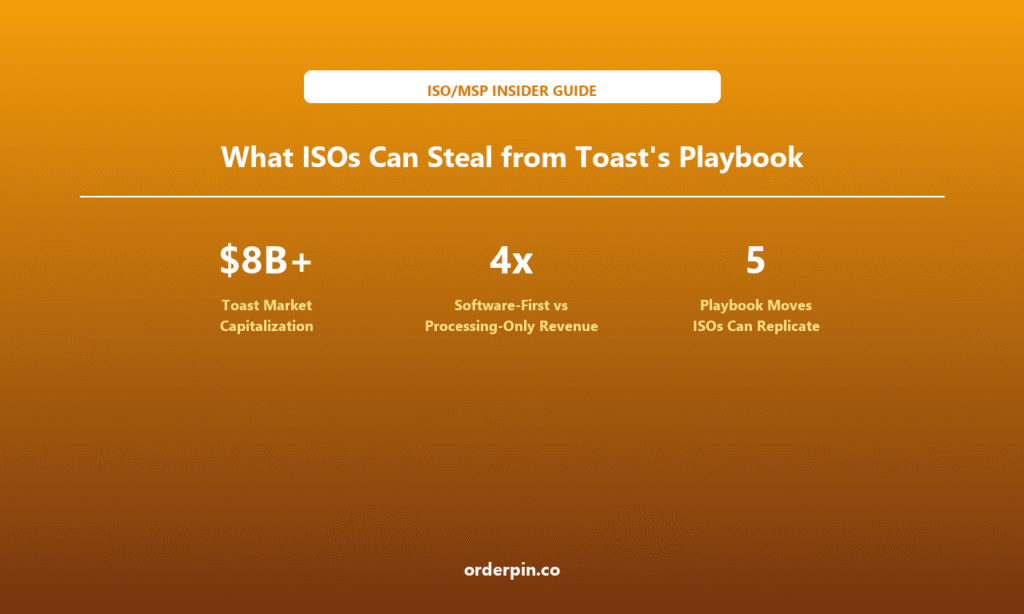
- Toast won by owning the workflow, not the rate: Toast’s path to an $8B+ market cap was not built on payment processing. It was built on owning the restaurant’s daily operational workflow — ordering, kitchen display, inventory, payroll, loyalty — and embedding payment as a feature of that workflow. The payment processor became invisible to the merchant, and the switching cost became the entire restaurant operating system. ISOs still competing on rate are playing a different game than the one Toast is winning.
- The Toast playbook has five replicable moves: Software-first acquisition, product ecosystem bundling, revenue diversification beyond interchange, data-driven merchant insights, and brand-as-platform positioning. Each of these moves is available to ISOs today through white-label POS platforms — the question is whether ISOs will deploy them before Toast or a similar vertical SaaS incumbent locks the verticals they serve.
- The window is closing — not closed: Toast’s dominance is concentrated in restaurants, and even there, not every segment is locked. Healthcare, auto repair, personal services, and multi-location operators across verticals still have open windows for an ISO to own the workflow first. But the playbook takes time to execute, and every quarter an ISO waits is a quarter the vertical SaaS incumbents are signing merchants onto their platforms. The right time to start stealing from Toast’s playbook was two years ago. The second-best time is now.
Capitalization
Processing-Only Revenue
ISOs Can Replicate
What Makes Toast’s Playbook Different from Traditional ISO Strategy
Toast is often described as a restaurant POS company that processes payments. That description reverses the actual logic of its business model. Toast is a restaurant workflow platform that generates revenue from payments — and the distinction matters because it explains every strategic decision Toast has made and every advantage ISOs have lost. The company did not start by competing for payment processing volume. It started by solving the restaurant’s operational problem — how to take orders, manage the kitchen, track inventory, pay staff, and retain customers — and it made payment processing a feature of that solution.
The result is a business model that is structurally different from the ISO model. Toast’s revenue per merchant is higher because it collects software subscription fees, hardware margins, payment processing fees, and ancillary service revenue — not just interchange. Its retention is higher because switching means replacing the restaurant’s entire operational system. Its acquisition cost is lower because the software is the product the merchant buys, and payment processing is included. And its competitive moat is deeper because every additional product — payroll, loyalty, analytics — increases the switching cost and the per-merchant revenue simultaneously.
ISOs have watched this happen from the outside and have largely responded by treating Toast as a competitor to be defended against — usually by trying to retain restaurant merchants on rate. That response misunderstands the competitive dynamic. Toast is not winning because it has better payment rates. It is winning because it owns the workflow that makes the payment rate irrelevant. The question for ISOs is not how to defend against Toast in restaurants. It is how to steal the five moves that made Toast successful — and deploy them in verticals where the window is still open.
from Workflow Ownership
vs Processing-Only ISO
Moves for ISOs
for Verticals Still Open
1. Move One: Software-First Acquisition
Toast sells software and includes payments — not the reverse: When a Toast salesperson walks into a restaurant, the pitch is not “we can save you 10 basis points on processing.” The pitch is “we can run your entire restaurant — ordering, kitchen, inventory, payroll, loyalty — and payment processing is included.” The merchant buys the software because it solves their operational problem. Payment processing is a line item in a broader solution, not the solution itself. This inverts the entire ISO sales model, where the payment rate is the product and the software is an afterthought.
ISOs can replicate this with a white-label platform: The move is not to build software from scratch. It is to deploy a white-label POS platform under the ISO’s brand and reframe the sales pitch from rate-first to software-first. Every new merchant is sold the platform — the operational solution — with payment processing included as a feature. The merchant experiences the relationship as a software deployment, not a payment processing arrangement, which changes the switching cost from 5 basis points to the entire operational system.
The existing merchant base needs the same conversion: For merchants already on the ISO’s processing-only service, the conversion is a sales motion — not a renewal. The ISO proactively approaches these merchants with a platform offer: “We can now run your entire business on our system, and your payment processing stays the same.” The conversion moves the merchant from a rate-level relationship to a workflow-level relationship, which is the single most valuable move an ISO can make before an exit or before a vertical SaaS competitor arrives.
2. Move Two: Product Ecosystem Bundling
Toast bundles products to increase per-merchant revenue and switching cost simultaneously: A restaurant on Toast uses the POS, online ordering, kitchen display, payroll, gift cards, loyalty, and analytics — all from the same platform. Each additional product increases the monthly revenue Toast collects from that merchant and increases the switching cost, because replacing any one of those products means finding a new vendor, migrating data, and retraining staff. The bundle is both a revenue strategy and a retention strategy in a single move.
ISOs can bundle through platform modules: A white-label POS platform with multiple modules — POS, ordering, loyalty, inventory, analytics — gives the ISO the same bundling capability. The ISO offers the merchant a platform that handles multiple operational needs, and each module the merchant adopts increases the per-merchant revenue and the switching cost. The ISO does not need to build each product — the platform provides them — but the ISO owns the bundle and the relationship.
3. Move Three: Revenue Diversification Beyond Interchange
Toast’s revenue is not dependent on interchange: Toast collects SaaS subscription fees, hardware margins, payment processing fees, capital lending revenue, and advertising revenue from its marketplace. Payment processing is one revenue stream among several, which means the business is not squeezed when interchange rates compress or when processors compete on margin. The revenue base is diversified, predictable, and structurally more valuable than pure processing revenue.
ISOs must build the same diversification: SaaS subscription fees from the software platform, hardware margins from terminal and tablet deployments, and ancillary revenue from services like loyalty, gift cards, or capital lending — all of these are available to the ISO that owns the platform. The ISO that relies solely on processing revenue is a single-stream business in a multi-stream world, and the valuation reflects it. Revenue diversification is both a business quality improvement and an exit multiple improvement.
4. Move Four: Data-Driven Merchant Insights
Toast uses merchant data to deepen the relationship: Toast knows how every restaurant on its platform performs — sales trends, menu item popularity, labor costs, customer behavior. It uses this data to offer insights, benchmarking, and recommendations that make the platform more valuable to the merchant over time. The merchant gets intelligence they cannot get from a payment processor, which makes the relationship sticky in a way that rate competition cannot replicate.
ISOs can build the same data asset: A white-label POS platform gives the ISO access to operational data across the entire merchant portfolio — sales patterns, inventory turnover, multi-location performance, customer behavior. This data can be turned into benchmarking reports, operational recommendations, and industry insights that the ISO delivers to merchants as a value-added service. The merchant receives intelligence, not just processing — and the relationship deepens every month the data compounds.
5. Move Five: Brand-as-Platform Positioning
Toast is the platform — not a reseller: Toast does not position itself as a payment processor that also offers software. It positions itself as a restaurant technology platform that includes payments. The brand is the platform, and the merchant’s relationship is with the brand — not with a payment processor underneath. This positioning is what allows Toast to command premium pricing, retain merchants at high rates, and build a brand that merchants trust for their entire operation.
ISOs must become the platform brand: Deploying a white-label POS platform under the ISO’s own brand is the fastest way to make this move. The merchant’s relationship is with the ISO’s brand — not with an underlying platform vendor. The ISO presents the platform as its product, owns the merchant relationship, collects the data, and controls the experience. The brand transition from “payment processor” to “technology platform” is the positioning shift that changes how merchants, investors, and acquirers perceive the business.
The Toast Playbook: What ISOs Can Replicate
| Playbook Move | What Toast Did | What ISOs Can Do |
|---|---|---|
| Acquisition Model | Sell software, include payments | Deploy white-label POS, reframe pitch |
| Product Ecosystem | Bundle POS, payroll, loyalty, analytics | Offer multi-module platform under own brand |
| Revenue Model | SaaS + hardware + payments + capital | SaaS fees + hardware + processing + services |
| Data Strategy | Merchant benchmarking and insights | Portfolio-wide analytics, reporting as service |
| Brand Position | Restaurant technology platform | Vertical technology platform under ISO brand |
How OrderPin Lets ISOs Execute the Toast Playbook Under Their Own Brand
OrderPin is a white-label POS platform that gives ISOs the five Toast playbook moves — software-first acquisition, product ecosystem bundling, revenue diversification, data-driven insights, and brand-as-platform positioning — without building software from scratch. For the ISO that wants to steal from Toast’s playbook before the window closes, OrderPin is the platform that makes it possible.
- Software-first from day one: Every merchant deployed on OrderPin is sold the platform — not the rate — with payment processing embedded as a feature. The acquisition model shifts from rate-selling to solution-selling, which is the first and most important move in the Toast playbook.
- Multi-module ecosystem: OrderPin supports POS, online ordering, loyalty, inventory, and analytics as integrated modules — the same bundling strategy that makes Toast’s per-merchant revenue and switching cost compounding. Each module the merchant adopts increases revenue and retention simultaneously.
- Diversified revenue streams: SaaS subscription fees, hardware margins, and payment processing revenue flow to the ISO under a white-label arrangement — the same revenue diversification that makes Toast’s business model structurally superior to a pure processing model.
- Brand-as-platform: OrderPin is deployed under the ISO’s brand — the merchant’s relationship is with the ISO, not with an underlying platform vendor. The ISO is the platform, the brand, and the relationship owner, which is the positioning shift that changes how investors and acquirers value the business.
Frequently Asked Questions
Is this just about restaurants — or does the playbook apply to other verticals?
The Toast playbook is restaurant-specific in its execution, but the five moves — software-first acquisition, product ecosystem bundling, revenue diversification, data-driven insights, and brand-as-platform positioning — are vertical-agnostic. ISOs serving healthcare, auto repair, personal services, or multi-location operators can deploy the same playbook with a white-label POS platform configured for their vertical. The moves are the same; the vertical configuration is different.
Do I need to build my own software to execute this playbook?
No. A white-label POS platform partnership — like OrderPin — gives the ISO a fully functional, branded software platform without building it from scratch. The ISO presents OrderPin as its own product, owns the merchant relationship, collects the data, and embeds payment processing as a feature. This is exactly what Toast does operationally — the difference is that with white-label, the ISO is the brand, not the reseller.
How long does it take to execute the five moves?
Moves one (software-first acquisition) and five (brand-as-platform) are positioning shifts that can happen immediately with a white-label deployment. Moves two (ecosystem bundling) and three (revenue diversification) build over time as merchants adopt additional modules. Move four (data-driven insights) compounds as the platform accumulates operational data across the portfolio. A meaningful execution of all five moves is achievable in 12-18 months — the same timeline Toast used, compressed because the platform already exists.
What if some of my merchants are already on Toast?
For merchants already deeply embedded in Toast, the ISO is in a defensive position — but not a hopeless one. Merchants who have outgrown Toast — who need more locations, more integrations, or more flexibility than Toast provides — are actively looking for alternatives. The ISO that monitors merchant platform usage and identifies these inflection points has a real conversion opportunity that rate-selling would never create. The key is to have a platform ready when the merchant becomes receptive.
How does this change my business valuation?
An ISO that executes the five moves transitions from a processing-only business valued at 3-5x EBITDA to a software-enabled business valued at 8-15x. The revenue diversification, recurring SaaS revenue, and software-penetration rate are the three factors acquirers use to reclassify the business — and each of them is a direct output of the Toast playbook moves. On a $5M EBITDA business, the valuation difference is $17.5M+ at the software-enabled end.
Isn’t Toast too far ahead to catch?
In restaurants, Toast has a significant head start — but not every restaurant segment is locked, and not every vertical is restaurants. The playbook is not about catching Toast in its own market. It is about deploying the same moves in verticals where the window is still open — healthcare, auto repair, personal services, multi-location operators — and building a platform business in those verticals before a vertical SaaS incumbent does. The goal is not to be Toast. It is to be the Toast of a different vertical.
Toast’s path to an $8B+ market cap was not built on payment processing. It was built on five moves — software-first acquisition, product ecosystem bundling, revenue diversification beyond interchange, data-driven merchant insights, and brand-as-platform positioning — each of which is available to ISOs today through white-label POS platforms. The moves are the same; the vertical is different. ISOs that deploy these moves in verticals where the window is still open — healthcare, auto repair, personal services, multi-location operators — can build a platform business before a vertical SaaS incumbent locks the market. The window is not closed, but it is closing faster than most ISO leaders realize. OrderPin is a white-label POS platform that lets ISOs execute all five Toast playbook moves under their own brand — software-first acquisition, multi-module ecosystem, diversified revenue, data-driven insights, and brand-as-platform positioning — without building software from scratch.
About OrderPin
OrderPin is a white-label POS platform built for ISO and MSP partners. We offer full data ownership, flexible pricing, and seamless API integrations to help you build a recurring revenue business under your own brand. Learn more about OrderPin’s white-label solution