
TL;DR — Quick Summary
- By 2030, pure processing will be a commodity indistinguishable from electricity — and ISOs that are only payment processors will be as invisible: When embedded payment is everywhere and processing rates have converged, the ISO that is only a rate and a contract will have no reason to exist. Merchants will get their processing from their software vendor, their bank, or their platform. The ISO that has not built a different relationship will have no leverage to resist this disintermediation.
- ISO relevance in 2030 will come from two sources: advisory depth and platform ownership: Advisory depth is the ability to provide insights, recommendations, and operational guidance that a processor or software vendor cannot — built from years of serving merchants in specific verticals and industries. Platform ownership is the POS, the data, and the workflow that makes the ISO indispensable to daily operations. Both require starting now: advisory depth takes years to build, and platform ownership requires an early-mover advantage in a market that is still contested.
- The ISO that is both advisor and platform owner will be indispensable; the ISO that is neither will be irrelevant: Advisory without platform is hard to defend — advisors get replaced by software. Platform without advisory is a utility — merchants stay until someone undercuts the rate. The ISO that combines both — providing insights from accumulated merchant knowledge while running the platform that generates them — creates the only defensible position in 2030. The window to build this position is open now; it will not stay open indefinitely.
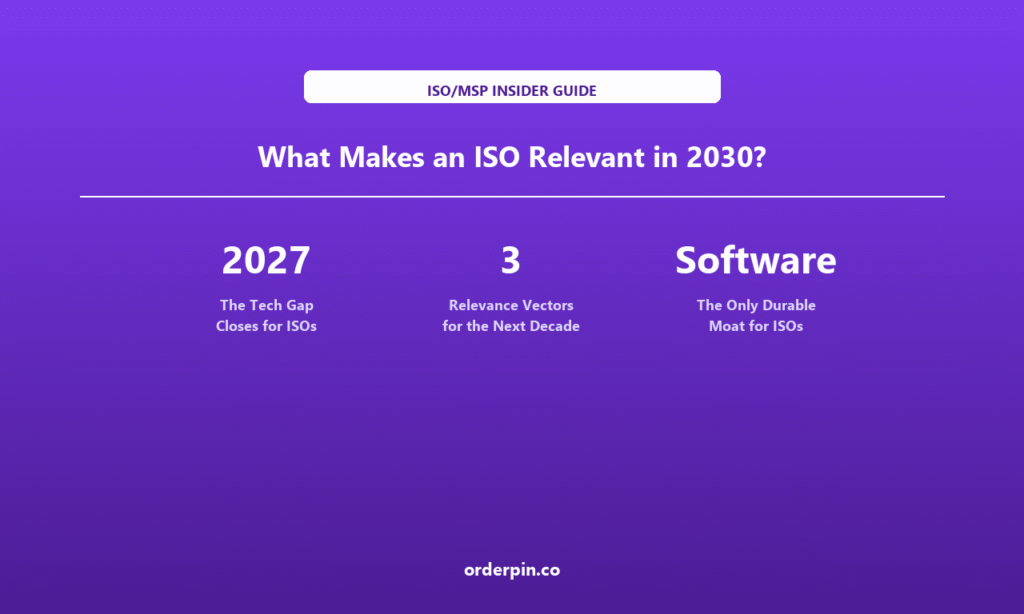
for ISOs
for the Next Decade
Moat for ISOs
What Will Make an ISO Relevant — or Irrelevant — in 2030
Ask an ISO what they do and the answer is usually some version of: we provide payment processing. Ask a merchant what their processor does for them and the answer is usually: they charge me to take cards. This gap — between the ISO’s sense of their own value and the merchant’s lived experience of that value — is the core relevance problem facing the industry. By 2030, if this gap is not closed, the ISO that is only a payment processor will be as invisible as the electricity provider they pay monthly without thinking about.
The trajectory is clear. Embedded payment is accelerating: software platforms, banks, and marketplace processors are inserting payment processing into the merchant’s workflow without a separate ISO relationship. When a merchant signs up for a Toast account, they get payment processing as part of the platform — no separate ISO, no separate conversation, no separate relationship. The ISO that is only a payment processor is competing against this wave with the wrong product. The ISO that is a trusted advisor and the platform that runs the merchant’s business is not competing against it — they are part of it.
This article maps the three vectors of ISO relevance for 2030, explains why the window to build them is now, and identifies what separates the ISOs that will be indispensable from those that will be disintermediated.
Is Still Open
Is Irreplaceable
Cannot Be Embedded
= Indispensable
1. The Relevance Problem: Why Pure Processing Is a Commodity
Processing without advisory or platform is a utility — and utilities get commoditized: When an ISO sells only processing, they are selling a rate and a contract. There is nothing in that product that a software vendor, a bank, or an embedded payment provider cannot replicate by adding a payment integration to their existing product. The ISO that is only a payment processor has already been disintermediated in many merchant segments — the remaining segments are those where the ISO has either built advisory depth or platform ownership. Without either, the ISO is a utility waiting to be replaced.
The embedded payment trend accelerates the timeline: The ISO that assumed they had ten years to make this transition is now operating under a different timeline. Embedded payment integrations are reaching mainstream merchants in multiple verticals — restaurants, retail, health and beauty — through the software platforms they already use. The ISO without a platform strategy is not competing against these providers on equal terms; they are competing with a product that is already integrated into the merchant’s workflow, with relationships the ISO never built.
2. Advisory Depth: The Knowledge Asset That Cannot Be Embedded
Advisory depth comes from years of accumulated merchant knowledge — and it cannot be replicated by a platform: After serving thousands of restaurants across multiple years and geographies, an ISO has accumulated knowledge that no software vendor can replicate in the short term: industry benchmarks, cash flow patterns, staffing models, seasonal rhythms, and growth strategies specific to their merchant base. This knowledge, productized into business reviews, benchmark reports, and advisory conversations, creates a relationship that goes beyond the transaction — and it is the foundation of an ISO’s relevance in 2030.
Advisory without platform is vulnerable, but advisory with platform is defensible: An ISO that provides advisory services but no platform is still vulnerable to replacement — a sophisticated software vendor can build similar advisory content, and the ISO’s knowledge advantage erodes over time. The defensible position is advisory depth combined with platform ownership: the platform generates the data that makes advisory possible, and the advisory deepens the relationship that makes platform switching costly. Neither alone is sufficient; both together create an indispensable position.
3. Platform Ownership: The Operational Integration That Creates Switching Costs
Platform ownership means the ISO runs the merchant’s daily operations — not just their payment processing: When the ISO’s white-label POS runs the merchant’s point of sale, inventory, reporting, and customer management, the merchant’s relationship with the ISO is not about a rate. It is about their business. Switching the ISO means switching the operating system of their restaurant or retail location. That is a switching cost that no embedded payment integration can replicate — because embedded payment runs alongside the merchant’s workflow; it does not replace it.
Platform ownership also generates the data that powers advisory depth: The white-label POS generates the transaction data, operational patterns, and customer insights that make genuine advisory services possible. An ISO that runs the platform knows which merchants are declining, which products are underperforming, which locations are seasonal, and which merchants would benefit from a growth conversation. This data cannot be generated by a processor that only sees transaction records — it requires running the operational layer that produces them.
4. The Three Vectors of ISO Relevance in 2030
Vector 1 — Data and Insight: Be the partner who knows more about the merchant’s business than anyone else: The ISO that has the data, the benchmarks, and the industry knowledge to walk into a business review with genuine insight — not a sales pitch — is the ISO that merchants will keep. This requires accumulating data over years, investing in portfolio analytics, and building a merchant-success practice that uses that data to create value. This is a slow build, which is why the ISO that starts now will have an unassailable advantage in 2030.
Vector 2 — Technology: Own the platform that runs the merchant’s business: The ISO that owns the white-label POS platform runs the operational layer of the merchant’s business. This is not just a payment integration — it is the interface through which the merchant manages their entire operation. Switching the ISO means rebuilding that operational layer, which is a cost no merchant incurs lightly. Platform ownership is the structural moat that makes the advisory relationship defensible.
Vector 3 — Community: Become a node in the merchant’s business network: The ISO that connects merchants to each other — through industry events, referral programs, peer groups, and business introductions — becomes a node in the merchant’s business network, not just a vendor. This network position is invisible to competitors and nearly impossible to disintermediate, because it is built on personal and professional relationships, not just product features. The ISO that builds a merchant community around its brand is not selling processing; they are selling belonging.
5. Building the Indispensable ISO Starting Now
The transition starts with a platform decision: The first step toward indispensable status is owning the platform that runs the merchant’s operations. A white-label POS under the ISO’s brand creates the operational integration, the data asset, and the switching cost that are the foundation of everything else. Without platform ownership, advisory depth is vulnerable to software-driven alternatives; with it, advisory depth becomes the reason merchants stay with the platform the ISO owns.
The window is open now — but it will not stay open: The ISO that builds platform ownership and advisory depth in the next three years will have the data, the merchant relationships, and the operational integration that makes them indispensable in 2030. The ISO that waits until the embedded payment wave reaches their merchant base will be competing from a position of weakness — with merchants who have already moved to a platform provider and no switching cost to pull them back. The choice is made now, not in 2029.
The ISO Relevance Spectrum in 2030
| Position | Indispensable ISO | Vulnerable ISO | Irrelevant ISO |
|---|---|---|---|
| Core Value | Advisory + Platform | Either/Neither | Rate only |
| Merchant Relationship | Runs their business | Occasional contact | Annual renewal |
| Data Access | Full operational data | Transaction data only | No data |
| Switching Cost | Very high (ops + advisory) | Moderate | None |
| 2030 Trajectory | Indispensable / Growing | Discretionary | Disintermediated |
| Start Building | Now | Urgent | Too late |
How OrderPin Helps an ISO Build the Indispensable Position for 2030
OrderPin is a white-label POS platform that lets an ISO own the operational layer of their merchants’ businesses. When the ISO’s platform runs the POS, the reporting, and the workflow, the ISO is not a payment processor — they are the operator of their merchants’ most critical business system. That is the foundation of the indispensable position: advisory depth powered by platform data, with switching costs that no embedded payment can replicate.
- Own the platform, own the data: OrderPin generates the full operational data set — transaction volume, customer behavior, inventory patterns, staffing rhythms — that powers genuine advisory conversations and the merchant-success programs that make the ISO indispensable.
- Create switching costs that are structural: When the ISO’s platform runs the merchant’s operations, switching the ISO means rebuilding the operational layer. No rate undercut can justify that cost — which means the merchant stays because leaving would be disruptive, not because they forgot to leave.
- Build advisory depth from platform data: The data from OrderPin gives the ISO the portfolio intelligence to run business reviews, identify at-risk merchants, spot expansion opportunities, and deliver insights that a processor without platform access cannot match.
- Start the transition now: The window to build the indispensable position is open — but it closes as embedded payment reaches mainstream merchants in each vertical. OrderPin lets an ISO start building the platform position that makes them relevant in 2030.
Frequently Asked Questions
Why will pure processing be a commodity by 2030?
Embedded payment integrations are reaching mainstream merchants through software vendors, banks, and platform providers that add payment processing to their existing products without a separate ISO relationship. When a merchant signs up for a restaurant POS or retail platform, payment processing comes with it. The ISO that is only a rate and a contract has no leverage against this wave — they have no relationship, no data, and no switching cost to resist it.
What makes an ISO indispensable in 2030?
The combination of advisory depth and platform ownership. Advisory depth — the accumulated knowledge of the merchant’s business — creates a relationship that goes beyond transactions. Platform ownership — running the POS, the workflow, and the data — creates the switching costs that keep merchants from leaving. Neither alone is sufficient; together they create the indispensable position that cannot be replicated by an embedded payment provider.
How does platform ownership create a switching cost that processors cannot match?
When the ISO’s white-label POS runs the merchant’s operations — POS, inventory, reporting, customer management — switching the ISO means rebuilding the operational layer. Embedded payment runs alongside the merchant’s workflow; it does not replace it. The ISO that owns the platform is the operational layer, not a feature of it, which means no rate undercut can justify the cost of replacing them.
What are the three vectors of ISO relevance in 2030?
Data and insight (knowing more about the merchant’s business than anyone else), technology (owning the platform that runs their operations), and community (becoming a node in the merchant’s business network). The ISO that builds all three — powered by platform ownership and deepened by advisory depth — will be indispensable in 2030.
Why is advisory without platform not a durable position?
Because software vendors can build advisory content. Benchmark reports, industry data, and best-practice guides can be generated by AI from aggregated industry data. The advisory advantage of an ISO that has served merchants for years is real but erodible — without platform ownership, the ISO’s knowledge advantage eventually gets matched by software. The durable position is advisory depth powered by platform data, with platform switching costs protecting the relationship.
When should an ISO start building the indispensable position?
Now. Advisory depth takes years to build — the knowledge advantage comes from accumulated merchant data and relationships that cannot be assembled quickly. Platform ownership requires an early-mover advantage in a market that is still contested. The ISO that waits until embedded payment reaches their merchant base will be competing from a position of weakness with no platform, no data, and no switching cost. The choice is made now, not in 2029.
By 2030, pure processing will be as invisible as electricity — a utility merchants pay without thinking about, obtained from whoever is cheapest or most convenient. The ISO that is only a payment processor will be disintermediated by embedded payment, platform consolidation, and bank integrations. The ISO that is indispensable in 2030 will be the one that combines advisory depth with platform ownership: knowing more about the merchant’s business than anyone else, running the platform that makes that knowledge possible, and building the community that makes leaving costly. The transition starts with a platform decision — owning the POS that runs the merchant’s operations, generates the data that powers advisory depth, and creates the switching cost that protects the relationship. The window is open now. OrderPin is a white-label POS platform that lets an ISO build the indispensable position for 2030: owning the operational layer, the data, and the merchant relationship that no embedded payment integration can replicate.
About OrderPin
OrderPin is a white-label POS platform built for ISO and MSP partners. We offer full data ownership, flexible pricing, and seamless API integrations to help you build a recurring revenue business under your own brand. Learn more about OrderPin’s white-label solution