
TL;DR — Quick Summary
- Three business models are emerging in payments, and they are not the same business: Traditional ISOs sell processing — their revenue is volume times margin, and their only defensible asset is the merchant book. Technology-Enabled ISOs add a software platform on top of processing — creating recurring revenue, switching costs, and a defensible position. Software-Led Payments Companies use software to own the merchant relationship and treat the ISO as a distribution channel. Each model has a different unit economics, a different trajectory, and a different exit multiple — and confusing them is a fatal strategic error.
- The transition from Traditional to Technology-Enabled is the critical strategic move: Most of the competitive pressure on ISOs comes from Software-Led Payments Companies — not from other ISOs. The defense is not to compete on price; it is to build the same platform moat the software companies have. White-label POS that runs under the ISO’s brand, with data ownership and recurring revenue, is how an ISO moves from renting merchants on margin to owning them on platform. The transition window is open — but it is closing as merchant expectations rise.
- Hybrid positioning is the most dangerous posture: ISOs that try to be both a Traditional ISO and a Technology-Enabled ISO — reselling a third-party platform while maintaining a processing-only business — end up with the worst of both worlds: the margin compression of processing-only with the cost of carrying software they do not own. The only sustainable hybrid is owning the platform. Everything else is a transitional state, not a business model.
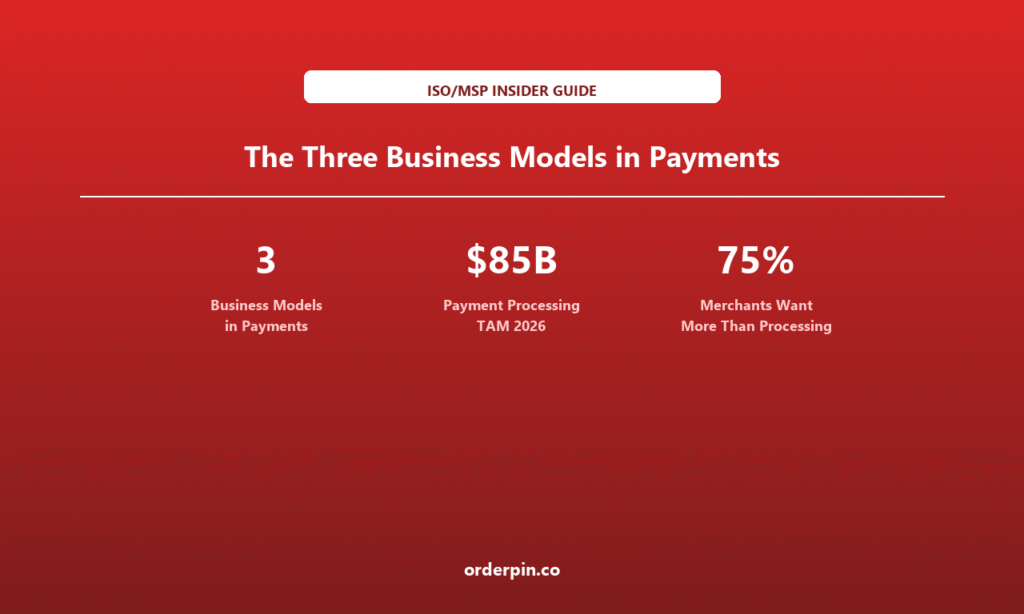
in Payments
TAM 2026
More Than Processing
The Three Business Models Splitting the Payments Industry
The payments industry no longer has a single business model. It has three, and they are diverging rapidly. Traditional ISOs sell processing: volume times margin, merchant book as the only asset. Technology-Enabled ISOs add a software platform on top: recurring revenue, switching costs, and a real moat. Software-Led Payments Companies put payments inside software: they own the merchant relationship, the data, and the platform, and they use ISOs as a distribution channel to reach merchants. These are not variations on the same business. They are different businesses with different unit economics, different defensibility, and different exit multiples.
The critical strategic question for every ISO leader is not which model they are in today — it is which model they are building toward, and whether the transition they are making is deliberate or accidental. The gap between the models is widening. ISOs that stay in the traditional model will find their margins compress and their merchants churn to whoever owns the software. ISOs that successfully transition to technology-enabled will find a compounding business and a defensible position. The hybrid position — reselling a third-party platform while maintaining a processing business — is the most dangerous posture of all.
This article maps the three models, explains the transition logic, and identifies what separates the ISOs that make the platform shift from those that do not.
Merchant Book Only
Plus Processing
ISO as Channel
vs Software x 5-12x
1. Traditional ISO: Volume Times Margin and Nothing Else
The traditional model is processing — and only processing: Revenue is volume times margin. The only defensible asset is the merchant book. The growth engine is adding more merchants; the retention engine is relationship. There is no recurring revenue, no switching cost, and no data asset. Every merchant is rented at the prevailing margin rate, and every year the margin compresses further as competition and platform disintermediation intensify.
The trajectory is margin compression toward zero: Traditional ISOs are not losing to other ISOs. They are losing to Software-Led Payments Companies that own the merchant relationship through software, to processors that disintermediate the ISO entirely, and to merchant expectations that have shifted toward platforms and away from bare processing. The traditional model is not a stable business; it is a declining one with a declining asset base.
2. Technology-Enabled ISO: The Platform Shift That Creates a Real Moat
The technology-enabled model adds software on top of processing: Recurring revenue comes from software subscriptions and platform fees. Switching costs come from the POS, the data, and the workflow that runs inside the platform. The merchant relationship is owned through software, not just through the processing contract. And the data generated by the platform — transaction history, operational patterns, customer behavior — is an asset that can be monetized in advisory, lending, and cross-sell contexts.
The unit economics of technology-enabled are fundamentally different: Processing alone generates revenue proportional to volume and churns with every rate negotiation. Software generates recurring revenue that is not proportional to volume — a $500/month restaurant pays the same subscription whether it processes $10,000 or $100,000. And software revenue is stickier: switching a POS is harder than switching a processor, which means the merchant retention rate in technology-enabled businesses is measurably higher.
3. Software-Led Payments Company: The Model ISOs Are Competing Against
Software-Led Payments Companies use software to own the merchant relationship: They put payments inside a vertical SaaS platform — Toast for restaurants, Mindbody for wellness, ShopWare for retail — and use the payment as a feature, not a product. The ISO is not their competitor; they are the ISO’s competitor. They use ISOs as a distribution channel to reach merchants, then own the merchant through the software layer. The ISO that signed the merchant becomes, in effect, a vendor to the software company — a source of processing volume that can be replaced at any time.
The exit multiple gap reflects the model difference: Software businesses exit at 5-12x revenue; processing businesses exit at 1-2x. The gap is not a temporary market inefficiency — it reflects the fundamental difference in recurring revenue, switching costs, and defensibility between the models. An ISO that wants to exit at a software multiple must build a software business. There is no other path.
4. The Hybrid Trap: Why Reselling Someone Else’s Platform Is Not a Model
The most dangerous posture is reselling a third-party platform while maintaining a processing business: This hybrid has the margin compression of processing-only with the cost of carrying software it does not own. The ISO is paying for a platform it does not control, reselling it to merchants it does not own, while competing against Software-Led Payments Companies that own their platforms and their merchant relationships. The hybrid is a transitional state, not a destination. The question is where it is transitioning to.
The only sustainable hybrid is owning the platform: The ISO that builds a white-label POS under its own brand — owning the software, the data, and the merchant relationship — is the only one that combines the revenue diversification of technology-enabled with the defensibility of owning the asset. Reselling a white-label product from a platform vendor is still a hybrid, but it is a hybrid with an exit path toward full platform ownership.
5. The Transition: From Processing to Platform
The transition to technology-enabled requires owning the platform — not reselling one: A white-label POS platform under the ISO’s brand is the foundation of the transition. It creates recurring revenue, switching costs, and data ownership. It lets the ISO compete directly against Software-Led Payments Companies by offering the same merchant relationship and software experience — under the ISO’s brand, not a vendor’s. The transition is not a product decision; it is a business model decision.
The window is open — but it is closing: Merchants are still in the process of expecting software from their payment provider. The ISOs that provide it now will own the relationship when those expectations solidify. The ISOs that wait will find their merchants have already moved to a platform provider — and the ISO will be the processing vendor, not the merchant partner. The transition to technology-enabled is not optional for ISOs that want to remain relevant in ten years.
Three Business Models in Payments
| Dimension | Traditional ISO | Tech-Enabled ISO | Software-Led Payments |
|---|---|---|---|
| Revenue Model | Volume x Margin | Processing + Recurring | Software + Payments |
| Switching Cost | Low / None | High (POS, Data) | Very High |
| Data Ownership | Minimal | Full Portfolio Data | Full |
| Exit Multiple | 1-2x Revenue | 3-5x Revenue | 5-12x Revenue |
| Merchant Ownership | Processing contract only | Software + Processing | Full (owns software) |
| Long-term Trajectory | Margin compression | Recurring compounding | Dominant platform |
How OrderPin Helps an ISO Make the Platform Shift
OrderPin is a white-label POS platform that lets an ISO build the technology-enabled model: owning the software, the data, and the merchant relationship under its own brand. It is the foundation of the platform shift that moves an ISO from renting merchants at declining margin rates to owning them with recurring revenue and real switching costs.
- Own the platform, own the merchant: OrderPin runs under the ISO’s brand, so the merchant relationship — the POS, the data, the workflow — belongs to the ISO, not a vendor. That is the foundation of the technology-enabled model and the only sustainable defense against Software-Led Payments Companies.
- Build recurring revenue: A white-label POS platform generates subscription revenue that is not proportional to transaction volume — the foundation of the unit economics that justifies a technology-enabled exit multiple.
- Create real switching costs: When the ISO’s platform runs the merchant’s operations — POS, inventory, reporting — switching the processor means switching the operating system. That is a switching cost the ISO can defend.
- Own the data asset: Portfolio data from OrderPin gives the ISO the visibility to run merchant success programs, identify expansion opportunities, and build the advisory revenue that deepens the merchant relationship beyond processing.
Frequently Asked Questions
What are the three business models in payments?
Traditional ISOs (processing only, volume times margin, merchant book as asset), Technology-Enabled ISOs (software platform plus processing, recurring revenue and switching costs), and Software-Led Payments Companies (payments inside vertical SaaS, own the merchant relationship, use ISOs as distribution). These are not variations on the same business — they have different unit economics, different defensibility, and different exit multiples.
Why is the transition to technology-enabled the critical move for ISOs?
Because most competitive pressure comes from Software-Led Payments Companies, not other ISOs. The defense is not to compete on price — it is to build the same platform moat: a white-label POS that owns the merchant relationship, creates switching costs, and generates recurring revenue. The transition window is open but closing as merchant expectations for software shift.
What is the hybrid trap in payments?
Reselling a third-party platform while maintaining a processing-only business. This hybrid has the margin compression of processing with the cost of carrying software it does not own. The ISO is paying for a platform it does not control, reselling it to merchants it does not own, while competing against companies that own both. The only sustainable hybrid is owning the platform.
How does owning a platform change the exit multiple?
Software businesses exit at 5-12x revenue; processing businesses exit at 1-2x. The gap reflects recurring revenue, switching costs, and defensibility — all of which come from owning the platform. An ISO that wants a software exit multiple must build a software business. There is no other path to a 5-12x exit from a payments business.
How does a white-label POS platform create a real moat?
By creating switching costs that are not about rates. When the ISO’s platform runs the merchant’s POS, inventory, reporting, and customer data, switching the processor means switching the operating system. That is a switching cost that cannot be undercut on price — and it is the foundation of the merchant retention that makes the technology-enabled model work.
What separates ISOs that make the platform shift from those that do not?
A deliberate business model decision versus a passive response to competitive pressure. The ISOs that make the shift invest in a white-label platform before they are forced to — because they understand that the transition takes time, and that arriving after the competitive threat materializes means arriving from a position of weakness. The window is open. It is not open forever.
The payments industry has split into three distinct business models with different unit economics, different defensibility, and different exit multiples. Traditional ISOs are in a volume-times-margin business with no moat and a declining trajectory. Technology-Enabled ISOs — those that own a software platform and the merchant relationship that comes with it — are in a compounding business with real switching costs. Software-Led Payments Companies own the merchant through software and use ISOs as a distribution channel. The most dangerous posture is the hybrid: reselling someone else’s platform while maintaining a processing business, with the worst of both worlds and no exit path. The transition to technology-enabled is not optional for ISOs that want to remain relevant and exit at a meaningful multiple. OrderPin is a white-label POS platform that lets an ISO own the platform — and with it, the merchant relationship, the data, and the compounding unit economics — under its own brand.
About OrderPin
OrderPin is a white-label POS platform built for ISO and MSP partners. We offer full data ownership, flexible pricing, and seamless API integrations to help you build a recurring revenue business under your own brand. Learn more about OrderPin’s white-label solution