
TL;DR — Quick Summary
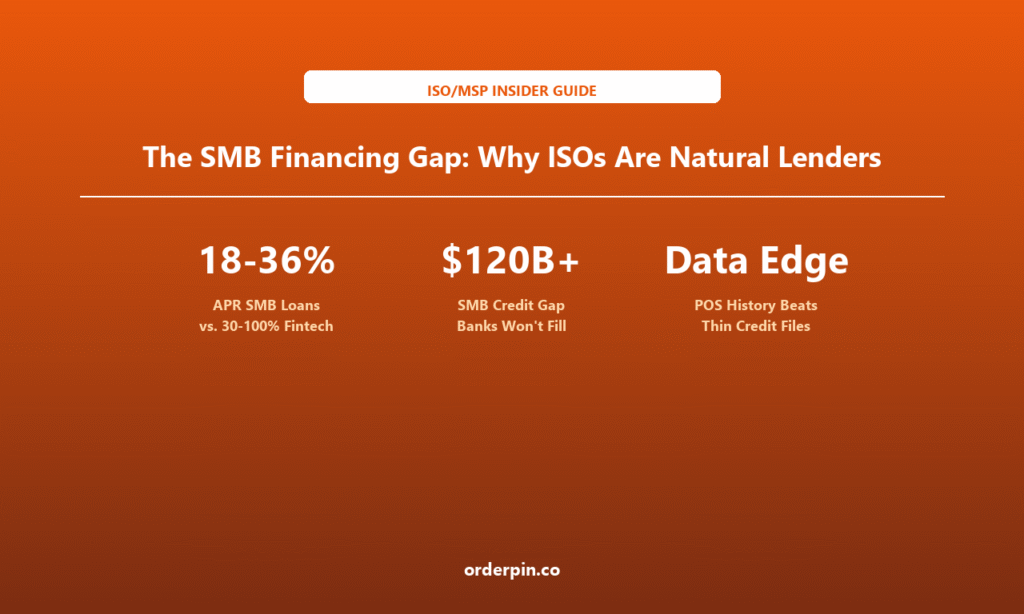
- The SMB credit gap is real, growing, and nobody is filling it: Bank lending to small businesses fell 40% post-2023 as institutions tightened credit standards. Fintechs and merchant cash advance providers filled part of the gap — but at APRs of 30% to 100%+, using underwriting models that do not actually know how the merchant’s business performs. ISOs have the data to underwrite this risk more accurately than anyone, and they are not using it.
- ISO transaction data is a more accurate picture of merchant creditworthiness than any credit score: Six to twelve months of daily card volume, ticket sizes, seasonal patterns, customer concentration, and day-of-week revenue tells you exactly what a merchant can afford to repay and when. This is more predictive than a FICO score — which does not capture business performance at all — and more real-time than bank statements, which can be manually managed.
- ISOs can offer merchant capital at 18-36% APR and still earn more than on interchange — while building the deepest retention lock-in in the business: A merchant who relies on their ISO for working capital does not shop around on rate. They cannot afford to lose the relationship. ISOs that build an embedded lending capability — merchant cash advances, revolving credit lines, or revenue-based financing — are building a compounding revenue engine that turns every transaction relationship into a financial services relationship.
vs 30-100% Fintech
Banks Won’+chr(39)+’t Fill
Thin Credit Files
Why ISOs Are the Natural Lender to Their Merchants
Small businesses need working capital. It is one of the most persistent facts of SMB life: revenue is lumpy, payroll is fixed, and the gap between a big invoice and its payment — or between a slow January and a booming April — is where businesses get into trouble. Every year, hundreds of thousands of SMBs seek capital to bridge these gaps. The traditional bank loan is out of reach for most. The fintechMCA is available but expensive. And the ISO, who processes the merchant’s transactions every single day and knows exactly what that merchant earns, is not in the conversation.
This is a structural inefficiency in the market — and it is the single biggest untapped opportunity in the ISO business model. The ISO has better data about merchant creditworthiness than any bank or fintech. That data is real-time, merchant-authorized, and more predictive than any credit bureau score. Using it to offer working capital — merchant cash advances, revenue-based financing, or revolving credit lines — is not a fintech pivot. It is a natural extension of a relationship the ISO already owns. This article explains why the timing is right, why the data advantage is real, and how ISOs can build an embedded lending capability that compounds in retention, margin, and exit value.
Nobody Filling
Exploiting Gap
Revenue Visibility
Rate Switching
1. The SMB Credit Gap Is Growing — And Banks Are Not Filling It
Bank lending to small businesses fell 40% after 2023, and has not recovered: Post-pandemic credit tightening accelerated as banks reassessed SMB risk. Community and regional banks — which historically served the SMB market — pulled back most aggressively. SBA lending volumes dropped sharply. Online lending platforms partially filled the gap, but at terms that reflected the increased risk in the market. The result is a structural credit void: legitimate businesses with real cash flows cannot access capital at reasonable rates through traditional channels.
The gap is not demand — it is supply and pricing: SMBs need working capital consistently. The gap is not that merchants stopped needing money; it is that the institutions that used to provide it have priced it out of reach, or stopped lending entirely. A restaurant with $80,000 in monthly card volume and a demonstrated seasonal pattern does not look like a good credit risk to a bank that does not understand restaurants. To a lender that can see the restaurant’s actual daily revenue — which the ISO can — the creditworthiness is obvious.
2. Fintechs Are Exploiting the Gap at 30-100% APR
Merchant cash advances and short-term fintech loans are readily available — at rates that extract value from vulnerable merchants: The fintech MCA market is enormous and growing. Merchant cash advance providers will advance against future card receipts at effective APRs of 30%, 50%, even 100%+ for the riskiest borrowers. They are filling the gap — but they are filling it on terms that are genuinely exploitative, and on underwriting models that use bank statements and personal credit scores that do not actually know how the merchant’s business performs.
The ISO can do it better, at better rates, because they have better data: The fintech is underwriting based on bank statements and personal credit scores — data that can be gamed, lagged, and incomplete. The ISO is underwriting based on real, daily card transaction data: the actual revenue, day-by-day, for six to twelve months. This is not a marginal improvement in underwriting accuracy; it is a fundamentally different information set. An ISO that can see a merchant’s daily volume, seasonal patterns, and ticket sizes can price a loan more accurately than any fintech — and pass that accuracy on to the merchant in the form of better rates, while earning a better spread.
3. ISO Transaction Data Is a Better Credit Signal Than Credit Bureaus
A FICO score does not tell you how much a merchant earns — it tells you how much debt they have and how they have managed it: Consumer credit scores were not designed to assess business performance. They capture debt management, not business performance. A restaurant owner with a 720 FICO might have a restaurant that does $30,000/month in card volume and one that does $300,000/month — and a FICO score that looks identical. The ISO’s transaction data tells you which one you are dealing with. It is real-time, authoritative, and almost impossible to fabricate or manage.
Six months of daily card volume is the most predictive dataset available for merchant underwriting: Daily transaction history captures the actual rhythm of a business: average daily volume, seasonal peaks and troughs, day-of-week patterns, customer concentration risk, and the trend direction. A merchant whose volume is growing 15% year-over-year is a different credit risk than one whose volume is declining 10%. Bank statements can be managed; a processor’s daily settlement data is authoritative. ISOs that have built platform depth have this data — and most are not using it for anything except billing.
4. How ISOs Can Build an Embedded Lending Capability
Three models: merchant cash advances, revenue-based financing, and revolving credit lines: The most common and accessible entry point is a merchant cash advance: the ISO advances against future card receipts, with repayment as a fixed percentage of daily volume. The ISO knows exactly when the advance is repaid (because they process the receipts), has direct recourse if the merchant defaults (they can adjust the daily holdback percentage), and earns a spread that compounds over time. Revenue-based financing and revolving credit lines follow similar logic with different structures. All three turn a transaction relationship into a financial services relationship.
Pricing at 18-36% APR is dramatically better than fintech alternatives — and still earns a superior spread: A merchant cash advance at 18-36% APR versus a fintech MCA at 50-100%+ APR is a meaningful difference for the merchant. At those rates, the ISO is providing genuine value at a fair price — not extracting rent from captive borrowers. The ISO earns a net interest margin that typically exceeds their interchange revenue on the same merchant, with an additional retention benefit that interchange alone cannot match: a merchant who relies on their ISO for working capital does not switch processors, because the switching cost of losing access to that credit facility is higher than any basis-point savings.
5. The Compounding Retention Effect
A merchant who depends on their ISO for working capital has a switching cost that no rate competitor can overcome: The deepest retention mechanism in the ISO business is not a contractual lock-in — it is a dependency relationship. A merchant who relies on their ISO for a $50,000 working capital line, and knows that the relationship unlocks that credit when needed, does not shop around on interchange. They cannot afford to lose the relationship. This is retention that is built on genuine value provided — not on confusing contracts or switching friction — and it is the most durable form of merchant lock-in an ISO can build.
Embedded lending transforms the ISO’s exit multiple from a transaction multiple to a financial services multiple: A pure-processing ISO with no lending capability sells at 1-3x annual residual. An ISO that has built an embedded lending book — where the capital deployed earns a net interest margin and the merchant relationships are secured by that capital dependency — sells at a multiple that reflects the financial services business, not just the processing book. Buyers that are themselves financial services companies or platform businesses pay a premium for lending-enabled portfolios. The embedded lending capability is the feature that most dramatically separates the ISO exit story from a pure-processing story.
Bank vs. Fintech vs. ISO Lending to SMBs
| Dimension | Traditional Bank | Fintech MCA | ISO Embedded Lending |
|---|---|---|---|
| Typical APR | 6-12% (if approved) | 30-100%+ effective APR | 18-36% (fair, transparent) |
| Approval Rate | Very low for SMBs post-2023 | High (but predatory pricing) | High (real-time data underwriting) |
| Underwriting Data | Tax returns, bank statements (lagged) | Bank statements, personal credit | Daily POS volume (real-time, authoritative) |
| Merchant Relationship | Transactional (loan only) | Transactional (MCA only) | Integrated (payments + capital) |
| Retention Effect | None | Minimal | Deep (capital dependency) |
| Exit Multiple Impact | None | Minimal | Significant (financial services premium) |
How OrderPin Helps ISOs Build the Embedded Lending Advantage
OrderPin is a white-label POS platform that gives ISOs the daily transaction data foundation to underwrite merchant credit — not just process their transactions, but build the financial services relationship that turns a processing book into an embedded lending portfolio. Through full data ownership and API integrations, an ISO can build the underwriting engine that uses six to twelve months of real-time merchant revenue data to price and manage working capital products more accurately than any fintech competitor.
- Build the data foundation for accurate merchant underwriting: OrderPin gives ISOs access to the daily volume, seasonal patterns, and transaction-level data that enables accurate, real-time underwriting of merchant creditworthiness — the dataset that no credit bureau or bank statement can match.
- Transform a processing relationship into a financial services relationship: A merchant that relies on their ISO for working capital does not switch processors. OrderPin’s platform depth enables ISOs to offer merchant cash advances, revenue-based financing, and revolving credit lines — turning a transaction relationship into a capital relationship that compounds in retention.
- Price fairly and earn a superior spread: With accurate real-time data, the ISO can offer merchant loans at 18-36% APR — dramatically better than fintech alternatives — while earning a net interest margin that exceeds interchange on the same merchant. Fair pricing builds trust; trust builds retention; retention compounds in portfolio value.
- Maximize exit multiples with a lending-enabled portfolio: An ISO that has built an embedded lending book — where capital deployed earns net interest margin and merchant relationships are secured by capital dependency — exits at a financial services multiple, not a processing multiple. OrderPin’s platform gives ISOs the data and API depth to build that story.
Frequently Asked Questions
Why did bank lending to small businesses fall so sharply post-2023?
Post-pandemic credit tightening accelerated as banks reassessed SMB risk across multiple sectors. Community and regional banks — the traditional SMB lenders — pulled back most aggressively due to rising loan losses and regulatory pressure. SBA lending volumes dropped. The result was a structural gap: legitimate businesses with real cash flows found that their traditional bank relationship could no longer provide the working capital they needed. This gap created the opening for fintech MCAs at exploitative rates — and for ISOs with better data.
Is embedded lending a fintech pivot — or a natural extension of the ISO relationship?
It is a natural extension. The ISO already has the relationship — they process the merchant’s transactions every day. They already have the data — six to twelve months of daily card volume that is more predictive than any credit score. They already have the collection mechanism — daily settlement deduction. Building an embedded lending capability uses existing assets and existing relationships, not new ones. The ISO is not becoming a fintech; they are using the data and relationship they already own to offer a more comprehensive set of financial services to merchants they already serve.
What does “POS transaction data beats credit bureaus” actually mean in practice?
It means the ISO can see what a merchant actually earns — day by day, month by month — rather than inferring it from lagged, gameable signals. Six to twelve months of daily card volume shows the actual rhythm of the business: average daily revenue, seasonal patterns, day-of-week distribution, growth trends, and customer concentration. A merchant whose volume is growing 15% year-over-year is a different credit risk than one declining 10%. A restaurant in a tourist town has a predictable seasonal pattern that makes December and January volatility manageable. This is not marginal underwriting improvement; it is a fundamentally different information set that lets the ISO price risk more accurately than any alternative lender.
What types of embedded lending products should an ISO offer?
Merchant cash advances are the most accessible entry point: advance a lump sum against future card receipts, with repayment as a fixed percentage of daily volume until the advance plus fee is repaid. Revenue-based financing follows similar logic with larger amounts and longer terms. Revolving credit lines offer ongoing access to capital up to a defined limit, repaid on the merchant’s schedule. All three use the same underlying data — daily transaction volume — for underwriting and repayment tracking. The ISO does not need to become a bank; they can structure these products through a lending partner or platform that handles regulatory compliance, while the ISO retains the merchant relationship and underwriting control.
How does embedded lending affect merchant retention?
The retention effect is structural, not contractual. A merchant who relies on their ISO for a $50,000 working capital line does not switch processors, because the switching cost of losing that credit facility is higher than any basis-point savings. This is retention built on genuine value — the merchant is getting capital at better rates than the alternative, and they know it. It is not lock-in through confusing contracts; it is lock-in through a dependency relationship that the merchant values. The deepest retention mechanism in the ISO business.
How does embedded lending change the ISO exit story?
A pure-processing ISO exits at 1-3x annual residual. An ISO with an embedded lending book exits at a multiple that reflects the financial services business — typically 1-3x annual net interest income from the lending portfolio, plus the processing multiple. For a portfolio with $5 million in capital deployed at a 20% net interest margin, that is $1 million in annual lending income — on top of processing revenue. Buyers that are financial services companies, private equity with a lending thesis, or platform businesses pay a significant premium for a lending-enabled ISO because they are acquiring not just a merchant book but a credit operation. The embedded lending capability is the feature that most dramatically separates the ISO exit story from a pure-processing story.
The SMB credit gap is not a market failure — it is a structural inefficiency that ISOs are uniquely positioned to resolve. Banks pulled back post-2023. Fintechs charge 30-100% APR using underwriting data that is inferior to what the ISO already has. The ISO has six to twelve months of daily transaction data that shows exactly how much every merchant earns, when, and from whom — the most predictive underwriting dataset available for small business credit. Building an embedded lending capability — merchant cash advances, revenue-based financing, or revolving credit lines — is not a fintech pivot. It is using the data and relationship the ISO already owns to offer a more comprehensive financial services product. Priced at 18-36% APR, the ISO offers a dramatically better deal than fintech alternatives while earning a net interest margin that exceeds interchange on the same merchant. And the retention effect is structural, not contractual: a merchant who depends on their ISO for working capital does not switch processors. OrderPin is a white-label POS platform that gives ISOs the data foundation and API depth to build that embedded lending capability — transforming a processing book into a financial services portfolio that compounds in retention, margin, and exit value.
About OrderPin
OrderPin is a white-label POS platform built for ISO and MSP partners. We offer full data ownership, flexible pricing, and seamless API integrations to help you build a recurring revenue business under your own brand. Learn more about OrderPin’s white-label solution