
TL;DR — Quick Summary
- ESG mandates are now in force — and most merchants are completely unprepared: The SEC’s climate disclosure rules that took effect in 2024, the EU’s Corporate Sustainability Reporting Directive (CSRD), and a wave of state-level ESG mandates now require companies to track and report carbon footprint, supply chain emissions, and sustainable sourcing. Multi-location operators — restaurants, retailers, and service chains — are hit hardest because their footprint is distributed across dozens or hundreds of sites. The majority have no system to collect this data, and the reporting deadlines are real.
- The compliance burden creates a product opportunity for ISOs: Sustainability requirements generate demand for three capabilities ISOs can deliver on top of their existing payment relationship — a carbon calculator at checkout that estimates the footprint of each transaction, an ESG reporting dashboard that aggregates emissions across locations, and sustainable supplier payment rails that route spend toward verified low-carbon vendors. These are recurring-revenue software products, not one-time payment features, and they attach to a merchant relationship the ISO already owns.
- ISOs are uniquely positioned because they already own the data and the relationship: Sustainability reporting is fundamentally a data problem — you cannot report what you cannot measure, and you cannot measure it without transaction-level data. The ISO already processes the merchant’s transactions and already has the merchant relationship. Big Tech payments players can bolt on a carbon calculator, but they do not own the merchant advisory relationship that turns a compliance requirement into an ongoing service. The ISO that delivers sustainability features becomes the merchant’s sustainability partner, not just their payment processor.
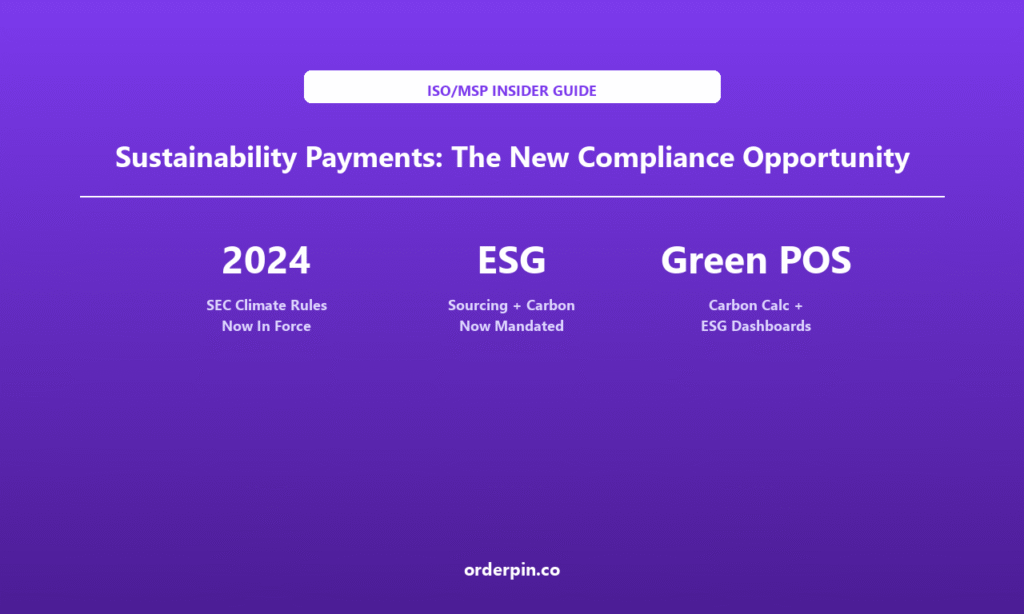
Now In Force
Now Mandated
ESG Dashboards
Why Sustainability Compliance Is Becoming an ISO Opportunity
For two decades, “sustainability” in payments meant a marketing slogan — a processor that planted a tree per transaction or offset a fraction of card brand emissions. That era is ending. Regulators in the US and EU have moved from voluntary frameworks to mandatory disclosure, and the merchants that ISOs serve are now legally required to track and report their environmental footprint. A restaurant group with forty locations cannot satisfy a CSRD-aligned customer’s supplier questionnaire without knowing the emissions of each site. A retailer cannot respond to a state climate mandate without aggregating data it does not currently collect.
The gap between what merchants are required to report and what they can actually measure is the opportunity. ISOs that already process transactions and already own the merchant relationship are closer to the data than any third-party ESG consultancy. By layering sustainability features — measurement, reporting, and sustainable payment routing — on top of the existing payment platform, an ISO can turn a regulatory burden into a recurring-revenue product and a deeper merchant relationship. This article explains what the mandates actually require, what products the gap creates, and why ISOs are better positioned than Big Tech to deliver them.
Now In Force
Globally
Hits Operators
At Checkout
1. ESG Mandates Are Now In Force — And Merchants Are Unprepared
The SEC’s climate disclosure rules that took effect in 2024, the EU’s CSRD, and state-level mandates have shifted ESG from voluntary to mandatory: Companies above defined thresholds must now disclose Scope 1, 2, and (increasingly) Scope 3 emissions — the direct emissions, the purchased-energy emissions, and the supply-chain emissions. For a multi-location restaurant or retailer, Scope 3 is the largest and hardest to measure: it includes every supplier, every shipment, and every product. The reporting is no longer a nice-to-have; it is a legal requirement with deadlines.
Most merchants have no system to collect the required data: The data needed for ESG reporting lives in transaction records, supplier invoices, and utility bills — fragmented across systems the merchant does not integrate. A restaurant group cannot answer a corporate customer’s supplier-carbon questionnaire because the data is not collected at the point of sale, not aggregated across locations, and not mapped to emissions factors. This is the gap: the mandate exists, the data does not, and the merchant has no tool to close the distance.
2. The Carbon Calculator at Checkout Opportunity
A carbon calculator at checkout estimates the footprint of each transaction in real time: For every sale, the POS can compute an estimated carbon footprint based on the product mix, supplier, and delivery method — using emissions factors mapped to the merchant’s catalog. The customer sees the footprint; the merchant accumulates a per-transaction emissions dataset that feeds the reporting layer. This is not greenwashing — it is measurement, which is the prerequisite for any credible sustainability claim.
The carbon calculator is a differentiator for the merchant — and a recurring product for the ISO: A merchant that can show customers their carbon footprint at checkout — and offer a low-carbon alternative — wins goodwill and a marketing story. The ISO that provides the calculator owns the per-transaction emissions dataset, which is the foundation for every downstream sustainability product. It is a feature that attaches to the existing POS relationship and generates recurring software revenue, not a one-time payment feature.
3. ESG Reporting Dashboards as a Recurring Revenue Product
The ESG reporting dashboard aggregates emissions across locations and maps them to mandate-ready formats: The merchant’s per-transaction data — collected by the carbon calculator — is aggregated across all locations into a single emissions view, broken down by Scope 1, 2, and 3, and exported in the format the relevant mandate requires. For a multi-location operator, this is the difference between a manual, error-prone spreadsheet exercise every reporting cycle and an automated, audit-ready export. The dashboard is a subscription product: the merchant pays monthly for the reporting capability, and the ISO earns recurring revenue that is not subject to interchange compression.
The reporting layer is where the ISO’s data advantage becomes a moat: A merchant that runs its ESG reporting through the ISO’s dashboard has its emissions data integrated with its payment data in one system. Switching to a different provider means rebuilding the emissions dataset from scratch — a cost no merchant undertakes lightly. The reporting dashboard is not just recurring revenue; it is a switching cost built on data integration, the most durable kind.
4. Sustainable Supplier Payment Rails
Sustainable supplier payment rails route merchant spend toward verified low-carbon vendors: Once the ISO has the merchant’s transaction and emissions data, it can offer a payment rail that prioritizes suppliers with verified sustainability credentials — and surfaces the carbon impact of each procurement choice at the point of payment. For merchants under ESG pressure from their own customers, this closes the loop: they can report lower Scope 3 emissions because their payment system steers spend toward cleaner suppliers. The rail is a value-added payment product that competes on sustainability outcomes, not basis points.
The payment rail is the deepest integration — and the hardest to leave: When a merchant’s supplier payments flow through the ISO’s sustainability-tagged rail, the ISO owns the procurement-to-emissions data chain end to end. This is the deepest form of integration in the B2B payments space: the merchant cannot leave without re-establishing every supplier relationship in a new system. The sustainable payment rail is the capstone of the ISO’s sustainability offering — and the strongest retention lock in the portfolio.
5. Why ISOs Are Best Positioned to Deliver Sustainability Features
ISOs already own the transaction data and the merchant relationship that sustainability reporting requires: Big Tech payments players can bolt a carbon calculator onto a consumer app, but they do not own the merchant advisory relationship that turns a compliance requirement into an ongoing service. The ISO processes the merchant’s transactions (the data source), already has the merchant relationship (the distribution channel), and already delivers value-added services on top of payments (the business model). Sustainability features are a natural extension of all three — not a new business the ISO has to build from scratch.
The ISO becomes the merchant’s sustainability partner, not just a payment processor: A merchant under ESG pressure needs help, not a slogan. The ISO that delivers carbon measurement, reporting, and sustainable payment routing becomes the partner the merchant relies on to satisfy mandates and answer customer questionnaires. That relationship is advisory, recurring, and hard to displace — exactly the kind of relationship that compounds in retention and portfolio value. Sustainability is not a marketing angle for the ISO; it is a product category.
Traditional POS vs. Sustainability-Enabled POS
| Dimension | Traditional POS | Sustainability-Enabled POS |
|---|---|---|
| Carbon Footprint Data | Not collected | Per-transaction, real-time |
| ESG Reporting | Manual spreadsheet | Automated dashboard export |
| Mandate Compliance | Merchant struggles | ISO delivers ready format |
| Supplier Sourcing | No carbon signal | Sustainable rail priority |
| ISO Revenue Model | Interchange only | Interchange + subscription |
| Merchant Relationship | Transactional | Advisory / recurring |
How OrderPin Helps ISOs Deliver Sustainability Features
OrderPin is a white-label POS platform that gives ISOs the data foundation and API depth to build sustainability features on top of the existing payment relationship — not as a marketing slogan, but as a measurable, recurring-revenue product. Through full data ownership and flexible API integrations, an ISO can layer carbon measurement, ESG reporting, and sustainable payment routing onto the platform merchants already use every day.
- Own the transaction data that sustainability reporting requires: OrderPin gives ISOs full data ownership over the merchant’s transaction records — the exact dataset needed to compute per-transaction carbon footprints and aggregate them into mandate-ready ESG reports. The ISO that owns the data owns the sustainability product.
- Build a carbon calculator at checkout as a differentiator: A white-label POS platform under the ISO’s brand can compute an estimated carbon footprint per transaction and surface it at checkout — giving the merchant a sustainability story and the ISO a recurring software feature that attaches to the existing relationship.
- Deliver an ESG reporting dashboard as subscription revenue: OrderPin’s platform depth enables ISOs to aggregate emissions across all merchant locations and export them in mandate-ready formats. The dashboard is a monthly subscription product — recurring, high-margin revenue that is not subject to interchange compression.
- Turn a compliance burden into a retention moat: A merchant that runs ESG reporting through the ISO’s platform has its emissions data integrated with its payment data. Switching providers means rebuilding that dataset from scratch. The sustainability layer is a switching cost built on data integration — the most durable kind.
Frequently Asked Questions
What ESG mandates actually apply to the merchants my ISO serves?
The SEC’s climate disclosure rules that took effect in 2024 require covered companies to disclose Scope 1 and 2 emissions, with Scope 3 (supply chain) phased in for larger filers. The EU’s CSRD applies to a broad set of companies doing business in the EU. State-level mandates — particularly in California and other leading states — extend requirements to companies that may not be SEC-covered. Crucially, these mandates flow downstream: a large company’s mandate creates pressure on its suppliers (your merchants) to report their own footprint. A restaurant group supplying a CSRD-covered corporate client will be asked for emissions data regardless of its own filing status.
Why would a small or mid-size merchant care about carbon tracking?
Two reasons. First, mandate-driven: their own customers (large companies, government buyers, institutional procurement) now require emissions data as a condition of doing business. Second, market-driven: consumers and B2B buyers increasingly prefer low-carbon suppliers, and a merchant that can demonstrate a smaller footprint wins contracts. For a multi-location operator, the footprint is real and material — and the inability to measure it is becoming a competitive liability, not just a compliance gap.
Is sustainability a real revenue opportunity for ISOs, or just greenwashing?
The opportunity is in measurement and reporting, not slogans. A carbon calculator that estimates real per-transaction footprints, an ESG dashboard that aggregates real emissions data, and a sustainable payment rail that steers real spend — these are functional products that solve a compliance and procurement problem the merchant actually has. The “greenwashing” risk comes from processors that slap a tree-planting badge on a transaction without measuring anything. ISOs that deliver measurement and reporting are providing genuine value, not marketing.
What exactly is a carbon calculator at checkout?
It is a feature that computes an estimated carbon footprint for each transaction based on the product mix, supplier, and delivery method — using emissions factors mapped to the merchant’s catalog. The customer sees the footprint at the point of sale; the merchant accumulates a per-transaction emissions dataset that feeds the reporting layer. It is measurement infrastructure, and it is the foundation for every downstream sustainability product the ISO can offer.
How does an ESG reporting dashboard actually work for a merchant?
The merchant’s per-transaction emissions data — collected by the carbon calculator — is aggregated across all locations into a single emissions view, broken down by Scope 1, 2, and 3, and exported in the format the relevant mandate requires. For a multi-location operator, this replaces a manual, error-prone spreadsheet exercise every reporting cycle with an automated, audit-ready export. The merchant pays a monthly subscription for the capability, and the ISO earns recurring revenue that does not depend on transaction volume.
Why are ISOs better positioned than Big Tech payments players for this?
Big Tech can bolt a carbon calculator onto a consumer app, but they do not own the merchant advisory relationship that turns a compliance requirement into an ongoing service. The ISO already processes the merchant’s transactions (the data source), already has the merchant relationship (the distribution channel), and already delivers value-added services on top of payments (the business model). Sustainability features are a natural extension of all three. The ISO that delivers them becomes the merchant’s sustainability partner — advisory, recurring, and hard to displace — not just a payment processor with a green logo.
ESG mandates are no longer voluntary. The SEC’s climate disclosure rules that took effect in 2024, the EU’s CSRD, and state-level mandates now require merchants — especially multi-location operators — to track carbon footprint, supply chain emissions, and sustainable sourcing, with real reporting deadlines. Most merchants have no system to collect this data, and the gap between what they must report and what they can measure is the ISO opportunity. Three products sit on top of the existing payment relationship: a carbon calculator at checkout that estimates per-transaction footprint, an ESG reporting dashboard that aggregates emissions across locations into mandate-ready exports, and sustainable supplier payment rails that steer spend toward low-carbon vendors. All three are recurring-revenue software products, not one-time payment features — and they generate subscription income that is not subject to interchange compression. ISOs are uniquely positioned because they already own the transaction data and the merchant relationship that sustainability reporting requires. Big Tech can bolt on a calculator; it cannot replace the advisory relationship that turns a compliance burden into an ongoing service. The ISO that delivers sustainability features becomes the merchant’s sustainability partner — advisory, recurring, and hard to displace. OrderPin is a white-label POS platform that gives ISOs the data ownership and API depth to build that sustainability layer — turning a regulatory burden into a retention moat and a new recurring revenue stream, under the ISO’s own brand.
About OrderPin
OrderPin is a white-label POS platform built for ISO and MSP partners. We offer full data ownership, flexible pricing, and seamless API integrations to help you build a recurring revenue business under your own brand. Learn more about OrderPin’s white-label solution