
TL;DR — Quick Summary
- The PayFac model was built for a different merchant than the one ISOs serve: Stripe, Square, and Adyen pioneered the payment facilitator model — onboarding thousands of sub-merchants under a single master merchant account, eliminating the ISO intermediary for small merchants. The model works brilliantly at massive scale, where technology-driven onboarding and a self-serve product offset thin per-merchant economics. But the merchant at the center of the PayFac model is the micro-SMB doing $1K-$5K/month — not the $50K-$500K/month merchant that ISOs traditionally serve and retain profitably.
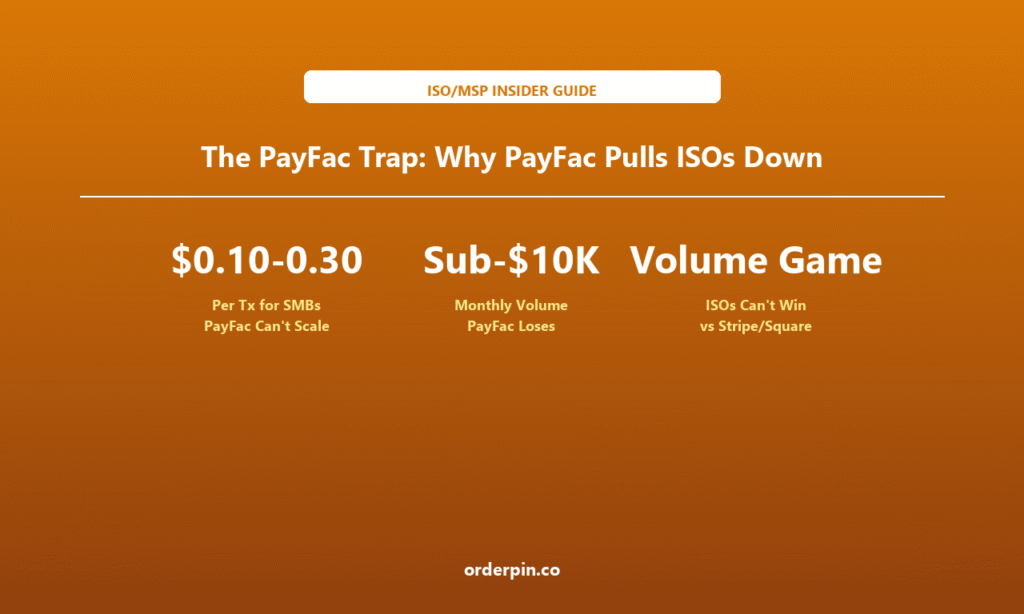
- PayFac economics break for sub-$10K/month merchants — and ISOs that copy the model inherit the loss: At $0.10-$0.30 per transaction plus a flat monthly fee, a sub-$10K/month merchant generates revenue that does not cover the support, compliance, and risk costs of serving them. The PayFacs absorb this because their venture capital funds customer acquisition at a loss, betting on a small fraction of merchants scaling up. An ISO that copies the PayFac model for SMBs enters a volume game it cannot win — without the balance sheet to fund the losses or the scale to reach profitability.
- The path forward is not to out-PayFac the PayFacs — it is to sell what they cannot: PayFacs win on self-serve, low-touch, price-transparent commodity processing. They lose on relationship, advisory, and value-added services. The ISO that competes on basis points loses; the ISO that builds value-added services — lending, automation, sustainability, customer success — on top of the payment relationship wins merchants that PayFacs cannot retain. The trap is trying to beat PayFacs at their own game. The opportunity is playing a different game.
PayFac Can’t Scale
PayFac Loses
vs Stripe/Square
The PayFac Trap Most ISOs Fall Into
The payment facilitator (PayFac) model reshaped payments. Instead of each merchant having its own merchant account — underwritten, boarded, and managed individually (the traditional ISO model) — a PayFac onboards sub-merchants under a single master merchant account. Stripe, Square, and Adyen built this model, and it eliminated the ISO intermediary for millions of small merchants by making onboarding instant and self-serve. For the micro-merchant, it was a breakthrough: sign up in minutes, start taking payments today, no sales call required.
The trap is that the model’s economics only work at scale, and the scale requires capital and technology that ISOs do not have. When an ISO tries to copy the PayFac model to win SMB volume — offering instant onboarding, rock-bottom rates, and minimal touch — it inherits the brutal per-merchant economics without the venture funding to absorb the losses. This article explains why the PayFac model was built for a different merchant, why its economics break below $10K/month, and what ISOs should do instead to win the merchants PayFacs cannot retain.
Master MID Model
At SMB Volume
PayFac Loses
Many Sub-Merchants
1. The PayFac Model Was Built for a Different Merchant
The PayFac model optimized for the micro-SMB doing $1K-$5K/month, not the mid-market merchant ISOs serve: Stripe, Square, and Adyen built self-serve, instant-onboarding products for the smallest merchants — solopreneurs, side businesses, pop-up shops. At that volume, the merchant does not need an ISO relationship; they need a button that works. The PayFac model eliminated the sales-and-service layer because, at that volume, the layer was not worth the cost. The merchant at the center of the PayFac model is fundamentally different from the $50K-$500K/month merchant that ISOs profitably serve and retain.
The model works at scale because technology replaces the human layer — but scale requires capital ISOs do not have: A PayFac can onboard a million sub-merchants because the onboarding is automated, the risk is pooled under one master account, and the support is largely self-serve documentation. But reaching the scale where the thin per-merchant economics turn profitable requires years of venture-funded customer acquisition. An ISO that copies the self-serve, low-touch model without that capital is buying the losses without the path to the profits.
2. Why PayFac Economics Break for Sub-$10K/Month Merchants
At $0.10-$0.30 per transaction plus a flat monthly fee, sub-$10K/month merchants generate revenue that does not cover their cost to serve: A merchant doing $5,000/month at an average ticket of $25 generates 200 transactions. At $0.20 per transaction, that is $40 in processing revenue. Add a $25 monthly fee and you have $65/month in total revenue. The support cost, compliance cost, and risk reserve for that merchant — even at low-touch — routinely exceeds $65. The PayFacs absorb this because their model bets that a fraction of these merchants will scale to $50K/month and subsidize the rest. An ISO without that bet structure just loses money.
The flat-fee-plus-cent model is a customer-acquisition loss leader — not a sustainable ISO product: When an ISO offers instant onboarding and rock-bottom rates to win SMB volume, it is pricing the product below its cost to serve, hoping volume will fix it. But volume at sub-$10K/month does not fix it — it multiplies the loss. The only entities that can run this model profitably are those funded to acquire customers at a loss and patient enough to wait for the survivors to scale. ISOs are not those entities, and pretending otherwise is the trap.
3. The Volume Game ISOs Can’t Win
PayFacs have near-infinite capital and a self-serve engine; an ISO competing on volume is outgunned on every axis: Stripe and Square can spend hundreds of millions on customer acquisition because their investors fund it and their unit economics work at scale. An ISO cannot match that spend, cannot match that technology investment, and cannot match that patience. Competing on volume — more merchants, lower rates, instant onboarding — is competing on the exact axis where the PayFacs have every advantage and the ISO has none. It is not a fair fight; it is a mismatch.
The merchants ISOs win on volume are the ones PayFacs lose money on — and that is not a win: The SMB merchants that flow to an ISO chasing volume are precisely the sub-$10K/month merchants that PayFacs acquire at a loss and hope will scale. If they scale, the PayFac captures them. If they do not, the ISO absorbs the cost. Either way, the ISO is competing for the worst part of the market — the part where the economics are structurally unfavorable. Winning that segment means owning unprofitable merchants.
4. What ISOs Should Do Instead — Sell Value, Not Volume
PayFacs win on self-serve, low-touch, price-transparent commodity processing — and lose on relationship and advisory: A PayFac merchant gets a dashboard and a support article. They do not get a relationship manager who knows their business, a lender who understands their cash flow, or a consultant who helps them reduce churn. Those are exactly the services ISOs are structurally better at delivering — because ISOs are local, relationship-driven, and merchant-focused. The ISO that leans into advisory services is playing a game the PayFacs explicitly chose not to play.
Value-added services — lending, automation, sustainability, customer success — sit on top of the payment relationship and compound in retention: The ISO that offers merchant cash advances, B2B payment automation, ESG reporting, and proactive customer success is not competing on the rate of the swipe. It is competing on the total value delivered to the merchant. A merchant that relies on their ISO for working capital, automation, and advisory does not switch to a PayFac over a basis-point difference — because the PayFac does not offer any of those things. Value, not volume, is the durable ISO strategy.
5. The ISO Advantage PayFac Can’t Replicate
The human relationship is the ISO’s moat — and it is the one thing PayFacs structurally cannot provide at scale: A PayFac’s entire design philosophy is to remove the human from the transaction. That is its strength for micro-merchants and its weakness for relationship-driven merchants. The ISO’s strength is the opposite: a named contact who knows the merchant’s business, shows up when something breaks, and advises on growth. For the $50K-$500K/month merchant, that relationship is worth more than a few basis points — and it is something no self-serve PayFac can replicate, by design.
The ISO that stops chasing PayFac volume and starts building advisory relationships wins the merchants that matter: The mid-market merchant that PayFacs acquire at a loss and fail to retain is exactly the merchant an ISO can serve profitably with relationship and value-added services. The trap is believing the ISO must beat the PayFac at its own game. The opportunity is recognizing the game is not worth playing — and building the advisory business that PayFacs structurally cannot.
PayFac Model vs. ISO Model for SMBs
| Dimension | PayFac Model | ISO Model (Advisory) |
|---|---|---|
| Target Merchant | Micro-SMB $1K-5K/mo | Mid-market $50K-500K/mo |
| Onboarding | Instant, self-serve | Guided, relationship-led |
| Economics Below $10K/mo | Loss leader (VC-funded) | Not pursued (focus up-market) |
| Human Relationship | None (self-serve) | Named advisor / CSM |
| Value-Added Services | Minimal (dashboard only) | Lending, automation, advisory |
| Retention Driver | Convenience + inertia | Value + relationship |
How OrderPin Helps ISOs Avoid the PayFac Trap
OrderPin is a white-label POS platform that gives ISOs the product depth to compete on value, not volume. Instead of racing PayFacs to the bottom on rate and self-serve onboarding, an ISO using OrderPin builds a branded platform with value-added services — lending, automation, sustainability, and customer success — that the self-serve PayFacs structurally cannot deliver. The platform is the ISO’s, the relationship is the ISO’s, and the merchant stays with the ISO.
- Compete on value, not basis points: OrderPin’s white-label platform lets the ISO deliver a full-featured POS and payment experience under its own brand — with the data ownership and flexibility to layer value-added services on top. The ISO wins on the total value delivered, not the rate of the swipe.
- Own the merchant relationship, not just the transaction: A white-label platform under the ISO’s brand means the merchant interacts with the ISO, not a third-party PayFac logo. The relationship, the support, and the advisory all flow through the ISO — the exact moat PayFacs cannot replicate.
- Build value-added services on top of the payment relationship: OrderPin’s API integrations enable ISOs to deliver merchant cash advances, B2B payment automation, ESG reporting, and other services that compound in retention. A merchant that relies on the ISO for these services does not switch to a self-serve PayFac over a rate difference.
- Focus up-market where the economics work: The ISO that uses OrderPin to serve the $50K-$500K/month merchant with relationship and advisory — not the sub-$10K/month merchant that PayFacs lose money on — builds a profitable portfolio without entering the volume game it cannot win.
Frequently Asked Questions
What exactly is the PayFac model?
A payment facilitator (PayFac) onboards sub-merchants under a single master merchant account, rather than giving each merchant its own individually underwritten account. Stripe, Square, and Adyen pioneered this model, which makes onboarding instant and self-serve — eliminating the ISO intermediary for small merchants. The master account pools risk and simplifies compliance, but the economics only work at the massive scale these platforms achieve with venture funding.
Why does the PayFac model lose money on small merchants?
At sub-$10K/month, a merchant generates only tens of dollars in processing revenue per month — not enough to cover support, compliance, and risk costs. The PayFacs absorb this as a customer-acquisition loss leader, betting that a small fraction of merchants will scale up and subsidize the rest. An ISO without that venture funding and scale cannot absorb the losses; it just bleeds money on every small merchant it acquires at PayFac-style pricing.
Can an ISO succeed with a PayFac-style model?
Not by copying it for SMB volume. The model requires capital and technology scale that ISOs do not have. The ISO can succeed by using PayFac-style instant onboarding as a feature — not as the whole product — while competing on the relationship and value-added services that PayFacs structurally cannot deliver. The mistake is treating the PayFac model as a strategy rather than a feature set to borrow selectively.
What should ISOs do instead of chasing PayFac volume?
Sell value, not volume. Build value-added services — merchant lending, B2B payment automation, ESG reporting, proactive customer success — on top of the payment relationship, and focus on the mid-market merchant where the economics work. The ISO that competes on the total value delivered to the merchant, not the rate of the swipe, wins merchants that PayFacs cannot retain and builds a portfolio that compounds in retention rather than churning on price.
Why can’t PayFacs just add relationship and advisory services?
Their entire design philosophy is to remove the human from the transaction to achieve scale and low cost. Adding named advisors and proactive relationship management destroys the unit economics that make the self-serve model work. A PayFac could theoretically build an enterprise sales motion for large merchants — and the largest ones do — but for the mid-market merchant, the self-serve model is structurally incompatible with the high-touch relationship an ISO provides. That incompatibility is the ISO’s opening.
How does a white-label platform help the ISO avoid the trap?
A white-label POS platform under the ISO’s brand lets the ISO deliver a full-featured experience with the data ownership and flexibility to layer value-added services — without building the platform from scratch. The merchant interacts with the ISO, not a third-party PayFac logo. The ISO owns the relationship, the support, and the advisory — the exact moat PayFacs cannot replicate — and competes on value rather than entering the volume game it cannot win. OrderPin is built for exactly this: a white-label POS platform for ISO and MSP partners to build a recurring-revenue business under their own brand.
The PayFac model reshaped payments by onboarding sub-merchants under a master account, eliminating the ISO intermediary for small merchants. It works brilliantly at scale — but PayFac economics break for sub-$10K/month merchants, where $0.10-$0.30 per transaction plus a flat fee does not cover the cost to serve. The PayFacs absorb this as a venture-funded loss leader, betting that a fraction of merchants scale up. An ISO that copies the model to win SMB volume enters a game it cannot win: outgunned on capital, technology, and patience, competing for the exact merchants PayFacs lose money on. The trap is believing the ISO must beat the PayFac at its own game. The opportunity is recognizing the game is not worth playing. PayFacs win on self-serve, low-touch, price-transparent commodity processing — and lose on relationship and advisory. The ISO that competes on value-added services — merchant lending, B2B automation, ESG reporting, customer success — on top of the payment relationship wins merchants PayFacs cannot retain. The human relationship is the ISO’s moat, and it is the one thing PayFacs structurally cannot provide at scale. A white-label platform like OrderPin lets the ISO deliver a full-featured, branded experience with the data ownership to build those services — competing on value, not volume, and building a portfolio that compounds in retention rather than churning on price.
About OrderPin
OrderPin is a white-label POS platform built for ISO and MSP partners. We offer full data ownership, flexible pricing, and seamless API integrations to help you build a recurring revenue business under your own brand. Learn more about OrderPin’s white-label solution