
TL;DR — Quick Summary
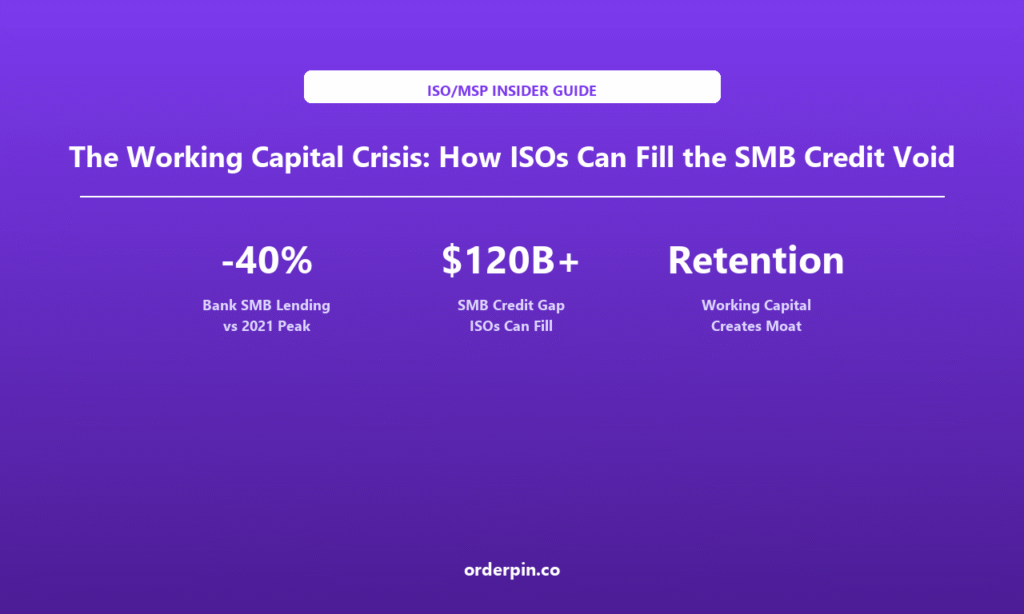
- Bank SMB lending has retreated dramatically post-2023, leaving a $120B+ credit gap: Rising rate environment and tighter bank credit standards have pushed bank SMB lending down 40% versus the 2021 peak. Merchants — especially restaurants, retailers, and service businesses — need working capital to manage cash flow gaps, hire staff for seasonal peaks, and invest in growth. But the traditional lender has retreated, and the gap is being filled by fintech merchant cash advance providers at 30-100% APR — the most expensive credit available to small businesses.
- ISOs have the data to underwrite SMB credit better than the banks and more fairly than the fintechs: A bank’s credit decision is based on tax returns, credit scores, and balance sheets — data that is stale, gamed, and often misleading for SMBs with seasonal revenue patterns and thin margins. The ISO’s transaction data shows real revenue trends, real cash flow health, and real merchant performance. This is a more accurate underwriting signal than any tax return — and it enables the ISO to offer working capital at a fair rate that is still profitable, creating the deepest competitive moat in the portfolio.
- Embedding working capital inside the POS dashboard is a recurring revenue stream and a retention moat: A merchant that gets their working capital through the ISO’s POS dashboard has the ISO’s financing embedded in the system they use every day. They cannot leave the ISO without leaving the capital — and leaving the capital is not an option for a business that depends on it. The embedded working capital relationship is the deepest form of integration in the ISO portfolio: high-margin recurring revenue and structural retention in one product.
vs 2021 Peak
ISOs Can Fill
Creates Moat
The Working Capital Gap Is an ISO Opportunity
The working capital gap for SMBs has never been larger. Post-2023, rising interest rates and tightening bank credit standards have pushed bank lending to SMBs down 40% from the 2021 peak. Merchants — restaurants preparing for a holiday rush, retailers restocking inventory, service businesses hiring ahead of a busy season — need working capital. The banks have retreated, and the fintech merchant cash advance providers have moved in, at 30-100% APR. For the merchant, this is the most expensive credit available to small businesses. For the ISO, it is an opportunity.
The ISO’s transaction data — six months of real revenue, real seasonal patterns, real cash flow health — is a more accurate credit signal than any tax return or credit score. Banks cannot see it. Fintech lenders see it, but they use it to justify high rates rather than fair ones. The ISO that uses its transaction data to underwrite working capital can offer the merchant a fair rate, earn a spread, and embed the financing in the POS system the merchant uses every day. The embedded working capital relationship is both a high-margin recurring revenue stream and the deepest retention moat in the portfolio. This article explains the credit gap, why ISOs are uniquely positioned to fill it, and how to build embedded working capital into the merchant relationship.
Post-2023
Banks Leave Behind
Than Banks
Deepest Lock-In
1. Why the Credit Gap Is Expanding Post-2023
Bank SMB lending peaked in 2021 and has retreated dramatically as rates rose and credit standards tightened: The post-pandemic credit boom gave way to a rapid tightening cycle. Rising rates increased the cost of bank funding; deteriorating SMB loan performance (post-PPPP loan defaults, inflation-driven margin compression) made banks more risk-averse. The result is a structural retreat from SMB credit that has not fully reversed despite rate stabilization. The merchants that were creditworthy in 2021 are now finding that their bank relationships no longer provide the working capital they need.
The merchant’s need did not shrink — the bank’s willingness to serve it did: Restaurants still need seasonal working capital. Retailers still need inventory financing. Service businesses still need to hire ahead of growth. The demand for SMB working capital has remained strong; the supply from traditional bank channels has not. This gap is being filled by fintech merchant cash advance providers — at 30-100% APR, the most expensive credit available to small businesses. The merchant pays more because the lender has less information, not because the credit risk is higher.
2. The Fintech MCA Alternative — And Its Limitations
Fintech MCA providers have filled part of the gap — at 30-100% APR, the most expensive credit available to SMBs: Merchant cash advance providers use the ISO’s transaction data to underwrite small-dollar, short-duration working capital advances repaid from future sales. The speed and accessibility are genuine advantages: a merchant can get funded in days, with no tax returns, no credit score requirement, and no collateral. But the pricing is punitive: an effective APR of 30-100% is not a fair deal for a merchant with genuine cash flow health — it is a tax on being outside the traditional banking system.
The fintech MCA pricing is the ISO’s opportunity — and the ISO’s ethical obligation: Fintech MCA providers price high partly because they use inferior data (bank account scraping, sparse transaction history) and partly because they capture the merchant’s desperation rather than their creditworthiness. An ISO with six months of real POS transaction data can underwrite more accurately, price more fairly, and still earn a better spread than the bank. The merchant gets a better deal. The ISO earns a recurring financing revenue stream. The transaction data that the ISO already has is the underwriting asset that makes this possible.
3. Why ISO Transaction Data Beats the Bank’s Credit Score
A bank’s credit decision is based on stale, gamed data — the ISO’s transaction data is real and current: A bank’s SMB credit decision relies on two-year-old tax returns, a credit score that is optimized for consumer credit behavior, and a balance sheet that tells you what the business owned last December, not what it earns this month. The ISO’s POS data shows real revenue trends for the last six months, the actual cash flow health of the business, and the seasonal patterns that a tax return cannot capture. For a restaurant with a Christmas peak and a January trough, the ISO’s transaction data tells you more about their creditworthiness than any tax return.
The ISO’s data advantage translates directly into a pricing advantage for the merchant and a spread advantage for the ISO: More accurate underwriting enables more accurate pricing. A merchant with stable, growing revenue patterns is genuinely lower risk than their credit score or tax return suggests — and the ISO can price accordingly. The merchant gets a fair rate, not a punitive one. The ISO earns a spread that reflects real credit quality, not the risk premium that fintechs charge for their information disadvantage. The data advantage is the underwriting advantage, and the underwriting advantage is the pricing advantage.
4. How to Build Embedded Working Capital Into the POS
The embedded working capital product lives inside the POS dashboard — the system the merchant already uses every day: A working capital offer that appears inside the POS dashboard — “Based on your last 6 months of revenue, you pre-qualify for up to $X in working capital” — reaches the merchant at the moment of financial need, in the system they trust. This is not a fintech lender’s ad in an email. It is a recommendation from the platform the merchant already uses. The conversion rate from embedded offer to funded advance is dramatically higher than cold outreach, because the trust relationship is already established.
The product structure can be MCA (repaid from future sales), revenue-based financing, or a hybrid: Each structure has different risk-return profiles. MCA — a fixed repayment amount deducted daily from transactions — is the simplest and most common. Revenue-based financing (a percentage of future revenue) is more aligned with merchant cash flow. A hybrid — a working capital line that the merchant draws as needed, repaid from daily transactions — is the most flexible and most likely to generate recurring use. The structure matters less than the embedding: the goal is a product the merchant uses inside the POS, repaid from transactions the ISO already processes.
5. Why Embedded Working Capital Is the Deepest Retention Moat
A merchant that depends on the ISO for working capital cannot leave the ISO without losing the capital: The embedded working capital relationship is different from every other ISO retention mechanism because it creates a financial dependency, not just a technical one. A merchant that gets their working capital through the ISO’s POS dashboard has the ISO’s financing embedded in the system they use every day. If they switch processors, they lose the working capital access — the credit line, the advance history, the pre-qualification signal. This is a switching cost that no competitor can easily replicate, because no competitor has the transaction data that underwrites the credit.
The financial moat compounds: the longer the merchant uses the ISO’s working capital, the more history, the better the credit terms, the deeper the dependency: Each month the merchant draws and repays through the ISO’s system, the ISO’s underwriting model improves, the merchant’s credit terms improve, and the relationship deepens. The embedded working capital product becomes more valuable to the merchant over time — and more difficult to leave. This is the compounding retention effect that the best ISO products create: revenue, retention, and data all reinforcing each other in a loop that gets stronger every month.
SMB Working Capital: Bank vs. Fintech MCA vs. ISO Embedded
| Dimension | Bank | Fintech MCA | ISO Embedded |
|---|---|---|---|
| Access | Difficult post-2023 | Easy, fast | In POS dashboard |
| Pricing | 8-15% APR | 30-100% APR | Fair, data-priced |
| Underwriting Data | Tax returns, credit score | Sparse bank data | Real POS revenue |
| Retention Effect | None | Minimal | Deepest structural moat |
| ISO Revenue | None | Referral only | Spread + recurring |
| Speed | Weeks | Days | Same-day (pre-qual) |
How OrderPin Helps ISOs Build Embedded Working Capital
OrderPin is a white-label POS platform that gives ISOs full data ownership over the transaction records that underwrite working capital. With that data, the ISO can pre-qualify merchants for credit, display working capital offers inside the POS dashboard, and manage repayment through the transaction stream — creating a complete embedded lending product under the ISO’s own brand, with the highest-margin recurring revenue in the portfolio.
- Own the transaction data that underwrites working capital: OrderPin gives ISOs full ownership over six months of real merchant revenue data — the exact underwriting signal that banks do not have and fintechs pay for. The ISO that owns the data owns the underwriting advantage, and the underwriting advantage is the pricing advantage and the retention advantage.
- Embed the working capital offer in the POS dashboard: A white-label platform under the ISO’s brand means the working capital offer appears in the system the merchant already uses every day. Pre-qualification signals, credit limit recommendations, and advance offers appear inside the dashboard — reaching the merchant at the moment of need, in a context of trust.
- Earn the spread on every advance: The ISO that originates working capital on its own platform earns the full spread on the loan — not a referral fee from a third-party lender. Over a portfolio of even modest size, embedded working capital revenue can exceed the interchange income from the same merchants.
- Create the deepest structural retention moat: A merchant that depends on the ISO’s working capital cannot leave without losing the credit relationship. The longer the merchant uses the ISO’s embedded working capital, the more history, the better the terms, the deeper the dependency. OrderPin’s white-label platform makes this the ISO’s moat, under the ISO’s brand, using the ISO’s data.
Frequently Asked Questions
How is ISO working capital underwriting different from bank underwriting?
A bank underwrites based on two-year-old tax returns, a personal credit score, and a balance sheet that tells you what the business owned last December. The ISO underwrites based on six months of real, daily transaction data — revenue trends, cash flow health, seasonal patterns, and actual business performance. For SMBs with fluctuating revenue, the bank’s data is stale and misleading; the ISO’s data is real and current. The more accurate data signal enables more accurate pricing, which means the ISO can offer fair rates while earning a better spread than the bank or the fintech.
What product structure should the ISO use — MCA, revenue-based financing, or something else?
Each structure has different trade-offs. MCA — a fixed repayment amount deducted daily from transactions — is the simplest and most common, with predictable cash flow for the lender. Revenue-based financing (a percentage of daily revenue) is more aligned with merchant cash flow and scales with the business. A working capital line — drawn as needed, repaid from daily transactions — is the most flexible and most likely to generate recurring use. The ISO’s transaction data enables any of these structures, and the choice depends on the ISO’s risk appetite and capital structure. What matters most is that the product is embedded in the POS — so the repayment flows through the ISO’s system and the relationship deepens with every transaction.
Does the ISO need to be a licensed lender to offer working capital?
This depends on the structure and the state. Some forms of merchant cash advance are not classified as loans and do not require a lending license. Revenue-based financing structures may require state lending licenses depending on the jurisdiction and the product. The ISO should work with a financial services attorney and a compliance advisor to structure the product correctly before launch. An alternative is to partner with a licensed lender and earn a referral fee or a revenue share — lower margin, but faster to market and lower regulatory burden. As the portfolio grows, the ISO can transition to direct origination.
How does embedded working capital improve retention?
The embedded working capital relationship creates a financial dependency that no competitor can easily replicate. A merchant that depends on the ISO for working capital — credit history, pre-qualification signals, advance access — cannot leave the ISO without leaving the capital. Switching processors means rebuilding the credit relationship from scratch. This is a structural switching cost, not a behavioral one. It compounds over time: every month the merchant uses the ISO’s working capital, the credit history grows, the terms improve, and the dependency deepens. The embedded working capital product becomes more valuable to the merchant and more difficult to leave.
How does the ISO price working capital fairly and profitably?
The ISO’s transaction data enables more accurate underwriting, which enables more accurate pricing. A merchant with stable, growing revenue patterns is genuinely lower risk than their credit score suggests — and the ISO can price accordingly. The merchant gets a better deal than the fintech MCA, and the ISO earns a better spread than the bank. As the underwriting model improves with data over time, the ISO can refine pricing continuously, offering better rates to good-credit merchants and maintaining profitability on riskier ones. The key principle is that the ISO prices on actual creditworthiness — using transaction data — not on the merchant’s desperation or lack of alternatives.
What is the revenue potential from embedded working capital?
The revenue potential is significant and highly concentrated. A merchant doing $50,000/month who takes a $25,000 advance at a 20% effective rate generates $5,000 in financing income. A portfolio of 200 active working capital merchants generates $1 million in financing income per advance cycle — and the ISO earns this on top of interchange. Recurring advances (merchants who pay back and redraw) make the revenue compounding. For an ISO competing in a market where interchange compresses and retention determines value, embedded working capital is the highest-margin recurring revenue stream available, and it is built on data the ISO already has. OrderPin is built for exactly this: a white-label POS platform with full data ownership that lets ISOs build the embedded working capital product under their own brand.
Post-2023, bank SMB lending is down 40% from the 2021 peak, leaving a $120B+ credit gap that fintech merchant cash advance providers are filling at 30-100% APR. The merchant pays a punitive rate not because their credit risk is high, but because the lender’s data is poor. The ISO’s transaction data — six months of real revenue, real cash flow, real seasonal patterns — is a more accurate underwriting signal than any tax return or credit score, and it enables the ISO to price fairly while earning a better spread. Embedding working capital inside the POS dashboard turns the data advantage into a high-margin recurring revenue stream that no competitor can easily replicate. The embedded working capital relationship is the deepest structural retention moat in the ISO portfolio: a merchant that depends on the ISO for working capital cannot leave without leaving the capital, and every month of use deepens the dependency and improves the terms. The ISO that builds the embedded working capital product now — before the fintechs or the banks fill the gap — wins the most profitable and most retention-resistant relationship in the portfolio. OrderPin is a white-label POS platform that gives ISOs the full data ownership and API depth to build the embedded working capital product under the ISO’s own brand, turning the credit gap into the ISO’s highest-margin recurring revenue stream and deepest retention moat.
About OrderPin
OrderPin is a white-label POS platform built for ISO and MSP partners. We offer full data ownership, flexible pricing, and seamless API integrations to help you build a recurring revenue business under your own brand. Learn more about OrderPin’s white-label solution