
TL;DR — Quick Summary
- CFPB Section 1033 and state open banking laws are coming — and they change the switching cost calculus fundamentally: Open banking regulations require banks to provide standardized APIs that let consumers and businesses access and share their financial data. In the payments context, this means a merchant will eventually be able to switch processors with one click, using a third-party app to move their transaction data and history to a new provider. The account loader and the manual data portability workaround that ISOs have relied on for retention will not survive this mandate. The threat is real and the timeline is tightening.
- The ISO whose only moat is lock-in faces a serious problem: When switching costs collapse, merchants choose on price and service — and ISO service has always been difficult to differentiate in the absence of a data relationship. An ISO that processes transactions but never gives the merchant usable data will lose that merchant to the cheapest processor the moment the API makes the switch frictionless. The era of retention through lock-in is ending. The question is not whether open banking will come, but how fast — and whether the ISO will be ready before the mandate arrives.
- The opportunity is to own the data layer before the mandate forces it open: ISOs with POS data APIs can become the open banking hub for their merchant base — offering the data services that merchants value, in the format they need, before a third-party fintech fills the gap. By building a data API strategy now, the ISO positions itself as the trusted data partner rather than the data source that the merchant is forced to share with competitors. The open banking mandate is a threat to the ISO that waits and an opportunity for the ISO that moves first.
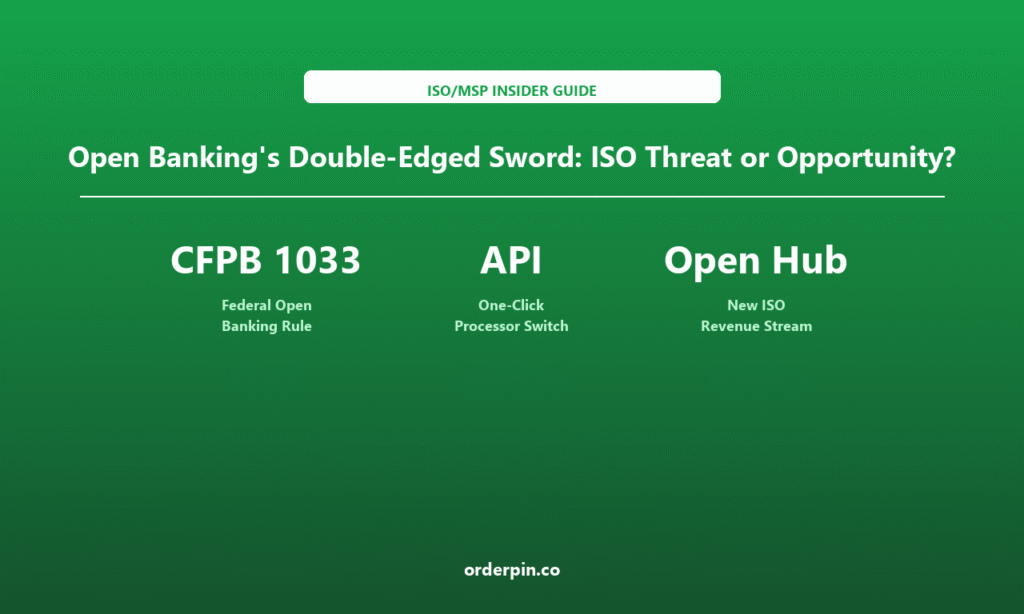
Banking Rule
Processor Switch
Revenue Stream
Open Banking Is Coming — And It Changes Everything About ISO Retention
Open banking is a regulatory mandate that requires financial institutions — including banks — to share consumer and business financial data through standardized, secure APIs. The most advanced version is the UK’s Open Banking Initiative, which forced the UK’s nine largest banks to build and expose APIs. The US version is arriving in waves: CFPB Section 1033, the federal rulemaking that establishes a right to financial data, is working toward implementation, while California, Colorado, and other states have passed their own open banking laws with timelines already in motion.
In payments, the implication is specific and disruptive. When a bank’s account data — including the merchant’s transaction history — must be available via a standardized API, the friction that makes switching processors difficult disappears. A merchant will be able to use a third-party app to move their transaction data to a new processor in one click. The account loader, the data migration workaround, the manual export — all the mechanisms that made switching painful — become irrelevant. An ISO whose retention strategy depends on switching friction faces an existential problem. But an ISO that builds the data layer before the mandate arrives turns the same disruption into a competitive advantage. This article explains what open banking actually requires, what it means for ISO retention, and how the ISO that moves first wins the data layer.
Rights Rule
Bank Data APIs
Data Partner
vs. Lock-In
1. What Open Banking Actually Means for Payments
Open banking mandates that banks provide standardized APIs for financial data — and the payments industry is in the first wave: CFPB Section 1033, once implemented, requires banks and financial institutions to make consumer and business financial data available through developer-accessible APIs. In the payments context, this means a merchant’s bank account data, transaction history, and account standing information must be accessible via a standardized API — not just the bank’s own portal, but a third-party API that any authorized provider can use. The goal is consumer choice; the consequence for ISOs is the elimination of the friction that makes switching processors hard.
State-level open banking laws are already in motion — the federal rule is catching up: California, Colorado, and other states have passed open banking laws with specific timelines and requirements. While the federal CFPB 1033 rulemaking works through implementation, the state laws are already creating precedent and forcing banks to build API infrastructure. For ISOs serving merchants in states with active open banking laws, the data portability requirement is not future tense — it is starting to arrive.
2. The Threat: CFPB 1033 and One-Click Processor Switching
When the bank provides the API, switching costs collapse — and the ISO that relied on friction loses its moat: The account loader, the manual transaction export, the migration support — these mechanisms that made switching painful are all workarounds for the absence of a standardized data API. When the bank provides the API, a fintech app can connect to the merchant’s bank account, pull the transaction history, and present a new processor for the merchant to authorize — in one click. The ISO whose retention strategy was built on lock-in rather than value loses the retention tool the moment the API goes live.
The threat is not the switch itself — it is the fintech that uses the data to make the switch easier than a phone call: Open banking does not just make switching technically possible; it enables a new category of fintech aggregators — account switching apps, processor comparison platforms, automated migration services — that use the API data to present switching as a service, not a chore. The merchant who has been vaguely considering a switch will be able to complete it without talking to anyone. An ISO without a data relationship with that merchant will lose them to the cheapest processor on the aggregator’s platform.
3. The Opportunity: ISOs as the Open Banking Hub for Merchants
The ISO that provides the data services merchants need becomes the trusted data partner — not the processor that the merchant might leave: Open banking regulations require that the bank’s API be accessible to any authorized provider. But they do not specify which provider the merchant uses to access and manage that data. The ISO that builds a merchant data platform — one that aggregates the merchant’s bank data, POS data, and transaction history into a single view — becomes the app the merchant uses to manage their financial data. In that role, the ISO is not fighting the open banking mandate; it is delivering what the mandate enables, on its own platform, under its own brand.
The data API strategy converts the open banking threat into a new recurring revenue stream: Once the ISO’s platform is the merchant’s open banking hub — aggregating data from the bank’s API, the ISO’s POS, and the merchant’s other financial accounts — the ISO can offer data analytics, cash flow forecasting, and business intelligence as premium subscription products. This is recurring revenue that is not interchange, not rate-sensitive, and not substitutable by a self-serve aggregator. The data platform is the moat, and the moat is built on value, not friction.
4. Building a Data API Strategy Before the Mandate Arrives
The ISO that builds the data layer before the mandate arrives wins the relationship before the fintechs arrive: Open banking fintechs are already building the aggregator apps that will use the bank APIs to make switching frictionless. The ISO that builds a merchant data platform now — one that merchants already use and trust — will not be displaced by those aggregators. A merchant who already gets their cash flow analytics from the ISO’s platform is not going to use a third-party aggregator for the same data. The ISO that builds the relationship first makes the aggregator irrelevant for retention purposes.
The data API strategy starts with giving merchants what open banking will eventually force banks to provide: Cash flow visibility, transaction analytics, and business intelligence are the data products that merchants actually value — and they are exactly the products the ISO’s POS data enables. The ISO that gives merchants this data first establishes the data relationship before the mandate creates the infrastructure for competitors to offer the same thing. The strategic question is not whether to build a data platform; it is how quickly to build it.
5. The ISO That Moves First Wins the Open Banking Layer
First-mover advantage in the data layer is not about being earliest — it is about being most useful: The ISO that builds the most useful merchant data platform — the one that merchants check first thing in the morning, that gives them the analytics they need to run their business — wins the open banking relationship before the fintechs arrive. The product is not the API infrastructure; it is the merchant experience. The ISO that makes the data platform indispensable becomes the hub, and the hub is the moat.
The open banking mandate is the ISO’s permission structure to build the data business it always should have built: For years, ISOs had a structural reason to avoid giving merchants too much data — data portability enables switching. Open banking eliminates that excuse. The mandate will force data sharing anyway; the ISO that builds the data platform first turns the mandate into an asset. The choice is not whether to be open-banking-ready, but whether to be ready before the mandate forces openness. The ISO that waits is the ISO that loses.
Traditional ISO vs. Open Banking-Ready ISO
| Dimension | Traditional ISO | Open Banking-Ready ISO |
|---|---|---|
| Retention Strategy | Lock-in / friction | Data value / trust |
| Open Banking Response | Wait and see | Build the data layer now |
| Data API | None | Merchant data hub |
| Switch Risk | High (lock-in removed) | Low (data trust) |
| New Revenue | None | Data analytics subscription |
| Fintech Threat | Existential | Mitigated by platform |
How OrderPin Helps ISOs Build the Open Banking Data Layer
OrderPin is a white-label POS platform that gives ISOs the data ownership and API depth to build the merchant data hub before the fintechs arrive. Through full data ownership and developer-accessible APIs, an ISO can layer cash flow analytics, transaction intelligence, and open banking aggregation on top of the payment platform — under the ISO’s own brand — turning the open banking mandate from a threat into a competitive advantage.
- Own the data before the mandate forces it open: OrderPin gives ISOs full ownership over the merchant’s transaction data — the exact dataset that open banking regulations will eventually require banks to share. The ISO that has this data in its platform before the bank API mandate arrives owns the relationship, not the bank.
- Build the merchant data hub under the ISO’s own brand: A white-label platform under the ISO’s brand gives merchants the cash flow analytics, transaction intelligence, and business intelligence they need — before the open banking fintechs arrive to offer the same thing. The ISO that builds the most useful data platform becomes the merchant’s data hub, not just their processor.
- Convert the data layer into recurring subscription revenue: Cash flow forecasting, business intelligence dashboards, and transaction analytics are premium data products that merchants will pay for — and that are entirely within the ISO’s capability to deliver on top of the POS data it already owns. This is recurring revenue that is not interchange and not rate-sensitive.
- Turn open banking from a threat into a first-mover advantage: The ISO that builds the merchant data platform now — before the CFPB 1033 mandate is fully implemented — wins the data relationship before the open banking fintechs arrive. OrderPin’s white-label architecture makes this the ISO’s platform, under the ISO’s brand, using the ISO’s data.
Frequently Asked Questions
What does CFPB Section 1033 actually require?
CFPB Section 1033 establishes a consumer right to access and share financial account data — including transaction history, account information, and usage data — through a standardized, developer-accessible interface. For businesses, this means a merchant’s bank must provide an API that lets authorized third parties access their financial data. The rulemaking is still working through implementation details, but the direction is clear: financial data must be shareable via APIs. State laws in California, Colorado, and elsewhere are already moving on similar timelines.
How does open banking actually enable processor switching?
Today, switching processors is difficult because the merchant must manually export their transaction history, provide it to the new processor, and rebuild their reporting in the new system. Open banking APIs eliminate this friction. A fintech aggregator can use the bank’s API to pull the merchant’s transaction data directly, present the data in a new processor’s format, and authorize the switch — in one click, without talking to anyone. The account loader and manual migration that made switching hard become irrelevant the moment the bank’s API is live.
Is the ISO that gives merchants more data worried about open banking enabling competitors?
Not if the ISO builds the data relationship first. Open banking requires banks to share data with any authorized provider — but it does not specify which provider the merchant uses to access and manage that data. The ISO that builds the most useful data platform — the one merchants already use and trust — becomes the app the merchant uses to access and manage their financial data. The open banking mandate is an opportunity for the ISO that builds the platform; it is a threat for the ISO that does not.
What data products can an ISO build on top of open banking?
The ISO’s POS data — combined with bank API data accessible through open banking — enables cash flow forecasting, working capital eligibility scoring, business intelligence dashboards, supplier payment analytics, and automated accounting integration. These are data products merchants value and will pay for, and they are exactly the products that the ISO’s data ownership enables. The data platform is both a retention tool and a new revenue stream.
What happens to the ISO that does not build a data API strategy?
It becomes vulnerable to two simultaneous pressures: open banking fintechs that use the bank APIs to make switching frictionless, and fintech aggregators that offer the data products the ISO did not build. An ISO without a data relationship with its merchants will lose them to the cheapest processor on the aggregator’s platform, because there is nothing in the relationship that makes the merchant prefer to stay. The open banking mandate will accelerate this dynamic, not create it.
How quickly does the ISO need to move?
The mandate timeline is tightening, but it is not instantaneous. The ISO that builds the data platform now — before the bank APIs are fully live, before the fintech aggregators have built their merchant base — wins the relationship that later becomes structurally difficult to displace. First-mover advantage in merchant data is not about being earliest; it is about being most useful. The ISO that makes its data platform indispensable first wins. OrderPin is built for exactly this: a white-label POS platform with full data ownership and developer APIs that lets ISOs build the merchant data hub under their own brand, before the fintechs arrive.
CFPB Section 1033 and state open banking laws require banks to provide standardized APIs that let merchants access and share their financial data — including the transaction history that makes switching processors hard. For ISOs whose only retention moat is lock-in and friction, this is a genuine threat: the moment the bank API is live, switching becomes one click, and the account loader becomes irrelevant. But for ISOs with POS data APIs, open banking is an opportunity: become the merchant’s open banking hub, offer the data services merchants actually value — cash flow forecasting, business intelligence, working capital scoring — before the fintech aggregators arrive. The ISO that builds the data platform first wins the data relationship before the mandate forces it open, converts the data layer into a recurring subscription revenue stream, and turns the open banking mandate from a threat into a first-mover advantage. The ISO that waits loses both the relationship and the revenue. OrderPin is a white-label POS platform that gives ISOs the data ownership and developer APIs to build the merchant data hub — under the ISO’s own brand, before the fintechs arrive, turning the open banking mandate into the ISO’s most durable competitive advantage.
About OrderPin
OrderPin is a white-label POS platform built for ISO and MSP partners. We offer full data ownership, flexible pricing, and seamless API integrations to help you build a recurring revenue business under your own brand. Learn more about OrderPin’s white-label solution