
TL;DR — Quick Summary
- The shift from transaction-fee to subscription-fee revenue is the most significant revenue model evolution in the ISO industry in 20 years: For two decades, ISO revenue was built on a percentage of every transaction. That model is rate-sensitive, volatile, and converging to the rail’s value. The subscription model — monthly platform fees, per-seat pricing, premium support tiers, white-label licensing — builds predictable recurring revenue on top of the transaction. The ISO that makes this shift stops selling processing and starts selling a platform the merchant pays for every month, regardless of volume.
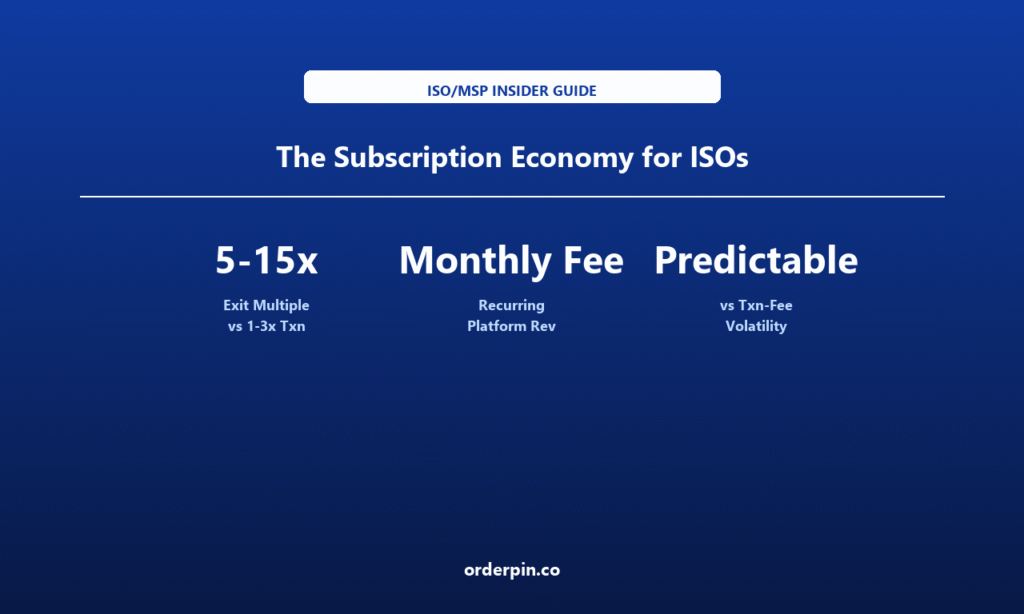
- Recurring revenue commands 5-15x revenue multiples at exit — versus 1-3x for pure transaction-fee businesses: A buyer values predictability. Transaction-fee revenue is rate-sensitive and can be repriced or lost with a single competitor quote. Recurring platform revenue is contracted, predictable, and retained. The same merchant book is worth 3-10x more as a subscription business than as a pure processing business, because the revenue is recurring and the relationship is structural. The revenue model, not the volume, determines the exit valuation.
- The recurring-revenue ISO compounds while the transaction-fee ISO converges to the rail: Every merchant that adopts a monthly platform fee adds predictable revenue that stacks month over month. The transaction-fee ISO’s revenue per merchant decays as rates compress. The recurring-revenue ISO builds a compounding base; the transaction-fee ISO builds a shrinking one. The subscription model is the structural advantage that separates the ISO that appreciates from the ISO that commoditizes.
vs 1-3x Txn
+ Seat Fees
Volatility
The Subscription Model Is the ISO’s Structural Advantage
The subscription economy is the shift from paying per transaction to paying per month for a platform. For two decades, ISO revenue was built on a percentage of every sale — a model that is rate-sensitive, volume-dependent, and converging to the payment rail’s value as rails commoditize. The subscription model decouples the ISO’s revenue from the transaction: the merchant pays a monthly platform fee, a per-seat price, a premium support tier, or a white-label license — regardless of how many transactions they process. The ISO stops selling processing and starts selling a platform the merchant uses every day.
This shift is the most significant revenue model evolution in the ISO industry in 20 years because it changes what the ISO is worth. Transaction-fee revenue sells at 1-3x revenue multiples. Recurring platform revenue sells at 5-15x. The same merchant book, restructured as a subscription business, is worth multiples more — because the revenue is predictable, contracted, and retained. This article explains why the subscription model is the structural advantage, how to bundle recurring revenue into every merchant contract, and how the recurring-revenue ISO compounds while the transaction-fee ISO converges to the rail.
Monthly Revenue
vs 1-3x Txn
Per Merchant
Txn Volume
1. Why Transaction-Fee Revenue Is the Wrong Foundation
Transaction-fee revenue is rate-sensitive, volatile, and converging to the rail’s value: Every transaction the ISO processes generates a fee — but that fee is set by a competitive market where rates compress as payment rails commoditize. The merchant’s volume fluctuates with the economy, the season, and their own business cycle. The revenue is tied to both a compressing margin and a volatile volume. The transaction-fee ISO’s revenue per merchant decays every year the market competes on price, and there is no structural defense — because processing is a commodity.
The transaction-fee ISO sells a commodity; the subscription ISO sells a platform the merchant uses every day: The transaction-fee ISO’s value to the merchant is “we process your payments slightly cheaper than the next guy.” The subscription ISO’s value is “we provide the platform your business runs on — and you pay us every month for it.” The first is a price quote; the second is a relationship. The revenue model determines whether the ISO is a vendor the merchant reviews annually or a platform the merchant depends on daily.
2. The Revenue Model Determines the Exit Multiple
A buyer pays for predictability — and recurring revenue is the most predictable revenue there is: Pure transaction-fee businesses sell at 1-3x revenue multiples, because the revenue can be repriced or lost with a single competitor quote, and it depends on volume the buyer cannot control. Recurring platform revenue — monthly fees, per-seat pricing, premium tiers — is contracted, retained, and predictable. Buyers pay 5-15x for it, because they can model it. The same merchant book is worth multiples more as a subscription business, because the revenue model changed, not the merchants.
The gap between 1-3x and 5-15x is the single biggest lever on ISO value — and it is a pricing decision, not a volume decision: An ISO with $1M in pure transaction-fee revenue is worth $1-3M at exit. The same ISO with $1M in recurring platform revenue is worth $5-15M. The difference is not the merchants — it is the revenue model. Bundling recurring revenue into every merchant contract is the highest-leverage action an ISO can take to increase its exit value, and it compounds with every new merchant and every renewal.
3. How to Bundle Recurring Revenue Into Every Merchant Contract
The monthly platform fee is the foundation — charge for the platform, not just the transaction: Every merchant on a white-label platform pays a monthly fee for the software, regardless of volume. This converts the relationship from “we process your payments” to “we provide your POS platform, and you pay us every month.” The fee is small relative to the merchant’s revenue but large relative to the ISO’s margin — and it is recurring. Even a $49-99/month platform fee across 500 merchants is $25-50K/month of predictable revenue that stacks independently of transaction volume.
Layer per-seat pricing, premium support tiers, and white-label licensing on top of the base fee: Per-seat pricing charges for each location or each staff user — scaling the fee with the merchant’s growth. Premium support tiers sell faster response, a dedicated CSM, and quarterly business reviews for a higher monthly fee. White-label licensing lets the ISO resell the platform under the merchant’s own brand at a margin. Each layer adds recurring revenue without adding transaction-dependent risk — and each layer deepens the merchant relationship from a price quote to a platform dependency.
4. The Recurring-Revenue ISO Compounds; the Transaction-Fee ISO Converges
Every merchant on a monthly fee adds predictable revenue that stacks — the recurring base compounds month over month: A recurring-revenue ISO adds $50-200/month of platform fee per merchant, and that revenue persists as long as the merchant stays. The base grows with every new merchant and every upsell, independent of transaction volume. A 500-merchant book at $100/month average is $50K/month — $600K/year — of revenue that exists whether the merchant processes $10K or $100K that month. The recurring base is the compounding asset.
The transaction-fee ISO’s revenue per merchant decays as rates compress — the recurring ISO’s does not: A transaction-fee ISO earning 0.3% on $50K/month earns $150/month per merchant — and that $150 shrinks every year the market competes on rate. The recurring ISO earns the same $150 in platform fee, plus transaction revenue on top, and the $150 does not compress because it is contracted, not priced per transaction. The recurring-revenue ISO builds a base that appreciates; the transaction-fee ISO builds one that decays. The model determines the trajectory.
5. The Subscription Model Is the Structural Advantage
The ISO that bundles recurring revenue decouples its value from the transaction — and from the rail’s competition: When the ISO’s revenue is a monthly platform fee, the merchant’s switching decision is no longer “who has the cheapest rate” — it is “who provides the platform my business runs on.” The subscription model creates a relationship that rate quotes cannot disrupt, because the value is the platform, not the processing. The ISO that builds this relationship owns a position the rail’s price competition cannot reach.
The window to shift is open while most ISOs still price per transaction — and it closes as the market commoditizes: Most ISOs still compete on rate, because the transaction-fee model is what they know. The ISO that shifts to subscription pricing now — before the market fully commoditizes — captures the merchants who will pay for a platform, not just a processor. The recurring-revenue model is the structural advantage that separates the ISO that compounds in value from the ISO that converges to the rail. The shift is a pricing decision the ISO can make today.
Transaction-Fee ISO vs. Subscription ISO
| Dimension | Transaction-Fee | Subscription ISO |
|---|---|---|
| Revenue Source | Per transaction | Monthly platform fee |
| Volatility | Volume-dependent | Predictable, contracted |
| Rate Pressure | Decays per merchant | Shielded by fee |
| Exit Multiple | 1-3x revenue | 5-15x revenue |
| Merchant View | Vendor (price quote) | Platform (daily use) |
| Value Trajectory | Converges to rail | Compounds |
How OrderPin Helps ISOs Build the Subscription Business
OrderPin is a white-label POS platform built for the subscription ISO. Monthly platform fees, per-seat pricing, premium support tiers, and white-label licensing all run on a single platform under the ISO’s own brand — turning every merchant contract into a recurring-revenue relationship that commands 5-15x the exit multiple of a pure transaction-fee book.
- Charge a monthly platform fee for the software, not just the transaction: OrderPin’s white-label architecture lets the ISO bill every merchant a recurring monthly fee for the POS platform — decoupling the ISO’s revenue from transaction volume and creating the predictable base that stacks month over month.
- Scale with per-seat and per-location pricing: As the merchant adds locations or staff users, the recurring fee scales with their growth — turning the ISO’s revenue into a function of the merchant’s success, not just their processing volume.
- Monetize premium support tiers and white-label licensing: Faster response, dedicated CSM, and quarterly business reviews become premium tiers the merchant pays more for monthly. White-label licensing lets the ISO resell the platform under the merchant’s brand at a margin. Each layer adds recurring revenue without transaction-dependent risk.
- Compound the base while the transaction-fee ISO converges: Every merchant on a monthly OrderPin fee adds predictable revenue that persists regardless of volume. The ISO that bundles recurring revenue into every contract builds the compounding asset that commands 5-15x at exit. OrderPin’s white-label platform makes this the ISO’s business, under the ISO’s brand, using the ISO’s merchant relationship.
Frequently Asked Questions
How do I shift existing merchants from transaction-fee to subscription pricing?
The shift is a repackaging, not a renegotiation of the rate. For a new merchant, the contract includes a monthly platform fee from day one. For an existing merchant, the ISO introduces the platform fee as part of a value-added bundle — “your POS platform, now including analytics and priority support, for $X/month” — while keeping the transaction rate competitive. The merchant pays for the platform they already use, and the ISO converts a price-quote relationship into a monthly recurring one. The key is to lead with the platform value, not the fee.
Will merchants resist paying a monthly fee on top of processing?
Merchants already pay monthly fees for the software they depend on — accounting, scheduling, marketing. A POS platform fee is the same model applied to the system the merchant uses every day. The resistance is minimal when the fee is framed as access to the platform (analytics, support, integrations) rather than an add-on to processing. Most SMBs expect to pay for software monthly; the ISO that charges for the platform aligns with the merchant’s existing expectations and builds a recurring relationship instead of a rate quote.
How much recurring revenue is realistic per merchant?
A monthly platform fee of $49-149 plus per-seat pricing of $10-20/user plus premium support tiers of $50-200/month is realistic for most SMB merchants. Across a 500-merchant book at an average of $100/month, that is $50K/month — $600K/year — of recurring revenue independent of transaction volume. The exact number depends on the merchant segment and the value bundled, but the structural point holds: recurring revenue per merchant is predictable, stacks, and does not compress with rate competition.
Does the subscription model help retention or just revenue?
Both. The monthly fee reframes the relationship from “we process your payments” to “we provide your platform” — and the merchant who pays a monthly fee for the platform they use daily is far less likely to switch on a rate quote. The subscription also creates a natural touchpoint (the monthly invoice, the support tier, the quarterly review) that keeps the ISO engaged with the merchant. Recurring revenue and retention reinforce each other: the fee deepens the relationship, and the deeper relationship sustains the fee.
Why does the exit multiple jump from 1-3x to 5-15x?
Buyers pay for predictability and retention. Transaction-fee revenue is rate-sensitive and can be repriced or lost with one competitor quote; it depends on volume the buyer cannot control. Recurring platform revenue is contracted, predictable, and retained — the buyer can model it and finance against it. A $1M recurring-revenue book is worth $5-15M at exit; the same $1M in transaction-fee revenue is worth $1-3M. The revenue model, not the merchants, drives the multiple. OrderPin is built for exactly this: a white-label platform that lets ISOs bundle recurring revenue into every merchant contract and compound the base that commands the higher multiple.
When should the ISO start the subscription shift?
Now. The window is open while most ISOs still price per transaction and compete on rate. Every month the ISO delays, it builds a transaction-fee book that converges to the rail’s value instead of a recurring base that compounds. New merchants should be contracted on the subscription model from day one; existing merchants should be migrated as their contracts renew. The shift is a pricing decision the ISO controls — and the earlier it starts, the larger the compounding base at exit. The cost of waiting is measured in exit multiples, not monthly fees.
The shift from transaction-fee to subscription-fee revenue is the most significant revenue model evolution in the ISO industry in 20 years. Transaction-fee revenue is rate-sensitive, volatile, and converging to the rail’s value; a single competitor quote can reprice or lose it. The subscription model — monthly platform fees, per-seat pricing, premium support tiers, white-label licensing — builds predictable recurring revenue that the ISO’s merchant pays every month regardless of volume. The revenue model, not the volume, determines the exit valuation: recurring platform revenue commands 5-15x revenue multiples versus 1-3x for pure transaction-fee businesses, because it is contracted, predictable, and retained. The recurring-revenue ISO compounds — every merchant adds predictable revenue that stacks month over month — while the transaction-fee ISO converges to the rail as rates compress. The subscription model is the structural advantage that decouples the ISO’s value from the transaction and from the rail’s price competition. The window to shift is open while most ISOs still price per transaction, and it closes as the market commoditizes. The ISO that bundles recurring revenue into every merchant contract builds the compounding asset that commands the higher multiple. OrderPin is a white-label POS platform that gives ISOs the monthly fee, per-seat, premium tier, and white-label architecture to build the subscription business under their own brand — turning every merchant contract into recurring revenue that compounds and sells for 5-15x at exit.
About OrderPin
OrderPin is a white-label POS platform built for ISO and MSP partners. We offer full data ownership, flexible pricing, and seamless API integrations to help you build a recurring revenue business under your own brand. Learn more about OrderPin’s white-label solution