
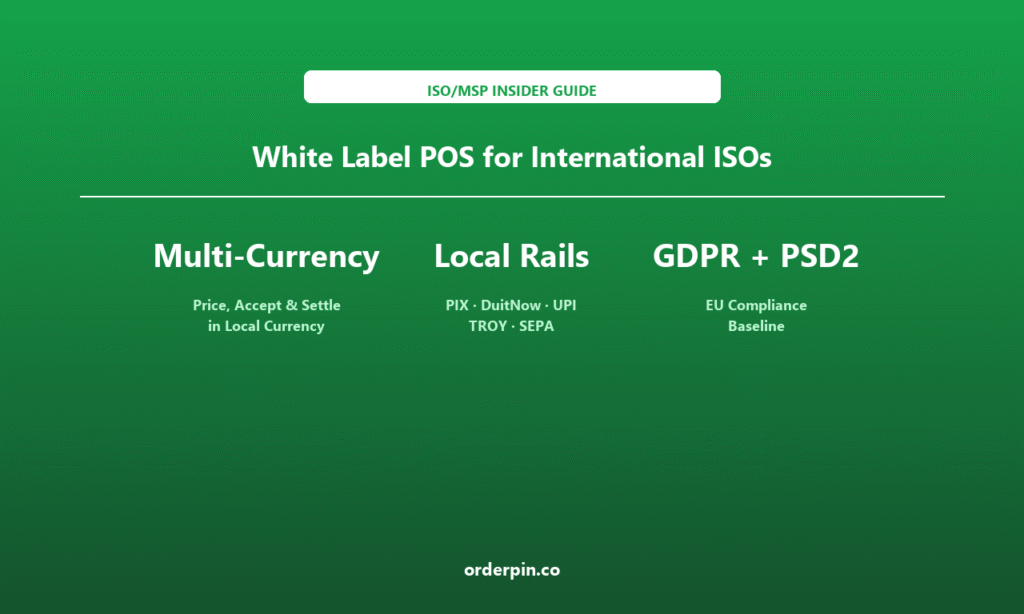
TL;DR — Quick Summary
- White label POS content is written for US ISOs — but the demand is global: In our own audience data, the majority of white label POS interest now originates outside the United States, led by Portugal, Malaysia, and Turkey. Each of those markets has its own payment rails, tax rules, and currency requirements, which means a US-centric white label playbook leaves both revenue and compliance on the table.
- Going international changes four things: Multi-currency settlement (accept, price, and settle in the merchant’s currency), cross-border acquiring (different acquirers, scheme rules, and risk models), local payment methods (PIX, DuitNow, UPI, TROY, iDEAL, SEPA), and regulatory and data compliance (GDPR, PSD2 and SCA, VAT, and data residency). The software may be the same in every market — the go-to-market is not.
- The ISOs that win internationally structure for it: the right contracting entity, a contract currency, data residency, local support, and a brand that travels. Treat compliance as a product feature, not a cost center — the ISO that solves localization for its merchants wins the accounts a US-only competitor cannot even quote.
Turkey Lead Interest
TROY · SEPA · More
Baseline
What Every ISO Should Know About International White Label POS
A white label POS lets an ISO or MSP sell a branded point-of-sale platform while a behind-the-scenes provider runs the software and infrastructure. The model itself is the same whether your merchants are in Ohio or Osaka — but almost everything around it changes when you cross a border: the currency merchants price in, the rails their customers pay on, the acquirer that settles the funds, and the rules that govern the data. Most white label POS content is written for US ISOs and stops at the border. This guide picks up where that content stops.
If you are an ISO or MSP serving merchants outside the United States — or planning to — international white label is less about software and more about localization: currency, rails, compliance, and contracts. Get those four right and the white label model travels. Get them wrong and a strong domestic playbook stalls in its first foreign market, no matter how good the platform underneath it is.
in the merchant’s currency
scheme rules and risk
TROY and local wallets
and data residency
1. Why White Label POS Content Is US-Centric — And Why That Costs You
The default playbook assumes US rails and US rules: most guides cover interchange, card-present versus card-not-present, and US tax — none of which answers a merchant in Kuala Lumpur who needs DuitNow QR at the counter, or a merchant in Lisbon who needs SEPA and EU VAT-ready invoicing. A US-centric playbook is not wrong; it is simply incomplete outside its home market.
The demand is already global: in our own audience data, the majority of white label POS interest originates outside the United States, led by Portugal, Malaysia, and Turkey. The ISO that localizes first serves demand its competitors cannot quote — and the content gap means there is far less competition for those searches today.
“International” is not one market — it is many: Portugal means EU rules, SEPA, GDPR, and the euro; Malaysia means DuitNow, local tax, and a QR-first checkout; Turkey means TROY, local FX dynamics, and inflation-aware pricing. There is no single “global” toggle. Treating international as one segment is the fastest way to be mediocre in all of them.
The cost of ignoring it is twofold: first, you cannot serve the merchant at all if you lack the rail or the compliance posture; second, even when you technically can, a poorly localized checkout loses conversions at the exact moment of payment — the one moment that decides the whole transaction. Localization is not a nice-to-have bolted on after launch; it is the product.
2. Multi-Currency Settlement: Accept, Price, and Settle in Local Currency
Price in the merchant’s currency: merchants think and set prices in their local currency. Handing them a USD rate card imports FX ambiguity into every conversation and forces the merchant to do a mental conversion before they can even judge your price. Quote where their business lives.
Accept in the customer’s currency: let shoppers pay in the currency they expect. Presenting the total in a familiar currency removes the “I do not know what I am actually paying” hesitation that quietly kills conversion at checkout — especially for cross-border shoppers.
Settle where the merchant banks: decide up front whether you settle in local currency, in USD, or in a currency the merchant chooses — and state clearly who bears the FX spread. Settlement is a pricing decision, not an operational afterthought, because it is where multi-currency quietly becomes a margin line.
Model the FX spread explicitly: multi-currency always means a conversion somewhere in the chain. The ISO that understands exactly where the spread sits — and can show it transparently — builds trust and protects margin, instead of discovering the cost for the first time in a settlement statement.
3. Cross-Border Acquiring and Local Payment Methods
Cross-border changes the acquirer: a merchant taking foreign cards may be processed by a local acquirer, a cross-border acquirer, or both — each with different pricing, risk appetite, and scheme rules. Match the acquiring setup to where the merchant’s customers actually are, not where the merchant is incorporated.
Scheme rules differ by region: Visa and Mastercard operate globally, but domestic debit networks and local schemes coexist alongside them in many markets. A merchant that accepts only international cards can miss the majority of local traffic — the everyday spending that keeps a business’s till full.
Local payment methods are not optional: PIX in Brazil, DuitNow in Malaysia, UPI in India, TROY in Turkey, iDEAL in the Netherlands, and SEPA in the EU are how local customers actually pay. A white label platform must surface these natively at checkout, not as a bolted-on afterthought buried three taps deep.
QR and wallet-first markets reward the platform that ships local rails: in many markets the checkout is QR-first or wallet-first. A card-only experience signals “foreign” to the shopper and suppresses conversion — even when the card technically works. Localization here is directly measurable in completed transactions.
4. Regulatory and Data Compliance: GDPR, PSD2, VAT, and Data Residency
GDPR governs the personal data of EU individuals: consent, retention limits, subject-access requests, and breach notification are obligations that flow through your brand. A white label provider can give you the tooling to support them, but the accountability — and the merchant’s trust — is yours.
PSD2 and SCA shape EU payments: Strong Customer Authentication changes how transactions are authenticated and where exemptions apply. Your checkout flow, retry logic, and support scripts must account for SCA — otherwise legitimate transactions fail and merchants blame the platform.
VAT and e-invoicing vary by country: EU VAT, country-specific digital reporting, and e-invoicing mandates increasingly require structured, timely transaction data. That is a compliance surface a white label platform can help standardize across markets — one of the strongest reasons to run international on a single platform rather than a patchwork.
Data residency is a design decision, not a checkbox: some markets require personal and transaction data to stay in-country. Confirm where data physically resides — and who can access it — before you promise a market you cannot serve compliantly. Retrofitting residency after launch is expensive; designing for it up front is not.
5. Structuring International White Label Agreements
Pick the contracting entity deliberately: whether you contract as your domestic entity, a local subsidiary, or through a regional partner changes your tax position, your liability, and your ability to enforce the brand. This is a legal and tax decision you make with advisors — and it shapes everything downstream.
Fix the contract currency: a long-term white label agreement signed in a currency you do not earn in imports FX risk straight into your margin. Choose settlement and contract currency with the same care you choose the pricing model — and revisit it on a schedule, not only when it hurts.
Local support is part of the product: merchants expect support in their language and time zone. Staff or partner for local Tier-1 support before you launch, not after the first churn wave. Support is where an internationally “available” product becomes an internationally trusted one.
Make the brand travel: a brand that works in one market may need localization — language, currency display, and even naming — to earn trust elsewhere. Plan brand localization alongside technical localization, because to a foreign merchant, your brand is the product.
US-Centric White Label vs. International-Ready White Label
| Dimension | US-Centric Setup | International-Ready Setup |
|---|---|---|
| Market Coverage | Single market | Multi-market by design |
| Currency | USD only | Price, accept, settle local |
| Payment Rails | Cards only | Cards plus local rails |
| Compliance | US rules assumed | GDPR, PSD2, VAT, residency |
| Support | Single time zone | Local language and hours |
| Contract | One entity, one currency | Structured per market |
How OrderPin Helps ISOs Take White Label Across Borders
OrderPin is a white-label POS platform built for ISO and MSP partners. For an ISO expanding beyond a single market, a white-label platform lets you localize the merchant experience while keeping the technology invisible — so the brand, the pricing, and the relationship stay yours in every market you enter. Through full data ownership, flexible pricing, and seamless API integrations, an ISO can build a recurring revenue business under its own brand without building software from scratch.
- Keep the merchant relationship in every market: a white label platform under your own brand means the merchant sees your name — not a vendor’s — whether they are down the street or across a border.
- Localize without rebuilding: the platform stays the same; you configure currency, rails, and support for each market as you expand, instead of standing up a separate product for every country.
- Price for local value: modular add-ons — loyalty, analytics, online ordering — let you price to local merchant economics rather than forcing every market onto a single global rate card.
- Own the compliance conversation: because the merchant is your account, you control the data and the compliance posture your markets require — a foundation international ISOs cannot get from an agent or referral model.
Frequently Asked Questions
What makes international white label POS different from a domestic rollout?
The platform can be the same, but four things change: currency (pricing, accepting, and settling), payment rails (local methods alongside cards), compliance (GDPR, PSD2, VAT, and data residency), and contracts (entity and currency structure). A domestic rollout assumes all four are fixed; an international rollout treats each market as its own configuration. That is why international white label is a localization exercise, not just a software deployment.
Do I need a local entity to run a white label POS in another country?
Not always, but the choice matters. Some ISOs contract through their domestic entity, some set up a local subsidiary, and some work through a regional partner. Each path changes your tax position, liability, and ability to enforce the brand locally. Confirm the right structure with legal and tax advisors before launching — the contracting entity is a strategic decision, not a paperwork detail.
How does multi-currency settlement work in a white label POS?
Three things get decided: the currency you price the merchant in, the currency the shopper pays in, and the currency and location the funds settle to. A conversion happens somewhere in that chain, and whoever bears the FX spread owns a margin line. Model the spread explicitly, settle where the merchant banks, and show the merchant how the conversion works — transparency here builds trust and protects your margin.
Which local payment methods should I prioritize?
Prioritize by market: PIX in Brazil, DuitNow in Malaysia, UPI in India, TROY in Turkey, iDEAL in the Netherlands, and SEPA in the EU. The right answer depends on where your merchants’ customers actually pay. In many markets QR-first and wallet-first checkouts dominate, so a card-only experience signals “foreign” and suppresses conversion — the rail you add first should be the one your market uses most.
What compliance requirements change when I go international?
For EU merchants, GDPR governs personal data and PSD2 with Strong Customer Authentication shapes payments; VAT rules and e-invoicing mandates govern transaction reporting; and some markets require data residency. The accountability flows through your brand — the platform can support you, but you are responsible. Treat compliance as a product feature: the ISO that solves it opens markets its competitors cannot.
How should international ISOs structure a white label agreement?
Four decisions: the contracting entity (domestic, local subsidiary, or regional partner), the contract and settlement currency, the data residency and compliance posture, and the local support model. Get those right and a white label agreement travels across markets without renegotiating the whole relationship in every country. Get them wrong and each new market becomes a fresh set of surprises.
Most white label POS content is written for US ISOs — but the demand is global, and our own audience data shows the majority of interest now comes from markets like Portugal, Malaysia, and Turkey. Taking a white label platform international changes four things: multi-currency settlement, cross-border acquiring, local payment methods, and regulatory and data compliance. None of them is a software feature you can switch on; each is a localization decision you make market by market. The ISOs that win internationally structure for it — the right contracting entity, a contract currency, data residency, local support, and a brand that travels — and they treat compliance as a product feature instead of a cost center. The content gap means there is less competition abroad than at home; the ISO that localizes first serves demand its competitors cannot even quote. OrderPin is a white-label POS platform built for ISO and MSP partners — giving you the foundation to localize the merchant experience while keeping the brand, the pricing, and the relationship yours in every market you enter.
About OrderPin
OrderPin is a white-label POS platform built for ISO and MSP partners. We offer full data ownership, flexible pricing, and seamless API integrations to help you build a recurring revenue business under your own brand. Learn more about OrderPin’s white-label solution