
TL;DR — Quick Summary
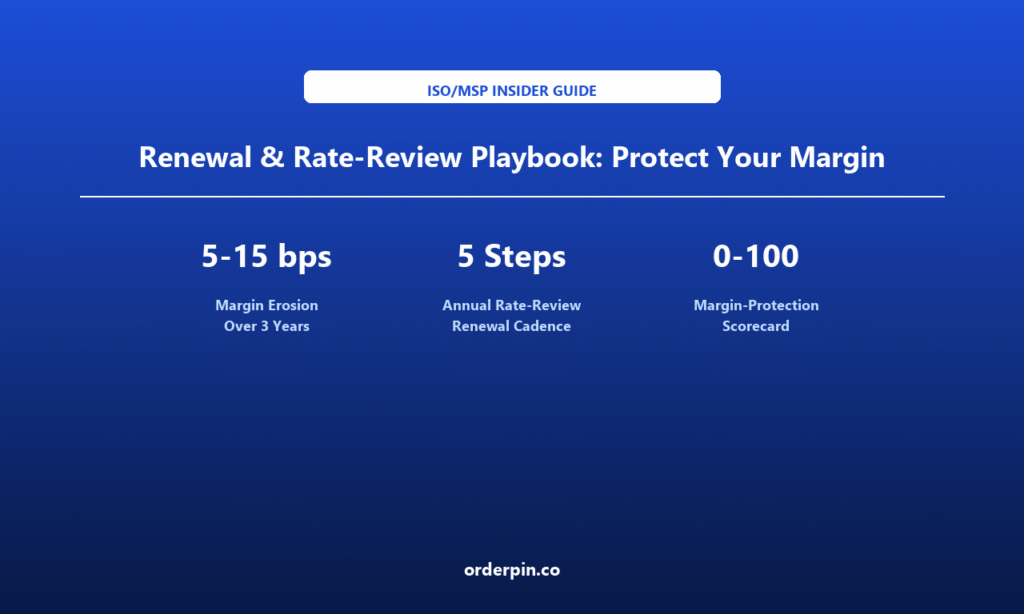
- The ISO’s margin is won or lost at renewal, not just at signing: most ISOs negotiate aggressively once (AD12), then never review the vendor relationship again — while the vendor’s rates creep, fees accumulate, and the ISO’s net margin erodes 5 to 15 bps over three years through “small” annual increases and new line-item fees. An ISO that does not run an annual rate-review cadence loses more margin to vendor creep than it gained in the original negotiation.
- The renewal playbook has five steps: benchmark your current rate against the market (is your wholesale rate still competitive, or has the vendor widened the spread?), detect triggered escalation clauses (many agreements include automatic annual increases of 2 to 5 percent that the ISO never noticed), identify renegotiation triggers (portfolio growth, competitive offers, or vendor service degradation), and deploy the leverage of data portability (AD7) — the ISO’s ability to migrate the portfolio to a competing vendor is the single strongest renewal leverage, if the contract preserves it.
- The margin-protection scorecard in this article gives the ISO a 0 to 100 score: it tracks rate competitiveness, fee creep, escalation-clause exposure, data portability strength, and renewal leverage. An ISO scoring below 60 should treat renewal as a renegotiation event, not a rubber stamp. The ISO that scores its position annually catches margin erosion before it compounds — and enters renewal with the data to win back what vendor creep took.
Over 3 Years Without Review
Renewal Cadence
Scorecard
The Margin You Won at Signing Is Not the Margin You Keep
The ISO’s instinct is to negotiate hard at signing (AD12) and then never look at the vendor agreement again. The vendor’s instinct is the opposite: the agreement includes annual escalation clauses, the vendor’s wholesale rates drift upward as the vendor’s own costs change, and new line-item fees appear in the monthly statement that were not in the original negotiation. Over three years, an ISO that never reviews the relationship loses 5 to 15 bps of net margin — more than the 8-lever negotiation (AD12) typically wins at signing. The renewal is where the ISO either protects or loses the margin it fought for.
The problem is structural: the ISO’s margin is a spread (merchant rate minus wholesale rate minus vendor fee), and the vendor controls two of the three variables (wholesale rate and vendor fee). The only variable the ISO fully controls is the merchant rate — and raising merchant rates to recover vendor creep is the worst possible response, because it increases merchant churn (see AD14 and AC14 churn cost). The ISO must instead manage the vendor relationship annually, using the renewal as a leverage point to reset the spread. This article gives the ISO the playbook.
spread competitiveness
2–5% annual
degradation
renewal leverage
Step 1 — Benchmark Your Rate Against the Market
Before entering renewal, the ISO must know whether its wholesale rate (the rate the vendor charges the ISO) is still competitive. The ISO should request current wholesale rate cards from 2 to 3 competing vendors (the ISO’s data portability from AD7 makes this credible — the ISO can actually move), and compare the competing wholesale rates against the current vendor’s rate. If the current vendor’s wholesale rate is 10 to 20 bps above market, the ISO has a benchmark to negotiate against. If it is at or below market, the ISO’s leverage is weaker — but fee structure (not just rate) is where most erosion hides.
The benchmark must include the full fee stack, not just the headline rate: per-transaction vendor fee, monthly platform fee, PCI compliance fee, chargeback fee, minimum monthly fee, and any new line items that appeared in the last 12 months. Vendors rarely raise the headline rate (it is visible and comparable); they add or increase line-item fees (which are buried in the statement). The ISO that benchmarks only the headline rate misses the real erosion.
Step 2 — Detect Triggered Escalation Clauses
Most white label agreements include automatic escalation clauses that the ISO never re-reads: an annual wholesale-rate increase of 2 to 5 percent, a “cost pass-through” clause that lets the vendor raise fees when its own costs change, or a “most-favored” recalculation that adjusts the ISO’s rate based on portfolio volume tiers. The ISO should extract every escalation clause from the original agreement (the contract the ISO negotiated in AD12) and calculate the cumulative effect over the agreement term. A 3 percent annual increase compounds to 9.3 percent over three years — a meaningful margin haircut that the ISO agreed to without noticing.
The ISO should negotiate the removal or cap of escalation clauses at signing (AD12 L2 — annual increase cap of 3 to 5 percent should be a floor, not a ceiling: the ISO should push for a 0 to 2 percent cap or a market-index link). At renewal, the ISO should challenge any escalation that exceeded the cap or triggered without notice, and use the violation as a renegotiation trigger.
Step 3 — Identify Renegotiation Triggers
Three triggers justify a renegotiation at renewal: (1) Portfolio growth — if the ISO’s volume grew 30 percent or more since signing, it has moved into a better volume tier and should demand the corresponding rate reduction (volume tiers exist to be claimed, not admired). (2) Competitive offers — a credible competing vendor offer (Step 1 benchmark) gives the ISO leverage to ask the current vendor to match or beat it. (3) Service degradation — if the vendor’s SLA attainment dropped, support response times increased, or platform uptime fell below the committed level (per AD18), the ISO has grounds to demand a rate concession in exchange for continuing the relationship.
The ISO should document all three triggers with data before entering renewal — volume growth from processing reports, competitive offers in writing, and SLA/uptime metrics from the AD18 support tracking. The ISO that walks into renewal with a data packet wins; the ISO that walks in with a feeling loses.
Step 4 — Deploy the Leverage of Data Portability
The single strongest renewal leverage is data portability — the ISO’s ability to migrate the portfolio to a competing vendor (AD7 due diligence, AD12 L4 data portability lever). If the contract preserves the ISO’s right to export merchant data, re-board merchants on a new platform, and exit without punitive fees (AD8 fine print), the ISO can credibly threaten to leave — and the vendor knows the threat is real. The ISO that signed away data portability (or accepted a punitive exit fee) has no renewal leverage; the vendor knows the ISO is locked.
The leverage is most effective when exercised as a credible option, not a bluff: the ISO should have a tested migration plan (AD3 migration playbook) and a competing offer in hand before raising the portability card. The ISO that threatens to leave without a plan looks weak; the ISO that can leave (and the vendor knows it) gets the rate it asks for. The ISO should never actually execute the migration threat unless the vendor forces it — the goal is a better rate, not a costly migration.
Step 5 — Renewal Checklist and Margin-Protection Scorecard
The ISO should run the renewal as a structured event, not a signature. The renewal checklist: (1) extract all escalation clauses from the current agreement and calculate cumulative effect; (2) benchmark wholesale rate and full fee stack against 2 to 3 competitors; (3) document portfolio growth, competitive offers, and service-degradation triggers; (4) confirm data portability and exit terms are intact (AD7, AD8); (5) prepare a target rate/fee structure with a walk-away floor; (6) schedule the renewal conversation 90 days before the agreement expires (not 30); (7) secure written confirmation of any concession before signing.
| Scorecard Dimension | Weight | Scoring Guide |
|---|---|---|
| Rate competitiveness | 25 | Wholesale rate within 5 bps of market = 25; 5–15 bps = 15; >15 bps = 5 |
| Fee creep control | 20 | No new fees in 12 mo = 20; 1–2 = 10; >2 = 0 |
| Escalation-clause exposure | 20 | Capped ≤2% = 20; 2–5% = 10; uncapped = 0 |
| Data portability strength | 20 | Full export + no exit fee = 20; partial = 10; locked = 0 |
| Renewal leverage | 15 | Growth + offers + plan = 15; one = 8; none = 0 |
Total score 0 to 100. Below 60 = treat renewal as a renegotiation event (the ISO is losing margin and has weak protection). 60 to 80 = negotiate specific concessions (rate, fees, or escalation cap). Above 80 = the relationship is healthy; renew with minor optimizations. The scorecard should be run 90 days before every renewal — not 30 days, when the ISO has no time to build leverage.
How OrderPin Protects Your Renewal Leverage
OrderPin is a white-label POS platform built for ISO and MSP partners — and data portability is a core design principle, not a negotiated exception. The ISO’s merchant data is exportable, the portfolio is re-boardable on OrderPin without punitive exit fees (consistent with AD7 and AD8), and the ISO’s renewal leverage is preserved because the ISO can credibly move if the relationship terms degrade. The ISO should confirm OrderPin’s data portability and exit terms during AD7 due diligence and AD12 negotiation — and run the margin-protection scorecard annually to catch vendor creep before it compounds. Use this five-step playbook to protect the margin you won at signing, every year, not just once.
Frequently Asked Questions
How often should I review my vendor relationship?
Annually, 90 days before the agreement expires — and quarterly for the metric tracking that feeds the review (rate benchmark, fee changes, SLA attainment, volume growth). The ISO that reviews only at renewal has no time to build leverage; the ISO that tracks quarterly enters renewal with the data already assembled. The annual review is the structured event; the quarterly tracking is what makes it credible.
What if the vendor refuses to renegotiate?
Then the ISO’s data portability (AD7, AD8) becomes the deciding factor. If the ISO can credibly migrate the portfolio to a competing vendor (Step 4), the vendor’s refusal is a bluff that the ISO calls by initiating a controlled migration evaluation. If the ISO cannot migrate (locked by weak portability or punitive exit fees), the vendor’s refusal is real — and the ISO should treat the next agreement term as the period to build portability before the following renewal. The ISO that signed weak portability at AD12 has limited options at AD20; the lesson is to negotiate portability hard at signing.
Should I raise merchant rates to recover vendor creep?
No — raising merchant rates to recover vendor creep is the worst response, because it increases merchant churn (AC14 churn cost) and destroys the portfolio value the ISO is trying to protect. The ISO should recover margin from the vendor (renegotiation), not the merchant. The only exception is if the merchant’s rate was set below market at signing and a modest, market-aligned increase is defensible — but this should be a deliberate portfolio repricing, not a reactive pass-through of vendor increases.
How does the scorecard relate to AD12 and AD15?
AD12 covers the signing-stage negotiation (the 8 levers the ISO uses to win margin at contract execution). This article (AD20) covers the renewal-stage negotiation (protecting that margin annually). AD15 covers the ISO’s TCO (the cost side); the scorecard protects the revenue side (margin per transaction) from vendor erosion. Together, AD12 + AD20 + AD15 give the ISO the full margin picture: win it at signing (AD12), protect it annually (AD20), and model its impact on the business (AD15). An ISO that masters all three treats the vendor relationship as a managed asset, not a signed-and-forgotten cost.
Can I negotiate mid-term, or only at renewal?
Mid-term negotiation is possible when a strong trigger appears — a major portfolio acquisition (volume tier jump), a credible competitive offer, or a service failure that breached SLA. The ISO should not wait for renewal if a trigger justifies earlier action; the vendor is more likely to concede mid-term when the ISO has just grown or has a live competitive offer than when the ISO is simply complaining about fees. The renewal window is the scheduled leverage point; triggers are the opportunistic ones.
What if I discover erosion after it has already compounded?
Recover it through the next renewal, and prevent recurrence with the scorecard. If the ISO discovers 10 bps of erosion that compounded over three years, it cannot retroactively undo it — but it can demand a rate reset at renewal that recovers the lost 10 bps plus protects against future creep (escalation cap, fee freeze). The ISO should also audit the last 12 months of statements to identify exactly where the erosion occurred (headline rate, line-item fees, or triggered escalation) so the renewal negotiation targets the specific leak, not a vague “your fees are too high.”
The ISO’s margin is won at signing but lost at renewal if never reviewed — vendor rate creep and new line-item fees erode 5 to 15 bps over three years, more than the original AD12 negotiation typically wins. The renewal playbook has five steps: benchmark your rate and full fee stack against the market, detect triggered escalation clauses (2 to 5 percent annual compounding), identify renegotiation triggers (portfolio growth, competitive offers, service degradation), deploy the leverage of data portability (the credible ability to migrate the portfolio), and run the renewal as a structured event with the margin-protection scorecard (0 to 100; below 60 = renegotiate). The ISO that scores its position 90 days before every renewal catches erosion before it compounds and enters the conversation with the data to win back what vendor creep took. OrderPin, a white-label POS platform built for ISO and MSP partners, preserves the ISO’s renewal leverage through data portability and exit terms that let the ISO credibly move if the relationship degrades — so the ISO protects the margin it fought for, every year.
About OrderPin
OrderPin is a white-label POS platform built for ISO and MSP partners. We offer full data ownership, flexible pricing, and seamless API integrations to help you build a recurring revenue business under your own brand. Learn more about OrderPin’s white-label solution