
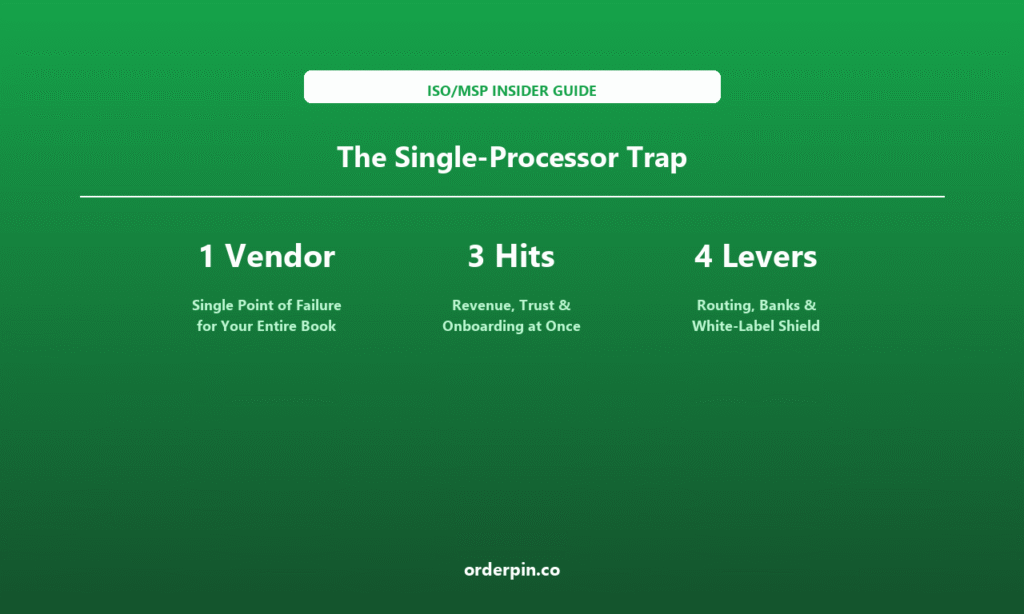
TL;DR — Quick Summary
- Single-processor dependency is the silent risk in most ISO books: When one acquiring relationship carries the entire portfolio, a single policy change, price hike, or operational disruption lands on every merchant at once — revenue, merchant trust, and new-merchant onboarding all take the hit together, and there is no second rail to fall back on.
- The exposure is three-dimensional: policy and rule changes the ISO cannot control, pricing reprices that compress margin overnight, and an operational single-point-of-failure where an outage, risk decision, or de-boarding freezes the whole book. Concentration turns every vendor event into an ISO event.
- Diversification is achievable without losing the relationship: Multi-processor routing, spreading across sponsor banks, and a white-label platform that sits above any one processor give the ISO independence — so the merchant relationship belongs to the ISO, not the vendor, and switching a rail no longer means losing the account.
for Your Entire Book
Onboarding at Once
White-Label Shield
What ISOs Need to Know About Portfolio Concentration Risk
Portfolio concentration risk is what happens when a single dependency carries an outsized share of your book. For most ISOs, that dependency is the acquiring relationship — the one processor, sponsor bank, and underwriting stack through which every merchant is boarded, funded, and supported. It is easy to overlook, because during growth periods a single smooth rail feels like efficiency: one integration, one underwriting path, one support line. The problem is not the efficiency. The problem is that the same setup that feels efficient in good times becomes a single point of failure the moment the vendor changes its mind.
Every ISO chooses a processor for good reasons — pricing, technology, brand, support. But when that one relationship is the only rail in the portfolio, the ISO has effectively rented its book from a vendor rather than owned it. A rule change the ISO did not write, a price increase it cannot refuse, or an operational event it did not cause all flow straight through to the ISO’s revenue and its merchants’ experience. This article explains why concentration is the hidden risk in most ISO books, what the three dimensions of exposure actually are, and how to diversify without surrendering the merchant relationship.
Carries the Whole Book
Without Your Consent
Overnight
Entire Onboarding
1. The Silent Risk in a Single Relationship
The book looks healthy right up until the moment it isn’t: An ISO running 90%+ of volume through one processor can post excellent growth numbers for years, because the single rail is fast, cheap, and easy to sell. The concentration does not show up in any standard report — there is no line item called “what happens if they change the rules.” The risk is silent precisely because everything is working.
When the vendor moves, the ISO absorbs the entire shock: If the processor tightens underwriting, reprices a category, or de-boards a vertical, the ISO cannot simply route that volume elsewhere — because there is no elsewhere. The merchant feels the change as the ISO’s fault, the ISO’s margin compresses, and new-merchant onboarding stalls while the ISO scrambles for a replacement rail. One vendor event becomes an ISO crisis.
2. Three Dimensions of Processor Exposure
Policy exposure — rules change without your consent: Processors adjust prohibited-business lists, reserve requirements, funding holds, and risk thresholds continuously. An ISO with one rail inherits every one of those changes instantly, with no ability to shop the rule elsewhere. The merchant-facing impact — a hold, a decline, a frozen category — reads as the ISO being difficult, even though the ISO had no say.
Price exposure — margin compresses overnight: A repricing of basis points, a new per-transaction fee, or a changed interchange pass-through lands on the whole book at once. There is no blended average to soften it, because the entire portfolio sits on the same schedule. The ISO either eats the margin or passes it to merchants it cannot afford to lose — both outcomes are worse than they would be with a diversified base.
3. Why Concentration Looks Like Efficiency
The sales motion rewards a single rail: It is far easier to train reps, build collateral, and close deals when there is exactly one path to “approved.” A single processor becomes the default because it is the path of least resistance, not because it is the lowest-risk structure. The efficiency is real in quarter one and expensive in year three.
Nobody measures the counterfactual: ISOs track volume, margin, and attrition — but rarely “what would have happened if that rail had changed.” Because the downside is invisible on the dashboard, the safer structure (a second rail, a sponsor-bank spread, a platform layer) looks like unnecessary cost rather than insurance. The absence of a measured risk is mistaken for the absence of a risk.
4. Diversification Strategies That Keep the Relationship
Multi-processor routing and a sponsor-bank spread reduce single-point risk: Boarding through two or more acquiring paths — and, where possible, across different sponsor banks — means a rule change or outage on one rail can be absorbed by routing volume to another. The merchants do not experience the disruption, and the ISO retains the account. The goal is not to abandon the primary processor; it is to ensure no single processor can hold the entire book hostage.
Segment by risk, not just by volume: The merchants most exposed to a processor’s policy whims — higher-risk categories, thinner underwriting tolerance, volatile funding — are the ones that most need a second rail. Diversification does not have to be portfolio-wide on day one; it starts with the segment where a single-vendor event would be most damaging, then expands as the second integration matures.
5. The White-Label Independence Layer
A white-label platform sits above any one processor — so the relationship is yours: When the merchant is boarded onto the ISO’s own branded platform rather than directly onto a processor’s stack, the ISO owns the login, the data, and the day-to-day relationship. Switching the underlying rail becomes an ISO decision, not a merchant-migrating event. The processor is a utility you route through, not the landlord you rent from.
Independence is the real moat: The ISO that can move processing, preserve the merchant relationship, and keep its own data is structurally safer than the ISO that has optimized itself into dependency. Diversification is the tactic; ownership of the relationship is the strategy. A white-label layer is what turns “we have a second processor” into “we own the book regardless of which processor is underneath it.”
Single-Processor Book vs. Diversified Book
| Dimension | Single-Processor Book | Diversified Book |
|---|---|---|
| Relationship Ownership | Rented from the vendor | Owned by the ISO |
| Margin Stability | Compressed overnight on reprice | Blended, shock absorbed |
| Operational Resilience | Outage freezes whole book | Volume routes to live rail |
| Onboarding Continuity | Stalls during vendor event | Continues on second rail |
| Exit / Switch Leverage | None — switch = lose account | Real — rail swappable |
| Valuation Multiple | Discounted (key-person risk) | Premium (portable book) |
How OrderPin Helps ISOs Escape the Single-Processor Trap
OrderPin is a white-label POS platform built for ISO and MSP partners. It gives the ISO the foundation to own the merchant relationship above any single processor — so the book is portable, the data is the ISO’s, and a vendor rule change or repricing no longer threatens the entire portfolio. Through its white-label POS program and seamless API integrations, an ISO can run multiple processing rails under one branded platform and keep the relationship regardless of which rail is underneath.
- Own the relationship, not the rail: A white-label platform under your brand is the independence layer — the merchant logs into your system, and switching the underlying processor becomes your decision, not a merchant-migration event.
- Run multiple rails under one brand: OrderPin’s integration flexibility lets you board and route through more than one processing path, so a policy change or outage on one rail can be absorbed without the merchant feeling it.
- Keep the data that proves portfolio health: Because the transaction data lives with the ISO, you can measure concentration risk directly and spot the segments most exposed to a single-vendor event before it happens.
- Build a portable, premium-valued book: A book the ISO owns and can move commands a higher valuation multiple than one held hostage to a single processor — diversification turns from insurance cost into enterprise value.
Frequently Asked Questions
What is processor concentration risk for an ISO?
It is the risk that arises when a single acquiring relationship — one processor, sponsor bank, and underwriting stack — carries an outsized or total share of an ISO’s portfolio. Because every merchant is boarded, funded, and supported through that one rail, any vendor event (a rule change, a repricing, an outage, a de-boarding) flows straight to the ISO’s revenue and its merchants’ experience. There is no second rail to absorb the shock.
How does a single processor change hurt an ISO’s revenue?
A processor repricing basis points, adding a per-transaction fee, or changing interchange pass-through lands on the entire book at once — there is no blended average to soften it. The ISO either absorbs the margin compression or passes it to merchants it cannot afford to lose. Both outcomes are worse than they would be with a diversified base, where the shock is spread across rails and segments.
Can an ISO diversify without losing the merchant relationship?
Yes — and that is the entire point. Diversification is about adding processing rails and structural independence, not about abandoning the primary processor or handing the relationship to a competitor. A white-label platform that sits above any one processor lets the ISO keep the merchant login, data, and day-to-day relationship while routing volume through whichever rail is healthiest at the moment.
What is multi-processor routing and how does it work?
It is the practice of boarding and transacting through two or more acquiring paths — ideally across different sponsor banks — so that volume can be directed to whichever rail is operational, compliant, and fairly priced. When one processor tightens underwriting or suffers an outage, the ISO routes affected merchants to the other rail. The merchant experiences continuity; the ISO retains the account.
How does a white-label platform reduce processor dependency?
Because the merchant is boarded onto the ISO’s own branded platform rather than directly onto a processor’s stack, the ISO owns the login, the data, and the relationship. The processor becomes a utility the ISO routes through, not the landlord it rents from. Switching the underlying rail becomes an ISO decision rather than a merchant-migration event — which is the structural definition of independence.
Does diversification hurt onboarding speed or pricing?
Not if it is segmented intelligently. Diversification does not have to be portfolio-wide on day one — it starts with the merchants and categories most exposed to a single-vendor event (higher-risk verticals, thinner underwriting tolerance) and expands as the second integration matures. The primary rail stays the default fast path; the second rail is the insurance that protects the book’s value, not a drag on every new sale.
Single-processor dependency is the silent risk in most ISO books — invisible during growth, devastating the moment the vendor moves. When one acquiring relationship carries the entire portfolio, a rule change, repricing, or operational disruption lands on every merchant at once, and there is no second rail to fall back on. The exposure is three-dimensional: policy, price, and operational single-point-of-failure, and concentration turns every vendor event into an ISO event. The fix is not to abandon the primary processor but to stop renting the book from it — multi-processor routing, a sponsor-bank spread, and a white-label platform that sits above any one processor give the ISO independence while keeping the relationship. The ISO that owns the relationship, the data, and the ability to swap rails is structurally safer and commands a higher valuation than the ISO that has optimized itself into dependency. OrderPin is a white-label POS platform built for ISO and MSP partners — giving you the foundation to own the merchant relationship above any single processor, run multiple rails under one brand, and build a portable book whose value no vendor event can erase.
About OrderPin
OrderPin is a white-label POS platform built for ISO and MSP partners. We offer full data ownership, flexible pricing, and seamless API integrations to help you build a recurring revenue business under your own brand. Learn more about OrderPin’s white-label solution