
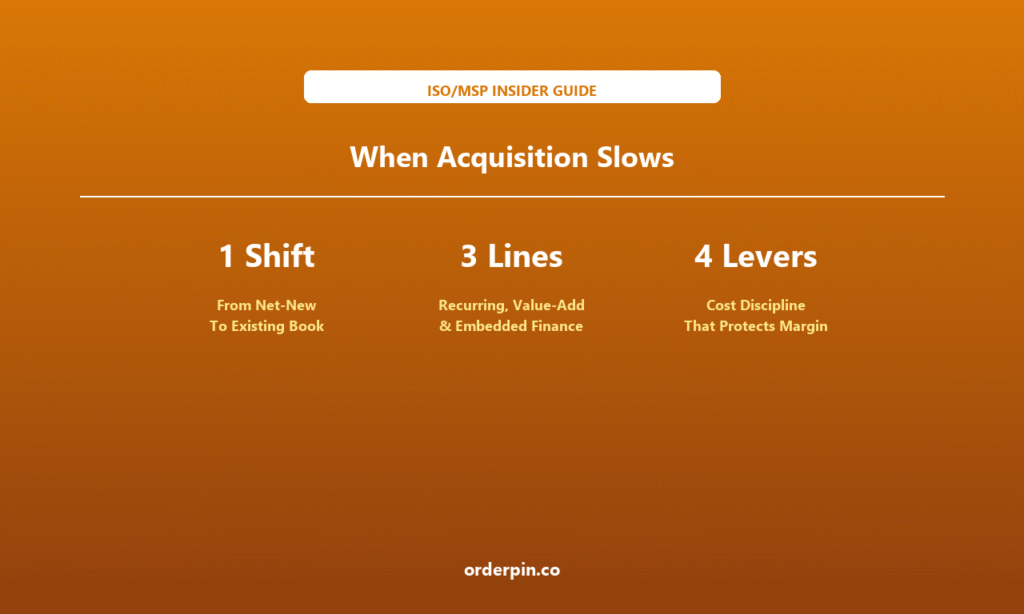
TL;DR — Quick Summary
- ISOs are built for acquisition, not for a slowdown: The entire operating model — comp plans, pipeline habits, and growth narratives — assumes net-new logos keep arriving. The moment acquisition stalls, most ISOs have no second engine, and the cost base built for growth becomes the thing that sinks them.
- A cooling market is a test of book quality, not just volume: When new merchants are scarce, the winners monetize the book they already have, diversify into recurring and value-add revenue, and impose cost discipline. The losers keep paying acquisition prices for shrinking returns.
- Three moves protect margin when volume flattens: Reallocate spend from net-new to existing-book monetization, build revenue lines that do not depend on transaction growth (recurring fees, value-add services, embedded finance), and pull the cost levers that protect contribution margin without gutting the relationship.
To Existing Book
& Embedded Finance
That Protects Margin
What ISOs Need to Know About an Acquisition Slowdown
An acquisition slowdown is what happens when the steady inflow of new merchant logos — the lifeblood of every ISO’s growth story — flattens, reverses, or gets dramatically more expensive to win. It can be triggered by a payments recession, a saturated local market, tightening underwriting, or simply the exhaustion of easy prospects. Whatever the cause, the ISO that spent years optimizing only for net-new growth suddenly finds its primary engine sputtering while its fixed cost base keeps running.
The danger is not the slowdown itself — it is the lack of a plan for it. ISOs built around acquisition have no operating muscle for monetizing the book they already hold, no diversified revenue lines to lean on, and no cost discipline honed for a flat-volume world. This article covers downturn readiness: how to reallocate from net-new to existing-book monetization, how to build revenue lines that survive flattening volume, and which cost levers actually protect margin without damaging the merchant relationship.
Flattens or Reverses
Decides Survivors
Becomes the Engine
Value-Add Revenue
1. ISOs Are Built for Acquisition, Not for a Slowdown
The operating model assumes the logo keeps arriving: Comp plans reward net-new wins, pipeline habits optimize for the next close, and the growth narrative depends on expanding the book. None of that muscle helps when the next close gets scarce — the organization has spent years perfecting exactly the thing it can no longer rely on.
The cost base becomes the threat: A structure sized for growth — headcount, marketing spend, support capacity — keeps burning when volume flattens. Without a second engine, the ISO is paying growth-era costs against a flat-revenue present, and contribution margin erodes from the top down. The slowdown exposes the inefficiency that growth had been hiding.
2. A Cooling Market Is a Test of Book Quality
Volume hid the weaknesses that a slowdown reveals: In good times, a churny book, undifferentiated merchants, and thin-margin accounts are masked by the next inbound logo. When acquisition slows, those same weaknesses surface as net attrition, support drag, and revenue that does not compound. Book quality — not book size — is what carries an ISO through the lean quarters.
The winners already own the relationship: ISOs that built durable, embedded, data-rich relationships with their merchants can monetize that position when new logos dry up. ISOs that treated merchants as transactional processing volume have nothing to fall back on. A slowdown separates the book you own from the book you merely processed.
3. Reallocate From Net-New to Existing-Book Monetization
The cheapest revenue is the revenue already on the books: Instead of spending ever more to acquire a scarcer merchant, redirect that energy to expanding share of wallet with existing merchants — cross-sell the platform depth, the value-add services, and the financing products they are not yet using. The acquisition cost is zero; the relationship is already won.
Operationalize the monetization motion: A slowdown is the moment to stand up the account-management cadence most ISOs never built — merchant business reviews, usage audits, and proactive expansion offers. The book you already hold has years of unmonetized potential; a cooling market is what finally justifies going after it.
4. Build Revenue Lines That Survive Flat Volume
Recurring, value-add, and embedded finance do not need volume to grow: Monthly platform fees, premium support tiers, analytics, loyalty, and embedded lending generate revenue from the existing base regardless of how many new logos arrive. These lines are the hedge: when transaction volume flattens, the recurring and value-add layer keeps revenue compounding.
Diversification is the antidote to volume dependency: An ISO whose entire revenue moves with transaction count is hostage to the macro. An ISO with three or four independent revenue lines — processing, recurring SaaS, value-add, embedded finance — can lose one and still grow. The slowdown is what makes that independence worth building years earlier.
5. Cost Levers That Protect Margin Without Breaking Trust
Cut the cost of acquisition, not the quality of service: When volume flattens, the first lever is to stop overpaying for scarce logos — tighten comp economics, pause saturated campaigns, and redirect that spend to existing-book monetization. Margin improves without the merchant ever feeling a thing.
Automate the back office and protect the front line: Workflow automation, self-service merchant onboarding, and consolidated reporting reduce per-merchant operating cost without degrading the relationship. The discipline that protects contribution margin in a downturn is the efficiency that compounds profit in the recovery.
Growth-Engine ISO vs. Book-Quality ISO in a Slowdown
| Dimension | Growth-Engine ISO | Book-Quality ISO |
|---|---|---|
| Primary Engine | Net-new acquisition | Existing-book monetization |
| Revenue Mix | 100% transaction volume | Diversified (recurring + value-add) |
| Cost Base | Sized for growth, burns flat | Resized, automated |
| Margin in Downturn | Compresses fast | Protected by second lines |
| Recovery Speed | Slow — must re-acquire | Fast — compounds on book |
How OrderPin Helps ISOs Monetize the Book When Acquisition Slows
OrderPin is a white-label POS platform built for ISO and MSP partners. It gives the ISO the foundation to monetize the existing book — not just process it — by layering recurring platform fees, value-add services, and embedded finance on top of a relationship the ISO already owns. Through its white-label POS program and seamless API integrations, an ISO can turn a flat-volume slowdown into an existing-book revenue expansion without buying a single new logo.
- Built-in recurring revenue: White-label platform fees and subscription tiers mean revenue keeps compounding from the existing book even when transaction volume flattens — the hedge against acquisition dependency.
- Own the data to expand share of wallet: Because the transaction and operational data lives with the ISO, you can spot unmonetized merchants and run proactive expansion offers the way an account-management team would.
- Add value-add and embedded finance: OrderPin’s integration flexibility lets you layer loyalty, analytics, and financing products onto the existing base — revenue lines that do not require new-merchant acquisition to grow.
- Automate to protect margin: Self-service onboarding and consolidated reporting reduce per-merchant operating cost, so the cost discipline a downturn demands never touches the merchant relationship.
Frequently Asked Questions
What causes an ISO’s merchant acquisition to slow down?
It can be a payments recession that freezes merchant spending, a saturated local market where easy prospects are exhausted, tightening underwriting that shrinks the addressable pool, or simply a cycle where new-logo demand softens. Whatever the trigger, the ISO that optimized only for net-new growth suddenly finds its primary engine sputtering while fixed costs keep running.
Why is book quality more important than book size in a downturn?
Volume masks weaknesses that a slowdown reveals: churny accounts, undifferentiated merchants, and thin-margin logos all look fine while the next inbound logo keeps arriving. When acquisition stalls, those weaknesses surface as net attrition and support drag. An ISO that owns durable, embedded, data-rich merchant relationships can monetize that position; an ISO that treated merchants as transactional volume has nothing to fall back on.
How should an ISO shift from acquisition to existing-book monetization?
Redirect the energy and budget spent chasing scarce new logos toward expanding share of wallet with merchants you already have — cross-sell platform depth, value-add services, and financing products they are not yet using. Stand up the account-management cadence most ISOs never built: merchant business reviews, usage audits, and proactive expansion offers. The acquisition cost is zero because the relationship is already won.
What revenue lines survive when transaction volume flattens?
Recurring platform fees, premium support tiers, analytics, loyalty, and embedded lending all generate revenue from the existing base regardless of how many new logos arrive. These lines are the hedge: when transaction volume flattens, the recurring and value-add layer keeps revenue compounding while the pure-processing line stalls.
Which cost levers protect margin without hurting merchants?
Start by cutting the cost of acquisition — tighten comp economics, pause saturated campaigns, and redirect that spend to existing-book monetization — so margin improves without the merchant feeling it. Then automate the back office: self-service onboarding, workflow automation, and consolidated reporting reduce per-merchant operating cost without degrading the relationship. Protect the front line; trim the waste.
Is a white-label platform useful when merchant acquisition slows?
It is exactly when acquisition slows that a white-label platform pays for itself. Because the ISO owns the merchant relationship, the data, and the branded surface, it can layer recurring fees, value-add services, and embedded finance on the existing book — turning a flat-volume period into an existing-book revenue expansion rather than a revenue cliff. OrderPin is built precisely for that second-engine strategy.
ISOs are built for acquisition, not for a slowdown — the entire operating model assumes net-new logos keep arriving, and when they stop, the growth-era cost base becomes the threat. A cooling market is a test of book quality, not just volume: it exposes the churn, thin margins, and transactional relationships that growth had been hiding, and it rewards the ISO that owns durable, embedded, data-rich merchant relationships. The response is not to spend more chasing scarce logos but to reallocate to existing-book monetization, build revenue lines — recurring, value-add, embedded finance — that do not depend on transaction growth, and pull the cost levers that protect contribution margin without touching the relationship. The ISO with three or four independent revenue lines can lose one and still grow; the ISO whose revenue moves entirely with volume is hostage to the macro. The slowdown is what makes that independence worth building years earlier. OrderPin is a white-label POS platform built for ISO and MSP partners — giving you the foundation to monetize the existing book with recurring fees, value-add services, and embedded finance, so a flat-volume period becomes an existing-book revenue expansion instead of a revenue cliff.
About OrderPin
OrderPin is a white-label POS platform built for ISO and MSP partners. We offer full data ownership, flexible pricing, and seamless API integrations to help you build a recurring revenue business under your own brand. Learn more about OrderPin’s white-label solution