
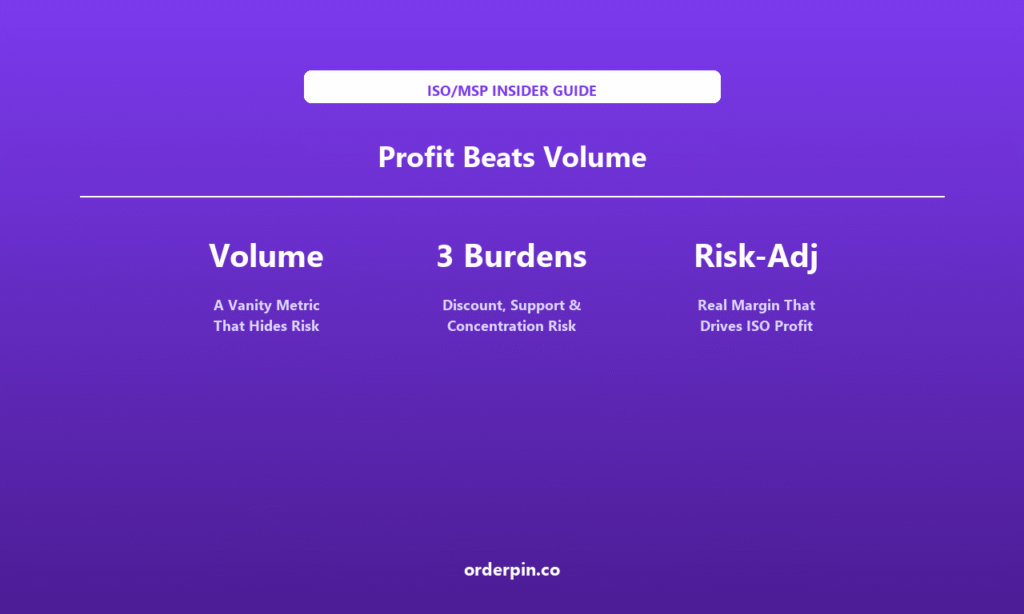
TL;DR — Quick Summary
- The biggest merchants are rarely the most profitable: They extract the deepest interchange discounts, demand the heaviest support, and concentrate revenue risk in a single relationship — the headline volume number hides a margin that thins with every account size tier you move up.
- Profitability must be measured risk-adjusted: The discount given, the support cost per merchant, and the customer-concentration exposure all erode the raw processing dollar, and the largest accounts often score worst on all three. Raw volume is a vanity metric; risk-adjusted margin is the truth.
- The merchants that actually drive ISO profit are frequently mid-market and well-segmented: They pay closer to standard pricing, need lighter support, and build stronger lifetime value per support dollar. Book quality — not total volume — is the metric that compounds enterprise value.
That Hides Risk
Concentration Risk
Drives ISO Profit
What ISOs Need to Know About Risk-Adjusted Merchant Profitability
Risk-adjusted merchant profitability is the simple idea that not all processing dollars are equal. A merchant doing $2M a year at standard pricing with light support is often far more valuable to an ISO than a merchant doing $20M a year at a deeply negotiated rate with a dedicated support pod and a contract that concentrates enormous revenue risk in one relationship. The volume headline tells you the top line; it tells you nothing about what is left after the discount, the support cost, and the concentration risk are subtracted.
Most ISOs manage their book by volume because volume is easy to measure and easy to celebrate. But volume is a vanity metric when the largest accounts are the ones eroding margin and concentrating risk. This article reframes portfolio profitability around risk-adjusted revenue, support burden per merchant, customer-concentration limits, and the practical question every ISO should be able to answer: which merchants actually drive profit, and which are just making the dashboard look busy.
Get the Deepest Cuts
Per Revenue Dollar
Outsized Risk
on Lifetime Value
1. Volume Is a Vanity Metric
The leaderboard rewards the wrong thing: ISOs track total processing volume because it is the easiest number to put on a slide. But a book that grew by signing three giant accounts looks identical on the volume chart to a book that grew by signing three hundred healthy mid-market merchants — and the two books are nothing alike in margin, risk, and durability.
Big accounts negotiate their way to thin margin: The larger the merchant, the more leverage it has to extract custom pricing, waived fees, and bespoke terms. By the time a $20M account is signed, the “processing margin” may be a fraction of the standard rate — and the ISO has committed support and risk resources that the discount never accounted for. Volume went up; profit per dollar went down.
2. The Three Burdens That Erode Big-Merchant Margin
Discount burden — the rate you gave away: Every basis point negotiated down is a permanent reduction in the profit of that account. Big merchants get the deepest cuts precisely because they have the leverage to demand them, and those cuts do not come back when the relationship matures.
Support burden — the cost you absorbed: Large accounts expect dedicated support, faster response, and custom handling. The cost of servicing one giant merchant can equal the cost of servicing dozens of mid-market merchants, and that cost rarely shows up against the account’s volume line. The heaviest support burden sits on the smallest margin.
3. Customer Concentration: When One Merchant Is Too Much
Concentration turns one merchant’s problem into the ISO’s problem: When a handful of large accounts represent a disproportionate share of revenue, the loss of any one of them is an existential event, not a line-item adjustment. The ISO’s valuation, its cash flow, and its ability to fund operations all ride on relationships it does not fully control.
Acquirers and buyers price concentration as risk: A portfolio concentrated in a few large accounts is discounted at valuation time, because the buyer sees key-person and key-account risk that a broad book does not have. The ISO that celebrated landing the whale may find the whale discounted its exit multiple.
4. Risk-Adjusted Revenue: The Metric That Matters
Subtract the discount, the support cost, and the risk premium: Risk-adjusted revenue starts with processing volume, then deducts the rate given away, the cost to service the account, and a risk premium for concentration and churn exposure. What remains is the profit the merchant actually contributes — and it frequently reorders the book, putting mid-market accounts above the giants.
Lifetime value per support dollar is the true scoreboard: A mid-market merchant paying near-standard rates, needing light support, and staying for years delivers more lifetime value per dollar of servicing cost than a discounted whale that consumes a support pod. The metric that compounds enterprise value is not the biggest account — it is the highest return on the ISO’s attention.
5. How to Spot the Merchants That Actually Pay
Score the book on contribution, not volume: Rank merchants by risk-adjusted profit contribution, support cost per dollar, and concentration weight — not by raw processing size. The accounts that rise to the top are the ones worth protecting, expanding, and referencing; the ones that sink are the ones worth re-pricing or right-sizing.
Build acquisition around the profile that pays: Once the ISO knows which merchants actually drive profit, it can aim its sales motion at that profile — mid-market, well-segmented, standard-priced, light-support accounts — rather than chasing the largest logo at any cost. The book becomes intentional, and its quality (not just its size) compounds.
Largest Accounts vs. Mid-Market Segment
| Dimension | Largest Accounts | Mid-Market Segment |
|---|---|---|
| Pricing Discount | Deepest cuts | Near-standard rate |
| Support Cost per $ | Highest (dedicated pod) | Lowest (shared tier) |
| Churn Risk | High (shoppable, leverage) | Lower (sticky, embedded) |
| Concentration Exposure | Outsized (few accounts) | Distributed (broad base) |
| LTV per Support $ | Low | High |
| Profit Contribution | Looks big, thins fast | Compounds quietly |
How OrderPin Helps ISOs Find the Merchants That Actually Pay
OrderPin is a white-label POS platform built for ISO and MSP partners. It gives the ISO the transaction data and operational visibility to score merchants on contribution — not volume — so the book can be managed and grown around the accounts that genuinely drive profit. Through its white-label POS program and seamless API integrations, an ISO can see discount given, support load, and concentration exposure per merchant, and steer acquisition toward the mid-market profile that compounds enterprise value.
- Measure contribution, not volume: The platform’s data lets you rank merchants by risk-adjusted profit, support cost per dollar, and concentration weight — surfacing the mid-market accounts that quietly outperform the discounted whales.
- Spot concentration before it becomes a threat: With the ISO owning the data, customer-concentration exposure is visible on the dashboard, not discovered at valuation time, so the book can be rebalanced proactively.
- Steer acquisition toward profit: Knowing which merchants actually pay lets you aim the sales motion at the mid-market, standard-priced, light-support profile — building a book whose quality compounds.
- Protect and expand the right accounts: The merchants that rise to the top of the contribution ranking are the ones worth proactive retention, cross-sell, and referral programs — turning book quality into durable enterprise value.
Frequently Asked Questions
Why aren’t the largest merchants the most profitable?
Because they have the leverage to extract the deepest discounts, demand the heaviest support, and concentrate revenue risk in a single relationship. By the time a very large account is signed, the processing margin may be a fraction of the standard rate, and the ISO has committed resources the discount never accounted for. Volume rises while profit per dollar falls.
What is risk-adjusted merchant revenue?
It is processing volume minus the rate given away, the cost to service the account, and a risk premium for concentration and churn exposure. What remains is the profit the merchant actually contributes. Ranking the book by this number frequently reorders it, putting mid-market accounts above the giants once discount, support, and risk are subtracted.
How does customer concentration hurt an ISO?
When a few large accounts represent a disproportionate share of revenue, the loss of any one of them is an existential event rather than a line-item adjustment — affecting cash flow, funding capacity, and valuation. Buyers and acquirers price concentrated portfolios with a risk discount, because key-account dependency is exactly the fragility a broad book does not have.
How much support burden is too much for one merchant?
The threshold is not a fixed number but a ratio: when the cost to service one account approaches or exceeds the margin it contributes after discount, the account is destroying value. A dedicated support pod for a deeply discounted whale is the classic example — the heaviest support burden sitting on the smallest margin. The metric to watch is support cost per revenue dollar, not absolute volume.
How should an ISO segment its book for profitability?
Rank merchants by risk-adjusted profit contribution, support cost per dollar, and concentration weight — not by raw processing size. The accounts that rise to the top are worth protecting, expanding, and referencing; the ones that sink are worth re-pricing or right-sizing. Segmentation by contribution turns the book from a volume leaderboard into a profit map.
How does a white-label platform help identify profit-driving merchants?
Because the transaction data lives with the ISO rather than the processor, the platform makes discount given, support load, and concentration exposure visible per merchant. That visibility lets the ISO score the book on contribution and steer acquisition toward the mid-market, standard-priced, light-support profile that delivers the highest lifetime value per dollar of servicing cost — building a book whose quality compounds.
The biggest merchants are rarely the most profitable, because they extract the deepest discounts, demand the heaviest support, and concentrate revenue risk in a single relationship — the volume headline hides a margin that thins with every account-size tier you move up. Profitability has to be measured risk-adjusted: subtract the discount given, the support cost per merchant, and the concentration and churn exposure, and the book frequently reorders itself, with mid-market accounts outperforming the discounted whales. The metric that compounds enterprise value is not the largest logo but the highest return on the ISO’s attention — lifetime value per support dollar. ISOs that score their book on contribution rather than volume can re-price or right-size the accounts that destroy value, protect and expand the ones that pay, and aim acquisition at the profile that compounds. OrderPin is a white-label POS platform built for ISO and MSP partners — giving you the data to measure merchant contribution directly, surface concentration risk before valuation time, and build a book whose quality, not just its size, drives durable profit.
About OrderPin
OrderPin is a white-label POS platform built for ISO and MSP partners. We offer full data ownership, flexible pricing, and seamless API integrations to help you build a recurring revenue business under your own brand. Learn more about OrderPin’s white-label solution