
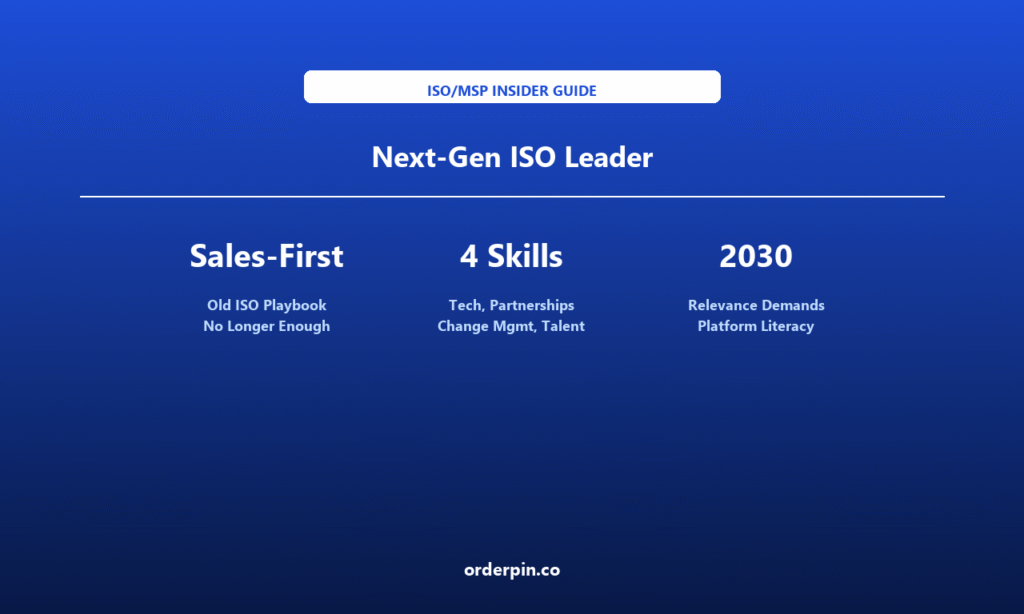
TL;DR — Quick Summary
- The old ISO playbook is no longer sufficient: Sales hustle and processor relationships built the last generation of ISOs, but the business is shifting from relationship-driven to platform-and-data-driven — and the skill set that got a leader here will not keep them relevant through 2030.
- Four skills define the next-generation ISO leader: Technology literacy (evaluating platforms, APIs, and AI tools), strategic partnership judgment, change management, and talent development. These are the capabilities that turn disruption from a threat into an advantage.
- The shift is personal before it is organizational: Leaders who build these skills now can re-architect their ISO around platforms and data; leaders who wait will be out-executed by ISOs run by operators who already speak the new language of payments.
No Longer Enough
Change Mgmt, Talent
Platform Literacy
What ISO Leaders Need to Know About the Skill Shift
The next generation of ISO leadership is being defined by a structural change in the business itself. For decades, running a successful ISO meant being a great salesperson and a trusted conduit to a processor — relationships, hustle, and rate negotiation were the core competencies. That world still exists, but it is shrinking as the business shifts from relationship-driven to platform-and-data-driven. The merchant no longer buys “a processor through a rep”; they buy a software experience, a data layer, and an embedded financial relationship.
That shift changes what an ISO leader must be good at. Technology literacy, strategic partnership judgment, change management, and talent development are replacing — not eliminating — the sales instinct as the deciding skills. This article maps the skill evolution every ISO leader should build now to stay relevant through 2030, and why the leaders who start early will compound their advantage over those who wait.
APIs & AI Tools
on Who to Align With
Through Transformation
the Right Team
1. The Old Playbook: Sales Hustle and Processor Relationships
What built the last generation is real but insufficient: The ISO leaders who won for twenty years were exceptional at selling, recruiting agents, and negotiating with processors. Those skills still matter — but they are now table stakes, not differentiators. The merchant’s decision is increasingly made on software and data, not on who has the best rate.
The business moved underneath the skill set: When the product was “processing plus a rep,” relationship skills were the whole game. Now the product is a branded platform, an integration layer, and an analytics surface — and the leader who cannot evaluate those things is delegating the most important decisions to someone else, or to a vendor.
2. Skill One: Technology Literacy
You do not need to be an engineer — you need to be a smart buyer and integrator: Technology literacy for an ISO leader means being able to evaluate a platform’s architecture, judge whether an API is genuinely open, and recognize which AI tools create leverage versus which are demos. It is the difference between choosing a platform and being chosen by one.
AI is the new literacy frontier: The leaders who can separate real AI capability from marketing — and who know how to deploy it across underwriting, support, and merchant insights — will run circles around those still treating AI as a buzzword. Literacy is what lets you ask vendors the questions that reveal whether they can actually deliver.
3. Skill Two: Strategic Partnership Judgment
The platform you pick defines the business you can run: Strategic partnership judgment is the ability to choose — and structure — relationships with platform providers, processors, fintechs, and ISVs in ways that keep the ISO in control of the merchant relationship. A bad partnership clause can turn your book into someone else’s asset.
Judgment beats access: Knowing which partnerships create optionality and which create dependency is the skill. The next-generation leader treats every partnership as a strategic decision about where the ISO’s value will live in 2030 — not just a cheaper rail today.
4. Skill Three: Change Management
The hardest part is not the tech — it is the transition: Re-architecting an ISO from relationship-driven to platform-and-data-driven means changing how reps sell, how support works, and how the organization measures success. Change management is the skill that decides whether a great strategy dies in the rollout.
Lead the narrative, do not announce it: The ISOs that transform successfully are led by people who can explain why the shift matters, bring the team along, and absorb the friction of change without losing momentum. That is a learnable leadership muscle, and it compounds with every transition the industry throws at you.
5. Skill Four: Talent Development
The new ISO needs a different kind of team: Platform specialists, data analysts, and integration engineers are now as important as account executives. Talent development is the skill of hiring, retaining, and growing people whose strengths complement the leader’s — and of building a culture where technical and commercial talent actually work together.
Develop leaders, not just reps: The next-generation ISO leader builds other leaders who can run platform-and-data-driven units independently. The organization that can promote from within its new skill base will out-execute the one perpetually chasing scarce external talent.
Last-Generation ISO Leader vs. Next-Generation ISO Leader
| Dimension | Last Generation | Next Generation |
|---|---|---|
| Core Competency | Sales hustle, rate negotiation | Tech literacy, platform judgment |
| Value Source | Processor relationship | Owned platform & data |
| Partnership View | Access to a rail | Optionality & control |
| Team Shape | Reps & agents | Reps + platform & data talent |
| 2030 Relevance | Commoditized | Differentiated |
How OrderPin Helps the Next-Generation ISO Leader
OrderPin is a white-label POS platform built for ISO and MSP partners. It is the asset that lets a relationship-driven ISO become a platform-and-data-driven one — without building technology from scratch. Through its white-label POS program, open API integrations, and full data ownership, an ISO leader can make the strategic partnership and technology decisions that define relevance through 2030.
- Technology literacy made operational: A real white-label platform with genuine API integration lets the leader evaluate, choose, and deploy technology instead of delegating the most important decisions to a vendor.
- Strategic partnership on your terms: Because the merchant relationship, the data, and the brand stay with the ISO, the OrderPin partnership creates optionality and control rather than dependency — the judgment call that protects your book in 2030.
- A foundation the team can build on: The platform gives technical and commercial talent a shared surface to work on, so talent development and change management have something concrete to rally around.
- Relevance through 2030: Owning a branded platform and the data layer is exactly the position the next-generation ISO leader needs — the shift from relationship-driven to platform-and-data-driven, made real.
Frequently Asked Questions
Why is the old ISO leadership playbook no longer enough?
Sales hustle and processor relationships built the last generation of ISOs, but the business has shifted from relationship-driven to platform-and-data-driven. The merchant now buys a software experience, a data layer, and an embedded financial relationship — not just “a processor through a rep.” Those legacy skills are table stakes now, not differentiators, and the leader who cannot evaluate platforms and data is delegating the most important decisions away.
What does technology literacy mean for an ISO leader?
It does not mean writing code — it means being a smart buyer and integrator: evaluating a platform’s architecture, judging whether an API is genuinely open, and recognizing which AI tools create leverage versus which are demos. Literacy is what lets you choose a platform instead of being chosen by one, and ask vendors the questions that reveal whether they can actually deliver.
Why is strategic partnership judgment a core skill now?
The platform and partnership you choose defines the business you can run. A bad clause can turn your book into someone else’s asset; a good one creates optionality and control. Next-generation leaders treat every partnership as a strategic decision about where the ISO’s value will live in 2030 — not just a cheaper rail today.
How does an ISO leader build change-management capability?
Re-architecting an ISO means changing how reps sell, how support works, and how the organization measures success — and the rollout, not the strategy, is where most transformations die. The skill is leading the narrative: explaining why the shift matters, bringing the team along, and absorbing the friction of change without losing momentum. It is a learnable muscle that compounds with every industry transition.
What kind of talent does the next-generation ISO need?
Platform specialists, data analysts, and integration engineers are now as important as account executives. Talent development means hiring, retaining, and growing people whose strengths complement the leader’s, and building a culture where technical and commercial talent work together — then developing other leaders who can run platform-and-data-driven units independently.
How does a white-label platform help an ISO leader stay relevant?
It is the asset that lets a relationship-driven ISO become a platform-and-data-driven one without building technology from scratch. Because the merchant relationship, the data, and the brand stay with the ISO, the partnership creates optionality and control rather than dependency — exactly the position the next-generation leader needs to remain differentiated through 2030. OrderPin is built for that role.
Running a successful ISO used to require sales hustle and processor relationships — and while those skills still matter, they are now table stakes rather than differentiators. The business has shifted from relationship-driven to platform-and-data-driven, and the leader who cannot evaluate platforms, APIs, and AI is delegating the most important decisions to someone else. Four skills define the next-generation ISO leader: technology literacy, strategic partnership judgment, change management, and talent development. The shift is personal before it is organizational — leaders who build these skills now can re-architect their ISO around platforms and data, while those who wait will be out-executed by operators who already speak the new language of payments. The hardest part is never the technology; it is the transition, and the leaders who can lead their teams through it will compound their advantage with every industry shift. OrderPin is a white-label POS platform built for ISO and MSP partners — giving you the branded platform, open integrations, and full data ownership that turn the shift from relationship-driven to platform-and-data-driven into a position of control rather than a threat.
About OrderPin
OrderPin is a white-label POS platform built for ISO and MSP partners. We offer full data ownership, flexible pricing, and seamless API integrations to help you build a recurring revenue business under your own brand. Learn more about OrderPin’s white-label solution