
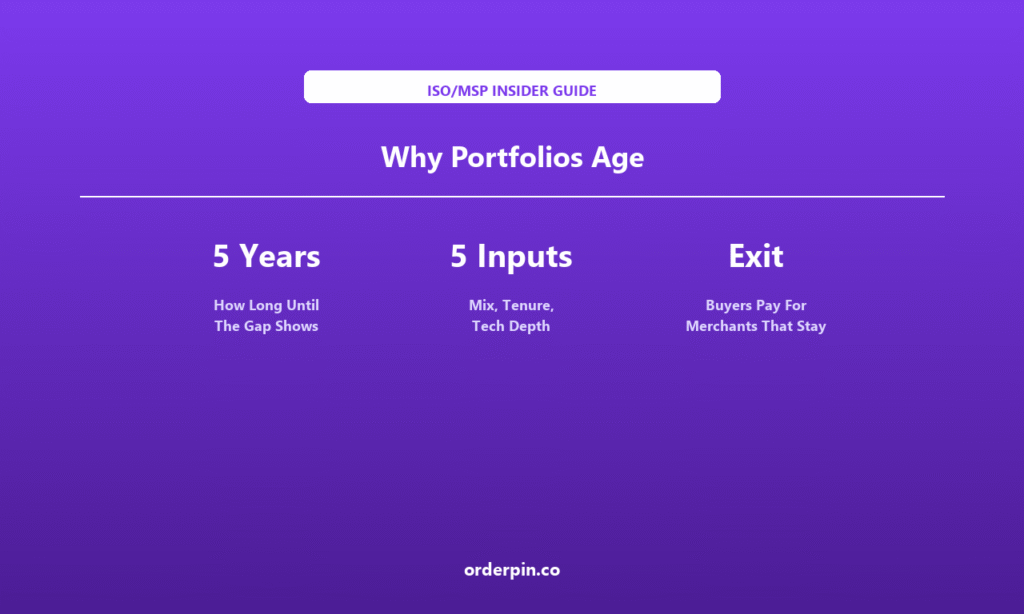
TL;DR — Quick Summary
- Volume tells you what a portfolio is worth today; composition tells you what it will be worth later: Two ISOs can report identical processing volume and hold books that diverge dramatically within five years. The difference is not size — it is what the book is made of.
- Durability has five ingredients: Industry mix, merchant longevity, economic resilience, technology adoption, and retention patterns. Each one either compounds or decays, and most ISOs measure none of them.
- Aging well is a steering problem, not a luck problem: Because every new merchant, renewal, and vertical choice changes the mix, portfolio durability can be managed quarterly — and it shows up directly in exit value, where buyers pay for merchants that stay.
The Gap Shows
Resilience, Tech
Merchants That Stay
Portfolios Age — Some Improve, Some Rot
A merchant portfolio is not a static asset sitting still until renewal season; it is a living composition that changes character every quarter. Merchants grow, stall, get acquired, or close. Verticals shift from expansion to consolidation. Pricing that was competitive becomes uncompetitive without anyone deciding anything. The net effect is that two books with identical volume today can look nothing alike in five years — one denser, stickier, and worth more per merchant; the other thinner, churn-prone, and worth less despite the same headline number.
Most ISOs manage volume because volume is what the statement shows, and then discover the composition problem at the worst possible moment — during diligence, when a buyer prices the book on retention rather than revenue. This article is about the second measure. Note the distinction from AC33, which asked why some portfolios grow faster: growth is about the rate at which a book expands, while this is about whether what you already hold holds its value. A portfolio can grow quickly and age badly.
You Are Weighted In
Merchants Actually Stay
A Downturn
Per Merchant
1. Composition, Not Size: What “Aging” Actually Measures
Aging is the change in quality per merchant over time: Volume is a snapshot; composition is a trajectory. A book where the average merchant earns more, stays longer, and runs more of your software is aging well even if total volume is flat. A book where volume grows only because new logos replace departing ones is aging badly while looking healthy.
The metric to watch is revenue per surviving merchant: Split your book into cohorts by sign year and track what each cohort contributes two, three, and five years later. Cohorts that deepen are durable; cohorts that require constant replacement are not. This single view exposes aging faster than any aggregate.
2. Ingredient One: Industry Mix
Verticals have structurally different lifespans: A portfolio weighted toward independents in a consolidating category will shed merchants regardless of how well you serve them, while one weighted toward categories with high switching costs and growing ticket sizes will deepen without effort. The mix you inherited or drifted into sets a ceiling on durability that service quality cannot fully overcome.
Concentration is the risk hiding inside mix: A book can be durable on average and fragile in fact — if 40% of margin sits in one vertical or a handful of accounts, one category downturn rewrites the whole portfolio. The concentration measure flagged in AC59 belongs here too: durability and concentration are two views of the same composition.
3. Ingredient Two: Merchant Longevity
Tenure is the compounding asset: A merchant in year five costs almost nothing to keep, refers others, and tolerates the occasional mistake. A merchant in month five costs everything to acquire and leaves over a rate quote. The average tenure of your book is therefore a direct proxy for how much of your revenue is compounding versus being rebuilt every year.
Longevity is decided at signing, not at renewal: The qualification discipline from AC61 is upstream of this entire article — merchants who were a good fit in month one become the tenured core in year five, and merchants acquired on price become the churn you spend the next decade replacing. Portfolios age the way they were originally assembled.
4. Ingredient Three: Technology Adoption and Economic Resilience
Embedded merchants do not shop on rate: A merchant running only your processing can be moved by a cheaper quote. A merchant running your POS, inventory, loyalty, and reporting cannot — the switching cost is operational, not contractual. Software penetration, the measure introduced in AC27, is the single strongest durability input an ISO controls directly.
Resilience is behaviour under stress, not in calm: The real test of composition arrives when the economy turns — which is exactly the behaviour examined in AC57. Discretionary, low-ticket, and thin-margin merchants cut costs and churn first; essential, high-ticket, and software-dependent merchants hold. A durable book is one whose mix was chosen with the downturn in mind, not discovered during it.
5. Steering the Mix: A Quarterly Practice
Score the book on durability, not volume: Once a quarter, segment merchants by vertical, tenure, software depth, and revenue, then ask which segments deepened and which required replacement. That view — the portfolio half of the dashboard built in AC59 — turns aging from an intuition into a number you can steer.
Steer acquisition toward the durable segments: Every new merchant is a vote on future composition. Point qualification and sales incentives at the verticals and merchant profiles that have historically lasted, and stop celebrating logo count where tenure data says the merchants will not stay.
Convert the existing book before it decays: The fastest durability gain is usually software adoption among merchants you already have — moving a processing-only merchant onto your platform changes its switching cost immediately. Retention spend follows the same logic as AC14: invest where the merchant is worth keeping, and know the difference.
Remember why this is worth doing: Durability is what a buyer prices. The exit-multiple argument in AC12 rests on exactly this — acquirers pay for merchants that stay, software that is embedded, and revenue that compounds. A portfolio that ages well does not just earn more while you own it; it sells for more when you don’t.
Fragile Book vs. Durable Book
| Dimension | Ages Badly | Ages Well |
|---|---|---|
| Headline | Volume held up by replacement | Revenue per merchant rising |
| Industry Mix | Consolidating, discretionary | Growing, essential, sticky |
| Tenure | Short, price-acquired | Long, qualified at signing |
| Technology | Processing only | POS, inventory, loyalty |
| In A Downturn | Churn concentrates | Volume holds, mix deepens |
How OrderPin Helps a Portfolio Age Well
OrderPin is a white-label POS platform built for ISO and MSP partners. Of the five durability inputs, technology adoption is the one an ISO can change fastest across the book it already owns — and that is what owning the software layer makes possible.
- Turn processing-only merchants into embedded ones: Moving an existing merchant onto a POS, inventory, and loyalty stack raises its switching cost immediately, which is the most direct durability gain available.
- Measure software penetration as a portfolio metric: When you own the platform, adoption is reportable per merchant and per segment, so durability stops being a feeling and becomes a tracked number.
- See the composition, not just the total: Full data ownership means tenure, revenue per merchant, and vertical mix are visible together — the same view a buyer will run during diligence.
- Build the asset that prices at exit: Embedded software and long-tenured merchants are precisely what acquirers pay a premium for, so the platform is also the exit-multiple argument from AC12.
Frequently Asked Questions
What does it mean for a merchant portfolio to “age”?
It means the composition changes character over time. Merchants grow or close, verticals expand or consolidate, and software either deepens or stays shallow. A book ages well when revenue per surviving merchant rises, tenure lengthens, and software penetration deepens — even if total volume is flat. A book ages badly when the headline holds only because new logos replace departing ones.
How is this different from asking why some portfolios grow faster?
Growth rate and durability are different questions. AC33 looked at why some books expand faster; this looks at whether what you already hold keeps its value. The two can diverge sharply — a portfolio can grow quickly by acquiring price-sensitive merchants and still age badly, because the book requires constant replacement to stand still.
Which single metric best predicts portfolio durability?
Cohort revenue: split merchants by sign year and track what each cohort contributes two, three, and five years later. Cohorts that deepen are durable; cohorts that must be replaced are not. Software penetration per merchant is the strongest leading version of the same signal, because embedded merchants rarely leave over price.
Can an existing fragile portfolio be steered back?
Partly, and faster than most ISOs expect — because the fastest lever is technology adoption among merchants you already have. Moving a processing-only merchant onto a full platform changes its switching cost immediately. Steering new acquisition toward historically durable segments then improves the mix at the margin each quarter. Verticals you cannot exit still constrain you, which is why mix should be measured before it becomes a problem.
Why does durability matter for a sale?
Because acquirers underwrite retention, not revenue. Diligence prices the book on how long merchants stay, how embedded the software is, and how much revenue compounds without new acquisition spend — the same thesis behind the exit-multiple argument in AC12. Two ISOs with identical volume can therefore receive very different offers.
How does a white-label POS platform change portfolio aging?
It converts technology adoption from a vendor relationship into a portfolio metric you control. You can move existing merchants onto software you own, measure penetration by segment, and see tenure and revenue per merchant together — the exact composition a buyer will examine. OrderPin is built for ISO and MSP partners doing that work.
Two ISOs can report the same volume and hold books that are worth very different amounts five years later, because volume is a snapshot and composition is a trajectory. Portfolios age well when the mix is weighted toward verticals that are growing rather than consolidating, when merchants were qualified at signing and therefore stay, when software is embedded deeply enough that a cheaper quote is irrelevant, and when the book holds its shape through a downturn instead of shredding. None of this is luck — every new merchant, renewal, and software decision is a vote on future composition, which means durability can be scored and steered quarterly. The practical sequence is: segment the book by vertical, tenure, software depth, and revenue; watch cohort revenue rather than the headline; point acquisition at segments that have historically lasted; and convert the merchants you already have from processing-only to embedded, because that is the fastest durability gain available. Do that and the book earns more while you own it — and prices higher when you sell it. OrderPin is a white-label POS platform built for ISO and MSP partners, giving you software your merchants actually run, measurable penetration by segment, and the portfolio data that makes composition visible before a buyer runs it for you.
About OrderPin
OrderPin is a white-label POS platform built for ISO and MSP partners. We offer full data ownership, flexible pricing, and seamless API integrations to help you build a recurring revenue business under your own brand. Learn more about OrderPin’s white-label solution