
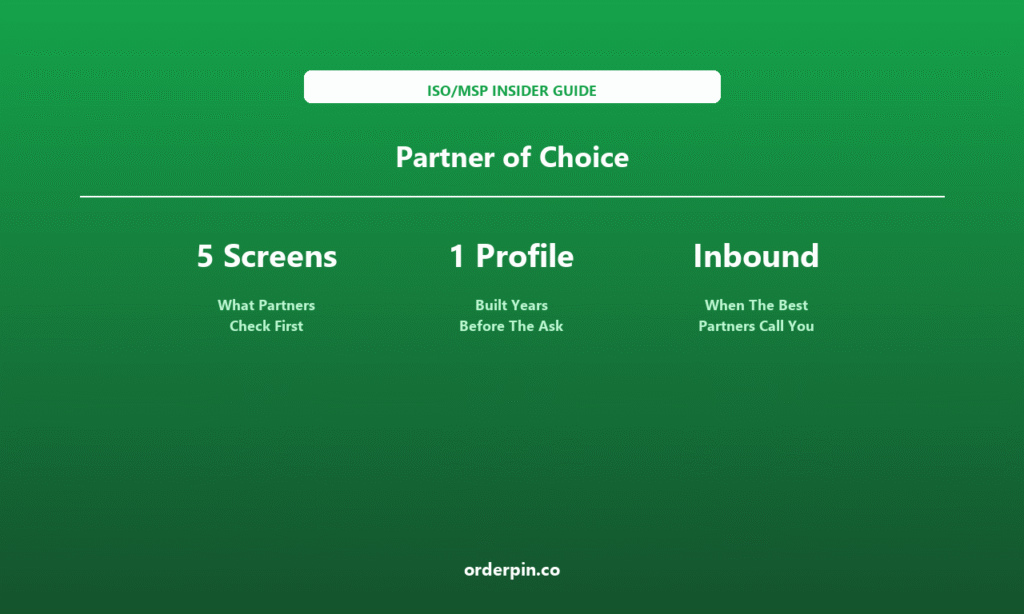
TL;DR — Quick Summary
- Strong partners screen you before you ever pitch them: Banks, ISVs, and vertical software vendors run a quiet due-diligence process on every ISO that approaches them. By the time the first meeting happens, they already have a view of your reputation, your book, and your technology — the pitch does not start the conversation, it confirms it.
- They screen on five things: Reputation and referencability, merchant quality, technology adoption, support standards, and growth potential. None of these can be faked at the meeting; all of them are built years earlier.
- Partner-readiness is an asset you build in advance: The ISOs that get inbound calls from the best partners did not win a competitive pitch — they became the obvious answer to “who should we send merchants to?” That position is engineered, not negotiated.
Check First
Before The Ask
Partners Call You
The Partnership Lens, Inverted
Most ISOs approach partnerships as a sales motion: identify a bank, ISV, or vertical software vendor, build the case, ask for the referral agreement. It is the same posture they use with merchants, and it is the wrong one. The strongest partners are not won — they are already choosing, quietly, long before you ask. Every bank with a merchant referral program and every vertical SaaS platform with payments ambitions maintains a short, unwritten list of ISOs it trusts. The question is not how you get on the list; it is why you are not on it yet.
This article inverts the lens. Rather than asking how to select partners — the subject of AC58’s quality diagnosis and the economics framing in AC68 — it asks what makes an ISO selectable. The answer is a partner-ready profile assembled across five dimensions: reputation, merchant quality, technology adoption, support standards, and growth potential. Each is inspectable from the outside, and none can be manufactured in the weeks before a pitch.
Says Unprompted
Are Your Résumé
Or Pass-Through
Are Actually Taking
1. Screen One: Reputation and Referencability
Due diligence is a phone call, not a questionnaire: Before a bank or ISV signs anything, someone asks two or three people in the industry what it is like to work with you. That conversation happens without you in the room and cannot be managed by marketing. Reputation is the only screen that is entirely outside your control and entirely determined by your past behaviour.
Referencability is a specific, buildable asset: Being liked is not enough; you need named merchants and named partners who will take a call and describe a specific outcome. That means deliberately cultivating three to five reference relationships — and protecting them, because a partner’s first question is “can I talk to one of your merchants?”
2. Screen Two: Merchant Quality — Your Book Is Your Résumé
A partner inherits your merchants, not your volume: When a bank refers a customer to you, it is lending its brand to the experience that merchant has. So it does not care how much you process; it cares what kind of merchants you already serve, how long they stay, and how they talk about you. A small, clean, tenured book beats a large churning one every time.
This is where qualification compounds twice: The merchant-qualification discipline from AC61 was framed as a growth decision — here it is also a partner-attraction decision. Every bad-fit merchant you decline makes the book more attractive to the partners you most want. Saying no is how you become the ISO that banks are comfortable recommending.
3. Screen Three: Technology Adoption
Software partners can tell a reseller from a product owner: An ISV evaluating you is asking whether you will deepen its product or just bolt processing onto it. If your technology story is “we resell a terminal and a gateway,” you are interchangeable with every other ISO and there is no reason to choose you. If you own a platform you can configure, you become an integration it wants.
Adoption is measured on your own merchants, not your deck: Sophisticated partners ask what percentage of your merchants run your software, not how many logos are on a slide. That metric — the software-penetration measure discussed in AC27 — is the shortest proof that you can actually deliver the experience you are promising to their customers.
4. Screen Four: Support Standards
The partner is buying risk, not revenue share: When a bank or ISV sends you its customers, the downside is asymmetric — a good experience earns it nothing it can claim, and a bad one costs it the relationship. So it screens your support harder than your economics: response times, escalation paths, who answers at 11pm on a Saturday.
Documented standards beat enthusiastic promises: A partner-ready ISO has written service levels, a named escalation owner, and reporting it can show. Vague reassurance reads as risk to anyone who has been burned before — and everyone evaluating you has.
5. Becoming the Partner of Choice: The Profile in Practice
Write your own reference sheet first: List the five facts a partner would discover about you — retention rate, average merchant tenure, software penetration, support SLAs, named references. If any is weak or unknown, that is the work. The gap between your sheet and your pitch is exactly what due diligence will expose.
Narrow before you reach out: The generalist is nobody’s obvious choice. Focus — the AC62 thesis — is what makes you recommendable: a bank can send you restaurant merchants because that is what you are known for, and a vague ISO cannot be sent anything specific at all.
Make yourself easy to diligence: Publish your specialisation, your support standards, and your integration capabilities where a partner’s analyst will find them. Most ISOs lose partnerships not on merit but on opacity — the evaluator could not confirm enough, fast enough, and moved to the next name.
Build the profile before you need it: Partner-readiness is an asset with a long lead time. The ISO that gets the ISV’s call in 2028 is the one whose reputation, book quality, and technology depth were legible in 2026 — which is why this work starts now, not when you decide to go looking.
The Partner’s Screen: Chosen vs. Chasing
| Dimension | Chasing ISO | Partner of Choice |
|---|---|---|
| Reputation | Unknown, unverifiable | Three named references |
| Merchant Book | Large, churning, mixed | Clean, tenured, specific |
| Technology | Resells a gateway | Owns a configurable platform |
| Support | “We’re very responsive” | Written SLAs and reporting |
| Positioning | Serves all SMBs | Known for one segment |
How OrderPin Makes an ISO Partner-Ready
OrderPin is a white-label POS platform built for ISO and MSP partners. Two of the five screens — technology adoption and merchant quality — are decided by whether you own the product layer, and that is what a white-label platform changes.
- Be a product owner, not a reseller: Owning a platform you can brand and configure is what separates you from every ISO with a gateway — and it is precisely what software partners screen for.
- Prove adoption with your own numbers: When the platform is yours, software penetration across your merchants is measurable, so “how many merchants actually run your product” becomes an answer instead of a hedge.
- Show the book, not the volume: Full data ownership means tenure, retention, and revenue per merchant are reportable by segment — which is the evidence a bank needs before it lends you its brand.
- Integrate instead of bolting on: API integrations let you plug into a partner’s software properly, which is the difference between being an option and being the recommended one.
Frequently Asked Questions
What do banks and ISVs actually check before partnering with an ISO?
Five things: reputation and referencability (what industry contacts say unprompted), merchant quality (tenure, retention, and fit rather than raw volume), technology adoption (whether you own a configurable platform or just resell one), support standards (written SLAs and escalation paths), and growth potential (a focused segment rather than a scatter). All five are inspectable from outside, and none can be assembled in the weeks before a pitch.
Does portfolio size matter to a potential partner?
Far less than most ISOs assume. A partner inherits the experience its customers have with you, so it screens the composition and durability of your book rather than its size. A smaller portfolio of long-tenured, well-fit merchants in a defined vertical is more attractive than a large churning one — because the risk being evaluated is reputational, not financial.
How long does it take to become a partner of choice?
The profile has a long lead time, because reputation and merchant tenure cannot be manufactured quickly. Expect the legibility work — references, SLAs, published specialisation — within a quarter or two, but the underlying assets (a clean tenured book, real software adoption) take one to three years to build. That is exactly why the work starts before you decide to go looking for partners.
Can a smaller ISO compete for partnerships against larger ones?
Yes — and focus is how. The largest ISOs are usually the least specific, which makes them hard for a partner to recommend for anything in particular. A smaller ISO that is unmistakably the best at one vertical, with documented support and named references, wins the referral that a generalist cannot be sent. Specificity beats scale in a referral decision.
How is this different from choosing the right partners?
It is the other side of the same door. AC58 covered how to diagnose whether a partnership is worth keeping once you have one; AC68 looks at how the money is structured. This article is about the prior question — becoming the ISO that strong partners want to approach — which determines whether you ever get the chance to evaluate them at all.
Does owning a white-label platform really change how partners see you?
It changes the category you are placed in. Software partners distinguish between an ISO that resells processing and one that owns a configurable product, because only the second can deepen their platform. Owning white-label POS also makes your software-penetration real and measurable, which converts a claim in your deck into evidence on their checklist. OrderPin is built for ISO and MSP partners making exactly that shift.
The best ISOs are chosen, not choosers. Every bank, ISV, and vertical software vendor with merchants to refer maintains a short unwritten list of operators it trusts, and by the time you pitch, the screen has already run: reputation, merchant quality, technology adoption, support standards, growth potential. None of these can be manufactured in the weeks before a meeting — reputation is set by how you have treated people, merchant tenure by the qualification discipline you practised years earlier, and technology depth by whether you own a product or resell one. The practical work is unglamorous: write your own reference sheet, cultivate named references, publish your support standards, and narrow until a partner can finish the sentence “they are the ones who…” Build that profile before you need it, and the strongest partners start calling you. OrderPin is a white-label POS platform built for ISO and MSP partners — giving you a product you own rather than resell, measurable software penetration, and the portfolio data that makes your book legible to anyone running due diligence.
About OrderPin
OrderPin is a white-label POS platform built for ISO and MSP partners. We offer full data ownership, flexible pricing, and seamless API integrations to help you build a recurring revenue business under your own brand. Learn more about OrderPin’s white-label solution