
TL;DR — Quick Summary
- Merchants are actively reducing their vendor count: Payments, payroll, POS, online ordering, loyalty, and business financing are converging into one integrated stack. The driver is not price — it is the integration tax: every additional vendor costs the merchant in reconciliation, logins, support calls, and finger-pointing.
- Payments-only ISOs get displaced from the relationship: When a merchant consolidates onto one platform, whoever owns that platform decides who processes the payments. An ISO that only sells processing is no longer a partner — it is a line item that can be re-quoted.
- The alternative is to become the integrated provider: Expansion does not mean building a software company. It means owning the platform layer so payments sit inside a stack the merchant depends on daily — which is the difference between being compared on rate and being impossible to displace.
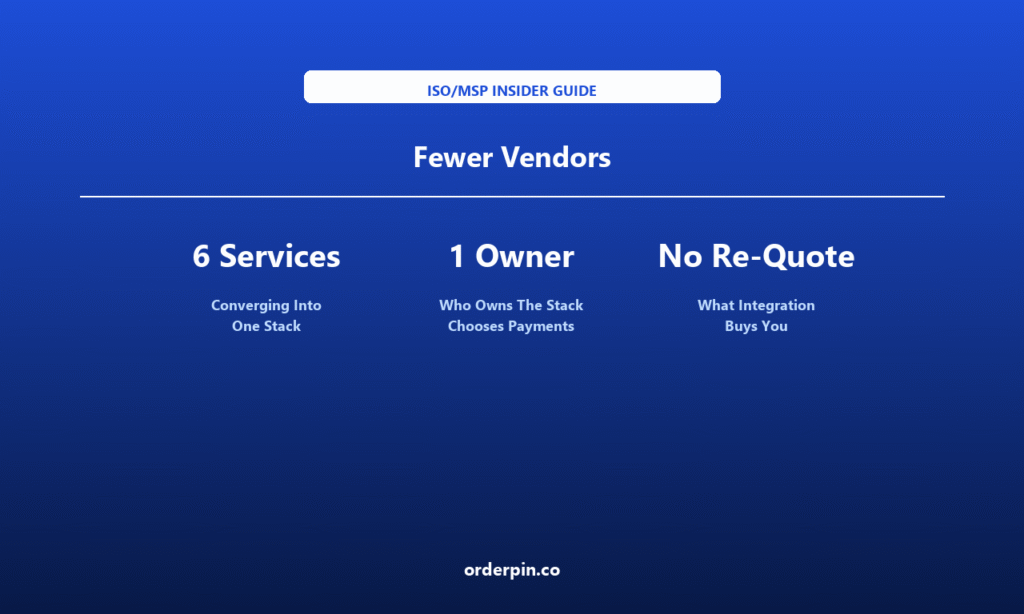
One Stack
Stack Chooses Payments
Buys You
The Consolidation Is Happening Without You
Ask a merchant how many vendors it pays for and the honest answer is usually six to ten: one for the POS, one for online ordering, one for payments, one for payroll, one for loyalty, another for scheduling or inventory. Each was chosen on its own merits, and each made sense in isolation. Together they produce something no merchant asked for — a business that requires a spreadsheet to reconcile, four support numbers to call when something breaks, and no single party accountable when the integrations disagree.
So merchants are consolidating, and they are doing it faster than most ISOs realise. The important detail is who captures the value when they do: whoever owns the platform the merchant runs its business on also decides who processes the payments. This is the displacement risk in its plainest form — not that a merchant chooses a cheaper processor, but that the decision stops being the merchant’s to make. Note this is the demand side of the argument that appears elsewhere in this series: AC21 described the dumb-pipe trap, and AC60 mapped differentiation vectors for the next five years. This article is about what the merchant is actually asking for right now.
Actually Happens
That Must Match In-Store
Merchants Want To Own
Real Payment Data
1. Why Now: The Integration Tax Got Too Expensive
Every vendor adds reconciliation, not just a bill: The true cost of a tenth vendor is not the subscription — it is the nightly reconciliation between systems that were never designed to agree, the duplicate data entry, and the hour spent deciding whose fault a discrepancy is. Merchants feel this cost daily, which is why consolidation has moved from preference to urgency.
Support fragmentation is the last straw: When the POS, the ordering channel, and the processor are three companies, every incident begins with three calls and three versions of “not our system.” A merchant who has lived through one bad weekend of that will trade features for a single throat to choke.
2. What “Multi-Service” Actually Means
Six categories are converging: POS and checkout, online ordering, payments, payroll and team management, loyalty and marketing, and business financing. None of these is new on its own; what is new is that merchants now expect them to share one customer record, one menu, one report, and one login.
Financing is the one that changes the relationship: Embedded capital is where payments data becomes a product. An ISO that sees a merchant’s actual cash flow can offer financing that a bank will not, and a merchant who takes capital from its payments provider does not re-shop that provider on rate.
Integration is the product, not the feature list: A merchant does not want six tools; it wants one system in which those six things already agree. That is why the winning offer is not the broadest bundle but the one with the fewest seams — a distinction that matters for how an ISO should expand.
3. The Displacement Risk for Payments-Only ISOs
The decision moves upstream of you: When a merchant adopts an integrated platform, payments come attached to it. The platform owner selects the processor — sometimes its own, sometimes a partner’s — and the ISO that previously owned the merchant relationship becomes an incumbent with no seat at the table.
This is the dumb-pipe trap, arriving from the demand side: AC21 warned that an ISO which only moves money becomes interchangeable infrastructure. The multi-service merchant is how that warning actually arrives in practice — not as a competitor undercutting you, but as a merchant reorganising its stack in a way that no longer includes you as a decision-maker.
The window is the renewal and the next expansion: Displacement rarely happens mid-contract. It happens when a merchant adds online ordering, opens a second location, or replaces a failing POS — moments when the stack is being redesigned and the payments decision is on the table. Those are the moments an ISO must be present for, with an answer that is more than rate.
4. The Expansion Roadmap Without Becoming a Software Company
Own the platform layer, not every application: The strategic move is not to build payroll, ordering, loyalty, and lending in-house — that is a decade of engineering. It is to own the platform the merchant logs into, so that payments sit inside the daily workflow and new services can be added as integrations under your brand.
Lead with the workflow, sell payments inside it: Merchants do not wake up wanting a processor; they want the day to run. When the conversation starts with ordering, inventory, or staffing — and payments is the part that makes it reconcile — the rate comparison never becomes the frame.
Use the data advantage you already have: An ISO sees transaction history that no lender or software vendor sees — which is the undermonetised asset described in AC15. Financing, inventory decisions, and staffing forecasts are all applications of that data, and all of them are reasons for a merchant to keep you.
5. Sequencing: What to Add First
Start where the merchant already feels pain: For most SMBs that is the POS and the ordering channel — the two systems whose disagreement produces daily reconciliation work. Adding or consolidating those two removes a real cost before you have to argue about anything.
Then loyalty, because it is retention disguised as marketing: Loyalty programs keep the merchant’s customers coming back, which keeps the merchant processing — and it gives you a reason to be in the merchant’s business monthly rather than annually.
Add capital last, because it needs the data: Financing is the highest-value and highest-trust expansion, and it depends on the transaction history you accumulate from the first three. Sequencing it last is what makes the offer credible rather than generic.
Keep the focus discipline: This is expansion inside a defined segment, not a return to being everything to everyone — the distinction drawn in AC62. Add services that serve the merchants you already know best; that is how the stack deepens without the pitch diluting.
Payments-Only ISO vs. Integrated Provider
| Dimension | Payments-Only | Integrated Provider |
|---|---|---|
| Merchant’s Vendor Count | Unchanged — plus you | Reduced |
| Position In The Stack | A line item | The system itself |
| Who Chooses Processing | The merchant, on rate | You, as part of the stack |
| Switching Cost | A re-quote | The whole daily workflow |
| Revenue Per Merchant | Processing margin | Software, services, capital |
How OrderPin Turns an ISO Into the Integrated Provider
OrderPin is a white-label POS platform built for ISO and MSP partners. The expansion roadmap does not require you to build six products — it requires you to own the platform the merchant logs into, with payments sitting inside it.
- Own the layer merchants use daily: The POS is where the day happens; when it carries your brand, payments stop being a separate vendor decision and become part of the system.
- Consolidate instead of adding: Ordering, loyalty, and inventory run on the same customer record and menu, which is exactly the integration tax the merchant is trying to eliminate.
- Expand on your own sequence: API integrations let you add services under your brand as the merchant is ready, rather than committing to a product roadmap you have to build.
- Keep the data that makes capital possible: Full data ownership means the transaction history required for financing and forecasting stays yours — the asset described in AC15.
Frequently Asked Questions
What is a “multi-service merchant”?
A merchant that has deliberately reduced its vendor count by consolidating several functions onto one integrated platform — typically POS, online ordering, payments, payroll or team management, loyalty, and business financing. The goal is not a cheaper bundle but fewer seams: one customer record, one report, one login, and one party accountable when something breaks.
Why do merchants want fewer vendors rather than best-of-breed tools?
Because of the integration tax. Each additional vendor adds nightly reconciliation, duplicate data entry, another support number, and ambiguity about who owns a problem. Best-of-breed was a reasonable strategy when each tool was standalone; once merchants depend on these systems agreeing in real time, the cost of non-integration exceeds the benefit of any single superior feature.
What happens to an ISO that only sells payments?
It gets displaced from the decision. When a merchant consolidates onto one platform, the platform owner determines who processes the payments, and the ISO becomes an incumbent without a seat. Displacement rarely happens mid-contract — it happens at renewal, at a second location, or when the merchant replaces a failing POS and redesigns the stack.
Does this mean an ISO has to become a software company?
No — and trying to is usually the wrong move. The strategic requirement is to own the platform layer the merchant logs into, so payments sit inside the daily workflow and additional services can be added as integrations under your brand. Building payroll, ordering, loyalty, and lending in-house is a decade of engineering; owning the platform is not.
Which service should an ISO add first?
Start where the merchant already feels pain — for most SMBs the POS and the online ordering channel, because their disagreement produces daily reconciliation work. Add loyalty next, since it keeps business flowing through the merchant. Add financing last: it is the highest-value expansion but depends on the transaction history you accumulate from the first three.
How does a white-label POS platform fit this shift?
It lets you be the integrated provider without building one. You own the platform the merchant uses daily, so payments stop being a separate re-quotable line item; ordering and loyalty share one record; and new services can be added via API integrations on your own sequence. Because you also keep the data, the transaction history needed for financing and forecasting stays yours. OrderPin is built for ISO and MSP partners making exactly this move.
Merchants are not looking for a cheaper processor; they are trying to run their business on fewer systems. That is the multi-service shift, and it carries an uncomfortable implication for ISOs: when a merchant consolidates, whoever owns the platform decides who processes the payments — which means a payments-only ISO can lose the account without ever being told no. The integration tax is what makes this urgent, and it is paid daily in reconciliation, duplicate entry, and support calls that begin with three vendors blaming each other. The response is not to build six products. It is to own the layer the merchant logs into, so payments sit inside the workflow rather than beside it, and to expand in a deliberate sequence: POS and ordering where the pain already is, loyalty because it keeps volume flowing, then financing once the transaction history supports it. Done this way, the merchant’s decision to consolidate becomes your opportunity rather than your displacement — and the rate conversation never becomes the frame. OrderPin is a white-label POS platform built for ISO and MSP partners: you own the system the merchant uses daily, ordering and loyalty share one record, new services arrive through API integrations on your own timeline, and the transaction data that makes capital possible stays yours.
About OrderPin
OrderPin is a white-label POS platform built for ISO and MSP partners. We offer full data ownership, flexible pricing, and seamless API integrations to help you build a recurring revenue business under your own brand. Learn more about OrderPin’s white-label solution