
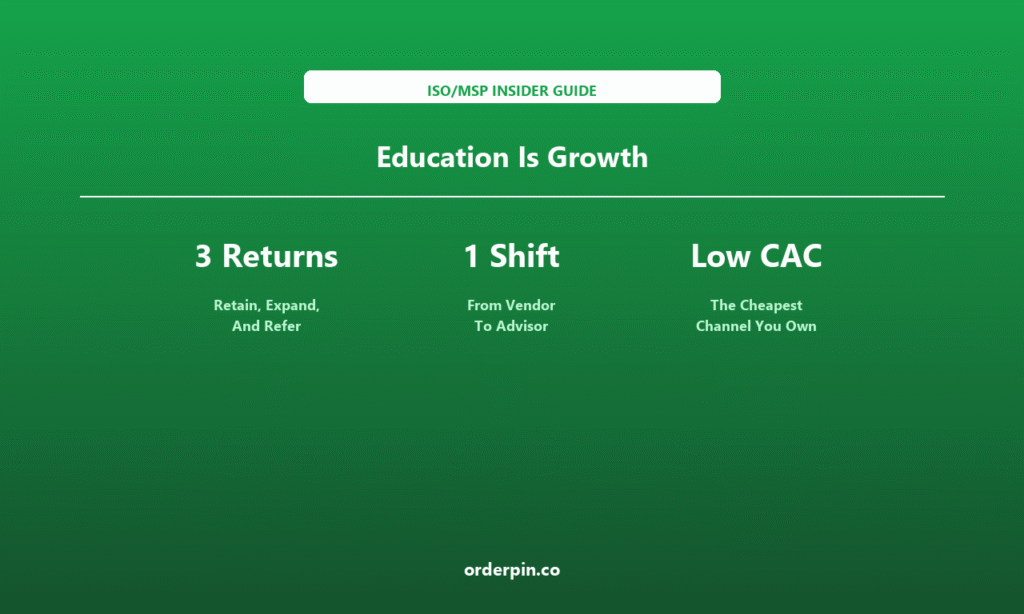
TL;DR — Quick Summary
- Education is acquisition, not support: Every benchmark, business review, and operational insight is a reason for a merchant to stay, expand, and refer — produced at a marginal cost far below any paid channel. Most ISOs file it under support and therefore never fund it.
- It works by changing the relationship, not the price: Teaching a merchant how its own business works moves the ISO from vendor to advisor. Advisors are not re-quoted on rate, because the comparison no longer applies.
- The compounding is in retention, expansion, and referrals: An educated merchant understands the value it receives, adopts more of your stack, and can articulate it to other merchants — which is the referral mechanism that generalists never activate.
And Refer
To Advisor
Channel You Own
Support Answers Questions; Education Changes What Merchants Ask
There is a version of merchant education that most ISOs already do and rarely value: the merchant calls with a problem, someone explains the answer, and the interaction is logged as support. It is reactive, it is unscalable, and — most importantly — it is filed under cost. That classification is the entire problem. Support is what you spend to keep a merchant whole; education is what you invest to make a merchant better, and the second one produces growth that the first one never will.
The distinction that matters is not the format but the posture. A vendor answers the question it was asked; an advisor changes what the merchant thinks to ask. And the advisor position is the one that survives a cheaper quote, because a merchant does not comparison-shop someone who understands its business. Note how this differs from the mechanics covered elsewhere in this series: AC17 built the business-review ritual, and AC46 addressed retention mechanics. This article is about education as a growth channel — the acquisition and expansion logic, not the meeting structure.
To Their Own Market
They Did Not Know
It Is Needed
Can Explain You
1. Why Education Is a Growth Channel, Not a Cost Centre
It produces the same outcomes as paid acquisition, at a fraction of the cost: Retained revenue, expansion revenue, and referred revenue are the three things a growth budget buys. Education produces all three from an asset you already own — the transaction and operational data of the merchants you serve. There is no media spend, and the marginal cost of the tenth merchant receiving an insight is near zero.
Budget classification decides whether it happens: Money filed under support gets optimised downward; money filed under growth gets defended and compounded. Most ISOs do genuinely useful education and then measure it as a cost of service, which is why it is always the first thing cut and never the thing scaled.
2. What to Teach: Benchmarks, Operations, and the Money
Benchmarks are the highest-value thing you can give: A merchant knows its own numbers and almost nothing about everyone else’s. Telling an operator that its average ticket is below comparable merchants in its category, or that its peak-hour throughput lags similar locations, is information it cannot get anywhere else — and it reframes you as the party who can see the market.
Operational guidance beats product training: Teaching a merchant how to use your software is onboarding; teaching it how to run a better shift, price a menu, or reduce no-shows is advisory. Only the second creates a reason to call you that has nothing to do with a problem.
Explain the money, including your own: Merchants who understand effective rate, interchange, and where margin actually goes stop suspecting you of hiding something. Transparency about the economics is itself education — and it removes the suspicion that makes a merchant receptive to the next cold call.
3. The Mechanism: From Vendor to Advisor
Trust is built before it is needed: The merchant that hears from you when nothing is wrong is the merchant that calls you when something is. That asymmetry is the whole point — the relationship is funded during calm periods so it is available during the re-quote, the outage, or the competitor’s pitch.
Advisors are not compared on rate: A vendor is evaluated on price because price is the only dimension in the relationship. Once a merchant is receiving insight it cannot get elsewhere, the comparison stops being like-for-like — which is precisely the escape from rate competition described in AC62.
4. Where It Compounding: Retention, Expansion, Referral
Retention, because understanding is stickiness: A merchant who understands what it is paying for and what it is getting is dramatically harder to displace than one who only sees a rate. Education converts an abstract monthly fee into a set of understood benefits — which is the durability logic from AC64, applied at the individual merchant level.
Expansion, because advice reveals gaps: A benchmark that shows weak online ordering or no loyalty program is not just insight — it is a specific, evidence-based reason for the merchant to adopt more of your stack. This is the most natural expansion motion available, and it is initiated by the merchant’s own data.
Referral, because educated merchants can explain you: Referral requires a merchant able to finish the sentence “you should call them because…” Education supplies the vocabulary. A merchant who understands what you actually do becomes a credible advocate; an uneducated one can only say the price was fine.
5. Building the Engine Without a Content Team
Start with one benchmark you can produce reliably: Do not build a content calendar. Pick the single comparison your data can support every quarter — average ticket against category, peak-hour throughput, or repeat-visit rate — and deliver it consistently. One credible recurring insight beats twelve sporadic ones.
Attach it to an existing touchpoint: Education that requires a new meeting will not survive a busy quarter. Attach the insight to the review, the statement, or the support follow-up you already have — the channel matters less than the cadence holding.
Segment it, or it will be ignored: A benchmark for restaurants is noise to a retailer. The focus discipline from AC62 applies here too: the more specific the insight is to the merchant’s actual business, the more it reads as advice rather than marketing.
Fund it as growth and measure it that way: Track retention, expansion, and referred revenue among merchants who receive education against those who do not. The moment the number is visible, the budget argument ends — and education stops being the first thing cut.
Vendor vs. Advisor
| Dimension | Vendor | Advisor |
|---|---|---|
| When You Call | When something breaks | When there’s something to say |
| What You Share | Answers | Benchmarks and insight |
| Basis Of Choice | Rate | Understanding of the business |
| Budget Line | Support cost | Growth channel |
| Merchant Can Refer You? | “Price was fine” | “They showed me…” |
How OrderPin Turns Merchant Data Into Advice
OrderPin is a white-label POS platform built for ISO and MSP partners. Education requires something true to say — and that depends entirely on whether you can see the merchant’s actual operating data.
- See the numbers the merchant cannot: Full data ownership means ticket size, peak hours, repeat visits, and channel mix are visible across your book — the raw material for benchmarks no one else can produce.
- Deliver it under your own brand: Because the platform is white-label, the insight arrives from you, not from a vendor logo — which is what makes it advisory rather than informational.
- Let the data recommend the next step: When a benchmark reveals weak online ordering or no loyalty, the adjacent product is already in your platform, so advice converts into expansion without a new vendor conversation.
- Compound it into retention: Merchants who understand what they are getting stay — and the operational insight is what makes the value legible in the first place.
Frequently Asked Questions
Why is merchant education considered a growth channel?
Because it produces the three outcomes a growth budget buys — retained revenue, expansion revenue, and referred revenue — from an asset you already own. The marginal cost of delivering an insight to the tenth merchant is near zero, and the mechanism is trust: a merchant who learns something from you does not treat you as an interchangeable vendor. Most ISOs already do this work and classify it as support, which is why it gets cut instead of scaled.
What kind of education actually moves the needle?
Benchmarks above all — a merchant knows its own numbers and nothing about everyone else’s. Then operational guidance: how to run a better shift, price a menu, or reduce no-shows. And finally transparency about the money, including your own economics. Note what is not on the list: product training. Teaching a merchant to use your software is onboarding, not advisory.
How is this different from running business reviews?
A business review is a meeting format; education is a positioning strategy. AC17 covered the review ritual itself. This article is about the growth logic — why the content of those conversations functions as acquisition and expansion rather than as service. You can run reviews without ever teaching anything, and you can educate without a formal review programme.
Can a small ISO do this without a content team?
Yes — start with one benchmark your data can support every quarter and deliver it consistently. Attach it to a touchpoint you already have, so a busy month does not break it, and segment it by vertical so it reads as advice rather than marketing. One credible recurring insight beats twelve sporadic ones, and no dedicated team is required to produce it.
How do you measure the return on merchant education?
Compare merchants who receive it against those who do not, across three metrics: retention over the following year, revenue per merchant (expansion), and referred new business. Expansion is usually the fastest signal, because a benchmark that reveals a gap naturally leads to adopting the adjacent product. Once that comparison is visible, the budget classification stops being an argument.
Why does owning the platform matter for education?
Because advice requires something true to say, and that requires data. An ISO that resells processing sees transactions; an ISO that owns the POS sees ticket size, peak hours, repeat visits, and channel mix — the inputs for benchmarks no competitor can produce. Ownership also means the insight arrives under your brand and the adjacent product is already in your stack. OrderPin is built for ISO and MSP partners doing exactly this.
Merchant education is the cheapest growth channel an ISO owns and the one most consistently misfiled. Every benchmark, every operational insight, and every honest explanation of the money does three things at once: it makes the merchant harder to displace, it reveals the next product that merchant should adopt, and it gives that merchant the vocabulary to refer you. None of that requires a media budget — it requires data you already hold and the discipline to deliver one credible insight on a schedule you can keep. The reason it rarely happens is classification: work filed under support is optimised downward, while work filed under growth is defended and compounded. Reframe it and the mechanism becomes obvious — a merchant who learns something from you stops comparison-shopping you on rate, because the comparison no longer applies. OrderPin is a white-label POS platform built for ISO and MSP partners, giving you the operating data behind benchmarks no one else can produce, the ability to deliver them under your own brand, and the adjacent products that turn revealed gaps into expansion.
About OrderPin
OrderPin is a white-label POS platform built for ISO and MSP partners. We offer full data ownership, flexible pricing, and seamless API integrations to help you build a recurring revenue business under your own brand. Learn more about OrderPin’s white-label solution