
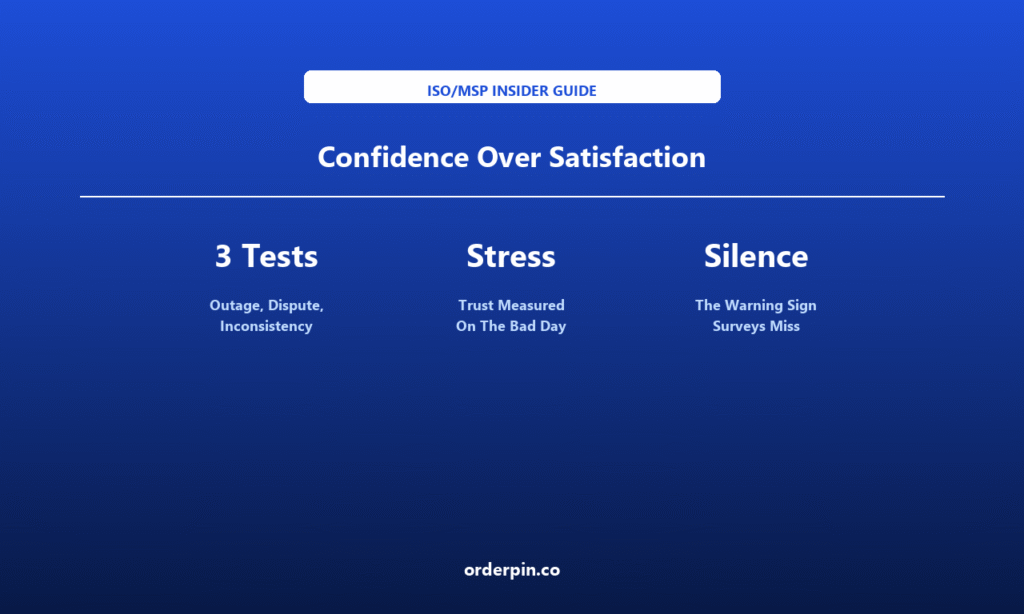
TL;DR — Quick Summary
- Satisfaction is a survey of the good days; confidence is behaviour on the bad ones: A merchant can report being satisfied every quarter and still leave the month after an outage, because what actually breaks is not contentment but the belief that you will be there when something goes wrong.
- Confidence is decided in three moments: An outage, a dispute or chargeback, and inconsistent service between representatives. Each one is a test of whether the relationship is real or merely contractual.
- Confidence is manageable, and it compounds: Reliability, continuity, service consistency, and incident behaviour are operational disciplines you can instrument — and they are what make retention, expansion, and referral (AC46, AC67) possible at all.
But The Bad Day
Inconsistency
Apology
Merchants Rarely Leave Because They Are Unhappy
Ask a departing merchant why they left and you will usually get a polite, uninformative answer: better rate, a competitor came by, we were reviewing vendors. The honest version is narrower and more specific. Something happened — a terminal went down on a Saturday, a chargeback was handled badly, three different people gave three different answers — and in that moment the merchant stopped believing that you would be there when it mattered. The rate was the excuse; the loss of confidence was the reason.
This matters because satisfaction and confidence are not the same measurement, and only one of them predicts retention. This article is about the difference, the three moments that decide confidence, and the operational disciplines that build it. It sits alongside the retention mechanics in AC46 and the education argument in AC67 — but it is about something prior to both: whether the merchant trusts you enough for any of that to land.
Stress, Not Comfort
Actual Product
Everyone They Ask
When It Broke
1. Satisfaction Is a Score; Confidence Is a Behaviour
Satisfaction surveys the good days: Most satisfaction measurement happens when nothing is wrong — a quarterly check-in, a survey after a successful onboarding. It captures whether the merchant is content in the state they are in, which is useful and almost entirely non-predictive, because nobody leaves on a good day.
Confidence shows up in what the merchant does next: A confident merchant calls you first when something breaks, takes your recommendation on an adjacent product, and refers you without hedging. An unconfident merchant does none of those things while remaining perfectly satisfied on paper — and quietly starts taking competitor calls.
2. Moment One: The Outage
Downtime is not a technical event to the merchant — it is revenue leaving the building: A restaurant that cannot take cards is not experiencing degraded service; it is watching customers walk out. The merchant does not evaluate your incident by severity classification. It evaluates it by whether anyone told them what was happening before they discovered it themselves.
Continuity beats apology: The merchant that survives an outage with its confidence intact is the one that had a fallback — offline mode, a spare terminal, a second processor path — and knew about it beforehand. Business continuity discussed in advance is worth more than any post-incident credit, because it converts an emergency into a procedure.
3. Moment Two: The Dispute
A chargeback is the first time the merchant finds out whose side you are on: Until something is contested, the relationship is theoretical. In a dispute the merchant learns whether you represent it or merely process for it — whether someone gathers evidence, explains the timeline, and says plainly what the likely outcome is.
Explaining the loss is part of the service: Merchants accept unfavourable outcomes surprisingly well when someone explained them in advance. What destroys confidence is discovering the result after the fact, with no explanation — the money is the smaller part of the damage.
4. Moment Three: Inconsistency
Three answers from three people is worse than one wrong answer: A merchant who calls about the same issue twice and gets two different explanations concludes that nobody is in charge. Inconsistency is read as incompetence even when each individual answer was reasonable — and it is the failure mode most often produced by growth, for exactly the reasons described in AC65.
Consistency is an infrastructure outcome, not a training outcome: You cannot train twenty people to improvise identically. Shared history, documented resolutions, and one view of the merchant are what make the fourth person to answer sound like the first — which is why the same data discipline that supports a modern sales motion (AC69) is what makes service coherent.
5. Managing Confidence: What to Measure and What to Do
Measure the behaviour, not the sentiment: Leading indicators of confidence are behavioural: does the merchant contact you first when something breaks, does it adopt what you recommend, does it refer without hedging, does it escalate or does it go quiet. Silence is the most reliable warning sign there is, and it never appears on a satisfaction survey.
Instrument reliability and continuity explicitly: Track uptime and incident response at merchant level, and pre-arrange the fallback — offline capability, spare hardware, documented escalation — before it is needed. A merchant that has been told in advance what happens when things break does not panic when they do.
Make incident behaviour a defined procedure: Who tells the merchant, how fast, in what channel, with what information, and who follows up afterwards. Written in advance, an incident becomes an execution; improvised, it becomes a memory the merchant keeps for years.
Educate before the incident, not after: A merchant who understands how disputes work, what continuity exists, and what to do at 8pm on a Saturday is far harder to lose — because the situation is legible rather than frightening. This is the education argument from AC67 applied to the exact moments that decide whether the relationship survives.
Satisfaction vs. Confidence
| Dimension | Satisfaction | Confidence |
|---|---|---|
| Measured When | Nothing is wrong | Something has broken |
| Captured By | Survey score | What the merchant does next |
| Fails At | Outage, dispute, inconsistency | Silence before departure |
| Built By | Price, responsiveness, rapport | Reliability, continuity, consistency |
| Predicts | How they describe you | Whether they stay |
How OrderPin Helps You Engineer Merchant Confidence
OrderPin is a white-label POS platform built for ISO and MSP partners. Confidence is mostly an operational problem — continuity, consistency, and incident behaviour — and operations run on data you can actually see.
- See reliability at merchant level: Full data ownership means uptime, transaction continuity, and service history are visible per merchant, so problems are caught before the merchant reports them.
- Keep service consistent as you grow: One shared view of the merchant means the fourth person to answer a call sees what the first one saw — which is what stops inconsistency from arriving with scale.
- Handle disputes with evidence, not guesswork: Transaction-level history makes it possible to reconstruct what happened quickly, explain the timeline plainly, and represent the merchant rather than apologise to it.
- Deliver continuity under your own brand: Offline capability and a platform you control mean the fallback is yours to promise — and promising it in advance is what keeps an outage from becoming a departure.
Frequently Asked Questions
What is the difference between merchant satisfaction and merchant confidence?
Satisfaction is a measure of contentment on the happy path — usually captured by a survey when nothing is wrong. Confidence is a measure of trust under stress: whether the merchant believes you will be there when something breaks. They diverge sharply, because a merchant can report satisfaction every quarter and still leave the month after an outage. Only one of them predicts retention.
Why do merchants really leave an ISO?
Usually not because of price, whatever they say at the time. They leave after a specific event — an outage nobody explained, a dispute handled without advocacy, or three different answers from three different people — in which they conclude that you will not be there when it matters. The rate is the reason given; the loss of confidence is the reason acting.
What are the three moments that decide merchant confidence?
An outage, a dispute or chargeback, and inconsistent service between representatives. In an outage the merchant learns whether anyone tells them what is happening before they discover it themselves. In a dispute it learns whose side you are on. In inconsistency it concludes that nobody is in charge. Each is a test of whether the relationship is real or merely contractual.
How do you measure merchant confidence?
Through behaviour rather than sentiment. Confident merchants call you first when something breaks, adopt what you recommend, and refer you without hedging. The warning signs run the other way: escalation replaced by silence, declining responsiveness, and fewer conversations about anything new. Silence is the most reliable predictor of departure and it never shows up on a survey.
Does business continuity matter more than a fast apology?
Yes. A merchant that survives an outage with its confidence intact is one that had a fallback — offline mode, spare hardware, a documented escalation path — and knew about it in advance. Continuity arranged beforehand converts an emergency into a procedure, which is worth far more than any post-incident credit, because the merchant is never frightened in the first place.
How does owning the platform help build confidence?
It makes reliability, consistency, and continuity things you control rather than things you hope for. Merchant-level uptime and service history let you catch problems before they are reported; transaction-level history lets you handle disputes with evidence; and offline capability under your own brand means the fallback is yours to promise in advance. OrderPin is built for ISO and MSP partners operating at that standard.
Satisfaction is a photograph of a good day; confidence is what the merchant believes about a bad one — and bad days are when merchants leave. The three moments that decide it are always the same: an outage nobody explained, a dispute handled without advocacy, and three different answers from three different people. Each is operationally mundane and each is survivable, provided it is prepared for rather than improvised. So manage confidence as a discipline rather than a sentiment: instrument reliability at merchant level, arrange continuity before you need it and tell the merchant what it is, make incident behaviour a written procedure instead of a reaction, give every person who answers the phone the same view of the account, and educate merchants about disputes and fallbacks while things are calm. Measure behaviour, not scores — whether they call you first, adopt what you recommend, refer without hedging, or simply go quiet. Confident merchants are the ones who stay, expand, and refer; satisfied merchants are the ones who leave and cite a better rate. OrderPin is a white-label POS platform built for ISO and MSP partners: merchant-level uptime, transaction history, and offline continuity under your own brand, so reliability is something you can promise in advance rather than apologise for afterwards.
About OrderPin
OrderPin is a white-label POS platform built for ISO and MSP partners. We offer full data ownership, flexible pricing, and seamless API integrations to help you build a recurring revenue business under your own brand. Learn more about OrderPin’s white-label solution