
TL;DR — Quick Summary
- The agent army was built for reach, not for retention: A 1099 network paid on signed volume is an efficient way to find merchants in a market where merchants had no alternative and the ISO had no software. Both halves of that market are gone.
- Three motions are proving more durable: Team selling for merchants whose buying decision now involves software, hybrid direct-plus-partner for accounts that compound, and partner-led growth where you have distribution but no brand.
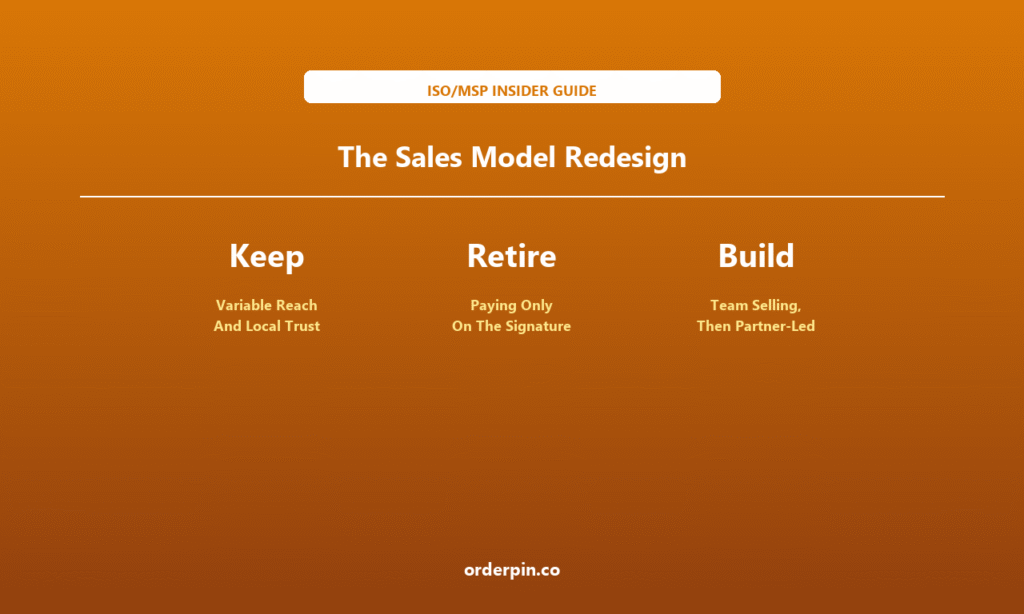
- A redesign is a sequence, not a reorganisation: Retire volume-only compensation, keep variable-cost reach and local relationships, and build enablement and data infrastructure before you touch the org chart — the same infrastructure argument made in AC65.
And Local Trust
And Zero Enablement
Then Partner-Led
The Model Was Designed for a Market That No Longer Exists
The dominant ISO sales model — a large network of independent 1099 agents, paid a signing bonus and a slice of residual, working their own relationships with no territory logic and no central enablement — was not an accident. It was an elegant answer to a specific problem: how to cover a fragmented national market of small merchants when you have no brand, no software, and no capital to carry a salaried sales force. Variable cost, infinite reach, payment on results. For decades it was simply the best available structure.
The problem is that the conditions that made it optimal have quietly disappeared. Merchants now evaluate software, not just rates (AC27). They want fewer vendors and an integrated stack (AC66). The profitable merchant is the one who stays, adopts, and expands — which is a qualification judgement (AC61), not a volume outcome. And the accounts that actually compound are the ones an unmanaged agent network has the least incentive to serve well. This article is not an argument for firing your agents. It is a map of what to keep, what to retire, and what to build first.
At Variable Cost
Alone
More Than One Visit
That Compound
1. What the Agent Model Was Actually Optimised For
It bought coverage without fixed cost: A salaried sales force is a fixed obligation in a business with volatile monthly revenue. Independent agents convert that into variable cost — you pay when something closes. That advantage is real and it does not expire, which is why the answer is redesign rather than replacement.
It monetised local trust that no brand could manufacture: The agent who has banked the restaurant owner for six years has an asset you cannot buy with marketing. This remains the single strongest reason not to tear the model down — and it is the same trust that makes an educated merchant refer you (AC67).
2. What to Retire: The Parts That Now Work Against You
Compensation that pays only on the signature: When the entire reward lands at acquisition, the agent has no economic reason to care whether the merchant fits, adopts, or stays — which is precisely how the wrong merchants enter a portfolio (AC61) and how durability erodes (AC64). The fix is not a smaller bonus; it is a bonus that vests against retention.
Signing without enablement: Agents who are recruited and then left alone do not become productive; they become expensive churn. This is the partner failure described in AC58 — paid to sign, never taught to sell — applied to your own distribution.
No shared view of the merchant after onboarding: If the agent cannot see adoption, ticket history, or revenue trend, the only feedback loop it has is the monthly residual — a signal that arrives late and explains nothing. That is a data gap before it is a management gap.
3. Team Selling: One Conversation Is No Longer Enough
The buying decision now spans three stakeholders: The owner cares about cost, the manager cares about whether the system is usable on a Friday night, and whoever runs the books cares about reconciliation. A single agent with a rate sheet cannot serve all three; a team can — a commercial lead, an implementation specialist, and a support contact who shows up before the contract is signed.
Team selling is where software actually gets sold: Merchants do not adopt a platform because it was mentioned in a pricing conversation; they adopt it because someone demonstrated it in their context. That is an implementation skill, not a closing skill — and it is why the same structure also improves activation, which is the retention lever described in AC46.
4. Hybrid Direct-Plus-Partner: Segment the Motion by Account Value
Not every merchant deserves the same motion: A single-location takeaway and a twelve-location group do not have the same lifetime value, the same complexity, or the same switching cost. Sending the same unstructured agent motion at both means over-serving the first and under-serving the second — the definition of a margin problem (AC62).
Go direct where the account compounds: Multi-location, software-dependent, or strategically referenceable merchants should be owned by an internal team with an account plan, because their value comes from expansion over years rather than from the initial signing. Independent distribution should cover the long tail, where its reach advantage is decisive and the account economics do not justify a salaried relationship.
Partner-led growth fills the gap you cannot fill: Where you have a product but no brand — a vertical, a geography, an adjacent segment — bank, ISV, and software distribution beats building another sales team, and it is cheaper than hiring into a market where you have no credibility. The economics have to be structured properly (AC68) and you have to be the partner they choose (AC63), but the motion itself is what makes growth possible without fixed headcount.
5. What to Build First: A Sequence, Not a Reorganisation
Step one is compensation, not headcount: Change what you pay for before you change who does the selling. Move a portion of acquisition reward onto retention and adoption, and behaviour changes within a quarter — without touching a single reporting line.
Step two is enablement and shared data: Give every seller — internal or independent — the same view of merchant adoption, revenue trend, and service history, plus the training to act on it. This is the infrastructure investment from AC65: build it while growth is still paying for it, not after.
Step three is the motion split: Define which segments are direct, which are partner-led, and which stay with independent distribution — then only restructure the org chart to serve that split. Doing it in this order means the structure follows the economics; doing it in reverse means you reorganise and then discover the incentives still point the old way.
Keep the agents who behave like partners: The redesign is not hostile to independent distribution — it is hostile to unmanaged, uninformed, volume-only distribution. The agents who already qualify, onboard, and stay in touch are the ones worth paying more, and they are usually the ones who welcome the change.
Volume Agent Model vs. Modern Go-to-Market
| Dimension | Volume Agent Model | Modern Go-to-Market |
|---|---|---|
| Paid For | Merchants signed | Merchants retained & adopted |
| Selling Unit | One agent, one conversation | Team: commercial + implementation |
| Motion by Segment | Same for every merchant | Direct / partner / independent by value |
| Seller Visibility | Monthly residual only | Adoption, revenue, service history |
| Growth Lever | Recruit more agents | Enable better + add partner distribution |
How OrderPin Supports a Modern Go-to-Market Motion
OrderPin is a white-label POS platform built for ISO and MSP partners. A modern sales motion fails without shared data — sellers cannot sell what they cannot see, and compensation tied to adoption is unadministrable without adoption data.
- Give every seller the same view of the merchant: Full data ownership means adoption, revenue trend, and service history are reportable per merchant, so independent and internal sellers operate from one source of truth.
- Make retention-based compensation administrable: When activation and tenure are tracked at merchant level, you can actually pay on the outcomes you say you value instead of on signatures alone.
- Support team selling with something to demonstrate: A branded platform turns the implementation conversation from a promise into a demonstration — which is what closes software-involved deals.
- Onboard partner-led distribution without rebuilding reporting: One platform means one reporting format across direct, partner, and independent channels, so segmenting the motion does not fragment the data.
Frequently Asked Questions
Is the 1099 agent model obsolete?
No — parts of it are worth keeping and parts are actively harmful. Keep variable-cost reach and local relationships, which remain genuinely valuable and hard to replicate. Retire compensation that pays only on signature, enablement that does not exist, and the absence of post-onboarding data. The model is not obsolete; the version of it with no enablement and no visibility is.
What is team selling in payments?
Selling as a unit rather than as an individual: a commercial lead handles economics, an implementation specialist demonstrates the software in the merchant’s own context, and a named support contact appears before the contract is signed. It exists because the modern buying decision spans an owner who cares about cost, a manager who cares about usability, and a bookkeeper who cares about reconciliation — three stakeholders a single rate-sheet conversation cannot serve.
What is a hybrid direct-plus-partner model?
Segmenting the sales motion by account value instead of applying one motion to every merchant. Multi-location, software-dependent, or referenceable accounts are owned directly by an internal team with an account plan, because their value compounds over years. Independent distribution covers the long tail, where reach matters more than account management. Partner-led distribution fills verticals and geographies where you have a product but no brand.
What should an ISO change first?
Compensation, not headcount. Move part of the acquisition reward onto retention and adoption and behaviour shifts within a quarter without any structural change. Then build enablement and shared merchant data. Only then split the motion by segment and adjust the org chart to serve it — so the structure follows the economics rather than the other way around.
How does paying on retention change agent behaviour?
It makes merchant quality the seller’s problem too. When the reward lands entirely at signing, there is no economic downside to a bad-fit merchant — the ISO absorbs the onboarding cost, support burden, and churn. When part of the reward vests against retention, the seller starts qualifying, which is the same discipline argued for in AC61, now enforced by pay rather than by policy.
How does owning the platform help a modern sales model?
It supplies the data the motion depends on. Adoption, revenue trend, and service history at merchant level let you pay on outcomes rather than signatures, give internal and independent sellers the same view, and turn the implementation conversation into a demonstration. It also keeps reporting consistent across direct, partner, and independent channels. OrderPin is built for ISO and MSP partners operating that model.
The agent army was a rational answer to a market that no longer exists — fragmented merchants, no software decision, and no way to cover the country without variable-cost distribution. What is worth keeping is the reach and the local trust. What has to go is everything that pays for a signature and then abandons the merchant: volume-only compensation, enablement that never happens, and sellers who cannot see adoption, revenue, or service history after onboarding. The durable version is not a bigger network but a better-structured one — pay on retention so merchant quality becomes the seller’s problem too, sell as a team because the decision now spans three stakeholders, and split the motion by account value so compounding accounts are owned and the long tail is covered by reach. Sequence it correctly: compensation first, enablement and data second, structure last. Do it in that order and the organisation follows the economics; do it in reverse and you reorganise into the same incentives. OrderPin is a white-label POS platform built for ISO and MSP partners: merchant-level adoption, revenue, and service data under your own brand, so retention-based pay is administrable and every seller — internal, partner, or independent — works from the same view of the merchant.
About OrderPin
OrderPin is a white-label POS platform built for ISO and MSP partners. We offer full data ownership, flexible pricing, and seamless API integrations to help you build a recurring revenue business under your own brand. Learn more about OrderPin’s white-label solution