
TL;DR — Quick Summary
- Partnerships rarely collapse over strategy — they collapse over money: Two organisations can agree on the market, the merchant, and the goal, and still fall apart because the economics reward one side for something the other side pays for.
- The strongest structures share the residual, not the signing: Recurring share over one-time spiffs, transparency into the actual economics, joint funding of growth, and incentives tied to merchant outcomes rather than merchant count.
- Economics is architecture, not negotiation: How the deal is built determines how both sides behave for years. Getting the structure right is what makes the quality tests in AC58 and the partner-attraction work in AC63 worth doing at all.
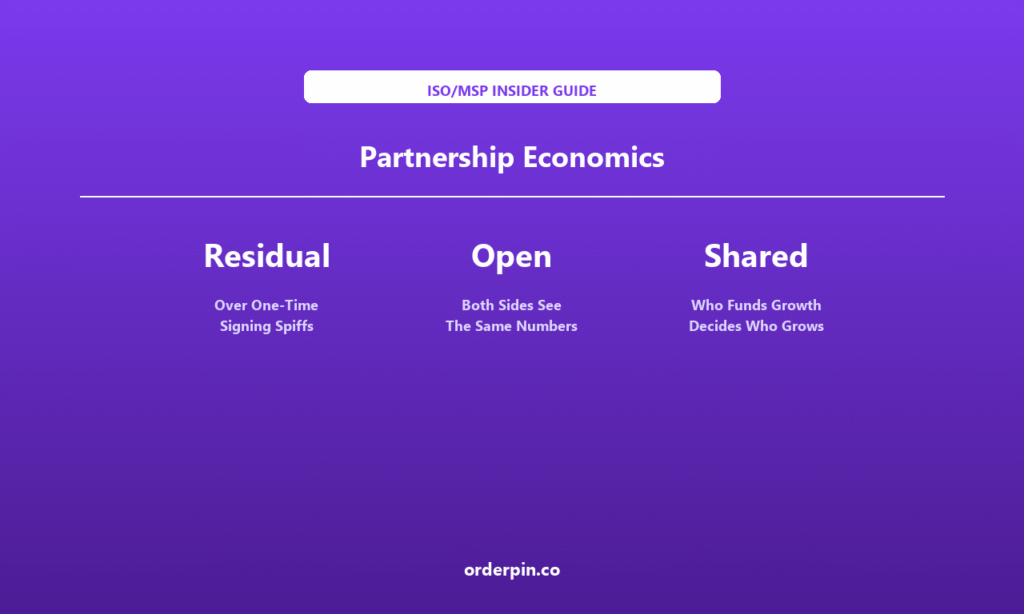
Signing Spiffs
The Same Numbers
Decides Who Grows
Partnerships Rarely Die Over Strategy
When a partnership between an ISO and a bank, ISV, or referral organisation fails, the post-mortem usually cites misalignment, communication, or commitment — the same soft diagnoses that appear in AC58’s quality tests. Those are real symptoms, but they are rarely the cause. The cause is usually arithmetic: one party is paid for something the other party bears the cost of, and the arrangement holds only until someone runs the numbers.
This article is about the commercial architecture underneath the relationship — not whether a partnership is worth keeping (AC58), and not how to become the partner others choose (AC63), but how the deal itself is built. Get the economics right and most behavioural problems never appear; get them wrong and no amount of communication fixes it, because both sides are behaving rationally according to incentives that point in different directions.
Merchant Stays
And Auditable
Not Signings
By Both Sides
1. Residual Share Over One-Time Spiffs
A signing bonus pays for an outcome the ISO has to live with: When a partner is paid once at acquisition, its incentive ends at the signature. The ISO carries onboarding cost, support burden, and churn risk on a merchant it did not choose. That is not a partnership; it is a lead purchase with a better name.
Residual share makes both sides care about retention: When the partner is paid while the merchant stays, merchant quality becomes the partner’s problem too. That single change does more for the durability of the book than any service-level agreement — and it is the same composition logic from AC64, now enforced by the contract rather than by goodwill.
2. Transparency: Both Sides Should See the Same Numbers
Opacity is read as bad faith, correctly: A partner that cannot see how its share is calculated will eventually assume the worst, because it has no way to confirm the best. Most partnership disputes are not disagreements about the number — they are disagreements about a number only one party can see.
Publish the calculation, not just the payment: The standard to aim for is a partner that can recompute its own monthly share from the reported inputs and get your number. That requires defined definitions — what counts as revenue, what is deducted, how attrition is treated — written down before the first dispute rather than during it.
3. Joint Investment: Who Funds Growth Decides Who Grows
Whichever side funds acquisition owns the relationship: If the ISO funds all marketing and enablement, the partner has no cost of failure and no reason to prioritise. If the partner funds it, it will demand economics that reflect that risk. Neither is wrong — but the arrangement must be explicit, because unstated asymmetry is where resentment forms.
Enablement is the investment partners undervalue: The highest-return joint spend is usually not marketing budget but enablement — training the partner’s front line so it can actually explain the offer. This is the signing-after-silence failure described in AC58: a partner that was paid to sign and never taught to sell.
4. The Structures That Kill Partnerships
Volume-based incentives that ignore quality: Paying on merchant count or signed volume invites exactly the behaviour that destroys portfolio durability — bad-fit merchants acquired for the bonus. This is the qualification failure from AC61 re-entering through the partnership door.
Unbounded or unwritten attrition treatment: Nothing corrodes trust faster than discovering, mid-relationship, that chargebacks, attrition, or downgrades are handled in a way one side never agreed to. If the treatment of shrinkage is not written down, each party will invent the version that favours it.
Exclusivity without volume commitment: An ISO that grants exclusivity and receives no minimum in return has traded optionality for nothing. Exclusivity is legitimate, but it is a concession that should be priced — in committed volume, funded enablement, or a higher share.
5. Renegotiating a Partnership That Already Exists
Renegotiate while it is working, not while it is breaking: The leverage to fix a structure exists only when both sides are happy. Raising economics during a dispute reads as opportunism; raising them during a good quarter reads as investment in something both parties want to continue.
Trade, do not ask: A request for better economics needs a corresponding concession — committed volume, funded enablement, exclusivity, or longer term. Unilateral asks are where partnerships start to feel extractive, regardless of whether the number is fair.
Move one variable at a time: Changing the split, the incentive basis, and the reporting simultaneously makes it impossible to attribute the result. Restructure the incentive first, since that is what changes behaviour; adjust the rate second, once the new structure has produced data.
Write the definitions before you need them: Whatever you agree, document revenue definition, deduction treatment, attrition handling, and reporting cadence. The document is not bureaucracy — it is what prevents the same conversation from recurring every quarter with different numbers.
Transactional Deal vs. Aligned Partnership
| Dimension | Transactional | Aligned |
|---|---|---|
| Partner Paid | One-time spiff | Ongoing residual share |
| Incentive Basis | Merchants signed | Merchants retained |
| Economics Visibility | One side can see it | Both can recompute it |
| Growth Funding | Unstated, usually the ISO | Explicit and shared |
| Who Cares About Churn | The ISO, alone | Both, by contract |
How OrderPin Makes Partnership Economics Verifiable
OrderPin is a white-label POS platform built for ISO and MSP partners. Most partnership disputes are disputes about a number only one side can see — which is a data problem before it is a legal one.
- Both sides can recompute the share: Full data ownership means merchant-level revenue, retention, and deductions are reportable, so the partner can verify the calculation rather than trust it.
- Pay on outcomes you can actually measure: When software adoption and tenure are tracked per merchant, residual structures tied to retention become administrable instead of aspirational.
- Prove merchant quality, not just merchant count: Reporting by cohort and segment lets a partner see that the book is durable — which is what makes a residual deal worth more than a spiff.
- Standardise reporting across partners: One platform means one reporting format, so definitions do not have to be re-litigated with every new relationship.
Frequently Asked Questions
What is partnership economics?
The commercial architecture of a partnership: how revenue is split, what behaviour the incentives reward, who funds growth, how attrition is treated, and whether both sides can see the same numbers. It is distinct from whether a partnership is strategically worth having — plenty of sensible partnerships fail purely because the economics reward one side for something the other pays for.
Why is residual share better than a signing bonus?
Because it aligns incentives with retention. A one-time spiff pays the partner at signature, which is exactly when the ISO’s cost begins — onboarding, support, and churn risk. An ongoing residual share means the partner is paid while the merchant stays, so merchant quality becomes its concern too. The same logic drives portfolio durability in AC64; here it is enforced by the contract rather than by intention.
How transparent should the economics be?
Transparent enough that the partner can recompute its own monthly share from the reported inputs and arrive at your number. That requires written definitions of what counts as revenue, what is deducted, and how attrition and chargebacks are treated — agreed before the first dispute rather than during it. Most partnership conflicts are not disagreements about the amount, but about an amount only one party can see.
Which incentive structures damage partnerships?
Three in particular: volume-based incentives that ignore merchant quality (inviting bad-fit acquisition), unwritten treatment of attrition and chargebacks (each party invents the version that favours it), and exclusivity granted without a volume commitment or funded enablement in return. All three are survivable if stated and priced; all three are corrosive if discovered later.
How do you renegotiate an existing partnership?
Do it while the relationship is working, when leverage exists and the ask reads as investment rather than opportunism. Always trade rather than ask — offer committed volume, funded enablement, exclusivity, or longer term in exchange. Move one variable at a time, starting with the incentive basis, since that is what changes behaviour; adjust the rate later, once you have data.
How does owning the platform help structure the money?
It makes the numbers verifiable. When merchant-level revenue, retention, and software adoption live in your systems, a partner can recompute its own share instead of trusting a statement, and residual structures tied to real outcomes become administrable. It also produces the cohort and segment reporting that proves merchant quality — which is what makes a residual deal worth more to both sides. OrderPin is built for ISO and MSP partners operating at that level.
Partnerships rarely die over strategy; they die over arithmetic. Two organisations can agree on the market and the merchant and still fail, because the structure pays one side for something the other side absorbs — a spiff at signature, a share the partner cannot verify, growth that only one party funds, or an incentive that rewards merchant count while the ISO carries the churn. The fix is architecture rather than goodwill: share the residual so both sides care about retention, publish the calculation so neither has to assume bad faith, state who funds growth before resentment forms, and pay on outcomes instead of signings. Renegotiate while things are working, always trade rather than ask, and change one variable at a time so you can attribute the result. Write the definitions down. Do this and the soft problems — communication, commitment, alignment — mostly never appear, because both parties are behaving rationally in the same direction. OrderPin is a white-label POS platform built for ISO and MSP partners: merchant-level revenue, retention, and adoption data in your systems, so the share can be recomputed rather than trusted, and residual structures tied to real outcomes become something you can actually administer.
About OrderPin
OrderPin is a white-label POS platform built for ISO and MSP partners. We offer full data ownership, flexible pricing, and seamless API integrations to help you build a recurring revenue business under your own brand. Learn more about OrderPin’s white-label solution