
TL;DR — Quick Summary
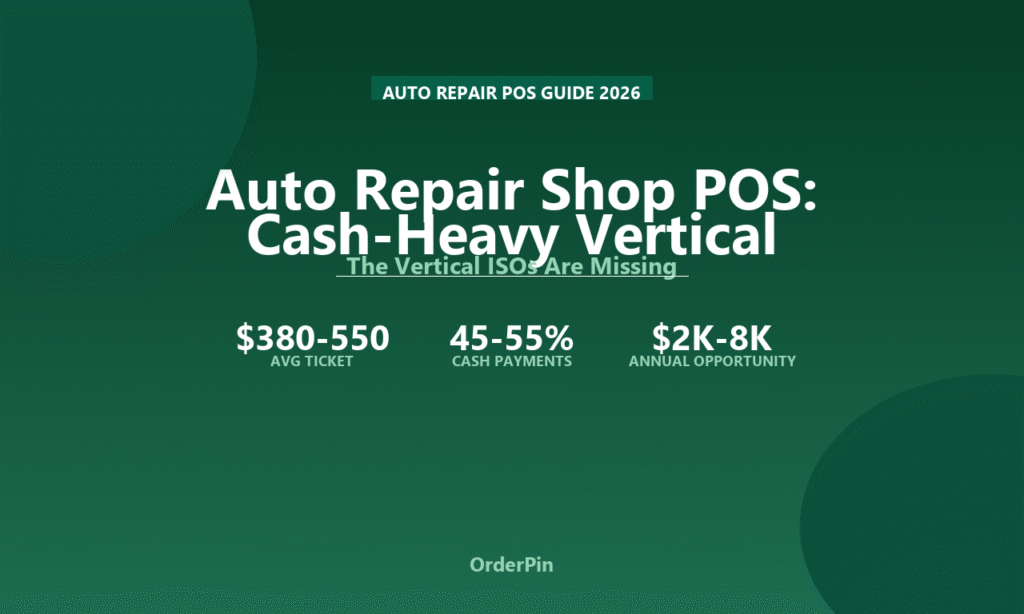
- Auto repair shops process an average ticket of $380–$550, with 45–55% of payments still made in cash or check — making this a uniquely cash-heavy vertical that most ISOs ignore.
- A specialized auto repair POS handles multi-bay job tracking, parts inventory, digital signatures, and integrated payment — turning a manual workflow into a $2,000–$8,000/year ISO opportunity per shop.
- ISOs who crack the auto repair vertical build multi-generational accounts: shops rarely switch POS once the mechanic trusts the system for billing and diagnostics.
Walk into 10 auto repair shops in any U.S. city. Six of them are still using paper receipts, a cash drawer, and a whiteboard for job tracking. This is not a technology problem — it is a massive opportunity.
The auto repair vertical is underserved, loyal, and profitable. Here is why ISOs should prioritize it and how to sell into it.
1. Why Auto Repair Is a Unique Vertical
Auto repair shops have distinct payment behaviors that set them apart from restaurants, retail, and most other verticals:
- High ticket, slow pay: $380–$550 average repair bills. Customers often negotiate or request payment plans.
- Cash dominant: 45–55% of payments are still cash or check, especially for older demographics and repeat customers.
- Parts + labor billing: Every job requires line-item billing: part numbers, labor hours, tax calculation, and sometimes insurance or fleet invoicing.
- Multi-day jobs: Repairs span hours or days. Payment is often collected at vehicle pickup — not at service start.
- Minimal credit card usage historically: Mechanics worry about card processing fees eating into thin margins.
2. What Auto Repair Shops Actually Need in a POS
| Feature | Why It Matters for Auto Shops | Priority |
|---|---|---|
| Multi-bay job tracking | Track status of each vehicle across bays (waiting, in-progress, complete) | Critical |
| Parts inventory | Link parts to repair orders, auto-replenish, track cost vs. retail margin | Critical |
| Digital signatures | Customer signs work order authorization on screen — eliminates paper | Critical |
| Layaway / payment on pickup | Store partial payments and collect balance when vehicle is picked up | High |
| Fleet invoicing | Bulk billing for commercial fleet accounts (car dealers, rental companies) | High |
| Interchange optimization | Route level 2 corporate card transactions for 0.4–0.8% fee savings on $500+ tickets | High |
| Integrated camera/DVR | Photo documentation of damage before and after repair (insurance claims) | Nice to have |
3. The ISO Revenue Opportunity
Additional revenue streams in this vertical:
- Level 2 corporate card routing: Auto shops often accept corporate/fleet cards. ISOs who configure level 2 qualifying save merchants 0.4–0.8% on each transaction — a savings of $2,000–$6,000/year per shop.
- Parts inventory POS upsell: Standalone inventory management software runs $50–$150/month. An integrated POS + inventory bundle commands $100–$200/month.
- Hardware: Auto shops need ruggedized terminals (oil-resistant, tough screens). Premium hardware = premium margin.
4. Selling Into Auto Repair Shops: Key Objections
“My customers pay in cash. I don’t need card processing.”
45–55% cash is real — but the other 45–55% is cards and digital payments. You are leaving $15K–$30K/year in uncollected revenue on the table. And every merchant who pays with a card costs you 2–3%.
“My current system works fine. I’ve been doing this for 20 years.”
The question is not whether it works — it is whether you are making more than you could. A proper POS would show you which services are most profitable, which parts have the best margins, and which customers are costing you money.
“Processing fees will eat my margins on $80 oil changes.”
Interchange-plus pricing with a $0.10 flat fee per transaction is designed for this. On a $80 oil change, you pay $0.10 + ~1.65% = $1.42 in fees. On a $500 brake job, $0.10 + 1.65% = $8.35. That is reasonable — and we can qualify your corporate and fleet cards at Level 2 for even lower rates.
5. Best POS Platforms for Auto Repair
| Platform | Inventory | Job Tracking | Fleet Billing | Level 2 Support | ISO Resale |
|---|---|---|---|---|---|
| Lightspeed | Yes | Yes | Yes | Yes | Strong |
| Clover | Yes | Partial | Partial | Yes | Strong |
| Shopify POS | Yes | No | No | Yes | Moderate |
| Custom/Aggregator | Custom | Custom | Custom | Custom | Best |
Bottom Line
Auto repair is the definition of an underserved vertical: high tickets, loyal customers, limited competition from other ISOs, and multiple revenue streams per merchant. The shops that need POS most are exactly the ones that do not have it yet.
ISOs who invest in understanding the auto repair workflow — parts inventory, multi-bay tracking, fleet invoicing — can position themselves as specialists, not generalists. That is how you win and keep these accounts.
Data sources: Auto Care Association 2026 Factbook, NADA (National Automobile Dealers Association), National Independent Auto Truck Dealers Association, Statista auto repair industry statistics. Market size and payment behavior data reflect U.S. market as of Q1 2026.