
TL;DR — Quick Summary
- In 2026, merchants should accept at least 5 payment types: credit cards, debit cards, contactless wallets (Apple Pay/Google Pay), BNPL solutions, and ACH/bank transfers.
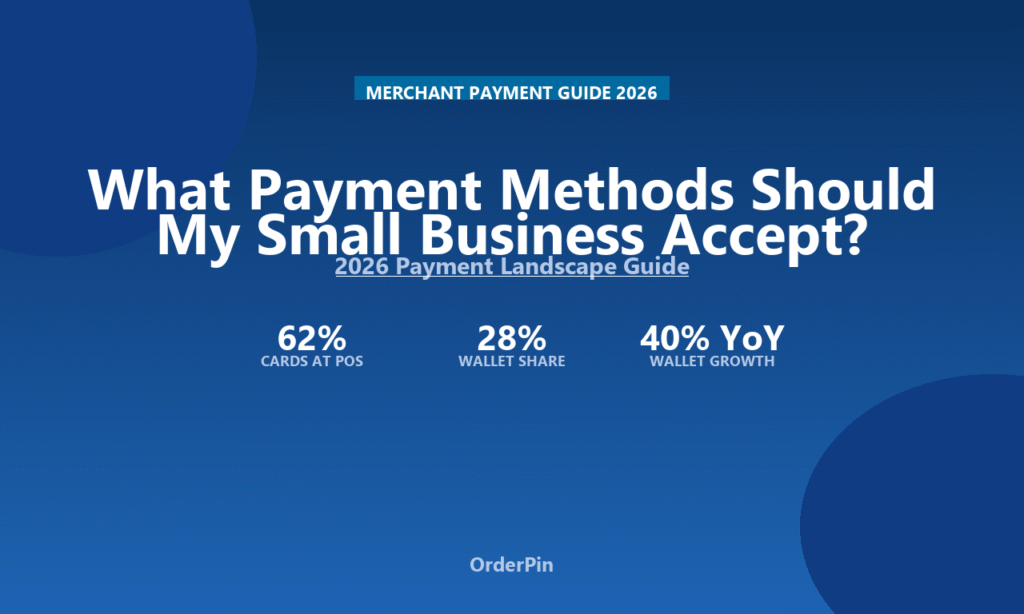
- Card payments still dominate at 62% of in-store transactions, but digital wallets grew 40% year-over-year and now represent 28% of POS volume.
- ISOs who help merchants choose the right payment mix increase processing volume 15-30% and reduce the risk of lost sales from rejected payment methods.
Every small business owner faces the same question: which payment methods should I accept? Accept too few and you lose customers. Accept too many and you pay unnecessary fees.
Here is the 2026 payment method landscape — what is essential, what is optional, and how ISOs can guide merchants to the optimal mix.
1. The Essential Five: Every Merchant Needs These
| Payment Type | Share of POS | Avg Fee | Requirement Level |
|---|---|---|---|
| Credit Cards (Visa, MC, Amex, Discover) | 38% | 1.5–3.5% | Essential |
| Debit Cards (PIN + Signature) | 24% | 0.3–1.5% | Essential |
| Digital Wallets (Apple Pay, Google Pay, Samsung Pay) | 28% | Same as card | Essential |
| BNPL (Affirm, Klarna, Afterpay) | 3% & growing | 2–6% | Recommended |
| ACH/Bank Transfers | 5% | 0.3–1.0% | Recommended |
2. By Industry: Recommended Payment Mix
Quick-Service Restaurant
Cards + wallets = 93% of transactions. Add BNPL for higher-ticket orders ($15+). Skip ACH — QSR customers rarely use it.
Full-Service Restaurant
Cards + wallets + BNPL (for parties of 4+, average ticket $80+). Offer ACH for catering/prepaid orders.
Retail & E-Commerce
All five: cards (60% of sales), wallets (25%), BNPL (8%), ACH (5%), crypto optional.
B2B / Professional Services
Cards + ACH is the minimum. Wallets and BNPL less relevant. Offer invoices via pay-by-link.
3. What Customers Actually Want in 2026
Prefer tap-to-pay (NFC) over inserting or swiping. If your POS doesn’t support contactless, 1 in 5 may walk away.
Have abandoned a purchase because their preferred payment method wasn’t accepted. That is lost revenue a new payment method would have captured.
Plan to add BNPL by the end of 2026. QSR and retail lead adoption.
Accept ACH at the point of sale. For B2B merchants that bill by invoice, this is a missed opportunity.
4. The ISO Sales Playbook
Step 1: Audit the merchant’s current payment stack. What do they accept? What do customers ask for? Look at statement data for patterns.
Step 2: Identify the gaps. Are they missing Apple Pay? BNPL for high-ticket items? ACH for B2B invoices? Each gap is an upsell opportunity.
Step 3: Present the revenue case. “Adding Apple Pay costs you nothing extra — it uses your existing terminal. And 85% of your customers prefer it. We can activate it today.”
Step 4: Enable and track. Activate new payment methods through the merchant’s POS settings. Track volume change over 60 days to prove the value.
Common Questions
“Do I need to accept Amex and Discover?”
Yes — Amex holds 26% of U.S. card spending, and Discover has strong regional penetration. Merchants who block Amex lose 1 in 4 affluent customers.
“Does accepting more methods mean higher fees?”
Not necessarily. Digital wallets use the same underlying card network — no extra fee. BNPL has higher fees but drives higher average orders. The volume gain usually offsets the cost.
“What about cryptocurrency?”
Optional for 2026. Crypto payments are still under 1% of in-store POS volume. Only offer if your merchant has a specific customer demand.
“How do I add more payment methods to my existing POS?”
Most POS platforms support enabling/disabling payment methods in the settings menu. If your hardware supports NFC (most terminals do), digital wallets are already available.
Bottom Line
In 2026, the minimum viable payment stack is: credit cards + debit cards + digital wallets. The competitive stack adds BNPL and ACH. ISOs who help merchants optimize this mix build trust, increase volume, and earn the right to manage every transaction.
Data sources: Nilson Report 2026, Federal Reserve Payments Study 2025, McKinsey Global Payments Report 2026, NRF payments trends. Statistics reflect U.S. market as of Q1 2026.