
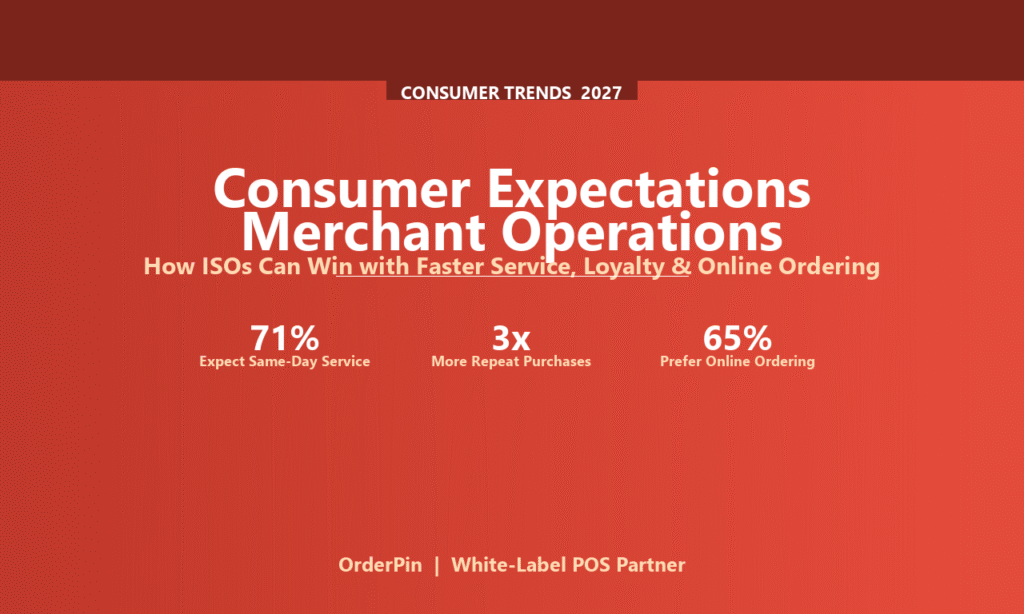
TL;DR — Quick Summary
- What’s changed: 71% of customers now expect same-day service; 65% prefer restaurants with native online ordering; loyalty members generate 3x more repeat purchases.
- The ISO opportunity: Merchants running legacy POS systems are leaving thousands of dollars per year on the table — ISOs who supply integrated modern platforms capture that gap.
- Action for ISOs: Lead merchant conversations with customer data and quantified ROI, not rate sheets. The platform is the product; the partnership is the value.
What Is the Merchant Expectation Shift?
The restaurant industry has always been a volume business — more covers, more transactions, more revenue. What has changed is the pace at which consumers expect things to happen. 71% of customers now expect same-day service or delivery, up from under 50% five years ago. This is not a minor preference shift. It is a structural change in what a viable restaurant operation must deliver to remain competitive.
This expectation acceleration has been driven by the cumulative effect of on-demand platforms. When DoorDash and Uber Eats deliver a meal in thirty minutes, consumers recalibrate what they will tolerate from a dine-in experience. When Amazon promises same-day shipping on household goods, the baseline for “fast enough” moves across all industries. Restaurants still running legacy order-taking systems — paper tickets, phone orders, manual table management — are operating with a fundamental misalignment between their technology and their customers’ expectations.
1. The Acceleration of Consumer Service Expectations
The merchants who are winning in this environment are the ones who have re-engineered their operations around digital speed. Online ordering, digital payments, kitchen display systems, and automated loyalty rewards are not nice-to-have features — they are the baseline infrastructure of a competitive restaurant in 2027. The gap between what consumers expect and what legacy operations deliver is exactly where ISOs add the most value.
Consider the economics: a restaurant processing $500,000/year in revenue through legacy systems with no loyalty program and no native online ordering is leaving revenue on the table in two compounding ways. First, it pays aggregator commissions on the digital orders it does capture — often 20–25% of each transaction. Second, it loses the repeat customer revenue that loyalty programs generate. Merchants using loyalty programs see 3x more repeat purchases — and repeat customers are the margin drivers in every restaurant business.
ISOs who understand this dynamic — and can supply the integrated platform to address it — are positioned as indispensable partners rather than transactional vendors. The conversation shifts from “can you lower my processing rate” to “can you help me run a better restaurant.” That is a far more defensible and valuable relationship to have with a merchant.
Legacy Restaurant vs. Modern Restaurant: The Expectation Gap
| Capability | Legacy POS | Modern POS + Loyalty | Impact |
|---|---|---|---|
| Order capture time | 3–5 min avg. | <60 sec | Meets 71% expectation |
| Repeat purchase rate | Baseline (1x) | 3x with loyalty | 3x revenue per customer |
| Online ordering commission | 15–30% (aggregator) | 0% (first-party) | $0 commission cost |
| Customer data ownership | None | Full ownership | Actionable marketing |
| ISO relationship value | Rate vendor | Operational partner | Defensible, recurring |
2. How Digital Expectations Are Rewriting the Merchant Playbook
65% of diners now prefer restaurants with online ordering as their primary engagement channel. This is not a Gen Z phenomenon — it spans demographics. Parents ordering on a work break, older diners avoiding phone wait times, regulars who know what they want and don’t want to wait for a server to take the order. Online ordering has become the path of least resistance for a growing majority of restaurant customers.
For merchants, this shift requires more than adding a third-party delivery tab. Restaurants without native online ordering are ceding margin to aggregator platforms that take 15–30% of each order. A restaurant doing $500,000 in annual revenue through third-party apps at a 25% commission is paying $125,000/year in aggregator fees — fees that disappear the moment a better first-party digital channel becomes available. First-party online ordering keeps the customer relationship, the data, and the margin.
The playbook rewrite also touches the physical experience. Tableside tablets, QR-code menus, contactless payment, and digital loyalty enrollment are all now expected by a significant portion of the diner base. Merchants who deploy these tools report lower perceived wait times, higher ticket sizes (digital upsell prompts outperform verbal upsells by most measures), and better customer data for targeted marketing. The technology investment compounds across both the digital and physical dining experience.
3. The Loyalty Loop: Turning First-Time Diners Into Regulars
The economics of restaurant customer acquisition are brutal. A first-time diner who walks in off the street costs the restaurant nothing in acquisition — but also represents almost no value on their own. The value of that customer is realized only if they come back. Merchants using loyalty programs see 3x more repeat purchases from enrolled customers compared to non-enrolled customers. That multiplier reshapes the unit economics of every restaurant that implements it correctly.
The mechanics of an effective loyalty loop are straightforward: capture the customer’s information on the first visit, give them a compelling reason to return (points, rewards, personalized offers), and use the data from repeat visits to make each subsequent experience more targeted. A customer who receives a birthday offer they actually want to redeem, a points balance they are close to redeeming, or a menu recommendation based on their order history is a customer who comes back. Repeat visits drive the majority of revenue for most restaurants.
The data layer is often underappreciated. Loyalty programs generate structured, longitudinal data on customer preferences, visit frequency, and order patterns. This data enables segmentation — identifying high-value regulars who deserve VIP treatment, detecting customers at risk of lapsing before they do, and tailoring marketing messages to specific audience segments rather than broadcasting generic promotions. Restaurants that operate without this data are flying blind in a market where their competitors increasingly are not.
4. What This Means for Technology Investments
Restaurants have historically underinvested in technology relative to other industries. The margins are thin, the decision-makers are often operators rather than technologists, and the perception of technology as an expense rather than an investment has led to years of deferred upgrades. That calculus is changing. The merchants who are growing revenue in 2027 are not doing so by cutting costs — they are doing so by capturing more of the customer journey through better technology.
The core technology investments that matter most for merchant operations are interconnected. A modern POS platform is the foundation — it captures every transaction, feeds the loyalty program, enables online ordering, and generates the reporting data that powers operational decisions. Layered on top: online ordering that feeds directly into the kitchen display system, loyalty enrollment that is frictionless at the point of sale, and payment processing that handles digital wallets, contactless, and card-not-present transactions without friction.
The mistake many merchants make is buying point solutions that don’t integrate. A loyalty app that doesn’t talk to the POS. An online ordering platform that runs on a separate tablet and requires manual re-entry. A payment processor that doesn’t capture the order data needed for reporting. Each disconnected system creates operational overhead, data fragmentation, and a worse experience for both the merchant and the customer. 65% of diners prefer restaurants with online ordering — but they prefer it far more when the experience is seamless, which requires integration, not another standalone app.
How OrderPin Helps ISOs Meet Merchant Expectations
Built-in Loyalty
Loyalty enrollment and rewards built directly into the POS workflow — no separate app, no additional training required.
Native Online Ordering
First-party online ordering that feeds directly into the kitchen — zero aggregator commissions, full customer data ownership.
White-Label for ISOs
ISOs deploy the platform under their own brand — data ownership, flexible pricing, and full recurring revenue under your brand.
5. How ISOs Can Position for the New Merchant Expectation
The ISO that shows up to a merchant conversation with a rate sheet is offering a commodity. The ISO that shows up with a comprehensive understanding of how the merchant’s customers behave, what they expect, and how technology can close the gap between those expectations and the merchant’s current operations — that ISO is offering a partnership. The shift in positioning from rate vendor to operational partner is the single most important strategic move an ISO can make in this environment.
The merchant conversation should lead with customer data, not feature lists. “71% of your customers expect same-day service — here’s how your current ticket time compares to that benchmark and what we can do to close that gap.” “3x more repeat purchases from loyalty members — here’s what a loyalty program would generate in additional annual revenue for a restaurant of your volume.” This framing makes the technology investment concrete and ROI-driven rather than aspirational and abstract.
ISOs should also be actively educating their merchant base on the cost of inaction. Merchants who are still processing on legacy platforms, paying aggregator commissions on online orders they could own, and losing repeat customers because they have no loyalty infrastructure are leaving money on the table every single day. Quantifying that cost — in concrete dollars per month — is often the most effective way to move a merchant from “interesting idea” to “I need this now.”
The ISOs who invest in understanding consumer behavior trends, can translate those trends into merchant-relevant insights, and have the technology platform to execute on those insights — are the ISOs that will grow. The market is moving toward merchants who meet consumer expectations. ISOs who can help their merchants get there are not just vendors — they are the infrastructure that makes modern restaurant operations possible.
Frequently Asked Questions
Why do 71% of consumers expect same-day service, and what does it mean for restaurant operations?
The 71% figure reflects the cumulative effect of on-demand platforms setting new baseline expectations across all service industries. When consumers can order groceries, meals, and goods with a few taps and receive them within hours, waiting 45 minutes for a table or a check becomes a negative experience. Restaurants that want to remain competitive need operational technology — online ordering, kitchen display systems, digital table management — that compresses service time and delivers on the speed customers now expect by default.
How significant is the 3x repeat purchase multiplier from loyalty programs?
Extremely significant. Merchants using loyalty programs see 3x more repeat purchases from enrolled customers. For a restaurant doing $500,000/year with a 60% repeat customer rate, moving even 30% of customers to a loyalty program and doubling their visit frequency adds approximately $90,000 in incremental annual revenue — revenue that is predictable, repeatable, and driven by the platform rather than by expensive marketing campaigns.
Why is native online ordering so important when third-party aggregators already handle it?
Because 65% of diners prefer restaurants with native online ordering, and the majority of that preference goes to restaurants with first-party digital ordering rather than third-party marketplaces. Aggregator platforms charge 15–30% commission per order — commissions that a native first-party ordering system eliminates entirely. A restaurant doing $200,000/year in delivery orders through a 25% commission aggregator is paying $50,000/year for the privilege. First-party online ordering captures that margin, the customer data, and the relationship.
Is loyalty technology difficult for restaurants to implement and manage?
It doesn’t have to be. Modern loyalty programs integrated directly into the POS eliminate most of the operational friction. Enrollment happens at the point of sale in under 30 seconds, points accrue automatically with every transaction, and reward redemption is handled by the same system without any manual tracking. The key is choosing a platform where loyalty is not a separate app but a built-in feature of the POS workflow — that way the program is always active, always visible, and requires no additional training or processes for restaurant staff.
How should ISOs structure merchant conversations about consumer expectation trends?
Lead with data, not product. Open with the consumer behavior trends that are affecting the merchant’s specific market — the 71% same-day expectation, the 65% online ordering preference, the 3x loyalty multiplier. Translate each trend into a concrete dollar impact for the merchant’s operation. Then position the ISO’s platform as the tool that closes the gap between where the merchant is today and where consumer expectations are heading. The merchant who understands the cost of inaction will move much faster than the one who is simply being sold a feature.
Consumer expectations have reset the baseline for what a viable restaurant operation must deliver. 71% expect same-day service, 65% prefer native online ordering, and loyalty program members generate 3x more repeat purchases. Merchants who invest in the technology to meet these expectations — and the ISOs who supply it — are positioned to capture the customers and revenue that laggards are leaving on the table. OrderPin is a restaurant POS software ISV focused on helping merchants streamline operations.
About OrderPin
OrderPin is a restaurant POS software ISV focused on helping ISO and MSP partners deliver the technology their merchants need. Our white-label platform combines built-in loyalty, native online ordering, and real-time reporting — all under your brand, with full data ownership and flexible pricing. Learn more about OrderPin’s white-label solution