
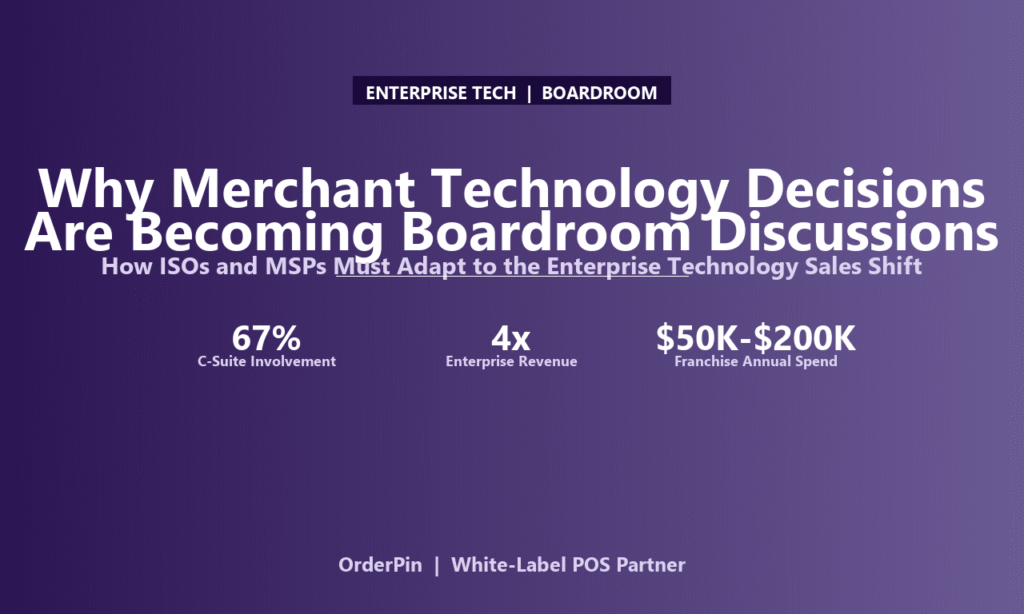
Merchant technology purchasing used to happen in the back office. Not anymore. 67% of merchants with 10+ locations now involve C-suite executives in POS decisions, and franchise groups are committing $50K–$200K annually to technology infrastructure. ISOs who can speak to CFOs and boards — not just operations managers — are capturing enterprise accounts while those still selling to store managers watch the market move upmarket.
1. The Shift from Ground-Level to Boardroom POS Decisions
Ten years ago, a restaurant POS decision looked like this: the owner talked to a vendor, maybe their accountant weighed in, and a purchase order got signed. The decision lived at the operations level — practical, tactical, and largely invisible to anyone above the store manager.
That world is gone. Today, technology purchasing at growing restaurant groups has migrated decisively upward. 67% of merchants operating 10 or more locations now involve C-suite executives — typically the CFO or CEO — in POS and payment technology decisions. At franchise groups and multi-location operators, the equivalent of a boardroom review is now standard procedure before any major technology commitment.
The driver is simple: the money involved. A 20-location franchise group committing to a unified POS platform is making a capital decision that affects the balance sheet for years. When a single enterprise deal can represent $500,000 in annual processing revenue plus software subscriptions, the CFO wants a seat at the table. This isn’t a preference — it’s a structural shift in how the industry buys.
For ISOs and MSPs, this shift is both a challenge and an enormous opportunity. The challenge: your sales pitch now needs to satisfy an audience that evaluates ROI models, vendor risk, and integration architecture. The opportunity: ISO partnerships with enterprise merchants generate 4x more revenue than portfolios focused exclusively on single-location SMB accounts. The boardroom doesn’t just change who you talk to — it changes the size of the deal.
2. What’s Driving C-Suite Involvement in Merchant Technology
Three forces are pushing technology decisions up the organizational ladder. Understanding them isn’t academic — it’s the foundation for building the right pitch to the right buyer.
First, technology spend has become material to the income statement. Franchise groups now invest $50,000 to $200,000 annually in technology infrastructure — not as overhead, but as a strategic line item that competes with other capital allocations. When technology spending crosses that threshold, the CFO has a fiduciary responsibility to evaluate it rigorously. It’s no longer a line item the operations team can approve unilaterally.
Second, payment and POS data now feeds directly into enterprise reporting systems. Modern POS platforms generate daily sales reports, labor analytics, food cost trends, and customer loyalty data that feed into executive dashboards. When the CEO reviews weekly performance, they’re looking at numbers the POS produced. That means the executive team has a direct operational stake in the quality and reliability of the technology — and they take the selection seriously because they live in its outputs every day.
Third, vendor concentration risk is a legitimate board-level concern. A franchise group that standardizes on a single POS vendor across 50 locations has made a significant risk decision. If that vendor has an outage, raises prices, or gets acquired, the impact flows straight to the board. CFOs and general counsels now explicitly evaluate vendor lock-in and data portability as part of every technology evaluation — concerns that never appeared in a conversation with a store manager.
3. The ISO Playbook for Boardroom-Level Conversations
Selling to a CFO is a fundamentally different skill than selling to an operations manager. The operations manager asks: does this work? Does it have the features I need? The CFO asks: what does this cost, what return does it deliver, and what risk does it introduce? ISOs who can answer all six questions — and present them in a format a CFO can take to a board — are the ones closing enterprise deals.
The first adjustment is language. An ISO who walks into an enterprise pitch talking about “terminal features” and “payment processing rates” signals they belong in a different conversation. The boardroom language is ROI, total cost of ownership, contract terms, service level agreements, and data security compliance. An ISO who can walk a CFO through a three-year TCO model that shows payback period and net margin contribution is speaking the language that gets meetings scheduled, not forwarded.
The second adjustment is documentation. Enterprise deals move through procurement and legal processes that require formal proposals, SLAs, and compliance documentation. An ISO who can provide a polished ROI deck, a clear SLA with uptime commitments, and SOC 2 compliance documentation has cleared hurdles that stop competitors who show up with a brochure and a handshake. The barrier to entry in the boardroom is higher — but so is the barrier to exit for the merchant.
The third adjustment is the relationship structure. Enterprise deals are rarely closed by a single rep calling on a single contact. They involve a multi-stakeholder engagement: the ISO’s senior leadership building trust with the merchant’s executive team, technical teams working through integration requirements, and legal reviewing contract terms. An ISO that can mobilize this kind of engagement — and sustain it across a multi-month sales cycle — is playing a different game than one chasing SMB accounts with a direct-to-owner cold call.
4. Enterprise and Franchise Opportunities for ISOs
Franchise groups and multi-location operators represent the highest-value segment in merchant services — and ISOs who position for them correctly are generating outsized returns. Enterprise merchant partnerships generate 4x the revenue of ISO portfolios focused purely on single-location SMBs. The math is straightforward: one franchise group with 30 locations is worth more than thirty individual single-location merchants, with far lower acquisition cost per location and far higher retention.
Franchise groups are particularly well-suited to the white-label POS model that ISOs can deliver. A franchise brand that wants consistent technology across all locations —统一的菜单显示, centralized reporting, unified loyalty programs — needs a platform that can be branded, configured, and deployed at scale. An ISO who can offer that platform as a white-label solution becomes a strategic partner rather than a vendor. The relationship shifts from “we sell you payment processing” to “we provide your technology infrastructure,” and that repositioning changes the pricing power, retention, and long-term value of the relationship entirely.
The technology investment thesis also favors ISOs who move upmarket. Franchise groups committing $50,000 to $200,000 annually to technology infrastructure are actively looking for partners who can help them deploy, manage, and optimize that spend. An ISO who can position themselves as a strategic technology partner — not just a payment processor — can capture consulting revenue, implementation revenue, and ongoing software margins in addition to the baseline processing relationship.
The practical reality: multi-location operators have already decided technology is a strategic priority. The question is whether ISOs are positioned to be the partner they’re looking for. The window is open — but it’s closing as more ISOs recognize the same opportunity and the competitive landscape in the enterprise segment intensifies.
5. How ISOs Can Prepare for the New Technology Sales Landscape
The shift toward boardroom-level technology decisions isn’t a trend ISOs can wait out. It’s a structural change in how the market buys, and the ISOs who adapt will capture the enterprise segment while those who don’t will find themselves increasingly relegated to a shrinking SMB market. Here’s what preparation looks like in practice.
Build an enterprise-ready value proposition. This means ROI calculators that a CFO can use, case studies from comparable enterprise deployments, reference clients who will speak to a prospective merchant’s executive team, and SLA commitments that match what enterprise buyers expect. It also means having your legal and compliance documentation organized: SOC 2 Type II reports, data processing agreements, and contract terms that enterprise legal teams can actually approve without a six-month negotiation.
Develop the right platform. Enterprise merchants don’t want a cobbled-together stack of point solutions — they want a unified platform that delivers POS, payments, reporting, loyalty, and digital ordering under a single contractual relationship. An ISO’s ability to offer that platform — or partner with a white-label POS provider who can — is the foundational capability that makes enterprise sales possible. OrderPin provides ISOs with a white-label POS platform purpose-built for this type of enterprise deployment at scale.
Invest in the sales relationship before the deal. Enterprise sales to franchise groups and multi-location operators move slowly, and the decision-makers change roles. An ISO who has been in a relationship with a franchise group’s executive team for two years before a technology decision is made has a decisive advantage over one who shows up with a proposal when the RFP is already published. Relationship capital in the enterprise segment compounds — and it’s built through consistent value delivery, not transactional sales calls.
The bottom line on preparation: the ISO who can speak boardroom language, present enterprise-grade documentation, and deliver a unified technology platform is positioned to capture the highest-value segment of the merchant services market. The shift from store-manager sales to CFO sales is not optional — it’s the difference between competing for the market that exists today and owning the market that exists five years from now.
Frequently Asked Questions
Q1: Why are C-suite executives now involved in POS purchasing decisions?
Technology spend at multi-location restaurant groups has become significant enough to warrant executive oversight. 67% of merchants operating 10+ locations now involve the CFO or CEO in POS decisions because the commitment involves material capital allocation, multi-year contracts, and operational data that flows into executive dashboards. It’s a fiduciary responsibility, not a preference.
Q2: How much do franchise groups actually invest in technology infrastructure?
Franchise groups and serious multi-location operators commit $50,000 to $200,000 annually to technology infrastructure, encompassing POS platforms, payment processing, software subscriptions, integration costs, and ongoing support. That range represents a strategic capital decision that requires board-level scrutiny, not a tactical purchase the operations team makes independently.
Q3: How does selling to enterprise merchants differ from selling to SMBs?
Enterprise sales require boardroom-level preparation: ROI models and TCO analyses for CFOs, SLA commitments and compliance documentation for legal teams, reference clients for executive evaluations, and multi-stakeholder relationship management across a longer sales cycle. ISOs who can present this package generate 4x more revenue from enterprise accounts than from SMB-only portfolios.
Q4: What makes franchise groups a particularly attractive segment for ISOs?
A single franchise group with 30–50 locations is worth more than 30–50 individual single-location merchants combined, with lower per-location acquisition cost and dramatically higher retention. Franchise groups also want white-label platforms that carry their brand, creating a sticky, long-term partnership rather than a transactional processing relationship.
Q5: How can an ISO prepare to sell at the boardroom level?
Start by building the enterprise toolkit: polished ROI and TCO documentation, SOC 2 compliance documentation, SLA commitments, reference clients, and case studies from comparable deployments. Partner with a white-label POS platform that can deliver the unified technology experience enterprise buyers expect. Then invest in relationships before the deal — enterprise sales are won by ISOs who have been in the room for two years, not those who show up when the RFP drops. OrderPin is a restaurant POS software ISV focused on helping merchants streamline operations.
The merchant technology market has moved to the boardroom, and the ISOs who have followed it there are generating 4x the revenue of those still selling to store managers. 67% of multi-location merchants now involve C-suite executives in POS decisions, franchise groups are committing $50K–$200K annually to technology infrastructure, and the window for ISOs to position as enterprise technology partners is open now. Build the enterprise toolkit, speak the boardroom language, and find the white-label platform that lets you deliver at scale. The market isn’t waiting.