
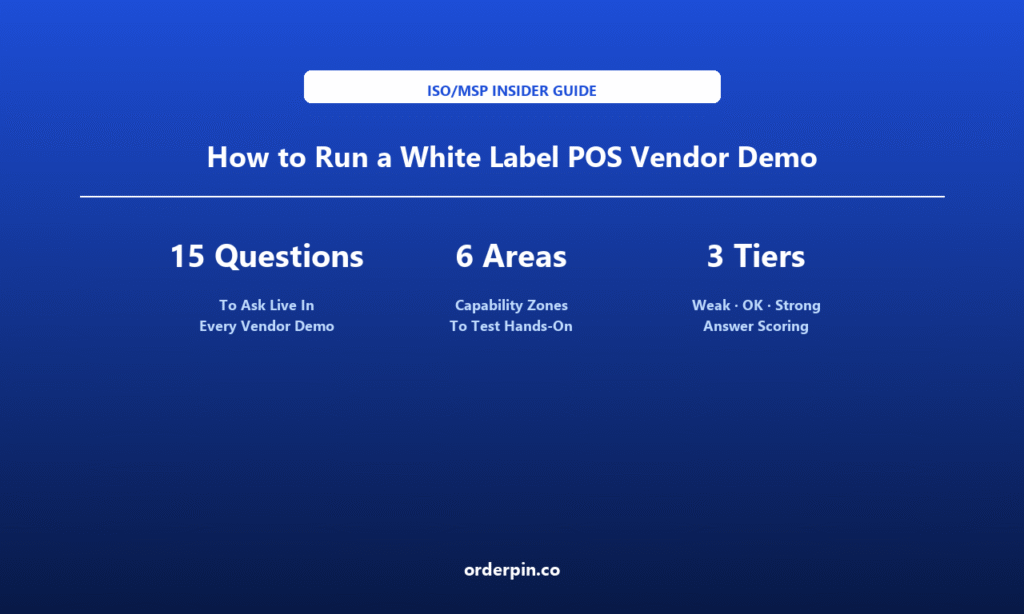
TL;DR — Quick Summary
- A vendor demo is a scripted performance, not an audit: the vendor controls the narrative, shows the prettiest features, defers pricing to a later call, and hides edge cases. ISOs who treat the demo as proof usually discover the gaps only after the contract is signed — when the cost to leave is highest.
- 15 questions across six capability areas turn the demo into evidence: API & integration, reliability & SLA, data & portability, pricing & fees, white-label depth, and AI features. Each question is designed to force a live, verifiable answer — not a slide. Ask them, score the answers Weak / OK / Strong, and you leave the call with data instead of impressions.
- The demo output feeds directly into the AD9 10-dimension scoring framework: your demo scores on the six areas map onto AD9 dimensions (API breadth, uptime, pricing transparency, white-label flexibility, AI depth, exit terms). Score the demo before you sign — the framework makes the tradeoffs explicit so the decision is based on evidence, not a polished pitch.
Every Demo
To Test Hands-On
Answer Scoring
Why Most Vendor Demos Fail You
A white label POS demo is built by the vendor, for the vendor. The sequence is designed to make the platform look effortless: the prettiest dashboard, the smoothest transaction, the cleanest report. What you do not see is the integration that took three weeks, the SLA that paid out zero credits last year, the rate escalation clause buried in schedule B, or the data export that costs $2,000 on exit. The demo is not lying — it is curating. And curation is the enemy of due diligence.
The fix is not to trust the demo less — it is to run the demo differently. Walk in with 15 questions that force live, verifiable answers, and a scoring rubric that turns each answer into a data point. By the end of the call, you should have evidence on the six capability areas that actually determine your long-term margin, merchant retention, and exit flexibility — not a feeling that the platform “seemed good.”
nothing until you test it
Pricing · Brand · AI
Score Every Reply
Before The Call
Before the Demo: Send the Vendor Your Test Merchant
The single biggest lever in demo quality is what happens before the call. Most ISOs accept a generic walkthrough of the vendor’s showcase account. Instead, send the vendor a representative test merchant profile 48 hours ahead — your typical restaurant or retail layout, your menu or catalog structure, your expected transaction volume — and require that the demo runs on a live sandbox or trial environment you can log into afterward, not a slides-only presentation.
Three prep rules that change the answers you get: (1) Require live environment access — if they can only show slides, that is your first data point. (2) Ban “let’s talk about pricing later” — pricing is question 9 and 10, and it stays on the agenda. (3) Record the session (with permission) so you can score answers against the rubric afterward instead of from memory. A vendor who resists any of these three is telling you something about what they are confident showing.
The 15 Questions, by Capability Area
Each question below is designed to force a verifiable answer. The “Strong answer proves” line tells you what evidence to look for. Ask all 15 in every demo — the pattern of weak answers across areas is more informative than any single feature.
Area 1 — API & Integration (Q1–Q3)
Q1. Can I see the API documentation now, and is there a live sandbox I can call with my own keys?
Strong answer proves: complete, current docs and a sandbox you control — not a Postman collection someone emails later.
Q2. Show me a real webhook firing end-to-end — not a screenshot of the logs.
Strong answer proves: event delivery actually works, with retries and a dead-letter path, in the environment you will use.
Q3. When an integration breaks, who owns the fix and what is the timeline — and show me the support SLA for it?
Strong answer proves: a defined ownership and remediation path, not “our engineers will look at it.”
Area 2 — Reliability & SLA (Q4–Q6)
Q4. What is your actual uptime over the last 12 months, and show me the public status page history?
Strong answer proves: a published number with incident history — not “we rarely go down.”
Q5. What does the SLA credit actually pay out, and how many times have you paid it in the last year?
Strong answer proves: credits are real and have been paid — a 99.99% SLA with no payout history is theater.
Q6. If your primary region goes down, what happens to my merchants — is there failover, and what is the RTO?
Strong answer proves: a documented failover and recovery time, not best-effort.
Area 3 — Data & Portability (Q7–Q8)
Q7. Export all of my merchant data in a machine-readable format right now — show me it works.
Strong answer proves: portable data on demand, not a “request processed in 30 days” process.
Q8. If I leave in month 13, is the export still free and complete — and is that in the contract?
Strong answer proves: portability is contractual at exit, not a friendship favor (see AD7 and AD8).
Area 4 — Pricing & Fees (Q9–Q10)
Q9. Show me the full rate card including escalation clauses — live, in the contract, not the one-pager.
Strong answer proves: every fee is visible now, including what changes in year two and three.
Q10. What fees appear after year one that are not on this sheet — and what triggers them?
Strong answer proves: they name the post-year-one fees voluntarily, instead of waiting for you to find them.
Area 5 — White-Label Depth (Q11–Q13)
Q11. Log in as my end merchant would see it — is the entire experience my brand, or yours showing through?
Strong answer proves: full white-label depth — dashboard, domain, receipts (see AD13).
Q12. Can my merchants email support@mydomain.com and get my branding in the reply?
Strong answer proves: support identity is yours, not a shared vendor queue with their footer.
Q13. Show me an app store listing under a partner brand, not yours.
Strong answer proves: the brand extends to the app stores, not just the web dashboard.
Area 6 — AI Features (Q14–Q15)
Q14. Run the AI feature on live data in this demo — not a pre-recorded clip.
Strong answer proves: the AI works on real input now, and you can evaluate accuracy (see AD6).
Q15. Who owns the output and the training data if I enable AI — and is that in the DPA?
Strong answer proves: your merchant data is not used to train their model without consent, in writing.
How to Score Each Answer: Weak / OK / Strong
Every answer gets one of three tiers. The tier, not the feature list, is what you carry into the AD9 framework. A “Weak” on a critical area is a red flag; an “OK” means it works but with caveats; a “Strong” means verifiable evidence was produced live.
| Capability Area | Weak | OK | Strong |
|---|---|---|---|
| API & Integration | Docs incomplete; no sandbox you control | Docs exist; sandbox shared but limited | Full docs + your own sandbox keys, live call works |
| Reliability & SLA | No SLA; “we rarely go down” | SLA stated; no payout history shown | SLA + status history + credits paid |
| Data & Portability | Export “on request”; fees at exit | Export works; exit terms unclear | Live export now; free at exit, in contract |
| Pricing & Fees | One-pager only; “let’s discuss later” | Full card; escalation vague | Full card + year 2/3 fees named live |
| White-Label Depth | Vendor brand throughout | Logo/color only; domain is theirs | Brand, domain, receipts, support, app store |
| AI Features | Slides only; no trial | Demo works; data terms unclear | Live on real data; DPA protects your data |
Red Flags That End the Conversation
Some answers are not just weak — they are disqualifying. If you hear any of these, the demo has done its job: it has shown you the gap before you paid to find it.
1. “We can’t show the contract, but trust us on pricing.” — If pricing transparency fails live, it will fail worse in year two (see AD12).
2. “Data export is a service, billed separately.” — Portability is a right, not a fee. This is the AD8 fine print in action.
3. “The AI runs on your merchants’ data for training.” — Without a restrictive DPA, this is a compliance liability you inherit (see AD6).
4. “Our brand shows on the merchant receipt, that’s standard.” — If the merchant sees the vendor, you do not own the relationship (see AD13).
5. “We don’t publish uptime, but we monitor it.” — Unverifiable reliability is unmanaged risk. No status page, no deal.
From Demo to Decision: Feeding the AD9 Framework
Your demo scores map directly onto the AD9 10-dimension framework. Convert each area tier to a 1–5 score (Weak = 1–2, OK = 3, Strong = 4–5) and drop it into the matching dimension. The demo is your fastest way to populate the framework with real evidence before you request contracts.
| Demo Area | Feeds AD9 Dimension | Vendor Score 1-5 |
|---|---|---|
| API & Integration | D01 API Breadth | |
| Reliability & SLA | D02 Uptime Reliability | |
| Pricing & Fees | D03 Pricing Transparency | |
| White-Label Depth | D04 White Label Flexibility | |
| AI Features | D05 AI Feature Depth | |
| Data & Portability | D08 Exit Terms & Portability |
Demo the shortlist of two to three vendors using the same 15 questions, then score them on the AD9 worksheet with your ISO-profile weights applied. The vendor with the highest weighted total — and no Weak tiers on critical dimensions — is your evidence-based choice. The demo is no longer the decision; it is the data behind it.
How OrderPin Handles the 15 Questions
OrderPin is a white-label POS platform built for ISO and MSP partners. In a vendor demo, OrderPin provides a complete documented API with your own sandbox keys, a public status page with uptime history, full pricing transparency with all fees in the contract (including year-two escalation caps), a fully white-labeled experience across dashboard, domain, receipts, support email, and app store, genuine AI features you can test live, and full data portability at any time — including at exit, with no export fees. Ask the same 15 questions in this framework and score OrderPin against any other platform you evaluate.
Frequently Asked Questions
How long should a proper vendor demo take?
Budget 60 to 90 minutes. A 20-minute highlight reel is a marketing session, not an evaluation. The 15 questions across six areas need time for live testing, and you should leave 10 to 15 minutes for the vendor to actually perform the actions (export data, fire a webhook, log in as your merchant) rather than describe them. If a vendor cannot fill 60 minutes with verifiable evidence, that constraint is itself a signal.
Should I bring my own technical person to the demo?
Yes, if you have one. Questions Q1 through Q3 (API, webhooks, integration ownership) are technical, and a developer will spot a vague answer faster than a sales lead will. If you do not have technical staff, send the test merchant profile ahead and require the live sandbox access anyway — you can still score the area OK or Weak based on whether the vendor produced verifiable evidence versus slides. The presence of a technical evaluator mainly improves the quality of the Q1–Q3 scores.
What if the vendor answers everything Strong except pricing?
Treat a Weak on pricing (Area 4) as a critical-area failure regardless of how strong the rest is. Pricing transparency and exit terms (Area 3) are the two dimensions where a gap shows up as recurring margin loss or trapped merchants over the full contract term. A vendor who is evasive on pricing live will be less transparent in the contract. Either get the full rate card with escalation clauses in the demo, or weight the gap heavily enough in the AD9 framework that it drops them below a more transparent competitor.
Can I run this demo framework on a platform I already use?
Absolutely — and you should, annually. Run the 15 questions against your current platform as a renewal checkpoint (see AD20). The answers you get today versus at signing tell you whether the vendor has drifted on the dimensions that matter. If portability, pricing transparency, or SLA evidence has weakened, that is your leverage at renewal. The framework is not just for new selection; it is a recurring audit tool for the platform you already depend on.
How do I handle a vendor who wants to “customize the demo for you”?
Customization is fine for the test merchant profile you send — that is the prep step. What you should not accept is a demo built around features you did not ask about while the 15 questions go unanswered. If a vendor steers toward their strengths and away from your questions, gently return to the list: “That’s great, now can we do Q7 — export the data live?” A vendor who consistently redirects is showing you where the gaps are. The discipline is staying on the 15 questions, not letting the agenda drift to their script.
Is recording the demo legally risky?
Recording a vendor sales call is standard practice and low risk as long as you ask for permission at the start — most vendors agree because it helps their own team. The recording is for your internal scoring, not publication. If a vendor refuses to let you record a sales demo, that refusal is itself a data point worth scoring. The goal of recording is simply to score answers against the rubric from evidence rather than memory, which improves the quality of your AD9 framework inputs.
A vendor demo is a curated performance, not an audit — and curation is the enemy of due diligence. Walk in with 15 questions across six capability areas (API & integration, reliability & SLA, data & portability, pricing & fees, white-label depth, and AI features) and force live, verifiable answers. Score every reply Weak / OK / Strong, watch for the five red flags that end the conversation, and map your scores into the AD9 10-dimension framework before you request contracts. The demo stops being the decision and becomes the evidence behind it. Run the same 15 questions on every vendor you shortlist — including OrderPin, a white-label POS platform built for ISO and MSP partners with a complete API, full pricing transparency, no exit fees, and a fully white-labeled experience designed to score well on every question in this framework.
About OrderPin
OrderPin is a white-label POS platform built for ISO and MSP partners. We offer full data ownership, flexible pricing, and seamless API integrations to help you build a recurring revenue business under your own brand. Learn more about OrderPin’s white-label solution