
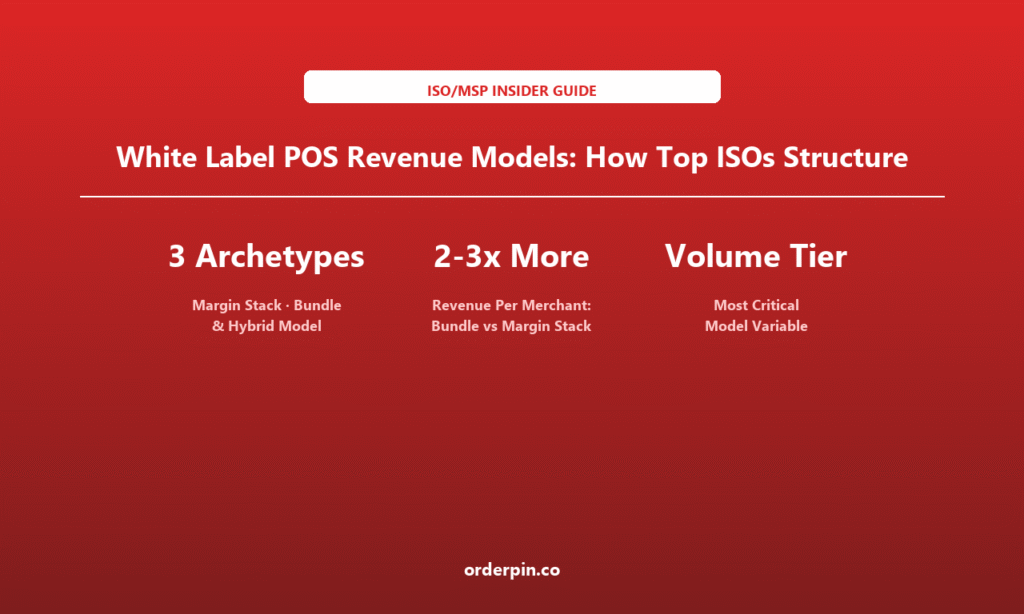
TL;DR — Quick Summary
- The three dominant revenue archetypes for white label ISOs produce very different income profiles — and the right model depends on your ISO’s size, technical capacity, and merchant base: the Margin Stack model generates predictable per-transaction margin with low complexity; the Bundle model adds monthly platform fees and professional services for higher MRR but requires support capacity; the Hybrid model splits the portfolio by merchant segment for maximum flexibility but adds operational complexity.
- Volume tier is the most important variable in revenue model selection: ISOs serving sub-$100K annual merchant volume typically cannot generate sufficient margin under the Bundle model alone — the per-merchant support cost exceeds the platform fee income. ISOs serving $500K+ merchants can carry the Bundle model because the platform fee income covers support costs at scale. The revenue model decision is partly a function of the merchant volume you serve.
- Most ISOs default to the Margin Stack model without considering whether the Bundle or Hybrid model fits their business better: the Margin Stack is the simplest to operate — you earn the spread between the interchange rate and the merchant rate. But ISOs with the technical capacity to white label deeply and the sales capacity to bundle professional services can earn 2–3x more per merchant under the Bundle model. The revenue model decision deserves its own strategic framework, not just a default to the simplest option.
· Hybrid
Bundle vs Margin Stack
Model Variable
Why Revenue Model Selection Deserves Its Own Framework
Most ISOs enter the white label POS business with a Margin Stack model by default — you set your merchant rate, the platform charges you a wholesale rate, and you earn the spread. It is the simplest model to operate and the easiest to explain to merchants. But it is not always the most profitable, and for ISOs with the capacity to white label deeply and bundle services, it leaves significant margin on the table.
This article lays out the three dominant revenue archetypes — Margin Stack, Bundle, and Hybrid — with benchmarks by merchant volume tier, so you can evaluate which model fits your ISO’s actual size, technical capacity, and merchant profile. The right revenue model for a 50-merchant portfolio running a Margin Stack is different from the right model for a 500-merchant portfolio running a Bundle. The goal is to choose with a framework, not a default.
+ SaaS add-ons
share + services
white label strategic
tech, merchant profile
Archetype 1: The Margin Stack Model
The Margin Stack is the simplest white label revenue model: you set the merchant’s processing rate, the platform charges you a wholesale interchange-plus rate, and you keep the spread. Additional revenue comes from SaaS add-ons — a monthly platform fee for the white-labeled dashboard, analytics, or loyalty tools — that the merchant pays on top of the processing margin.
Typical income per merchant (sub-$100K annual volume): $50–$150/month from the interchange spread (assuming 30–50 bps markup on $20K–$40K average monthly volume) plus $20–$50/month from SaaS add-ons. Total: $70–$200/month per merchant. Break-even support cost at this volume tier: approximately $30–$80/month per merchant. Net margin per merchant: $40–$120/month.
Best for: ISOs with limited support capacity, merchants under $100K annual volume, or ISOs using white label as a supplementary revenue stream alongside a primary processing business. Lowest complexity, lowest upside.
Archetype 2: The Bundle Model
The Bundle model layers three revenue streams into a single merchant contract: a monthly platform fee (the “bundle” — typically $50–$200/month per location), a per-transaction revenue share (you take a cut of the interchange spread), and professional services revenue (implementation, training, custom configuration — billed as a one-time or retainer engagement).
Typical income per merchant ($100K–$500K annual volume): $150–$400/month from the monthly platform fee, $100–$300/month from the transaction revenue share (on $30K–$80K monthly volume at 30–50 bps), plus $500–$2,000 from professional services onboarding. Total first-year income: $3,800–$9,400 per merchant — approximately 2–3x the Margin Stack equivalent at the same volume tier.
Break-even support cost at this volume tier: $100–$200/month per merchant for a dedicated account manager, technical support, and quarterly business reviews. Net margin per merchant: $150–$300/month — sufficient to cover support costs and generate healthy margin at 50+ merchant scale.
Best for: ISOs with dedicated account management and implementation capacity, merchants in the $100K–$500K annual volume range, and ISOs targeting multi-location operators who will pay for white-glove service and a fully branded experience. Highest upside, requires operational infrastructure.
Archetype 3: The Hybrid Model
The Hybrid model segments the merchant portfolio into two revenue tracks: referral-based volume for high-volume, price-sensitive merchants (you earn a referral fee from a processing partner — minimal margin, minimal support), and white label for strategic, mid-market accounts (you apply the Bundle model with full platform fees, revenue share, and services). The split maximizes revenue per merchant on accounts that will pay for white label, while capturing volume-based income on accounts that will not.
Typical portfolio split: 60–70% of merchants on referral (volume-driven, processing-first), 30–40% on white label Bundle (strategic accounts, higher margin per merchant). Portfolio economics: on a 100-merchant portfolio, 65 referral merchants at $50/month margin = $3,900/month, plus 35 white label Bundle merchants at $250/month average = $8,750/month. Total: $12,650/month — 30–50% higher than a pure Margin Stack at the same merchant count.
Best for: ISOs with a mixed merchant base — some high-volume accounts that require minimal support and respond to price, plus some strategic accounts that will pay for white label service. Highest flexibility, requires the most segmentation discipline and CRM infrastructure to manage two distinct merchant tracks.
Revenue Benchmarks by Merchant Volume Tier
| Volume Tier | Margin Stack /Merchant/Mo |
Bundle /Merchant/Mo |
Hybrid /Merchant/Mo |
Recommended Model |
|---|---|---|---|---|
| Sub-$100K annual | $70–$200 | $150–$350* | $90–$220 | Margin Stack |
| $100K–$500K annual | $200–$500 | $400–$800 | $300–$650 | Bundle |
| $500K+ annual | $500–$1,200 | $800–$2,000 | $700–$1,500 | Bundle or Hybrid |
*Bundle model at sub-$100K tier may not cover support costs without high merchant density (50+ merchants) or low-touch delivery via self-service onboarding.
Model Selection Flowchart
Use this decision tree to find your recommended revenue model. Answer each question based on your ISO’s current state and growth direction.
How OrderPin Supports Each Revenue Model
OrderPin is a white-label POS platform built for ISO and MSP partners. OrderPin’s platform supports all three revenue archetypes: the Margin Stack model (with competitive wholesale interchange rates and optional SaaS add-ons), the Bundle model (with a configurable monthly platform fee, revenue share reporting, and white-glove onboarding support), and the Hybrid model (with separate merchant segmentation tools and referral tracking). The platform is built to let you choose the revenue model that fits your business — not to force you into a single pricing structure. If you are evaluating OrderPin or any other white label platform, use the revenue model framework above to determine which archetype fits your ISO, then evaluate whether the platform supports that model at your merchant volume tier and support capacity.
Frequently Asked Questions
Why does the Bundle model require more support capacity than the Margin Stack?
The Bundle model’s monthly platform fee creates a different support expectation than the Margin Stack. A merchant paying $150–$400/month in platform fees expects a different service level than a merchant paying only per-transaction. The Bundle model requires an account manager or CSM touchpoint, technical support for configuration issues, and regular QBRs to justify the monthly fee. At sub-$100K merchant volume, the per-merchant platform fee income often does not cover the cost of this support level — which is why the Bundle model is only recommended for $100K+ volume merchants, or for ISOs with high merchant density and self-service onboarding tools. The Margin Stack model works at all volume tiers because the support expectation is lower — merchants are paying for processing, not a monthly subscription.
Can I start with Margin Stack and migrate to Bundle as my merchant base grows?
Yes — and this is the most common progression for ISOs building a white label business. Start with the Margin Stack model to acquire merchants efficiently and prove the business model with minimal overhead. As your merchant base reaches 50+ accounts and the average merchant volume crosses $100K annual, begin migrating select accounts to the Bundle model — offering the platform fee in exchange for a higher service level and additional features. The migration should be opt-in for existing merchants (to avoid churn) and standard for new merchant acquisition. This staged approach lets you build the support infrastructure as the revenue grows, rather than betting on Bundle-model economics before you have the merchant density to justify them.
What is the right referral fee rate for the Hybrid model’s referral track?
Referral fee rates in the payment industry typically range from 0.05%–0.15% of processed volume per month (paid monthly), or a flat $50–$150 per merchant per month. The referral model works when the ISO has minimal support obligations — the referral partner handles service, and you earn the fee passively. For a referral merchant at $200K annual volume, a 0.10% monthly referral fee generates $200/month — lower than the Margin Stack equivalent but with zero support cost. The Hybrid model’s referral track is most effective for price-sensitive, high-volume merchants where the ISO has limited differentiation leverage and the referral partner can offer a more competitive rate.
How does professional services fit into the Bundle model?
Professional services — implementation, training, custom configuration, custom integrations — can add $500–$5,000 in one-time revenue per merchant under the Bundle model. This is particularly valuable for multi-location operators under the Bundle model, where the implementation complexity justifies a services engagement. The key discipline is to price services separately from the platform fee — the platform fee covers the ongoing subscription, and services are billed as a project engagement with defined scope and deliverables. This keeps the recurring revenue model clean and avoids the trap of bundling services into the platform fee, which obscures the true economics of the merchant relationship and creates scope creep on the support side.
What revenue model works best for a new ISO with fewer than 20 merchants?
At under 20 merchants, the Margin Stack model is almost always the right starting point. With a small merchant base, the Bundle model’s monthly platform fee income is insufficient to cover the account management overhead, and the Hybrid model’s segmentation benefits only kick in at 50+ merchant scale. Start with the Margin Stack, keep overhead minimal, and focus on merchant acquisition. As you approach 30–50 merchants, begin evaluating whether your merchant base skews toward volume (favoring Hybrid) or toward mid-market strategic accounts (favoring Bundle). The transition from Margin Stack to Bundle or Hybrid typically happens organically as your merchant profile shifts from early adopters to established businesses that will pay for a higher service level.
How does OrderPin’s pricing model affect my revenue model choice?
OrderPin’s white label platform supports all three revenue archetypes by design. The platform’s configurable pricing tools allow you to set merchant-specific processing rates, configure monthly platform fees, and track revenue share attribution per merchant and per location. The key variable for revenue model selection is your merchant volume tier and support capacity — not the platform’s constraints. Use the volume tier benchmarks and the model selection flowchart above to determine which archetype fits your ISO, then confirm with OrderPin that the platform’s pricing configuration supports your chosen model at your target merchant volume and merchant count. The platform should adapt to your revenue model, not the other way around.
The most profitable white label ISOs do not all use the same revenue model — and understanding the three archetypes (Margin Stack, Bundle, Hybrid) is the first step to choosing the right one for your business. The Margin Stack is simplest: earn the interchange spread with minimal support overhead, best for sub-$100K merchant volume. The Bundle model adds monthly platform fees and professional services for 2–3x more revenue per merchant at $100K–$500K volume — but requires account management infrastructure. The Hybrid model splits your portfolio between referral volume (low margin, low support) and white label Bundle (high margin, high service) for maximum flexibility at scale. Volume tier is the most critical variable in model selection — the Bundle model does not work at sub-$100K volume without high merchant density. Start with Margin Stack, migrate to Bundle or Hybrid as your merchant base and support capacity grow, and choose the revenue model with a framework rather than a default. OrderPin is a white-label POS platform built for ISO and MSP partners — with configurable pricing tools that support all three revenue archetypes, so you can choose the model that fits your ISO rather than adapting your business to the platform.
About OrderPin
OrderPin is a white-label POS platform built for ISO and MSP partners. We offer full data ownership, flexible pricing, and seamless API integrations to help you build a recurring revenue business under your own brand. Learn more about OrderPin’s white-label solution