
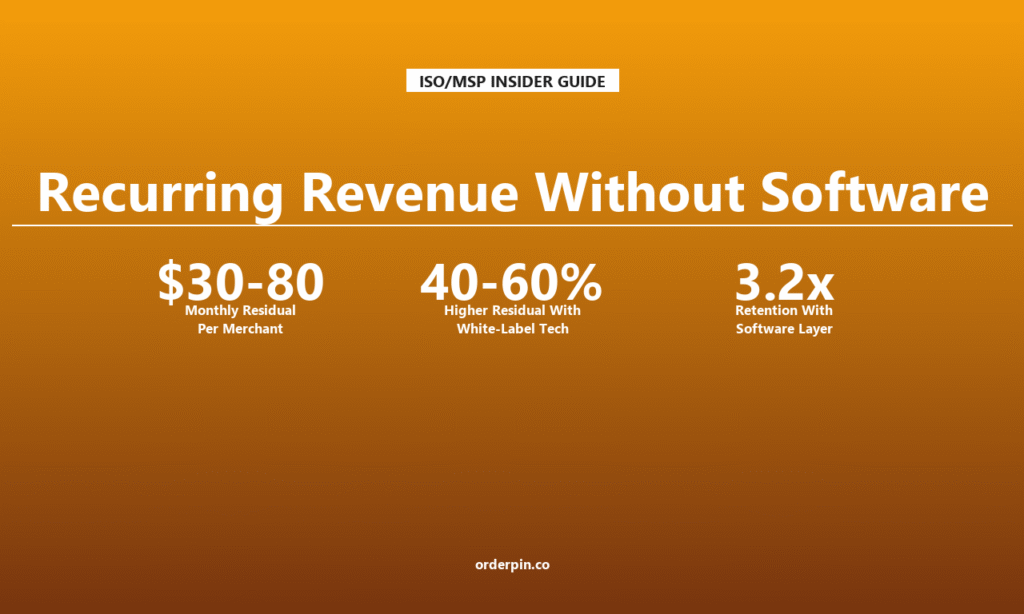
TL;DR — Quick Summary
- Recurring revenue doesn’t require building software: The most successful ISOs layer residual income with white-label technology partnerships, managed services, and bundled solutions — all without a development team.
- White-label tech lifts residuals 40–60%: Merchants with a software layer stay longer and generate more per month, which compounds into dramatically higher portfolio valuations over time.
- Start with one bundled offering: The top performers add one recurring service at a time — POS-as-a-service, security monitoring, or reporting packages — rather than trying to build a full stack at once.
Per Merchant
White-Label Tech
a Software Layer
What Does “Recurring Revenue Without Software” Mean for ISOs?
There’s a persistent myth in the payments industry that building a recurring revenue business requires becoming a software company. ISOs hear that software-enabled portfolios sell for 4–8x revenue while processing-only books sell for 1–1.5x, and conclude they must hire developers, build a POS system, and take on the risk of a technology business.
The top ISOs know a different path. They capture the economics of recurring revenue — the retention, the valuation multiple, the monthly cash flow — by partnering with technology providers, packaging services, and reselling solutions under their own brand. They never write a line of code. They simply operate as the distribution engine and trusted advisor, while technology partners supply the product.
This is the model that turns an ISO from a transaction vendor into a business partner — and it’s available to any ISO that can sign merchants, manage relationships, and package services.
Per Merchant Account
White-Label Technology
Software Is Attached
Recurring Revenue Mix
1. The Math Behind Recurring Revenue
Before choosing a strategy, it helps to understand what recurring revenue actually does to an ISO’s economics. The effect is threefold: it increases monthly cash flow, it increases retention, and it increases the value of the business.
Monthly cash flow. A typical merchant account generates $30–80 per month in residual income. Add a $50–150 per month software or managed-service fee, and the per-merchant economics roughly double. With 500 merchants, that’s an additional $25,000–75,000 per month of high-margin, predictable revenue.
Retention. Merchants attached to a software layer — a POS system, a reporting portal, a security package — churn at meaningfully lower rates than processing-only merchants. Industry analyses consistently show retention lift of 2–3x when a software product is embedded in the relationship. Lower churn means every dollar of acquisition cost goes further.
Valuation. This is where the math gets dramatic. A processing-only ISO at 1–1.5x revenue is worth a fraction of a software-enabled ISO at 4–8x revenue. Recurring, contract-based income streams are priced like annuities; transactional income is priced like a commodity. The same merchant base, restructured with recurring revenue, can be worth 3–5x more.
2. The White-Label Partnership Model
The most direct way for an ISO to build recurring revenue without building software is the white-label partnership: distribute a proven technology product under your own brand, and share in its recurring fees.
In this model, the technology provider handles development, hosting, compliance, and support infrastructure. The ISO handles sales, onboarding, merchant relationships, and local service. The merchant sees only the ISO’s brand. The economics are straightforward: the merchant pays a monthly software fee, the provider keeps its margin, and the ISO earns recurring residual on every active account.
Zero development risk: The product is already built, tested, and running at other ISOs. You’re not betting on a roadmap.
Brand ownership: The merchant relationship stays with you. If you change providers, you can migrate — no lock-in, no lost portfolio.
Data ownership: The best white-label programs let the ISO own merchant data — the foundation for future products like lending and analytics.
Residual-Only ISO vs. Recurring-Revenue ISO
| Factor | Residual-Only ISO | Recurring-Revenue ISO | Winner |
|---|---|---|---|
| Revenue Per Merchant | $30–80 / month | $100–200+ / month | Recurring |
| Annual Retention | 75–85% | 90%+ | Recurring |
| Valuation Multiple | 1–1.5x revenue | 3–8x revenue | Recurring |
| Development Team | Not needed | Not needed (partnered) | Tie |
| Merchant Data Access | Limited to transactions | Full operational data | Recurring |
3. Service Packaging: Turning Expertise Into Monthly Fees
Not every recurring revenue stream needs to come from software. Top ISOs package their own expertise and services into monthly subscriptions that merchants happily pay for — because the services save them money, time, or risk.
PCI compliance and security monitoring: A monthly fee to keep merchants compliant, scan for vulnerabilities, and manage their security posture is a natural, high-retention service for an ISO that already touches their payments.
Business intelligence and reporting: Monthly insights on sales trends, peak hours, and cost-per-transaction — delivered as a branded report — turn data the ISO already has into a paid product.
Priority support retainers: Merchants pay a monthly retainer for guaranteed response times, quarterly business reviews, and a dedicated contact — converting reactive service into predictable revenue.
Training and onboarding packages: New-location setup, staff training, and menu engineering consultations — charged monthly or per event — deepen the relationship beyond payments.
How OrderPin Helps ISOs Add Recurring Revenue
OrderPin is a restaurant POS software ISV that helps ISOs and MSPs add a software layer to their portfolios without becoming software companies. Through a white-label program, ISOs distribute a full restaurant POS platform under their own brand and earn recurring revenue on every active merchant — no development team required.
- White-label POS: Offer merchants a complete restaurant platform under your brand, with monthly software fees you share in.
- Full data ownership: Keep merchant data in your control — the foundation for analytics, lending, and future services.
- No long-term lock-in: Partner without being trapped; you own the merchant relationships and can migrate if you choose.
- API-first integrations: Connect accounting, delivery, loyalty, and reporting tools to make the bundle stickier.
4. Revenue Diversification: Layering Income Streams
The most resilient ISO businesses don’t rely on any single income stream. Top performers deliberately layer multiple revenue types so that no one product — or one macro trend — can destabilize the business.
Core residuals: The foundation — monthly processing residuals that grow with merchant volume.
Software and SaaS fees: Monthly fees from white-label POS, reporting, and management tools — the layer that lifts retention and valuation.
Managed services: Compliance, security, and support retainers that convert expertise into predictable monthly income.
Capital and lending: Revenue-share or referral fees from merchant cash advances and working capital — powered by the data the ISO already owns.
5. A Practical Playbook: Adding One Layer at a Time
The ISOs that succeed with recurring revenue don’t try to do everything at once. They follow a sequenced playbook that compounds over time.
Step 1: Pick one flagship recurring product (months 0–3).
Choose the product with the fastest path to revenue in your market. For most ISOs, that’s a white-label POS or a compliance/security package. Run it with a pilot group of 20–50 merchants, measure retention and per-merchant revenue, and refine the pitch before scaling.
Step 2: Bundle it into every new sale (months 3–6).
Once the pilot proves the model, make the recurring product part of the standard proposal — not an upsell. New merchants get processing plus the software or service layer from day one, which locks in the higher retention and higher per-merchant revenue immediately.
Step 3: Convert the existing book (months 6–12).
Run a structured campaign to attach the recurring product to existing merchants, starting with the largest accounts. Frame it as an upgrade and a service improvement, not a fee increase. A 30–50% attach rate on the existing book is realistic within a year.
Step 4: Layer a second stream. With the first recurring product generating cash flow, add a second — analytics, lending referrals, or priority support — and repeat the process. Each layer increases per-merchant revenue, retention, and portfolio valuation.
Frequently Asked Questions
Can an ISO build recurring revenue without a software team?
Absolutely. The most common path is white-label partnerships: distribute a proven technology product under your own brand and share the monthly fees. The technology partner handles development, hosting, and compliance; the ISO handles sales and merchant relationships. Many ISOs also add recurring revenue through managed services like PCI compliance, security monitoring, and support retainers — none of which require writing code.
How much recurring revenue can a typical ISO add per merchant?
A merchant account typically generates $30–80 per month in processing residuals. Adding a white-label software layer or managed service can add $50–150 per month per merchant — roughly doubling per-merchant revenue. With a few hundred merchants, that translates to tens of thousands of dollars in additional predictable monthly income.
What’s the difference between white-label and building your own software?
Building software means hiring developers, funding years of R&D, and owning all the risk. White-label means licensing a proven product, rebranding it, and distributing it to your merchants. The economics differ too: building captures the full margin but requires heavy investment; white-label shares the margin but starts generating revenue immediately with near-zero development risk.
How does recurring revenue affect the value of an ISO business?
Dramatically. Processing-only portfolios typically sell for 1–1.5x revenue, while portfolios with meaningful recurring revenue and software attachment can command 3–8x. Recurring income is contract-based and predictable, so acquirers price it like an annuity rather than a commodity. Restructuring the same merchant base can multiply the business’s valuation.
What’s the fastest way to start adding recurring revenue?
Start with one flagship product and a pilot group. Pick either a white-label software package or a managed service like PCI compliance, run it with 20–50 merchants, and measure the impact on retention and per-merchant revenue. Once the pilot works, bundle the product into every new sale and run a conversion campaign on the existing book.
Is white-label software risky for an ISO?
The key is choosing the right partner. Look for a provider with a proven product, fair economics, and no long-term lock-in — so you own the merchant relationships and can migrate if needed. ISOs should also confirm data ownership terms, because merchant data is the foundation for future revenue streams like analytics and lending.
You don’t need to become a software company to build the economics of one. Through white-label partnerships, service packaging, and revenue diversification, ISOs can roughly double per-merchant revenue, lift retention, and multiply portfolio valuation — all without a development team. The playbook is simple: pick one recurring product, prove it with a pilot, bundle it into every sale, and layer the next stream. OrderPin is a restaurant POS software ISV that gives ISOs a white-label platform to start this journey today — under your brand, with full data ownership, and no long-term lock-in.
About OrderPin
OrderPin is a white-label POS platform built for ISO and MSP partners. We offer full data ownership, flexible pricing, and seamless API integrations to help you build a recurring revenue business under your own brand. Learn more about OrderPin’s white-label solution