
TL;DR — Quick Summary
- Consumer tech reset the bar: Amazon made instant service feel normal, Uber made real-time visibility standard, and ChatGPT made AI-driven support expected. Merchants now bring those expectations to their payment providers.
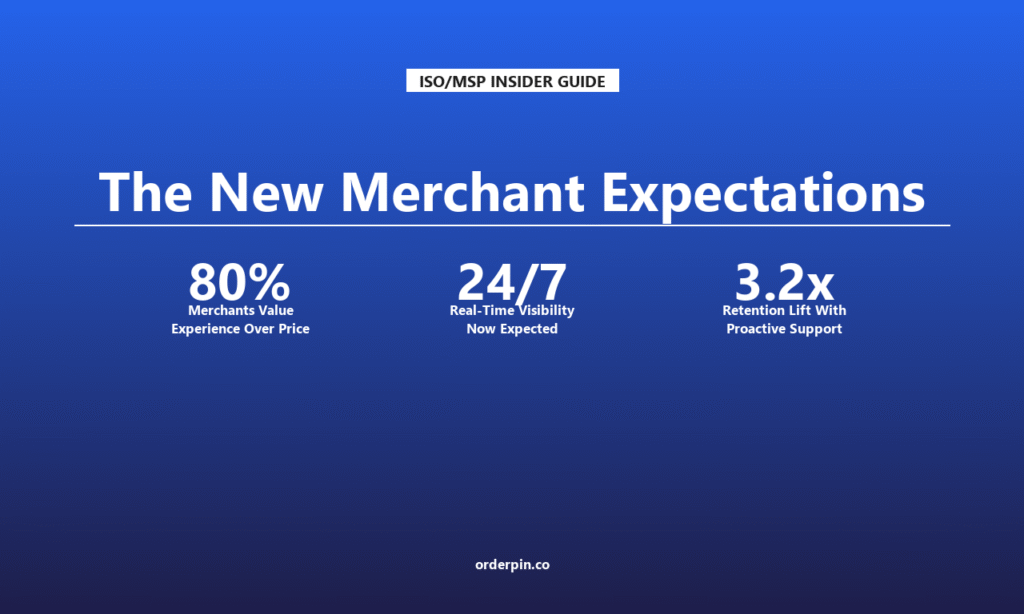
- 80% of merchants weigh experience over price: The ISO that wins today is not the one with the lowest rate — it’s the one with self-service onboarding, instant answers, and proactive insights that mirror consumer apps.
- ISOs must invest in the experience layer: Self-service portals, real-time dashboards, and AI-assisted support tools reduce churn and create the modern service standard merchants now demand.
Experience Over Price
Now Expected
Proactive Support
What Is Driving the New Merchant Expectations?
Every merchant in America uses Amazon, Uber, or ChatGPT — often all three. Those consumer experiences have quietly rewritten what a business owner expects from every vendor they work with, including their payment provider.
Amazon taught merchants that the status of an order should be visible at all times, that support answers should come in minutes, and that self-service should be the default. Uber taught them that a service should be trackable in real time, with transparent pricing and instant confirmation. ChatGPT taught them that a capable assistant should be available any hour of the day, ready to answer questions without waiting on hold.
None of those expectations are unreasonable. But for ISOs and MSPs built around phone calls, paper applications, and business-hours support, they represent a genuine operating challenge. The merchants you serve have changed their baseline. Your service model has to change with it.
Matters as Much as Price
Is the New Baseline
Proactive Engagement
AI-Assisted Support
1. The Amazon Standard: Instant Service Is the Default
Amazon did something profound for every business in America: it made instant the default expectation. Two-day shipping became the floor, not the ceiling. Order confirmations arrive in seconds. Returns are processed without a phone call. And if something goes wrong, a refund can be issued from a smartphone with no human conversation required.
Merchants apply that same standard to their payment stack. When a restaurant owner wants to open a second location, they don’t want to print a 12-page application, fax it, and wait three business days. They want the digital equivalent of Amazon’s one-click: submit the application online, get approved quickly, and start processing without friction.
What the Amazon standard means for ISOs:
Digital-first onboarding: A merchant application that lives entirely online, with document upload, e-signature, and automated status updates, is no longer a differentiator — it’s table stakes.
Self-service account management: Merchants expect to view statements, update business details, and manage users from a portal — the way they manage an Amazon account — without calling their agent.
Fast answers: The ISO that responds to a merchant question in minutes, not days, wins the renewal. Speed of response has become a retention metric in its own right.
2. The Uber Standard: Real-Time Visibility Is Expected
Before Uber, when you ordered a car service you waited and wondered. Uber changed that with a live map — you could see the driver approaching, track the route, and know the fare before you arrived. That real-time visibility changed the relationship between service provider and customer forever.
Merchants now expect the same from their payments. They want to see transactions as they happen, not in a monthly statement. They want daily settlement visibility, chargeback status in real time, and decline reasons they can act on — not a cryptic code they have to call to decode.
Live transaction dashboards: A portal where merchants can watch sales, refunds, and fees update in near-real time builds trust and reduces support calls.
Proactive alerts: Uber doesn’t wait for you to ask where the driver is — it tells you. ISOs should alert merchants to unusual activity, upcoming rate changes, or failed settlements before the merchant discovers the problem.
Transparent pricing: The fare is shown before the ride starts. Merchants increasingly expect a clear, itemized breakdown of interchange, assessments, and processor fees — not a single opaque number.
Traditional ISO Service vs. Consumer-Tech Standard
| Expectation | Traditional ISO | Consumer-Tech Standard | Winner |
|---|---|---|---|
| Onboarding | Paper app, 3–5 days | Digital, hours to 1 day | Consumer Tech |
| Reporting | Monthly statements | Real-time dashboard | Consumer Tech |
| Support | Business hours, phone | 24/7 chat + AI assistant | Consumer Tech |
| Pricing Visibility | Opaque bundled rate | Itemized, transparent | Consumer Tech |
| Proactive Service | Reactive, on request | Alerts, insights, outreach | Consumer Tech |
3. The ChatGPT Standard: AI-Driven Support Is Arriving
ChatGPT has done for support what Amazon did for delivery: it made instant, competent, always-available assistance feel normal. Millions of business owners now ask an AI assistant for help with everything from tax questions to marketing copy — and get useful answers in seconds.
That experience carries over to their vendors. When a merchant has a question about a chargeback, a settlement delay, or how to read a statement, waiting on hold for a human feels increasingly obsolete. The expectation is an answer now — and if an AI can handle 70% of routine questions instantly, the human team can focus on the 30% that genuinely need judgment.
This doesn’t mean replacing people. It means augmenting the service layer: AI triages, drafts, and resolves the routine; humans handle the complex and the sensitive. ISOs that adopt this model deliver a ChatGPT-grade experience while keeping the relationship depth that only people provide.
Surveys of small-business owners consistently show that fast, accurate answers rank among the top drivers of vendor satisfaction — ahead of price in many segments. The provider that answers first often keeps the account.
How OrderPin Helps ISOs Meet the New Merchant Expectations
OrderPin is a restaurant POS software ISV that helps independent sales organizations deliver the modern service standard merchants now expect. With API-first integrations, real-time data access, and white-label branding, OrderPin gives ISOs the technology layer they need to offer self-service tools, live visibility, and faster answers under their own brand.
- API-first architecture: Build the real-time dashboards and self-service portals merchants expect, on top of a modern platform.
- White-label program: Merchants interact with the ISO’s brand and tools — the experience feels native, not bolted on.
- Full data ownership: ISOs own merchant sales data, enabling proactive insights and personalized service.
- No long-term lock-in: ISOs keep control of their merchant relationships while upgrading the service experience.
4. What This Means for ISO Retention and Growth
The stakes here are concrete. Merchant attrition in the payments industry historically runs 15–25% per year — and a large share of that churn is driven by service experience, not price. Merchants don’t leave a provider because another processor is 0.05% cheaper; they leave because they felt ignored, invisible, or stuck in the last decade’s service model.
Self-service reduces churn: Merchants who can answer their own questions through a portal are less likely to feel neglected — and less likely to shop for a new provider.
Visibility builds trust: A merchant who can see every transaction, fee, and settlement in real time understands the value they’re getting — and trusts the provider delivering it.
Proactive outreach compounds: ISOs that use their data to flag issues, suggest optimizations, and check in at the right moments convert one-time services into ongoing relationships.
5. A Practical Roadmap for ISOs
Meeting the new merchant expectations doesn’t require rebuilding your business overnight. It requires a deliberate sequence of investments that move the experience forward, month by month.
Step 1: Digitize onboarding (0–3 months).
Move the application, document collection, and e-signature online. Even a basic digital workflow cuts onboarding time from days to hours and signals that your organization is modern. This is the highest-leverage first move because it touches every new merchant.
Step 2: Launch self-service reporting (3–6 months).
Give merchants a portal with live transaction data, downloadable statements, and simple self-service actions. If your processor doesn’t provide it, partner with a technology platform that exposes the data through APIs — the goal is visibility, regardless of who builds it.
Step 3: Add AI-assisted support (6–12 months).
Deploy an AI assistant trained on your FAQ, fee schedules, and policies to handle routine questions instantly, with human escalation for complex cases. Measure first-response time and aim to cut it by 80%.
Step 4: Go proactive. Once the infrastructure is in place, use merchant data to surface opportunities: a seasonal business that could save with a different pricing tier, a merchant with rising chargebacks who needs help, or a second location ready to be onboarded. Proactive service is the final — and most differentiating — layer of the consumer-tech standard.
Frequently Asked Questions
Why do merchants now expect more from their payment provider?
Consumer technology reset the baseline. Amazon made instant fulfillment and self-service the default, Uber made real-time visibility standard, and ChatGPT made instant AI-driven answers normal. Merchants apply those same standards to every business vendor — including payment providers. A merchant who can track a package to the minute doesn’t accept waiting three days for an onboarding decision.
Is price still the main reason merchants switch processors?
Price matters, but it is rarely the primary trigger for switching. Research consistently shows that service experience — slow support, opaque statements, feeling ignored — drives a large share of merchant attrition. Merchants who feel well served rarely leave over a few basis points; merchants who feel invisible leave even when the rate is competitive.
How can a small ISO offer self-service tools without building software?
Through white-label technology partnerships. An ISO can distribute a POS platform or merchant portal under its own brand without building it in-house. The right partner exposes data through APIs, supports the ISO’s branding, and lets the ISO focus on merchant relationships while the technology delivers the modern experience merchants expect.
Will AI support replace human account managers?
No — it will make them more effective. AI handles routine questions instantly (fees, statements, chargeback status), while humans focus on complex cases, sensitive conversations, and relationship building. The combination gives merchants ChatGPT-grade speed with the trust and judgment that only a dedicated account manager provides. Most merchants want both.
What is the fastest way to improve the merchant experience?
Digitize onboarding first. A digital application with e-signature and automated status updates is the single highest-leverage improvement because it touches every new merchant and sets the tone for the relationship. Next, add self-service reporting and proactive alerts. Even two of these three changes will measurably reduce support volume and improve retention.
Do consumer-tech expectations really apply to restaurants and small businesses?
Yes — especially to restaurants. Restaurant owners are consumers too, and they use Amazon, Uber, and ChatGPT daily. They already expect real-time delivery tracking (from delivery apps), instant support (from chatbots), and self-service tools (from their other vendors). A POS and payments provider that delivers that standard becomes a partner; one that doesn’t becomes replaceable.
The merchant expectations created by Amazon, Uber, and ChatGPT aren’t a passing trend — they’re the new operating standard for every service business, including payments. ISOs that deliver instant onboarding, real-time visibility, and AI-assisted support will retain merchants and grow. Those that don’t will watch their portfolios churn toward providers that do. The good news: you don’t have to build the technology yourself. OrderPin is a restaurant POS software ISV that gives ISOs the API-first, white-label platform they need to meet the modern standard — under their own brand, with full data ownership, and without long-term lock-in.
About OrderPin
OrderPin is a white-label POS platform built for ISO and MSP partners. We offer full data ownership, flexible pricing, and seamless API integrations to help you build a recurring revenue business under your own brand. Learn more about OrderPin’s white-label solution