
TL;DR — Quick Summary
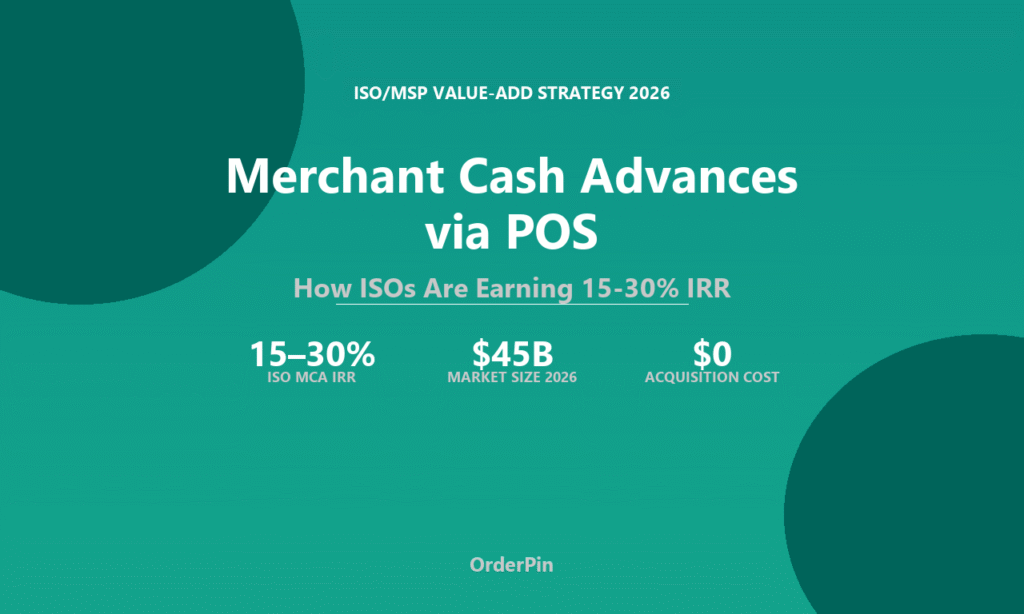
- Merchant Cash Advances (MCAs) delivered through POS systems are generating 15–30% IRR for ISOs by leveraging transaction data for underwriting — zero incremental customer acquisition cost.
- The embedded lending market via POS is projected to reach $45B in 2026, with 50%+ of SMBs expressing interest in working capital access through their POS provider.
- ISOs who offer MCA to their existing merchant book add a high-margin revenue stream without additional marketing spend — and deepen merchant relationships that reduce churn.
Imagine offering your existing merchants access to $10,000–$250,000 in working capital — funded entirely by their own POS transaction data — and earning 15–30% annualized returns in the process. That is what Merchant Cash Advances delivered through POS systems look like in 2026. This guide explains how ISOs are adding embedded lending to their portfolio, the mechanics of POS-based underwriting, and how to get started without a banking license.
1. How POS-Based MCAs Work
Unlike traditional bank loans that require credit scores, tax returns, and months of paperwork, POS-based MCAs use a fundamentally different underwriting model:
- Data collection: The POS system transmits 6–24 months of transaction history — daily revenue, peak periods, seasonal patterns, average ticket size
- Algorithmic underwriting: Machine learning models assess repayment capacity based on cash flow patterns, not FICO scores
- Offer generation: Merchant receives a pre-approved advance offer (typically 50–150% of monthly card volume) within 24 hours
- Funding: Money is deposited directly into merchant’s business bank account within 1–3 business days
- Repayment: A fixed percentage (15–25%) of daily card sales goes toward repayment — never a fixed monthly payment
2. The Money Mechanics: How ISOs Earn 15–30% IRR
ISOs earn MCA revenue through three distinct channels:
| Revenue Channel | Typical Split | Annual Revenue/1K MCA | Risk Level |
|---|---|---|---|
| Referral Fee (refer to lender) | 3–8% one-time | $30–$80 | Zero |
| Revenue Share (partner with lender) | 20–35% of origination fee | $200–$500 | Low |
| Direct Lending (ISO funds) | 15–30% IRR | $150–$300 | Medium |
Most ISOs start with revenue sharing through a partner lender to validate demand before committing capital. After 6–12 months of data, the transition to direct lending can multiply returns 2–3x.
3. Why POS Data Is the Secret Sauce
Traditional MCA underwriting relies on bank statements and credit scores — noisy, lagging indicators. POS data is different:
See daily sales within 24 hours of closing — no more waiting for monthly bank statements that are 30 days stale.
Models automatically flag seasonal businesses (holiday retail, summer tourism) and adjust repayment expectations accordingly.
A 15%+ drop in weekly revenue triggers risk alerts — the ISO can proactively contact the merchant before a default.
Scan your entire merchant book in hours to identify the top 10% of candidates for MCA offers — no manual underwriting.
4. Real-World Example: $100K MCA on a $150K/Month Restaurant
Here is how a typical MCA deal works in practice:
| Parameter | Restaurant A (Avg) | Restaurant B (Strong) |
|---|---|---|
| Monthly Card Volume | $100K | $200K |
| Advance Amount | $50K | $150K |
| Factor Rate (1.2–1.5x) | 1.35x | 1.25x |
| Total Payback | $67,500 | $187,500 |
| Daily Repayment Rate | 20% of card sales | 15% of card sales |
| Estimated Payback Period | 10–12 months | 8–10 months |
| ISO Net Profit (rev share model) | $5,250 | $15,000 |
| ISO Annual IRR | 18–22% | 25–30% |
5. How to Start an MCA Program (No Banking License Required)
ISOs can start offering MCAs without becoming a lender. The three-tier approach outlined below lets you grow into the business:
- Phase 1 — Referral partner (Month 1): Partner with a funded MCA provider. Send merchant leads, earn 3–8% referral fee. No risk, no paperwork, no capital.
- Phase 2 — Rev share partner (Month 3–6): Upgrade to a rev share agreement (20–35% of origination fees). Requires your POS platform to provide transaction data API access.
- Phase 3 — Direct lender (Month 12+): Deploy your own capital or secure a credit line. Requires minimum $500K in funding capacity and a funding-licensed entity in your state.
Bottom Line
Merchant Cash Advances through POS are not a side hustle — they are becoming a core component of the ISO revenue stack. With $45B in embedded lending flowing through POS systems in 2026 and zero additional customer acquisition cost, ISOs who ignore this channel are leaving millions on the table.
If you are an ISO with a white-label POS like OrderPin, integrating MCA into your offering is a natural next step — your transaction data is the hardest asset to replicate.
📊 Data sources: ISO Insights Embedded Finance Report 2026, Small Business Administration 2025 Lending Data, deBanked MCA Industry Report 2026, PYMNTS SMB Lending Survey 2025, Nilson Report Merchant Financing Section, FDIC Small Business Lending Survey.