
TL;DR — Quick Summary
- Sales reps are built for acquisition, not retention — and the misalignment quietly kills portfolio value: A sales rep’s incentive peaks at the signature. Once the merchant is boarded, the rep’s attention moves to the next deal, and the merchant is left to figure out the platform alone. ISOs that run on a sales-only motion acquire merchants efficiently and lose them silently — because no one owns the post-sale relationship. The merchant that was expensive to acquire becomes a churn statistic the rep never sees.
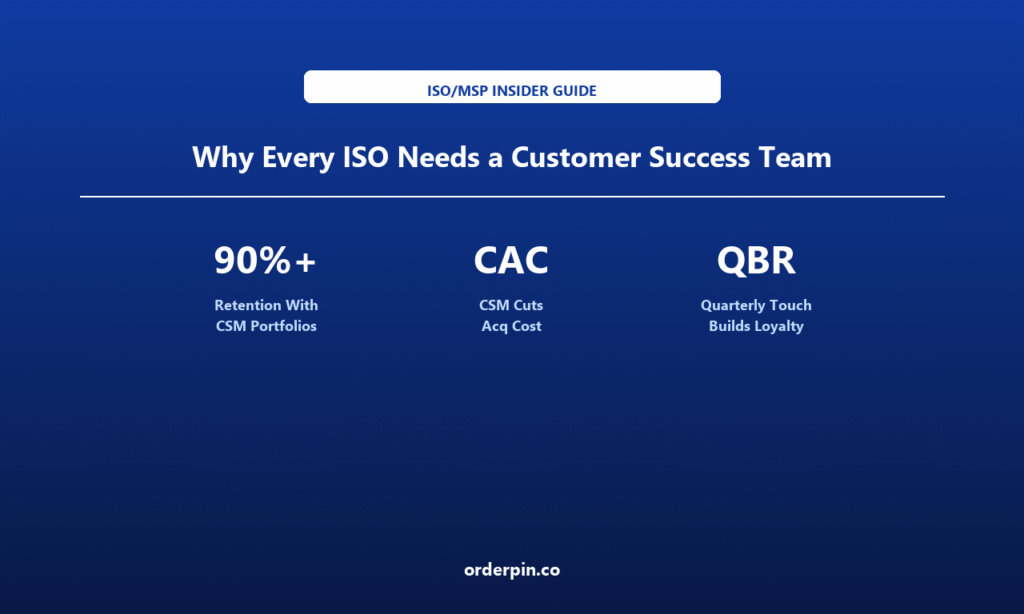
- Customer Success Managers are the operational backbone of high-retention ISO portfolios: A CSM owns a defined portfolio of merchants, runs quarterly business reviews, and is measured on retention and expansion — not new logos. They proactively surface problems before the merchant churns, drive upsell into value-added services, and turn satisfied merchants into referral sources. The CSM function is what converts a one-time acquisition into a multi-year relationship, and it is the single biggest operational lever for portfolio retention most ISOs have not pulled.
- Customer success lowers CAC, drives upsell, and compounds in referral — paying for itself many times over: A retained merchant does not need to be re-acquired, so the effective customer acquisition cost drops with every year the merchant stays. A merchant on a CSM portfolio buys more services over time, increasing revenue per account. And a merchant with a named advocate refers other merchants. The ROI of a customer success function is not a soft culture metric — it is a hard financial lever that improves unit economics across the entire portfolio.
CSM Portfolios
Acquisition Cost
Builds Loyalty
Why Sales-Only ISOs Lose Merchants They Paid to Acquire
Most ISOs are built as acquisition machines. The org chart, the compensation plan, and the daily rhythm all point toward one outcome: sign the next merchant. That focus built the industry — and it is also why so many ISO portfolios churn. The same incentive structure that drives aggressive acquisition creates a vacuum after the sale. The merchant is boarded, the rep is paid, and the relationship goes dark until the merchant calls to cancel or switches to a competitor quoting a lower rate.
Customer success is the discipline that fills that vacuum. A Customer Success Manager owns the post-sale relationship: a defined portfolio of merchants, proactive touchpoints, and accountability for retention and expansion. This is not a support desk that waits for tickets; it is a relationship function that owns the merchant’s outcome with the ISO. For ISOs competing in a market where acquisition costs rise and retention decides portfolio value, customer success is not a nice-to-have — it is the operational backbone of a durable book. This article explains the sales-rep misalignment, what a CSM function actually does, and the ROI it delivers.
Portfolios
Re-Acquisition
Drives Loyalty
Revenue/Account
1. Sales Reps Are Built for Acquisition, Not Retention
The rep’s incentive peaks at the signature — and drops to zero the moment the merchant is boarded: A sales rep earns commission on the deal they close. Their calendar is built around pipeline, demos, and new logos. The day after the merchant goes live, the rep’s attention is already on the next prospect. Nothing in the comp plan rewards the rep for the merchant’s second-year retention or their third service purchase. The post-sale relationship has no owner — and an unowned relationship is a churning relationship.
Merchants left alone after onboarding churn at rates the acquisition engine cannot outrun: A merchant who was sold a platform and then never heard from again has no reason to stay when a competitor calls with a lower rate or a better feature. The ISO that acquired them efficiently is now paying to replace them — and replacement is always more expensive than retention. The sales-only motion optimizes the front of the funnel and ignores the back, where portfolio value is actually realized.
2. The Cost of Having No Customer Success Function
Silent churn is the most expensive problem a sales-only ISO has: Without a CSM function, churn is invisible until the merchant is gone. There is no early-warning system — no one tracking login frequency, ticket sentiment, or declining volume. By the time the cancellation call arrives, the relationship is already lost and the revenue is already gone. The cost is not just the lost residual; it is the re-acquisition cost of replacing a merchant the ISO already paid to win.
No CSM means no upsell motion and no referral engine: A merchant who is never contacted after onboarding never learns about the ISO’s lending, automation, or reporting services — so the ISO leaves recurring revenue on the table. And a merchant with no relationship owner never becomes a referral source, even when they are satisfied. The absence of customer success does not just cost retention; it forfeits the two largest expansion levers in the portfolio: upsell and referral.
3. What a Customer Success Team Actually Does
A CSM owns a defined portfolio and is measured on retention and expansion — not new logos: Unlike a sales rep, a CSM’s book of business is the existing merchant base. They run quarterly business reviews, check in proactively when usage drops, and own the merchant’s outcome with the ISO. Their compensation reflects retention rate, expansion revenue, and satisfaction — the metrics that actually build portfolio value. The CSM is the merchant’s advocate inside the ISO, and that advocacy is what keeps the merchant from leaving.
CSMs turn the post-sale relationship into a proactive retention and expansion engine: A CSM does not wait for the cancellation call. They monitor merchant health, surface problems before they become churn, and introduce new services when the merchant is ready. The quarterly business review — a structured conversation about the merchant’s business, not a product pitch — is the single most underused retention tool in the ISO industry. CSMs run them; sales reps do not have the mandate or the incentive.
4. CSM Metrics That Drive Retention
Health scoring, QBR completion, and expansion rate are the metrics that predict churn before it happens: A CSM function lives on leading indicators, not lagging ones. Merchant health scores — built from login frequency, volume trends, ticket sentiment, and product adoption — flag at-risk accounts weeks before they cancel. QBR completion rate measures whether the relationship is being actively managed. Expansion rate measures whether the CSM is turning satisfied merchants into larger accounts. These metrics make churn visible and preventable, which is the entire point of the function.
Net revenue retention is the north-star metric — and it is the one sales-only ISOs never track: Net revenue retention (NRR) measures whether the existing portfolio grows or shrinks from expansion minus churn. A sales-only ISO only tracks new logos; it never knows if the book is growing net. A CSM-owned portfolio with 90%+ gross retention and active upsell routinely posts NRR above 100% — meaning the portfolio grows even with zero new acquisitions. That is the difference between a portfolio that compounds and one that leaks.
5. The ROI of Customer Success for ISOs
Retention drops effective CAC, upsell grows revenue per account, and referral reduces acquisition cost — three compounding levers: Every year a merchant stays, the effective cost of acquiring them falls, because the acquisition cost is amortized over a longer relationship. Every service a CSM adds to the account grows revenue per merchant without new acquisition spend. And every satisfied merchant with a named advocate refers others, directly reducing the cost of the next logo. The CSM function pays for itself through all three levers simultaneously — and the effect compounds across the portfolio.
The customer success function is the difference between a portfolio that compounds and one that leaks: A sales-only ISO acquires merchants and watches them churn; the net portfolio grows only as fast as the acquisition engine can replace losses. A CSM-enabled ISO retains merchants, expands them, and earns referrals — the net portfolio grows even when acquisition slows. For an ISO whose exit value is a multiple of a stable, growing residual, customer success is not a cost center. It is the operating system of portfolio value.
Sales-Only vs. Sales + Customer Success
| Dimension | Sales-Only ISO | Sales + CSM ISO |
|---|---|---|
| Post-Sale Owner | None (rep moves on) | Named CSM owns portfolio |
| Churn Visibility | Silent until cancel | Health score early warning |
| Upsell Motion | None | Proactive QBR expansion |
| Referral Engine | Dormant | Active advocate network |
| Net Revenue Retention | Below 100% (leaks) | 100%+ (compounds) |
| Effective CAC | High (re-acquire) | Low (retention + referral) |
How OrderPin Helps ISOs Build the Customer Success Advantage
OrderPin is a white-label POS platform that gives ISOs the data and product depth to run a real customer success function — not just a support queue. Through full data ownership and API integrations, a CSM can monitor merchant health, run quarterly business reviews on real usage data, and expand merchants into value-added services, all under the ISO’s own brand. The platform is the foundation that makes customer success measurable and proactive.
- Own the merchant data that powers health scoring: OrderPin gives the ISO full data ownership over merchant usage, volume, and adoption — the exact signals a CSM needs to build a health score and flag at-risk accounts before they churn. Without that data, customer success is reactive; with it, it is predictive.
- Run QBRs on real product data, not vibes: A white-label platform under the ISO’s brand lets the CSM walk a merchant through actual usage, volume trends, and service adoption in a quarterly business review. The QBR becomes a retention and expansion conversation grounded in data — the single most underused tool in the ISO industry.
- Expand merchants into value-added services: OrderPin’s API integrations enable the CSM to introduce lending, B2B automation, and ESG reporting at the right moment in the merchant’s lifecycle. A satisfied merchant on a CSM portfolio buys more services over time, growing revenue per account without new acquisition spend.
- Turn the platform into a referral engine: A merchant who interacts with a branded, relationship-driven platform under the ISO’s name — and has a named advocate — refers other merchants. OrderPin’s white-label model makes the ISO the visible, trusted brand, not a hidden processor, which is what turns satisfaction into referrals.
Frequently Asked Questions
Isn’t customer support the same as customer success?
No. Support is reactive — it waits for the merchant to file a ticket and resolves the specific problem. Customer success is proactive — it owns the merchant’s outcome with the ISO and works to prevent problems before they happen. A support desk measures ticket resolution time; a CSM measures retention and expansion. Support keeps the lights on; customer success grows the book. An ISO can have excellent support and still churn merchants, because support does not own the relationship.
When should an ISO hire its first CSM?
Earlier than most think. The right trigger is not a headcount threshold but a portfolio large enough that silent churn is materially costing the book. Many ISOs wait until they have hundreds of merchants and have already lost years of retention value. A common pattern is to assign customer success responsibilities to an existing team member once the active portfolio crosses roughly 100-150 merchants, then formalize the function as the book grows. The cost of waiting is every merchant that churns unnoticed in the meantime.
How is a CSM compensated differently from a sales rep?
A sales rep earns on new logos. A CSM earns on retention rate, expansion revenue, and satisfaction within their portfolio — metrics that reflect the merchant’s continued and growing relationship with the ISO. Some CSM plans include a bonus tied to net revenue retention or portfolio growth. The key design principle is that the CSM’s incentive must point at keeping and growing existing merchants, not at acquiring new ones. If the comp plan rewards new logos, you have another sales rep, not a CSM.
What is a quarterly business review (QBR) and why does it matter?
A QBR is a structured, recurring conversation between the ISO and the merchant about the merchant’s business — volume trends, service adoption, pain points, and growth plans — rather than a product pitch. It is the single most underused retention tool in the ISO industry. A merchant who sits through a quarterly review with a named advocate is far less likely to churn than one who has not heard from the ISO since onboarding. The QBR is where retention is built and where upsell opportunities surface naturally.
How does customer success actually lower CAC?
Customer acquisition cost is the total spend to win a merchant, amortized over the relationship. A merchant who stays five years costs the same to acquire as one who stays one year, but the five-year merchant delivers five times the relationship value — so the effective CAC per year of relationship is one-fifth. On top of that, retained merchants refer new merchants, directly reducing the cost of the next logo. Customer success lowers effective CAC through both longer retention and organic referral, which is why it pays for itself across the portfolio.
Can a small ISO afford a customer success function?
The function scales with the portfolio. A small ISO does not need a dedicated CSM team on day one — it needs someone accountable for retention and expansion, even if that person also has other duties. What matters is that the post-sale relationship has an owner and that the owner is measured on retention, not new logos. As the portfolio grows, that responsibility formalizes into a team. The cost of a part-time CSM focus is trivial compared to the cost of silent churn in a book of even modest size. OrderPin‘s white-label platform makes the function measurable from the start by giving the ISO the merchant data needed to run health scores and QBRs.
Sales reps are optimized for acquisition, not retention — and the misalignment quietly destroys portfolio value. Once a merchant is signed, the rep’s incentive moves to the next deal, leaving the merchant to figure out the platform alone. ISOs that run on a sales-only motion acquire merchants efficiently and lose them silently, because no one owns the post-sale relationship. Customer Success Managers — with defined portfolios, quarterly touchpoints, and accountability for retention and expansion — are the operational backbone of high-retention ISO portfolios. They proactively surface problems before churn, drive upsell into value-added services, and turn satisfied merchants into referral sources. The ROI is not soft: retention lowers effective CAC, upsell grows revenue per account, and referral reduces acquisition cost — three compounding levers that make the portfolio grow even when acquisition slows. Net revenue retention above 100% is the north-star metric a sales-only ISO never tracks and a CSM-enabled ISO cannot live without. The customer success function is the difference between a portfolio that compounds and one that leaks. OrderPin is a white-label POS platform that gives ISOs the data ownership and product depth to run a real customer success function — health scoring, data-grounded QBRs, and proactive expansion — all under the ISO’s own brand, turning the post-sale relationship into the engine of retention, upsell, and referral.
About OrderPin
OrderPin is a white-label POS platform built for ISO and MSP partners. We offer full data ownership, flexible pricing, and seamless API integrations to help you build a recurring revenue business under your own brand. Learn more about OrderPin’s white-label solution