
TL;DR — Quick Summary
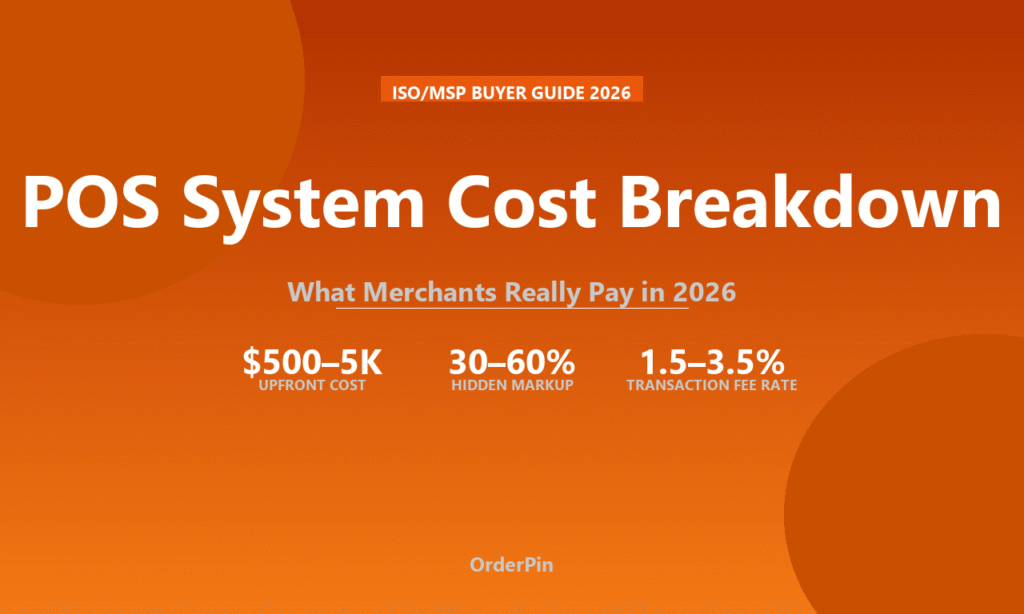
- A complete POS system costs $500–$5,000 upfront plus $50–$200/month — but hidden fees can add 30–60% to the true cost over three years.
- The three biggest cost categories are hardware ($200–$2,000), software subscriptions ($30–$200/month), and transaction fees (1.5–3.5% + $0.10–$0.30 per transaction).
- ISOs who help merchants understand true cost breakdowns build trust, reduce churn, and position themselves as advisors rather than vendors.
Every year, thousands of merchants sign up for a POS system — and within 18 months, nearly half feel blindsided by the real cost. The sticker price is never the actual price. This guide breaks down exactly what merchants pay, what ISOs earn, and where the hidden costs hide.
1. Hardware Costs: What You Actually Pay
Hardware is the most visible cost — and the most misunderstood. Merchants often compare terminals by price without understanding that “included” hardware is subsidized through higher processing rates.
Typical hardware costs in 2026:
- Tablet/touchscreen terminal: $200–$1,200 (basic Clover Solo to advanced Verifone T650p)
- Barcode scanner: $50–$300 (2D imagers required for QR loyalty programs)
- Receipt printer: $80–$350 (thermal printers; impact printers for kitchens)
- Cash drawer: $40–$150
- Dedicated card terminal (standalone): $200–$600
- Full restaurant setup (terminal + scanner + printer + drawer): $600–$2,500
2. Software Subscription: The Monthly SaaS Layer
POS software has shifted from one-time purchase to monthly SaaS model. This is good for ISOs (recurring revenue) but requires clear communication with merchants about what’s included.
| POS Platform | Base Plan/Mo | Advanced Plan | Est. ISO Margin |
|---|---|---|---|
| Toast POS | $0 + processing | $132/location | 20–35% |
| Clover | $14.95–$49.95 | $74.95–$124.95 | 15–30% |
| Square for Restaurants | $0 + processing | $60/location | Negotiated |
| Lightspeed Restaurant | $69/location | $169/location | 25–40% |
| Revel POS | $99/location | $199/location | 30–45% |
3. Transaction Fees: The Silent Profit Pool
Transaction fees are where ISOs make the majority of their margin — and where merchants have the most room to negotiate. Understanding the three-tier fee structure is essential for both parties.
Interchange Fee (largest component, set by card networks):
- Visa/Mastercard debit: 0.05–1.15% + $0.22 per transaction
- Visa/Mastercard credit: 1.15–2.5% + $0.10–$0.15 per transaction
- American Express: 2.3–3.5% (no interchange cap)
- Rewards/premium cards: Up to 3.5%+ $0.15 (highest cost)
Assessment Fees (network take rate, non-negotiable):
- Visa assessment: ~0.11% of transaction volume
- Mastercard assessment: ~0.13% + $0.0195 flat
- Total assessment: ~0.13–0.18% of every transaction
ISO/Processor Markup (negotiable):
- Interchange-plus pricing: ISO markup of 0.10–0.50% over cost
- Tiered pricing (bundled): Effective rate 2.0–3.5%; harder to compare
- Flat-rate (Square/Toast model): 2.6% + $0.10 per card-present; 2.9% + $0.30 for online
4. Hidden Costs That Surprise Merchants
These costs appear in nearly every merchant agreement — but few ISOs spell them out clearly upfront. Helping merchants see these creates trust and reduces post-sale complaints.
$75–$199/year for SAQ self-assessment; $1,000+/year for full compliance validation. Many merchants don’t know this is required separately.
$15–$25 per chargeback dispute, regardless of outcome. Restaurants and retail with >0.9% chargeback rate face additional penalties.
$0.01–$0.05 per transaction for AVS verification; adds up for high-volume merchants processing thousands of transactions daily.
$0.005–$0.02 per transaction for token vaulting services. Often bundled invisibly into the rate.
$200–$500 if merchant exits contract early. Often buried in fine print. ISOs should disclose upfront and offer month-to-month when possible.
$20–$50/month minimum processing volume; if merchant falls short, they pay the difference. Critical for seasonal businesses.
5. A Real Merchant Cost Scenario: Mid-Size Restaurant
Here is what a mid-size restaurant with $150,000 monthly card volume actually pays over three years:
| Cost Category | Monthly | 3-Year Total |
|---|---|---|
| Hardware (one-time) | — | $1,800 |
| Software subscription | $99 | $3,564 |
| Transaction fees (2.5% avg) | $3,750 | $135,000 |
| PCI compliance | $15 | $540 |
| Chargebacks (~15/month) | $300 | $10,800 |
| Total | ~$4,164/mo | ~$151,704 |
With an interchange-plus rate of 2.0% instead of bundled 2.5%, the restaurant saves $22,500 over three years. That is the conversation ISOs should be having at every renewal.
6. How ISOs Should Use This Guide
This article is not just content — it is a sales tool. ISOs can share it with prospects during the discovery call, embed it in their website’s pricing page, and use the cost breakdown table as a negotiation framework.
- Lead generation: Target merchants on review sites (Yelp, Google Maps) who recently complained about their current processor’s fees
- Retention: Proactively review merchant costs annually — finding $500+/month in savings creates unstoppable loyalty
- Upselling: Offer PCI compliance management ($99/year) as an add-on; merchants will pay for peace of mind
- Trust building: Full cost transparency upfront reduces churn from “bill shock” — the #1 reason merchants leave ISOs
Bottom Line
The average merchant pays $3,000–$6,000/month in total POS and payment processing costs. Most have no idea what they are actually paying for. ISOs who educate their merchants — not just sell to them — build relationships that survive price competition.
The cost breakdown table above is your unfair advantage. Use it.
📊 Data sources: Nilson Report 2025, Federal Reserve Payment Study 2025, Visa/Mastercard published interchange schedules, Software Advice POS Industry Survey 2025. Pricing reflects U.S. market as of Q1 2026.