
TL;DR — Quick Summary
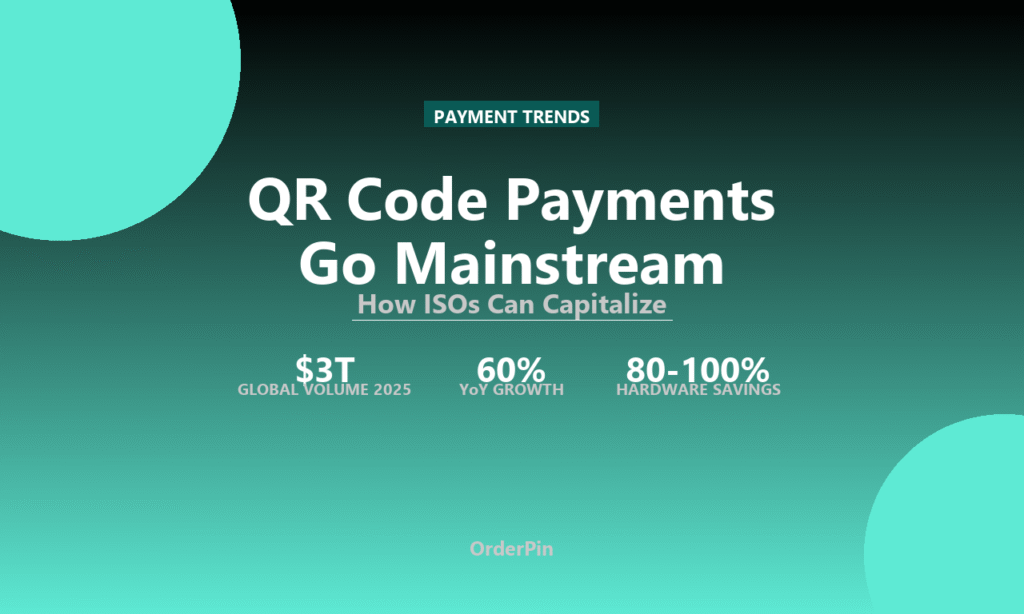
- QR code payments reached $3 trillion globally in 2025, with 60% year-over-year growth — driven by consumer preference for contactless, the elimination of hardware costs, and instant account-to-account settlement.
- QR code payments eliminate the need for dedicated card terminals, reducing merchant hardware costs by 80-100% — creating a massive cost-savings argument for merchants who are paying $30-100/month per terminal.
- ISOs who integrate QR code payment capabilities into their POS platforms capture the fastest-growing segment of the payments market while differentiating from competitors locked into traditional card terminal models.
QR Codes: The Payment Revolution That Is Already Here
In China, India, Brazil, and across Southeast Asia, QR code payments have already won. WeChat Pay, Alipay, and PIX have demonstrated that consumers will scan QR codes to pay for everything from street food to luxury hotels. In India alone, UPI-based QR payments process over $1 trillion annually. The question is not whether QR payments will become mainstream in the U.S. — it is how quickly.
The answer, according to Statista’s 2026 mobile payments report, is: very quickly. QR code payments reached $3 trillion globally in 2025, growing 60% year-over-year. In the United States, adoption is accelerating driven by: merchant demand for lower transaction costs, consumer comfort with contactless payment post-pandemic, and the ability for QR payments to settle instantly via A2A (account-to-account) rails at a fraction of traditional card interchange rates.
For ISOs, QR code payments represent both a threat and an opportunity. The threat: merchants who adopt QR payments may need fewer traditional card terminals, reducing terminal revenue. The opportunity: QR payments can be integrated into POS platforms, creating new revenue streams, lower merchant acquisition costs, and competitive differentiation that traditional card-terminal-focused ISOs cannot match.
How QR Code Payments Work in Practice
QR code payments come in two flavors: merchant-presented and consumer-presented. Understanding both is essential for ISOs who want to offer QR payment capabilities.
Merchant-Presented QR Codes (Static)
The merchant displays a printed QR code at the counter. The customer scans it with their banking app and enters the amount to pay. This is the model used by most small merchants globally — no app, no terminal, no hardware cost. Simple, low-cost, and highly effective for small merchants who cannot afford card terminals. Transaction costs are typically 0.5-1% via A2A rails, compared to 2-3% for traditional card transactions.
Merchant-Presented QR Codes (Dynamic)
The POS generates a unique QR code for each transaction, displayed on a screen or printed receipt. The customer scans it and confirms the pre-populated amount — more secure and suitable for higher-value transactions. Dynamic QR codes can encode transaction-specific data, including the exact amount, merchant ID, and authorization tokens.
Consumer-Presented QR Codes
The customer displays a QR code from their banking app, and the merchant scans it with a smartphone or tablet. This is the model behind WeChat Pay, Alipay, and some emerging U.S. solutions. It requires a smartphone or tablet with a camera, but no dedicated card terminal. Cost to the merchant: near-zero for A2A transactions, with the primary cost being any fees charged by the consumer’s bank.
Linked In-App Payments
QR codes can link to payment pages or checkout flows in banking apps, digital wallets, or payment apps. The customer scans a QR code that opens a payment link, enters payment details, and confirms. This hybrid approach bridges the gap between QR codes and traditional online checkout, enabling QR payments for e-commerce and remote transactions.
| QR Payment Type | Best Use Case | Hardware Needed | Typical Cost |
|---|---|---|---|
| Static Merchant QR | Small merchants, food stalls, markets | None (printed QR) | 0.5-1% via A2A |
| Dynamic Merchant QR | Restaurants, retail, any POS | POS screen or receipt printer | 0.5-1% via A2A |
| Consumer-Presented QR | Mobile-heavy merchants, delivery | Smartphone/tablet with camera | Near zero (A2A) |
| Traditional Card Terminal | High-volume, card-present transactions | Dedicated terminal ($200-500+) | 2-3% interchange + assessment |
The Business Case for ISOs to Adopt QR Payments
Lower Merchant Acquisition Costs
A traditional card terminal costs $200-500 per unit, plus monthly rental fees of $20-50. For merchants who need 3-5 terminals, the hardware investment alone is significant. QR payment capabilities built into a smartphone or tablet POS eliminate hardware costs entirely, making it possible to acquire merchants who cannot afford the capital investment in traditional terminals. This opens up entire market segments — food trucks, farmers markets, small artisans — that have been priced out of electronic payments.
Higher Transaction Margins via A2A Settlement
QR payments that settle via A2A rails (FedNow, RTP, or ACH) bypass traditional card networks entirely. There is no Visa/Mastercard interchange, no network assessment fees, no scheme costs. A QR payment that costs the merchant 0.7% via A2A is dramatically more profitable for the ISO than a card payment that costs 2.5% interchange. A2A payments can be 50-70% cheaper for merchants while generating higher ISO margins — a genuine win-win.
Competitive Differentiation
Most ISO sales conversations focus on card terminal rates — a race to the bottom where ISOs compete on basis points. QR payment capabilities change the conversation entirely: instead of competing on interchange-plus rates, ISOs compete on the value of a comprehensive payment platform that includes contactless QR, traditional cards, and emerging payment methods. This is a harder product to copy and a stickier merchant relationship to break.
Future-Proofing Against Fintech Disruption
Fintech companies like Block (Square), Stripe, and PayPal are aggressively pushing QR-based and A2A payment solutions to merchants. If ISOs do not offer QR payments, they risk losing merchants to these platforms. By adopting QR payment technology now, ISOs can retain existing merchants and compete directly with fintech platforms on their own turf.
How OrderPin Helps ISOs Integrate QR Payments
QR + Card in One Platform
OrderPin’s white-label POS integrates QR code payments alongside traditional card processing — giving merchants the best of both worlds and ISOs a complete payment platform that competes with fintech.
A2A Settlement via FedNow/RTP
OrderPin supports instant A2A settlement through FedNow and RTP rails — enabling merchants to receive funds in seconds rather than days, while reducing transaction costs by 50-70% vs. card payments.
No Dedicated Hardware Required
OrderPin’s QR payment capabilities run on existing smartphones, tablets, and POS terminals — eliminating hardware costs and enabling merchant acquisition in markets that cannot afford traditional card terminals.
Best Practices for QR Payment Implementation
1. Support Multiple QR Standards
The QR payment landscape is fragmented: merchants may need to support consumer-presented QR from WeChat Pay and Alipay (for tourism), merchant-presented QR from Zelle, Venmo, and PayPal, and emerging national standards like FedNow QR codes. Build flexibility into your QR payment integration to support multiple standards, and position this flexibility as a feature.
2. Make QR Payment Obvious to Customers
The biggest barrier to QR payment adoption is consumer awareness. Merchants need prominent signage explaining QR payments, staff trained to explain the process, and checkout flows that clearly present QR as an option. Help merchants train their staff and design customer-facing materials — this is where ISOs can add service value beyond the technology.
3. Pair QR with Loyalty and Digital Receipts
QR codes are not just for payment — they are a direct marketing channel. Every QR payment scan is an opportunity to collect customer data (with consent), deliver digital receipts, enroll customers in loyalty programs, and drive repeat visits. ISOs who help merchants use QR codes for more than just payment create additional value that justifies premium pricing.
Frequently Asked Questions
Will QR payments replace traditional card terminals entirely?
No — and ISOs should not position them as a replacement, but as a complement. Traditional card terminals remain essential for high-volume quick-service restaurants, gas stations, and any business where speed of transaction is critical (you cannot scan a QR code as fast as tapping a contactless card). QR payments excel in environments where hardware costs are prohibitive, transaction values are moderate, and merchant-customer relationships are ongoing (restaurants, retail, services). The winning strategy is offering both — and letting merchants choose the payment methods that work best for their specific business.
How do QR payments affect chargeback liability?
This is a critical question. A2A payments (FedNow, RTP, ACH) are direct bank transfers — they do not have the same chargeback protections as credit cards. If a customer pays via QR/A2A and disputes the transaction, the dispute resolution process is different from card chargebacks, often through the banks involved rather than card networks. Merchants offering QR payments need clear refund and dispute policies, and ISOs should ensure merchants understand the liability differences before signing them up for QR payments.
What percentage of U.S. consumers use QR payments regularly?
As of 2026, approximately 45% of U.S. consumers have used a QR code payment at least once, but regular usage (monthly or more) is around 20-25% — concentrated in urban areas, among younger consumers (Millennials and Gen Z), and in specific merchant categories (foodservice, convenience). This is growing rapidly, however, driven by Zelle’s consumer QR payments and PayPal/Venmo person-to-merchant capabilities. ISOs should not expect QR payments to replace cards in the near term, but should adopt them as an increasingly important complementary payment method.
What happens to ISO revenue when merchants switch from card terminals to QR payments?
This depends on the ISO’s pricing model. If ISOs charge a percentage of transaction volume, revenue may decline per transaction for QR payments (lower cost to merchant, but also lower absolute fee). However, if ISOs charge per-transaction or per-merchant flat fees — or if QR payments drive higher transaction volume (more customers paying who could not afford terminal costs) — overall revenue can increase. The strategic answer: ISOs should build QR payment revenue into a broader platform pricing model where QR and card payments are components of a total payment solution, not replacements for each other.
How do ISOs price QR payment solutions competitively?
QR payment pricing should reflect the cost advantage it offers merchants: if card payments cost 2.5% and QR/A2A costs 0.7%, pricing QR at 1.0-1.5% still saves the merchant money while generating better ISO margins than card processing. Position QR payments as a premium feature with tangible savings — not as a cheaper alternative to be discounted. Offer QR as an included capability in your platform subscription, not as a separate product, to maximize platform stickiness and simplify merchant pricing.
Conclusion
QR code payments are not a future trend — they are a present reality that ISOs can capitalize on today. With $3 trillion in global volume, 60% annual growth, and the ability to eliminate hardware costs while improving merchant margins, QR payments are the most compelling new payment capability available to ISOs.
The opportunity is not just about capturing QR payment volume — it is about competing with fintech platforms that are aggressively targeting your merchant base. Square, Stripe, and PayPal are all pushing QR-based solutions. ISOs who do not offer QR payments risk losing merchants who see these platforms as more modern alternatives.
The good news: QR payment technology is accessible, affordable, and achievable today. Integrated into a POS platform like OrderPin, QR payments become a natural part of the merchant’s workflow — not a separate product or added complexity. Merchants get lower costs, faster settlement, and no new hardware. ISOs get a differentiated product, better margins, and a platform that competes directly with fintech.
The question is not whether QR payments will grow — they will. The question is whether your ISO will be the one capturing that growth, or watching your merchants migrate to platforms that do.
About OrderPin
OrderPin is a white-label POS platform for ISO and MSP partners. Our QR payment integration — supporting A2A settlement via FedNow and RTP — helps ISOs compete with fintech platforms and capture the fastest-growing segment of the payments market.
Learn more about OrderPin’s QR payment capabilities