
TL;DR — Quick Summary
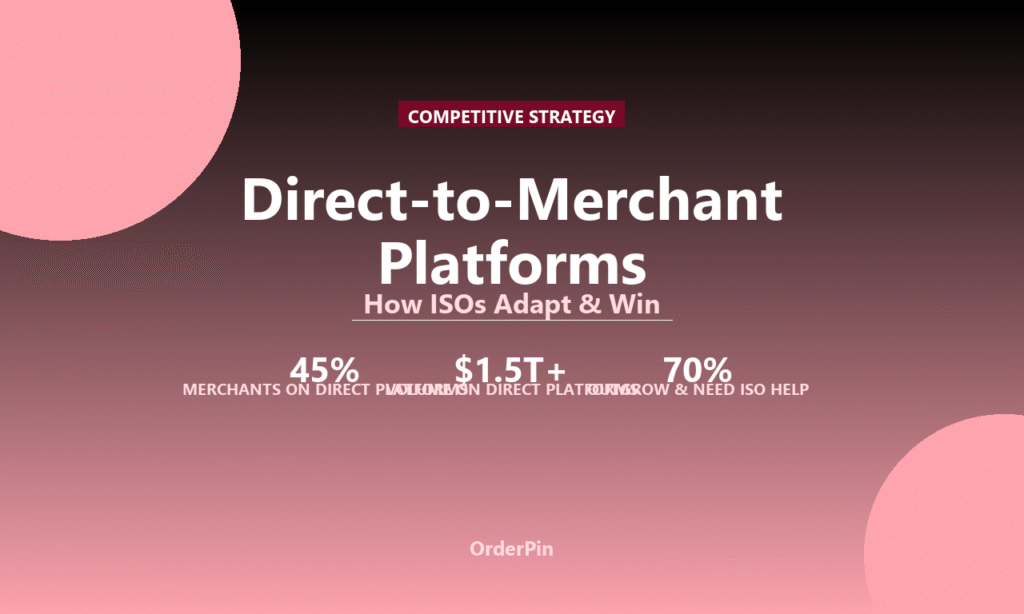
- 45% of new merchants now choose direct-to-merchant platforms (Shopify Payments, Square) over traditional ISOs — representing a seismic shift in how payment technology is being sold and delivered to small businesses.
- Direct platforms are winning on simplicity and price transparency, but they lose on customization, white-glove service, and complex business needs — creating a clear positioning opportunity for ISOs who play to their strengths.
- ISOs who adapt by offering hybrid models, white-label platforms, and service-heavy value propositions can actually benefit from direct platform growth — capturing merchants who outgrow direct solutions.
The Direct Platform Revolution: What ISOs Are Really Up Against
For the first time in the history of merchant payments, a significant portion of new small business owners are choosing their payment technology before they choose their bank. This is the revolution that Square, Shopify, Stripe, and a new generation of direct-to-merchant platforms have created — and it is reshaping the competitive landscape for ISOs everywhere.
According to The Strawhecker Group’s 2026 Independent Sales Organization Benchmarking Report, 45% of new merchants now evaluate direct-to-merchant platforms like Shopify Payments and Square as their first choice for payment processing — before ever contacting an ISO. This is a fundamental shift from the historical norm, where merchants found their ISO through their bank, their industry association, or a referral from another merchant.
The implications are stark: if ISOs continue selling the same way they have for the past 30 years, they will increasingly be competing for the scraps left behind after direct platforms have picked off the top of the market. But the story is not as dire as it might seem — and for ISOs who understand how to adapt, the direct platform revolution creates as many opportunities as it does threats.
Understanding the Direct Platform Value Proposition
To compete effectively against direct platforms, ISOs must understand exactly why merchants are choosing them in the first place. The direct platform pitch is compelling — and ISOs who dismiss it as superficial will fail to see the real competitive threat.
Why Merchants Love Direct Platforms
Speed of onboarding: A merchant can sign up for Square or Shopify Payments in 10 minutes, online, without talking to anyone. No bank statements, no credit check, no waiting for equipment to ship. For time-pressed entrepreneurs, this frictionless experience is irresistible.
Price transparency: Direct platforms publish their rates openly: 2.6% + 10 cents per transaction, no hidden fees, no monthly minimums. Compare this to the opaque, negotiated pricing of traditional ISO relationships, and the appeal is obvious.
Integrated ecosystem: Square and Shopify do not just offer payments — they offer a complete business operating system: POS, inventory, payroll, e-commerce, loans, and more. Merchants get everything in one place, with one bill, one dashboard, one relationship.
Digital-first design: Direct platforms were built for the smartphone era. Their interfaces are beautiful, intuitive, and mobile-first. Traditional ISO-provided solutions often look clunky by comparison, especially for younger merchants who expect consumer-grade UX in their business tools.
Why Direct Platforms Have Limits
Direct platforms were designed for a specific merchant profile: small, simple, early-stage businesses. As merchants grow, they almost inevitably encounter the walls of the direct platform model:
- Customization ceilings: Direct platforms offer limited ability to customize workflows, integrations, and reporting. Merchants with complex operations — multi-location, B2B invoicing, industry-specific requirements — quickly hit the limits of what Square or Shopify can provide.
- No white-glove support: Direct platforms are designed to scale through self-service. When a merchant has a problem, they get a chatbot or a community forum. For merchants who want a dedicated account manager, custom reporting, and hands-on support, this is a dealbreaker.
- Pricing at scale is a trap: Direct platform rates look attractive when a merchant is small, but they do not negotiate as volume grows. A merchant processing $500,000/month is paying the same 2.6% rate they paid when processing $5,000/month. A good ISO can typically beat that rate for high-volume merchants.
- Cash flow and lending limitations: While Square and Shopify offer merchant cash advances and loans, they are algorithmic and limited. ISOs who partner with lenders offering more flexible and personalized working capital products can provide better options for established merchants.
- Integration complexity: As merchants grow, they accumulate specialized software: ERP systems, industry-specific tools, custom integrations. Direct platforms have limited API ecosystems compared to the flexibility of traditional ISO-supported solutions.
| Criteria | Direct Platforms (Square, Shopify) | ISO-Provided Solutions |
|---|---|---|
| Onboarding Speed | 10 minutes, self-serve | 1-3 days, guided |
| Pricing Transparency | Published, simple | Negotiated, complex |
| High-Volume Pricing | No volume discounts | Negotiable at scale |
| Support Quality | Self-service, chatbot | Dedicated account manager |
| Customization | Limited by platform | Highly customizable |
| Complex Business Support | Not designed for this | Core strength |
The Merchant Lifecycle: The ISO Opportunity Hidden in Plain Sight
Here is the most important insight for ISOs competing with direct platforms: the direct platform is not the final destination for most merchants — it is the starting point. And that starting point is ISOs’ best acquisition channel.
According to industry research, approximately 70% of merchants who start on direct platforms eventually outgrow them and need more sophisticated solutions. This outgrow dynamic creates a massive opportunity for ISOs who know how to identify and engage merchants at the right moment in their lifecycle.
When Merchants Outgrow Direct Platforms
Volume milestone: When a merchant’s monthly processing volume exceeds $50,000-$100,000, the flat-rate pricing of direct platforms starts to become expensive compared to negotiated ISO pricing. At this volume, switching to an ISO-procured solution can save thousands of dollars per month — a compelling ROI conversation.
Multi-location expansion: Direct platforms handle single-location businesses well, but multi-location operations create complexity that outgrows their model: centralized reporting, location-level accounting, cross-location loyalty programs. Merchants expanding to a second or third location are prime ISO prospects.
Complexity trigger events: Certain business events predict ISO readiness: opening a second location, hiring a full-time accountant or CFO, seeking a business loan (especially if cash flow is complex), being acquired or merging with another business, entering a regulated industry, or needing custom integrations with ERP, inventory, or industry-specific software.
The referral moment: Merchants on direct platforms talk to each other. When a Square merchant connects with another merchant who is processing $200,000/month on a traditional ISO account and saving significantly, the conversion conversation begins. ISOs who build referral networks among merchants — including those who came from direct platforms — compound their acquisition advantage over time.
How OrderPin Helps ISOs Compete with Direct Platforms
White-Label Direct Experience
OrderPin’s white-label platform gives ISOs the modern, digital-first merchant experience that competes directly with Square and Shopify — while retaining full branding, pricing control, and merchant relationships.
Volume-Based Competitive Pricing
OrderPin enables ISOs to offer volume-tiered pricing that directly undercuts direct platform rates for merchants processing $50,000+/month — creating an immediate ROI case for switching.
Full-Service ISO Model
OrderPin’s ISO partner model gives merchants the dedicated account management, custom integrations, and white-glove support that direct platforms cannot match — positioning ISOs as the premium, high-touch alternative.
How ISOs Can Adapt Their Strategy
1. Position Yourself as the Merchant Growth Partner
The ISO value proposition should not be “we are cheaper than Square” — it should be “we grow with you.” Create a narrative that positions your ISO as the partner that merchants graduate to when they outgrow direct platforms. Build content, sales scripts, and referral programs around this growth narrative.
2. Target the Outgrow Moments
Do not try to compete with Square for brand-new merchants. Instead, focus on merchants who are hitting the walls of direct platforms: multi-location operators, high-volume processors, businesses with complex needs. Partner with accountants, bookkeepers, and business advisors who see these transitions happen.
3. Build a Hybrid Value Proposition
The most successful ISOs are building hybrid models that combine the best of direct platforms (modern UX, self-service onboarding, transparent pricing) with the best of ISO relationships (personal service, volume pricing, custom solutions). White-label platforms like OrderPin make this hybrid model accessible to ISOs of all sizes.
4. Leverage Direct Platform Awareness
Many merchants who start on Square or Shopify do not understand the full cost they are paying. ISOs who can clearly demonstrate the cost comparison at the merchant’s actual volume — showing concrete dollar savings — have a powerful conversion tool. Build a simple ROI calculator that shows exactly what a merchant would save switching from their current direct platform pricing.
5. Create a Referral Engine
Merchants who have successfully transitioned from direct platforms to ISO relationships are your best advocates. They understand both sides of the equation and can speak authentically about why the switch was worth it. Create a formal referral program that rewards these merchants for introducing their peers.
Frequently Asked Questions
Should ISOs try to compete with Square and Shopify on pricing alone?
No. Competing on price alone is a race to the bottom that ISOs cannot win against platforms with massive scale advantages. Direct platforms can afford to offer lower rates because they make money elsewhere: on loans, on subscriptions, on software add-ons. ISOs should compete on value, service, and specialization — not on headline pricing. The winning ISO pitch is: “You are not just switching payment providers, you are gaining a partner who grows with your business.”
How can ISOs identify when a merchant is ready to leave a direct platform?
Watch for these signals: the merchant mentions opening a second location, hiring a CFO or controller, seeking a business loan or line of credit, experiencing frustration with a platform limitation (cannot do something they need), processing over $50,000/month (the crossover point where ISO pricing beats direct platform flat rates), or receiving a direct platform loan/cash advance that limits their financial flexibility. Building relationships with accountants, attorneys, and business advisors who see these moments is the best way to identify transition-ready merchants.
Can ISOs use white-label platforms to offer a direct-platform-like experience?
Yes — and this is one of the most powerful competitive responses to direct platforms. White-label POS and payment platforms like OrderPin give ISOs the modern merchant experience (smartphone-friendly dashboards, self-service onboarding, transparent pricing tiers) while maintaining full control over branding, pricing, and merchant relationships. ISOs can offer their merchants the best of both worlds: a Square-like experience with an ISO relationship. This hybrid model is the future of the ISO business.
What percentage of merchants actually switch from direct platforms to ISOs?
Industry estimates suggest 15-25% of merchants who start on direct platforms eventually move to traditional ISO relationships — with the percentage higher among merchants who grow to mid-size ($100K+/month in volume) or develop complex business needs. While 75-85% stay on direct platforms, these “stayers” tend to be smaller, simpler businesses. Among the 15-25% who switch, the lifetime value to the ISO is typically 3-5x higher than a new merchant acquisition — because switchers have already validated their business model and understand the value of a real payment partnership.
How should ISOs structure their pitch to merchants currently on Square or Shopify?
Lead with curiosity and insight, not confrontation: “I work with businesses like yours who have been on Square/Shopify, and I have noticed a pattern of costs and limitations that most merchants do not see until they hit them. Can I share what I have observed with merchants at your volume and see if any of it resonates?” Frame the conversation as education, not sales. Then walk through: their actual current cost at their volume, the specific limitations they are likely encountering, and the concrete savings and capabilities they would gain with a partner. Make it easy for them to see the value — and let them decide to switch on their own timeline.
Conclusion
The direct platform revolution is real — 45% of new merchants choosing Square or Shopify before ever contacting an ISO is a structural shift, not a temporary trend. ISOs who bury their heads in the sand and hope it passes will be left behind. But ISOs who understand the dynamics, adapt their positioning, and play to their genuine strengths have more opportunity than ever.
The direct platform is the entry point for many merchants — and the ISO relationship is the destination for merchants who grow. That is the story ISOs need to tell: not “we compete with Square” but “we are what comes after Square.”
The merchant lifecycle is the ISO’s secret weapon. 70% of merchants outgrow direct platforms eventually. Those outgrow moments — volume milestones, multi-location expansion, complexity trigger events — are the ISO’s best acquisition opportunities. ISOs who position themselves as merchant growth partners, build referral networks, and offer the service depth that direct platforms cannot match will not just survive the direct platform revolution — they will thrive because of it.
OrderPin’s white-label platform — with modern UX, volume-based pricing, full customization, and white-glove ISO support — gives ISOs the tools to compete at every stage of the merchant lifecycle. Be the partner that Square merchants graduate to. That is where the long-term value is — and that is where ISOs win.
About OrderPin
OrderPin is a white-label POS platform for ISO and MSP partners. Our platform — with direct-platform-style merchant experience and ISO-grade customization and support — helps ISOs compete with Square, Shopify, and Stripe while building deep, high-value merchant relationships.
Learn more about OrderPin’s ISO partner program