
TL;DR — Quick Summary
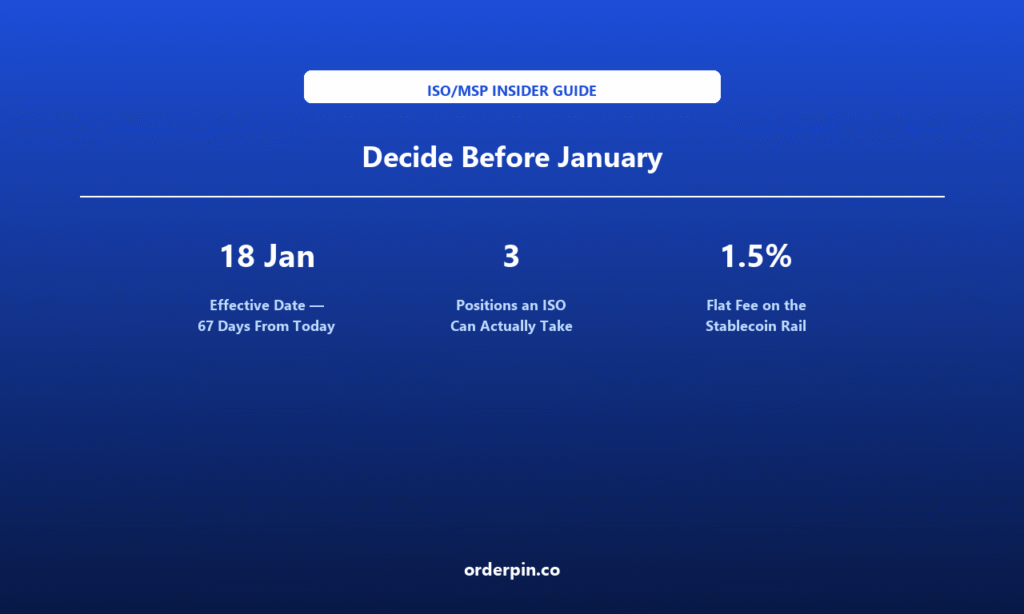
- The date is real and it is close: the GENIUS Act and the OCC’s implementing rule take effect on 18 January 2027 — 67 days from the date this was written. The OCC published its final rule on 23 October 2026. There is no further waiting for clarity on the main framework.
- You are almost certainly not an issuer, and you may be a service provider: the Act’s “digital asset service provider” definition covers anyone who, for compensation, transfers digital assets to a third party, exchanges them, or holds them in custody. Reselling POS is not that. Holding merchant settlement in stablecoin, running a wallet, or converting and paying out probably is.
- The business question is not adoption, it is the fee: a flat stablecoin rail prices around 1.5% against a card ticket near 2.7%, and an ISO’s residual lives inside that spread. Every point of volume that migrates takes residual with it unless you are the one charging. Decide which of the three positions you are taking before your merchants decide for you.
The Decision, Up Front
By 18 January 2027 you need three things on paper: an inventory of every place a stablecoin touches your stack, written answers from each processor about the role it plays under the Act, and a named position — pass-through, own the rail, or decline. The inventory is a week of work. The position is a strategy call, and it is the one most ISOs will make by accident.
The Date That Is Not In Anyone’s Plan
Stablecoin payments have been a background curiosity for most ISOs for three years — something the crypto-native merchants asked about, something a processor demoed once, something that never quite arrived. That framing expires on 18 January 2027, when the GENIUS Act and the OCC’s implementing rule take effect. What changes is not that stablecoins become legal tender, because they do not. What changes is that the rail becomes licensable, the issuer becomes identifiable, and the intermediary becomes an entity the statute has a name for.
The volume numbers explain why this stopped being theoretical. Monthly stablecoin payment volume ran around $5 billion in January 2024 and exceeded $30 billion by early 2026 — a sixfold increase in under two years, with the steepest acceleration in the second half of 2025. McKinsey and Artemis put real payments at roughly 1% of the $35 trillion in annual stablecoin transfer volume, which is the honest framing: the rail is growing fast and the payment use case is still small. Stripe’s stablecoin acceptance product is priced at 1.5% and live in more than seventy countries. That number is the one to remember, because it is the number your residual has to survive.
This is a briefing, not a forecast. Everything in the first three sections is a dated fact with a source at the bottom; the analysis starts when I tell you where the fee goes. If your processor or counsel disagrees with a specific point, the source section tells you exactly which document to put in front of them.
1. The Timeline, With the Dates That Bind You
Most of this calendar is already behind us. The Act was signed in July 2025, the OCC proposed in March 2026 and finalised in October. What remains is the compliance window, and it is shorter than the statute’s eighteen-month headline suggests because the framework is no longer moving.
Two things are easy to misread here. First, the effective date is the earlier of eighteen months after enactment or 120 days after final implementing rules — and because the OCC finalised in October, the January date controls. Second, the 2027 obligation is about foreign issuers and order compliance, not about a permitted-issuer-only list; that list arrives in 2028. Operators who read only the 2028 headline miss the obligation that starts this winter.
2. What Actually Changed — Three Facts
Strip the commentary and the statute does three things that matter to a payments business.
Only a permitted issuer may issue a payment stablecoin in the United States: a subsidiary of an insured depository institution, a federal qualified nonbank issuer approved by the OCC, or a state qualified issuer capped at $10 billion outstanding. Reserves are 1:1 in cash, insured deposits, short-dated Treasuries, repos and government money market funds; monthly reserve composition is published, examined by an accounting firm and certified by the CEO and CFO; reserves cannot be pledged or reused. Issuers above $50 billion publish audited annual statements.
A “digital asset service provider” is anyone who, for compensation or profit, exchanges digital assets for money or other digital assets, transfers digital assets to a third party, acts as a custodian, or participates in financial services relating to digital asset issuance. Protocols, validators and self-custodial software are excluded. Payment processors sit inside the definition. The obligation attached to the name is simple: you may only make available coins that pass the statutory test.
Knowingly participating in an unlicensed issuance carries a fine of up to $1 million per violation and up to five years, or both, from January 2027. Treasury’s proposal lists the conduct that counts as participation: market making for a newly issued coin, distributing it, making it available for secondary trading, coordinating key steps of issuance, or taking on a secondary redemption obligation. “We just facilitated it” is not a defence the statute recognises.
3. What It Does Not Do — Read This Before You Brief Anyone
Regulated is not the same as safe, and licensed is not the same as settled. Four limits are worth stating plainly, because each one is a claim someone in your organisation will make in the next sixty days.
It is not legal tender. Nothing in the Act requires a merchant, a landlord or a supplier to accept a stablecoin. Acceptance remains a commercial choice, which is why the adoption numbers still look the way they do: US consumer awareness sat at 16% in S&P Global’s Q2 2026 survey, with fraud risk (48%) and fund security (46%) the top concerns, and physical acceptance in the euro area remained below 1%.
It is not a full digital-asset framework. The CLARITY Act, which would have addressed market structure beyond stablecoins, failed to advance in the Senate in September 2026. GENIUS is the only federal framework in force, and it governs payment stablecoins — not tokens generally, not DeFi, not securities.
It does not solve a run. The reserve test is about asset quality and eligibility, not about how fast those assets convert to cash when redemptions arrive faster than settlement cycles. A fully backed coin removes most solvency risk and leaves timing risk intact: the token trades around the clock, the reserves settle on banking days.
It does not let issuers pay yield. A permitted issuer cannot pay interest or yield to holders simply for holding, using or retaining the coin. That removes the “earn on your float” pitch from every merchant conversation — and it is why the yield conversation has moved to exchanges and card programmes rather than to the token itself.
4. What It Means for an ISO — Three Impacts
Here is where the briefing turns into a decision. Three impacts, in the order they will arrive.
Impact 1 — Your role depends on whether you touch the money
Reselling POS terminals and placing merchant processing through a licensed acquirer does not make you a digital asset service provider. That is not legal advice and the edges are genuinely unsettled — payment APIs, orchestration layers and wallet software all sit near the exclusions — but the centre of the definition is clear enough to plan against. What pulls you in is custody and movement: holding merchant settlement in stablecoin, operating a wallet that holds customer funds, converting coin to fiat for a merchant, or paying merchants out in coin. Each of those is one of the five enumerated activities, done for compensation. If you do any of them, you are in scope, and the obligations attach on the dates above rather than on a schedule you choose.
The practical test is a single question asked at every step of your stack: who is holding the funds at this moment? If the answer is ever “we are”, you have a role under the Act, and you need to know which one before a merchant asks you to prove it.
Impact 2 — The spread is the whole argument
A card ticket for a small merchant runs somewhere near 2.7% all-in. A flat stablecoin rail prices around 1.5%. To a merchant, that is a 1.2-point saving and an easy yes. To an ISO, it is the disappearance of the only number it controls, because residual is a share of that discount and the discount just got smaller — or vanished entirely, if the merchant moves to a native wallet-to-wallet flow with no acquirer in the middle at all.
Where the fee goes when volume migrates
Illustrative arithmetic on stated inputs — substitute your own residual and mix. Per $10M of annual volume moved off card.
| Scenario | Merchant pays | You keep | Annual change |
|---|---|---|---|
| Card, today | 2.70% · $270,000 | 0.35% · $35,000 | baseline |
| Pass-through to a 1.5% rail | 1.50% · $150,000 | $0 | −$35,000 |
| Own the rail at 1.20% | 1.20% · $120,000 | 0.80% · $80,000 | +$45,000 |
| Native wallet-to-wallet | ≈0% network | $0 plus hardware | −$35,000 |
The third row is the only one that improves your position, and it is also the only one that puts you inside the digital asset service provider definition. That is not a coincidence — the statute prices the role. Owning the rail at 1.20% still leaves the merchant 1.5 points better off than card, which is why it is sellable.
This is the sentence worth taking to your next partner meeting: stablecoin acceptance is not a product decision, it is a decision about who owns the spread. Decline it and a processor will sell it to your merchant directly; pass it through and you keep the account while donating the residual; own it and you take on the role, the compliance and the fee. There is no fourth option where the merchant gets a 1.2-point saving and you keep 35 basis points.
Impact 3 — The support model changes shape
Stablecoin settlement is irreversible. There is no chargeback window, no representment, no retrieval request that recovers funds from a cardholder’s bank. For a merchant, that is the feature — it removes a cost centre that has been priced into their discount for decades. For the ISO, it moves a whole category of work: disputes become a pre-payment question (“who is this customer, and have we seen the wallet before”) rather than a post-payment one. If your support tiering assumes a chargeback queue, the queue does not disappear; it converts into refund policy, identity checks and a conversation about who eats a depeg.
That is also why the hardware question matters more than it looks. NCR Voyix shipped a stablecoin payment module for its Aloha restaurant platform in February 2026, covering roughly 100,000 US restaurant locations. Toast does not accept crypto natively; Square enabled Bitcoin, not USDC; Lightspeed reaches stablecoin acceptance through Stripe’s rail rather than native support. Merchants on those stacks are being served by workarounds — a second tablet, a gateway QR code, an order keyed in as cash — and workarounds are where reconciliation breaks.
5. The Three Positions
Every ISO lands in one of three places whether or not it decides. The value of naming the position is that the operational consequences stop being surprises.
| Position | What you do | Revenue effect | Compliance load |
|---|---|---|---|
| A · Pass-through | Refer merchants to a licensed gateway or your processor’s product; stay the account owner, not the money holder | Residual declines with card volume; you keep the relationship and the hardware | Low — diligence on the partner, not a licence |
| B · Own the rail | Operate the acceptance and settlement layer, price it yourself, hold or convert funds in a controlled account structure | Fee income that does not depend on interchange; the only route that beats card economics | High — likely a service provider; BSA/AML, custody, key management, vendor diligence |
| C · Decline | Take no position, support no workaround, tell merchants no in writing | No change until a competitor wins the account on this feature alone | None — but the exposure does not leave |
Position A is where most ISOs will end up by default, and it is a defensible choice for a book concentrated in restaurants and retail where stablecoin demand is thin. Position C is defensible too, provided it is written down and communicated — the failure mode is not declining, it is declining while a rep quietly sets up a merchant with a third-party gateway and creates an unmanaged exposure with your name on the invoice. Position B is the only one that changes your economics, and it should be entered deliberately, with counsel, not because a merchant asked twice.
6. Risk Exposure by Role
The same statute distributes risk unevenly. Find your row, then find the row of whoever you depend on — because in most ISOs the larger exposure sits with a vendor.
| Role | What creates the exposure | What it costs | Bites on |
|---|---|---|---|
| ISO / reseller | Holding settlement in coin, running a wallet, converting for merchants, paying out in coin | Service-provider obligations; up to $1M per violation for knowing participation in unlicensed issuance | 18 Jan 2027 |
| POS / software vendor | Native acceptance, key custody, refund and dispute handling inside the terminal | Same definition; plus firmware and support liability when a payment is irreversible | 18 Jan 2027 |
| Processor / gateway | Listing coins, diluting foreign-issuer representations, AML monitoring gaps | Cannot make a foreign coin available without documented issuer compliance; delisting risk flows to you | 18 Jan 2027 / 18 Jul 2028 |
| Merchant | Accepting a coin at par; no chargeback; a depeg during the holding period | Irreversible loss, accounting treatment, tax basis on every settlement | Immediately |
| Issuer | Licensing, reserve composition, monthly attestation, no-yield rule, capital floor | Approval process, ongoing examination, revocation risk | 18 Jan 2027 |
7. The Decision Checklist
Five items now, four to watch, five to refuse. Written to be finished before the effective date rather than started after it.
- Inventory every touchpoint. List each place a stablecoin appears in your stack — gateway, wallet, payout, float, treasury — and write down who holds the funds at that step. This is the document that answers every later question.
- Get written answers from each processor and gateway. Three questions: which role do you play under the Act, how do you handle the foreign-issuer condition on 18 January 2027, and what happens to any coin on your list that is not from a permitted issuer. Verbal assurances are not evidence.
- Name your position. Pass-through, own the rail, or decline — written down, with a date and an owner. The default is a decision made by whoever answers the merchant’s call.
- Fix the merchant agreement. Irreversible settlement, refund policy, who bears depeg risk during the holding window, and what happens if a coin is delisted mid-month.
- Price the migration. Model 10%, 20% and 30% of volume moving off card and look at the residual line, not the merchant’s saving. Use your own basis points; the arithmetic in section 4 is a template, not a benchmark.
- 23 November 2026: comments close on the OCC’s application and registration forms. If you depend on a foreign-issued coin, this is the only open input window.
- Treasury comparability determinations: none had been published as of November 2026 for the EU, UK, Singapore, Japan or the UAE. Until one lands, no foreign issuer can use the registration route, which means the coins available to your merchants may narrow without warning.
- State certification: state regimes must be certified as substantially similar before state-qualified issuers can be relied on. That process runs through 2028.
- Your POS vendor’s roadmap: native support exists at NCR Voyix, not at Toast or Square, and Lightspeed reaches it through Stripe. Where your merchants sit determines whether acceptance is a feature or a workaround.
- Don’t issue your own stablecoin. The capital, reserve, attestation and examination burden is a bank-adjacent business, not a reseller side project.
- Don’t hold merchant settlement in coin as a float. This is the single fastest way to become a service provider with custody obligations you have not staffed.
- Don’t route merchants to an unregistered foreign issuer “just for now”. From 18 January 2027 the foreign-issuer condition applies, and knowing participation is the language in the penalty clause.
- Don’t market “no fees” acceptance you cannot fund. Native wallet-to-wallet has no network fee because there is no network. If you are in the middle, somebody is paying you, and the merchant will find out.
- Don’t assume your processor’s compliance covers you. The obligation is on each service provider. A vendor’s licence is evidence about the vendor.
Why the Inventory Comes First
The reason most ISOs cannot answer “who holds the funds” is that settlement, residual and merchant data live in three different systems, so no single view shows where a dollar — or a token — actually sits. That is a data problem before it is a compliance problem.
- Settlement and residual on one record: the same per-merchant view that produces NMGM is what lets you price a rail change instead of estimating it.
- Attach and software revenue in the same ledger: as card volume migrates, the only line that holds is recurring software — which is the argument in the attach analysis.
- Merchant-level export for diligence: when a processor asks what you actually do with funds, an account-level export answers it in an hour rather than a quarter.
Frequently Asked Questions
Does this mean my merchants can accept stablecoins legally now?
They could before, in most cases — what changes is who may issue and who may intermediate. The Act does not make stablecoins legal tender and does not compel anyone to accept them. What it does is create a licensed issuer category and impose conditions on the businesses that make coins available to US users. Merchant acceptance is still a commercial choice, and the demand side is still small: 16% consumer awareness and under 1% physical acceptance in the euro area.
Am I a digital asset service provider if I just resell POS?
Selling hardware and placing processing through a licensed acquirer does not, on the face of the definition, make you one. What does is holding customer funds, operating a wallet, converting coin for a merchant, or paying out in coin — all for compensation. The edges around payment APIs and orchestration layers are unsettled, so treat this as a test to apply with counsel rather than a conclusion. The question that resolves most cases is who holds the funds at each step.
Which date actually applies to me — 2027 or 2028?
Both, for different obligations. From 18 January 2027 you may not make a foreign-issued coin available unless the issuer can and will comply with lawful orders such as freezes, and the custody rules apply. From 18 July 2028 the permitted-issuer test applies to every coin you offer. The 2027 date is the one most operators miss because the 2028 headline is the one that gets quoted.
Is a stablecoin cheaper for the merchant, and does that help me?
It is cheaper for the merchant and usually worse for you, because your residual is a slice of the discount. A 1.5% flat rail against a 2.7% card ticket saves the merchant 1.2 points; if you pass it through, your basis points on that volume go to zero. The only version that improves your position is owning the rail and pricing it yourself, which is also the version that puts you inside the service-provider definition.
What about chargebacks — isn’t no-chargeback a win?
For the merchant it removes a real cost. For you it removes a service and a control at the same time. Irreversibility means the dispute moves before the payment, into identity and refund policy, and it means a mistaken payment is a loss rather than a claim. If your support model is staffed around a chargeback queue, that staffing assumption needs revisiting at the same time as the pricing.
Are the numbers in this article forecasts?
No. The dates, definitions, thresholds and penalties are from the statute, the OCC final rule and Treasury’s proposal, all sourced below. The volume figures are from published research noted in the sources. The percentage economics in section 4 are illustrative arithmetic on stated inputs — 2.70% card, 1.50% rail, 0.35% residual — and you should replace them with your own before making a decision.
On 18 January 2027 the rail becomes licensable, and the question stops being whether stablecoins matter and becomes who charges the fee when a merchant accepts one. Three facts to hold: only permitted issuers may issue, from that date a foreign coin cannot be made available unless its issuer will honour lawful orders, and knowing participation in an unlicensed issuance is a crime carrying up to $1 million per violation. Your exposure turns on one question asked at every step of the stack — who holds the funds — and the honest answer for most ISOs today is nobody knows, because settlement and residual sit in different systems. Answer it, name your position among pass-through, own-the-rail or decline, and price the migration before the merchant asks. OrderPin is a white-label POS platform built for ISO and MSP partners: merchant-level margin, settlement and software revenue on one record, which is what makes the inventory an afternoon instead of a quarter.
Sources, Dates & What Would Change This
Primary documents: GENIUS Act, P.L. 119-27 (12 U.S.C. 5901 et seq.), enacted 18 July 2025. OCC final rule implementing the Act, 91 Fed. Reg. 67000 (23 October 2026), effective 18 January 2027. Treasury proposed rule on issuance, offer and sale, published 18 August 2026, comments closed 19 October 2026. Congressional Research Service, Stablecoin Legislation: An Overview of the GENIUS Act of 2025 (IN12553), updated 20 August 2026.
Market data: monthly stablecoin payment volume and the share of transfer volume attributable to real payments from McKinsey and Artemis research as reported in industry summaries; US consumer awareness from S&P Global’s Q2 2026 survey; euro-area physical acceptance from European Central Bank reporting; stablecoin rail pricing from published gateway fee schedules; POS vendor support status from vendor documentation and product announcements current to November 2026.
Status as of 12 November 2026: no Treasury determination that any foreign regime is comparable had been published, for the EU, UK, Singapore, Japan, the UAE or any other jurisdiction; the OCC had not yet announced when it would begin accepting issuer applications; and the CLARITY Act had failed to advance in the Senate in September 2026, leaving GENIUS as the only federal digital-asset framework in force.
What would change this analysis: finalisation of Treasury’s issuance rule, the first comparability determination, certification of state regimes, the OCC opening applications and issuing waivers, or new legislation addressing market structure. Any of these can move the dates or narrow the available coin list, and the checklist in section 7 is designed to be re-run when one lands.
Not legal advice: whether a particular business is a digital asset service provider, a custodian, or neither depends on facts and on how the agencies apply an unsettled definition. Validate your position with counsel before acting on it.
About OrderPin
OrderPin is a white-label POS platform built for ISO and MSP partners. We offer full data ownership, flexible pricing, and seamless API integrations to help you build a recurring revenue business under your own brand. Learn more about OrderPin’s white-label solution