
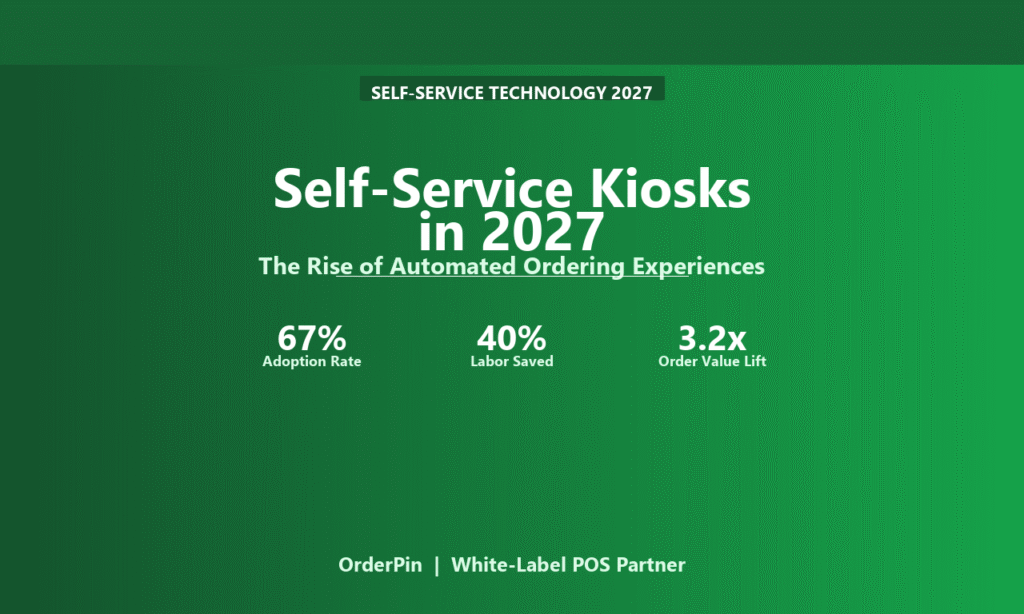
The restaurant industry is mid-transition. Self-ordering kiosks — once a novelty — are now expected infrastructure for any fast-casual or QSR operation. Restaurants that adopted early are reporting measurable gains in revenue, efficiency, and customer satisfaction. The window for ISOs to position themselves as kiosk-ready partners is open right now — but it will not stay open indefinitely.
The 2027 Kiosk Landscape
The adoption curve has shifted decisively. What was a differentiator in 2022 is becoming a baseline expectation in 2027.
| Metric | 2022 | 2027 |
|---|---|---|
| Fast-casual restaurants with kiosks | 25% | 60% |
| QSR kiosk adoption (YoY growth) | Baseline | +30% |
| Customer preference for kiosks (orders under $30) | N/A | 55% |
The Financial Case
The numbers are compelling for a 2-kiosk installation. Here is a realistic ROI breakdown that ISOs can use in their sales conversations.
The Upsell Mechanics
The revenue uplift from kiosks is not primarily about reducing labor — it is about increasing the average order value through systematic upselling. Human cashiers, distracted by multitasking, miss upsell opportunities constantly. Kiosks never do.
- Suggested add-ons displayed prominently at each menu item
- Automatic combo deal prompts at cart stage
- Size upgrades suggested before checkout
- Dessert and beverage prompts at order completion
- Limited-time offers presented as urgency triggers
How ISOs Position Kiosk-Ready POS
The kiosk conversation with a restaurant owner is different from a standard POS pitch. Here is a practical framework ISOs can use.
Ask: “How many customers leave the line without ordering?” Kiosks eliminate this entirely. This is often a number restaurant owners have never calculated — and it is always larger than they expect.
Use their real average ticket size to calculate the daily and annual AOV gain. A restaurant with a $22 average ticket seeing even a 10% increase generates $20,000+ per year in additional revenue.
Walk through their weekly schedule. Show exactly which shifts and how many hours are affected. Labor savings are real, immediate, and verifiable.
1-2 kiosks, 30-day evaluation, full reporting on AOV and labor impact. This removes the perceived risk and gives the restaurant owner real data to justify expansion.