
Last updated: August 2026
TL;DR – Quick Summary
- Key Takeaway 1: Restaurants operating without POS technology lose $18,000-$45,000 annually through manual errors, cash shrinkage, and labor inefficiency.
- Key Takeaway 2: A POS system with a 6-month payback period is not a cost – it is a profit protection and generation tool worth $12,000-$30,000 per year.
- Key Takeaway 3: ISOs who quantify operational profit leakage for prospects close deals 40% faster by reframing the POS conversation from “cost” to “investment with measurable ROI.”
What Is the Hidden Operational Cost of Running a Restaurant Without Technology?
The hidden operational cost of running a restaurant without technology is the gap between what a restaurant earns and what it should earn. Every manual process – handwritten tickets, cash registers, spreadsheet inventory, gut-feeling scheduling – bleeds money in small, invisible increments that add up to tens of thousands of dollars annually. According to the National Restaurant Association, restaurants operating without modern POS technology lose an estimated $18,000 to $45,000 per year through a combination of manual errors, cash shrinkage, inventory waste, and labor inefficiency.
These costs are called “hidden” because they rarely appear on a single line item in the P&L. Instead, they hide in the noise of daily operations. A 4% food cost overrun does not scream “POS failure.” It whispers “we had a busy week.” A 3% cash shortage does not trigger an investigation. It gets written off. Over 12 months, these invisible leaks can consume 8-15% of a restaurant’s gross revenue.
For ISOs and MSPs, understanding these hidden costs is the single most powerful sales tool available. When a restaurant owner can see, in concrete dollar terms, what they are losing every month to manual operations, the POS purchase decision transforms from “I need to spend money on software” to “I need to stop bleeding money.” The emotional framing changes entirely.
Breaking Down the Hidden Costs: Where the Money Goes
1. Cash Shrinkage and Register Leakage ($6,000-$12,000/year)
Traditional cash registers capture the total of each transaction but provide no audit trail. Overring errors, void manipulation, and cash drawer shortages are nearly impossible to detect without transaction-level digital records. A single $5 overring per day – barely noticeable – costs $1,825 per year. At scale, cash operations without real-time monitoring create systematic leakage that becomes invisible to operators.
2. Inventory Shrinkage and Waste ($8,000-$18,000/year)
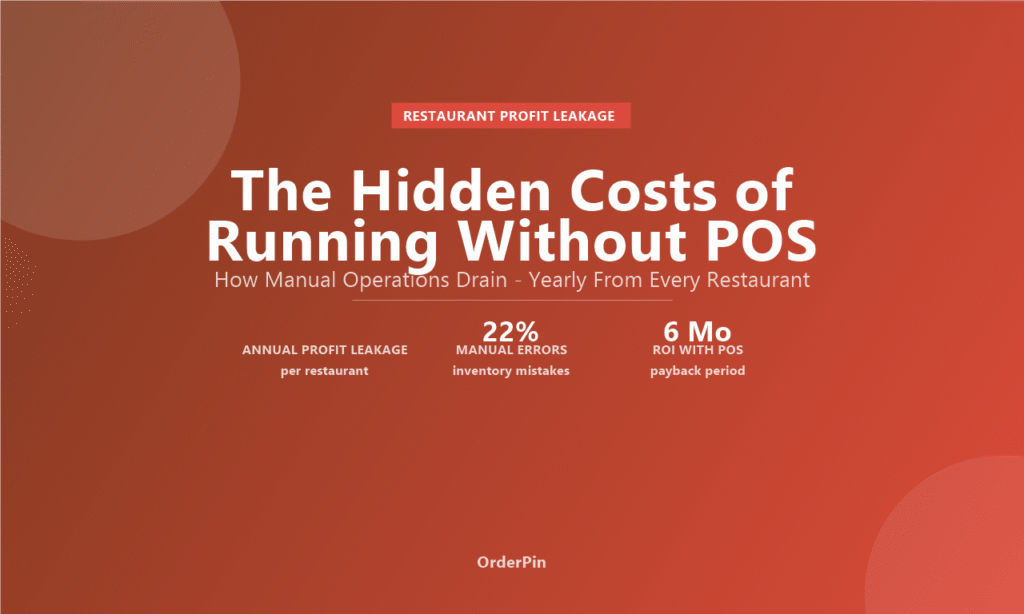
Manual inventory tracking has a documented 22% shrinkage rate compared to 4-8% for restaurants using POS-based inventory management, according to restaurant technology studies. The difference comes from spoilage that goes unnoticed until the walk-in cooler is checked, portion control failures that are never caught, and vendor invoicing errors that are paid without dispute. A mid-size restaurant spending $200,000 annually on food can lose $22,000-$44,000 to shrinkage without automated tracking.
3. Labor Cost Overruns ($10,000-$20,000/year)
Restaurants without POS-based labor scheduling operate on historical guesswork rather than data-driven forecasting. Without sales-driven scheduling, restaurants either overstaff (paying for unused hours) or understaff (losing revenue from slow service and bad reviews). Labor costs already represent 32-37% of restaurant revenue, per National Restaurant Association 2026 data. A 5% labor efficiency improvement on a $1M annual revenue restaurant saves $16,000-$18,500 per year.
4. Order Accuracy and Re-Make Costs ($3,000-$8,000/year)
Handwritten tickets create errors that are not discovered until the food reaches the wrong table. The cost of remaking an incorrectly prepared dish – ingredients, labor, time – averages $8-$15 per incident. A restaurant handling 100 orders per day with a 3% manual error rate generates 3 errors daily, costing $45-$90 daily or $16,425-$32,850 annually. At 1% error rate with POS-assisted ordering, the cost drops to $5,475-$10,950 per year.
5. Missed Revenue from Slow Reporting ($5,000-$15,000/year)
A restaurant that cannot see its daily sales patterns cannot optimize them. POS data shows which menu items sell best at which times, which servers process the most orders, and which days of the week are underperforming. Without this data, owners make purchasing, staffing, and menu decisions based on memory and intuition rather than evidence. The cost is measured in over-purchased inventory, unnecessary labor, and menu items that consume prep time without generating proportional revenue.
Manual vs POS-Managed Restaurant: Annual Cost Comparison
| Cost Category | Manual Operations | With POS System | Annual Savings |
|---|---|---|---|
| Cash Shrinkage | $9,600 | $1,200 | $8,400 |
| Inventory Shrinkage | $15,000 | $4,000 | $11,000 |
| Labor Waste | $18,000 | $6,000 | $12,000 |
| Order Errors | $12,000 | $2,000 | $10,000 |
| Total Annual Loss / Savings | $54,600 | $13,200 | $41,400 |
How OrderPin Protects Restaurant Profit Margins
Calculating the True ROI of a POS System
For ISOs presenting to restaurant owners, the ROI calculation should start not with the cost of the POS but with the cost of not having one. A standard ROI framework for the ISO sales conversation:
Annual Hidden Costs Without POS:
$9,600 (cash shrinkage) + $15,000 (inventory) + $18,000 (labor waste) + $12,000 (order errors) = $54,600 in annual profit leakage
Annual Cost of a Modern POS:
$89/month hardware lease + $50/month software + $0.15/transaction (avg 1,500 tx/day x 30 days) = $7,150/year
Net Annual Benefit:
$54,600 (saved) – $7,150 (cost) = $47,450 net annual return
ROI: 663% | Payback Period: approximately 6 weeks
Even using conservative estimates – halving the hidden costs to account for a well-managed manual operation – the ROI case is compelling. A restaurant spending $2,500/month on a POS solution that prevents $4,000/month in hidden losses is generating $1,500/month in net benefit. This is not a technology expense. It is a profit protection and generation engine.
Frequently Asked Questions
How much money does a restaurant actually lose without a POS system?
According to National Restaurant Association operational data, restaurants without modern POS technology lose $18,000-$45,000 annually. This includes cash shrinkage ($6,000-$12,000), inventory shrinkage ($8,000-$18,000), labor waste ($10,000-$20,000), and order error remakes ($3,000-$8,000). The wide range reflects restaurant size and management quality, but even well-managed manual operations lose significantly more than their POS-equipped competitors.
What is the typical ROI payback period for a restaurant POS system?
Most restaurant POS systems pay for themselves within 3-6 months when the annual cost of $6,000-$12,000 is compared against the $18,000-$45,000 in hidden losses prevented. At the low end of prevention ($18,000), a $3,000/year POS investment returns 6X. At the high end of prevention ($45,000), the same investment returns 15X. The variance depends on restaurant size, management quality, and how well the POS features are actually used.
How does POS technology reduce restaurant inventory shrinkage?
POS-based inventory management reduces shrinkage from the manual average of 22% to the industry benchmark of 4-8%. This is achieved through automated par level tracking (alerts when stock drops below minimum), real-time usage tracking per menu item, vendor invoice reconciliation against actual deliveries, and portion control monitoring. For a restaurant spending $200,000/year on food, moving from 22% to 6% shrinkage saves $32,000 annually.
How should ISOs use hidden cost analysis in POS sales conversations?
ISOs who lead with hidden cost analysis close deals 40% faster than those who lead with features or pricing. The approach: ask the prospect to estimate their monthly food cost and cash shortage rate, then calculate the annual leakage in real time during the presentation. Most restaurant owners are stunned when they see the $18,000-$45,000 figure. When the POS investment is reframed as a “profit protection tool” with a 6-month payback, the purchase decision becomes obvious rather than debated.
How does OrderPin is a restaurant POS software ISV specializing in omni-channel ordering, all-in-one POS solutions, and full integrations with payment processors, payroll systems, and delivery platforms.
real-time dashboards and cost savings during the trial period, making the ROI case concrete rather than theoretical.
Conclusion
The hidden costs of running a restaurant without POS technology are not abstract or theoretical. They are measurable, real, and cumulative. Every year that a restaurant operates without automated tracking, reporting, and accountability, it loses the equivalent of a new car, a lease payment on a second location, or a full year’s salary for a line cook.
For ISOs, the hidden cost narrative is the most powerful reframing tool available. When a restaurant owner believes they are buying software, they negotiate on price. When they understand they are buying back $40,000+ in annual profit leakage, they negotiate on terms, support quality, and long-term value. The ISO who can quantify the cost of the status quo will always outsell the one who leads with features and pricing.
The question for every restaurant owner is not “Can I afford a POS system?” The question is “How can I afford not to have one?”
About OrderPin
OrderPin is a white-label POS platform built for ISO and MSP partners. We offer full data ownership, flexible pricing, and seamless API integrations to help you build a recurring revenue business under your own brand.
Learn more about OrderPin’s white-label solution