
Last updated: August 2026
TL;DR – Quick Summary
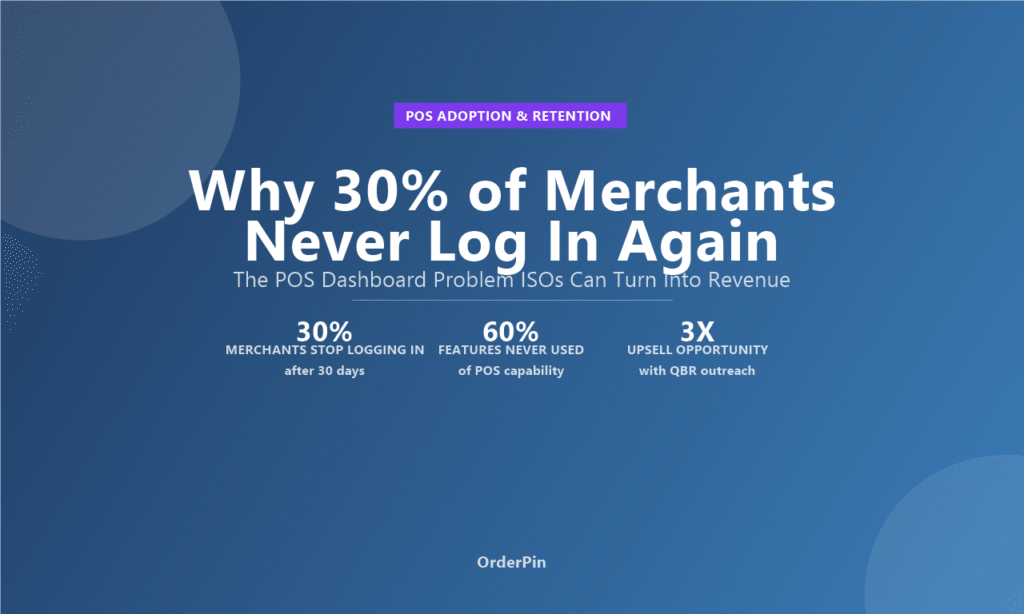
- Key Takeaway 1: 30% of SMB merchants stop logging into their POS dashboard within 30 days of onboarding, wasting 60% of paid features.
- Key Takeaway 2: Every inactive merchant represents $120-$300 in monthly upsell potential that ISOs leave on the table.
- Key Takeaway 3: ISOs should implement a quarterly QBR (Quarterly Business Review) process targeting login-rate metrics to unlock hidden revenue.
What Is the POS Dashboard Adoption Problem?
The POS dashboard adoption problem is a silent revenue killer that most ISOs and MSPs never measure. When a merchant goes live on a new POS system, the assumption is that they will use every feature they are paying for. In reality, 30% of SMB merchants stop logging into their dashboard within 30 days of activation. This means 3 out of every 10 merchants you sign are leaving their most powerful business intelligence tools untouched, according to POS adoption studies and SaaS engagement reports.
The consequences ripple across your entire book of business. Merchants who never see their transaction data cannot make data-driven decisions. They do not notice inventory shortfalls, peak hour patterns, or employee performance issues. Over time, this disengagement erodes their confidence in the POS system itself, creating churn risk that feels inexplicable. The merchant blames the software. The ISO loses the account.
Meanwhile, ISOs are leaving significant recurring revenue on the table. Features like advanced reporting, loyalty programs, online ordering integrations, and inventory analytics represent $50-$200 per merchant per month in upsell opportunity that never gets activated simply because the merchant never logs in to discover these capabilities exist.
Why Merchants Stop Logging In
Understanding why merchants disengage from their POS dashboard is the first step toward fixing the problem. The causes fall into four distinct categories, each requiring a different intervention strategy for ISOs.
1. Onboarding Failure: Most POS onboarding focuses on getting the merchant to the “first transaction” rather than building genuine proficiency. The merchant learns just enough to process payments. Everything else – reporting, inventory management, employee scheduling – is left for “later.” Later never comes.
2. Feature Discovery Gap: Merchants simply do not know what their POS can do. A restaurant owner may never realize that their system has built-in menu mix analysis, labor cost reporting, or customer repeat-rate tracking – until an ISO shows them during a Quarterly Business Review.
3. Perceived Complexity: Dashboard interfaces can feel overwhelming to non-technical operators. If the first login experience is confusing, merchants avoid returning. This is especially true for older restaurant operators and single-location owners without dedicated office staff.
4. Time Poverty: Restaurant owners are among the most time-constrained small business operators. Running a kitchen, managing staff, ordering supplies, and handling customer issues leave little bandwidth for sitting at a computer reviewing transaction data. The POS dashboard becomes “one more thing” they do not have time to do.
The Hidden Cost for ISOs: More Than Just Lost Upsell
For ISOs and MSPs, inactive merchants create cascading problems beyond missed upsell revenue. The most significant is churn acceleration. Merchants who do not see value in their POS dashboard do not see value in their monthly statement either. When a competitor makes a cold call offering a lower rate, the disengaged merchant has no loyalty anchor holding them in place. They switch processors because they never felt the depth of their current system’s value.
According to SaaS retention research, engaged users have a 2.4X lower churn rate than disengaged users, regardless of price. This means every inactive merchant in your book is statistically more likely to leave within 12-18 months. The cost of acquiring a new merchant ($500-$2,000 in sales commissions and onboarding time) far exceeds the cost of re-engaging an existing inactive account.
Data from payment industry analysts shows that ISOs with active merchant engagement programs report 40-60% higher merchant retention rates and significantly lower annual churn compared to those running a passive “sign and forget” model. The difference is not in the POS technology – it is in how actively ISOs help merchants discover and use what they already paid for.
How OrderPin Helps ISOs Drive Dashboard Adoption
How ISOs Can Fix the Dashboard Adoption Problem
The solution is not better software – it is better merchant engagement strategy. Here is a proven framework ISOs can implement immediately:
Step 1: Establish a Login-Rate KPI
Track what percentage of your merchants log into their dashboard at least once per month. Set a target of 75%+ monthly login rate. This single metric will tell you more about the health of your book than any financial report.
Step 2: Implement 30-60-90 Day Check-ins
Schedule automated outreach at 30, 60, and 90 days post-onboarding. The 30-day check-in should focus on feature discovery (“Did you know your POS can…”). The 60-day check-in should address pain points (“Your sales data shows…”). The 90-day check-in is your first formal QBR opportunity.
Step 3: Build a QBR Playbook
Create a repeatable Quarterly Business Review format that any ISO sales or support rep can run. The QBR should always include: a dashboard highlight (showing one useful insight the merchant did not know), a feature activation recommendation, and a 90-day goal. Keep it under 30 minutes.
Step 4: Use Data to Start Conversations
Merchants who see their own data react differently than merchants who receive generic sales pitches. “Your Tuesday 6-8 PM window is your lowest-rated service time, averaging 3.2 stars on delivery platforms” is more compelling than “Would you like to add online ordering?”
Step 5: Turn Engagement Into Referral Generation
Highly engaged merchants become referral sources. When a restaurant owner understands their data and sees the value of their POS, they recommend it to peers. The same engagement process that reduces churn also drives organic growth through merchant-to-merchant referrals.
Frequently Asked Questions
How do ISOs measure POS dashboard engagement effectively?
ISOs should track monthly active users (MAU) as a percentage of total merchants, targeting 75%+ MAU rate. Most POS platforms provide admin dashboards showing login frequency by merchant. A 30-day rolling window is the standard benchmark. ISOs running this metric consistently report 40-60% lower annual churn compared to those who do not track it.
What should an ISO include in a Quarterly Business Review for restaurants?
A QBR for restaurants should include: sales trend analysis (daily, weekly, monthly), peak hour identification, average ticket size trends, labor cost as a percentage of revenue, top-selling and bottom-selling menu items, and any unused POS features that could address a pain point observed in the data. Keep the presentation under 30 minutes and always end with one clear, data-backed recommendation.
How much revenue is an ISO leaving on the table with inactive merchants?
With 30% of merchants inactive and an average of $120-$300 per merchant per month in untapped upsell potential, an ISO with 100 merchants is potentially losing $360-$900 per month in recurring revenue – or $4,320-$10,800 annually – simply from unactivated features. At scale (500+ merchants), the number becomes six figures. Activation rate directly correlates with residual income per merchant.
How does OrderPin is a restaurant POS software ISV specializing in omni-channel ordering, all-in-one POS solutions, and full integrations with payment processors, payroll systems, and delivery platforms.
sell rates over time.
What is the connection between POS dashboard usage and merchant churn?
SaaS research consistently shows that engaged users have 2.4X lower churn rates than disengaged users. In POS, this means merchants who regularly log in to review their data feel the tangible value of the system every month. They are less susceptible to competitor price pitches because they understand what they have. Unengaged merchants, by contrast, have no value anchor – they remember only the monthly cost and are always open to switching for a slightly lower rate.
Conclusion
The POS dashboard adoption problem is not a software issue – it is a business strategy issue. The merchants who are not logging in are not just wasting features. They are building no emotional or operational attachment to your platform. When a competitor arrives with a lower rate, they have nothing to lose by switching.
ISOs who implement structured engagement programs – including login-rate tracking, 30-60-90 day check-ins, and Quarterly Business Reviews – transform their book from a portfolio of passive accounts into an actively managed revenue engine. The cost is minimal: a CRM note, a 30-minute call, and a data report. The return is measured in retention rate improvement, upsell conversion, and merchant referrals.
The question is not whether your merchants are using their POS dashboard. The question is what you are doing about the ones who are not.
About OrderPin
OrderPin is a white-label POS platform built for ISO and MSP partners. We offer full data ownership, flexible pricing, and seamless API integrations to help you build a recurring revenue business under your own brand.
Learn more about OrderPin’s white-label solution