
TL;DR — Quick Summary
- Merchant onboarding failures cost ISOs more than bad pricing — they create churn: a merchant who goes live without proper configuration, training, and stabilization becomes a churn risk by month two. The ISO has paid the acquisition cost, spent the onboarding time, and then loses the merchant to a competitor who offers better first-month support — while the ISO is still recovering the CAC.
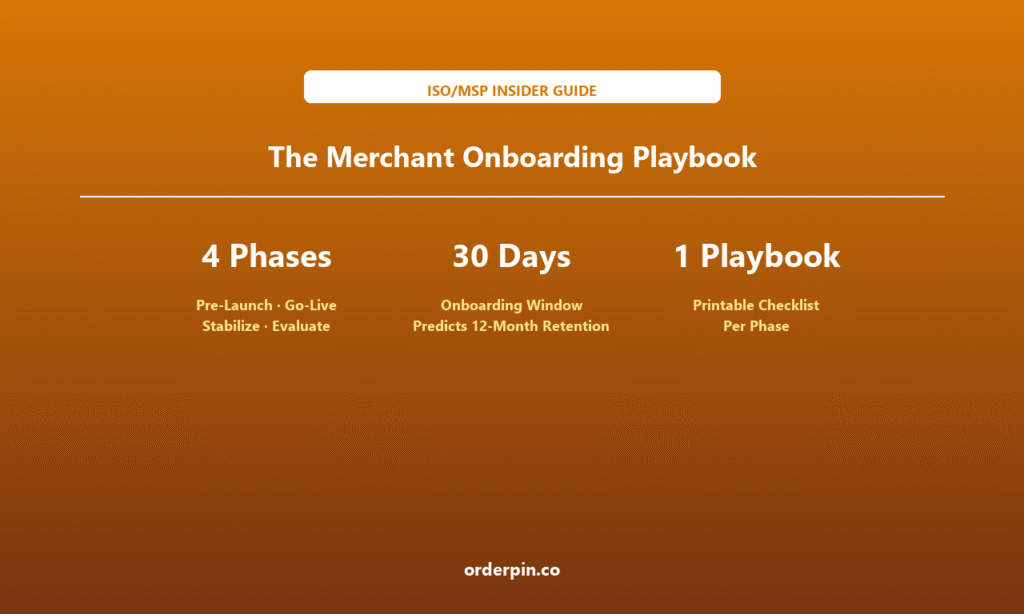
- The merchant onboarding sequence has four phases: pre-launch (5 days before go-live — account, hardware, configuration), launch day (live transaction walkthrough and staff training), 7-day stabilization (monitoring and rapid issue resolution), and 30-day success criteria (metrics that predict 12-month retention). Each phase has a specific checklist and a specific ISO action.
- Onboarding quality is a competitive moat: most ISOs treat onboarding as a logistics exercise — get the merchant live and move on. The ISO that treats onboarding as a brand-building experience — where the merchant feels supported, configured correctly, and trained properly — earns a level of loyalty that is difficult for a competitor to displace in month six. Onboarding is where the merchant relationship is built or broken.
Stabilize · Evaluate
Predicts 12-Month Retention
Per Phase
Why Merchants Cancel in Month Two
The merchant went live on day one. The ISO helped with the setup. The first week was rocky — a few support tickets, a configuration issue, a staff training gap — but it was expected. By month two, the merchant has processed enough transactions to have a clear opinion of the platform, and they have received at least one outreach call from a competitor. They cancel. The ISO has spent three weeks onboarding a merchant who is now churning to a competitor who did not do the onboarding work.
The pattern is predictable and preventable. Merchants who go live without complete configuration, without staff training completion, and without a 7-day stabilization follow-up are significantly more likely to churn in month two than merchants who complete a structured onboarding sequence. The ISO that builds an onboarding playbook — and executes it consistently — dramatically reduces early-stage churn and recovers CAC faster.
means losing the CAC
where merchants stall
prevents month-2 churn
12-month retention
Phase 1 — Pre-Launch Checklist (5 Days Before Go-Live)
The pre-launch phase is where the ISO controls the configuration quality. Every item completed before go-live reduces the support ticket volume on launch day by 60 to 80 percent — because the merchant is receiving a pre-tested, pre-configured system, not a fresh setup they have to navigate on their own. The ISO should complete all of the following before the go-live date:
- Account created under the ISO’s white-label dashboard, not the merchant’s direct sign-up
- Business profile configured: merchant name, address, tax ID, business hours, timezone
- Payment processing configured: processor selection, rate schedule loaded, test transaction completed
- Hardware provisioned (if applicable): terminal registered, receipt printer and cash drawer configured, network connection tested
- Menu or catalog loaded with test items — merchant verifies accuracy before go-live
- Tax rates configured by jurisdiction — test with a sample transaction before going live
- Receipt template configured with merchant branding (logo, business name, contact, return policy)
- Staff accounts created with appropriate permission levels (owner, manager, server, etc.)
- Integration confirmed: any accounting software, loyalty program, or third-party integration tested end-to-end
- Merchant’s day-1 contact plan confirmed: who do they call if something fails on launch day?
Phase 2 — Launch Day Runbook
Launch day is not the time for configuration — it is the time for live transaction processing and staff training under ISO supervision. The goal is to get the merchant through their first business day without critical failures, with a clear escalation path for issues. The ISO’s role on launch day is a mix of technical support and confidence-building — the merchant needs to feel supported, not abandoned.
ISO on-site or remote checklist for launch day: confirm the first live transaction processes correctly and the receipt prints cleanly. Walk the merchant through the end-of-day reconciliation report — this is the report they will use every day, and if they understand it on day one, they trust the platform faster. Conduct the first staff training session covering the three most common transactions (sale, refund, void) and the two most common error conditions (network failure, declined card). Confirm the merchant knows how to reach ISO support — give them a direct contact, not just a portal. Set a follow-up call for day 3, not day 30.
Phase 3 — 7-Day Stabilization Protocol
The first seven days after go-live are the stabilization window — the period when configuration gaps, training gaps, and hardware issues surface in production. The ISO’s job during this window is to identify and resolve issues before the merchant forms a negative impression of the platform. This is a proactive window, not a reactive one: the ISO should reach out, not wait for tickets.
Day 3 call: review the 3-day transaction volume and batch summary with the merchant. Identify any declined card patterns (wrong card type, network issue, configuration error). Confirm all hardware is functioning without intervention. Ask: “What has surprised you?” — this question surfaces the issues the merchant is too polite to raise unsolicited.
Day 7 call: review the full week — transaction count, average ticket, refund rate, any unresolved tickets. Compare against the merchant’s stated expectations from the sales conversation. Identify the gap: if the merchant expected $5,000 in daily volume and is at $1,200, the gap is either a configuration issue (missing menu items, wrong tax rates causing customer abandonment) or a training issue (staff not using the system for all transactions). Resolve the gap before day 14.
Phase 4 — 30-Day Success Criteria
The 30-day checkpoint is the ISO’s primary churn prevention milestone. Merchants who clear the 30-day criteria are significantly more likely to be retained at 12 months. Merchants who do not clear the criteria should receive an escalated outreach and a dedicated retention plan before the 60-day mark.
| Metric | Success Threshold | What It Signals | Merchant Result |
|---|---|---|---|
| Transaction volume | ≥ 70% of sales forecast | System adoption rate; menu/hardware completeness | Pass / Fail |
| Refund rate | ≤ 3% of transactions | Training quality; configuration accuracy | Pass / Fail |
| Support tickets open >48h | ≤ 2 unresolved tickets | Configuration or hardware gaps | Pass / Fail |
| Staff training completion | All staff completed session | System usage breadth; risk of bypass | Pass / Fail |
| Merchant satisfaction score | ≥ 7/10 on Day 30 survey | Overall experience; relationship health | Pass / Fail |
If three or more metrics fail at Day 30, activate the retention protocol immediately: schedule an on-site or video call within 5 business days, identify the primary pain point from the merchant’s perspective, and present a specific remediation plan with a timeline. Merchants who fail the 30-day criteria and receive no outreach are the most likely to cancel at renewal.
How OrderPin Supports the Onboarding Playbook
OrderPin is a white-label POS platform built for ISO and MSP partners. On the onboarding playbook: OrderPin provides plug-and-play deployment with pre-configured account provisioning, a white-label dashboard the ISO controls before handing to the merchant, a merchant onboarding guide template ISOs can brand and use with their new merchants, and a partner support escalation path for issues that surface in the 7-day stabilization window. Use the 30-day success criteria to track every new merchant — and use the retention protocol for any merchant who fails the Day 30 checkpoint.
Frequently Asked Questions
How long should the ISO spend on launch day?
Budget 2 to 4 hours on launch day, in person or via video. The first 30 minutes should be a live transaction walkthrough — the merchant processes 5 to 10 real transactions under your guidance. The next 60 minutes is staff training for all shift managers. The remaining time is configuration review and escalation-path setup. If the ISO is not present for at least the first two hours on launch day, the merchant will encounter issues without a clear contact — and the relationship starts with a support failure.
What if the merchant does not want the ISO present on launch day?
If the merchant declines ISO presence on launch day, require a video call at minimum — not just a phone number to call. The video call lets you see the merchant’s screen, identify configuration gaps in real time, and deliver the staff training that prevents day-two tickets. If they decline even the video call, confirm the pre-launch checklist is complete, set a Day 1 follow-up call, and activate the Day 3 stabilization check without waiting for a ticket. The ISO’s absence on launch day is a risk — the follow-up protocol manages that risk.
Should onboarding be the same for restaurants and retail?
The four-phase structure is the same — pre-launch, launch day, stabilization, 30-day checkpoint — but the specific checklist items differ. For restaurants, the focus is on menu configuration accuracy, table management setup, kitchen printer routing, and staff training on the order flow. For retail, the focus is on product catalog completeness, barcode scanning, inventory integration, and staff training on the return process. Customize the pre-launch checklist and the staff training agenda by vertical, not by ISO.
How do I handle multi-location onboarding without scaling myself out?
At three or more locations, the ISO needs a scalable onboarding model: a documented playbook (this article), a launch-day checklist the merchant completes before your involvement (reducing your time per location), and a standardization of the Day 3 and Day 7 calls using a template script rather than an open-ended conversation. See AD17 for the multi-location expansion playbook, which covers how to onboard locations 2 through N without increasing ISO overhead proportionally.
What is the most common launch day failure?
Tax rate misconfiguration is the most common launch day failure — and the most visible one to the end customer. If the merchant is charging the wrong tax rate, their customers notice when the total is unexpectedly high, and the merchant loses confidence in the platform immediately. Verify tax rates against the merchant’s jurisdiction before the first live transaction, not after. This is item one on the pre-launch checklist for a reason.
Should the ISO charge for onboarding?
Onboarding should not be a revenue line — it is a CAC investment. A professional, high-quality onboarding experience is one of the strongest competitive differentiators an ISO has against a competitor who sells and abandons. The merchant who receives a structured onboarding experience from your ISO and a generic email setup link from a competitor will remember the difference at renewal. Build the cost of onboarding into the margin structure (it is cheaper to onboard well than to replace a churned merchant), and market the quality of your onboarding as a brand promise.
Merchants who fail the 30-day onboarding checkpoint are the most likely to cancel at renewal — and the ISO who does not have a structured onboarding playbook will lose those merchants without knowing why. Build the four-phase playbook: pre-launch configuration checklist, launch day runbook with ISO presence, 7-day stabilization protocol with proactive outreach on Days 3 and 7, and a Day 30 success criteria review with a retention protocol for any merchant who fails the checkpoint. The quality of the ISO’s onboarding is the primary determinant of early-stage merchant retention — and it is the most scalable competitive advantage an ISO can build. OrderPin is a white-label POS platform built for ISO and MSP partners, with plug-and-play deployment, white-label dashboard controls, and a partner support escalation path designed to help ISOs execute the onboarding playbook consistently for every new merchant.
About OrderPin
OrderPin is a white-label POS platform built for ISO and MSP partners. We offer full data ownership, flexible pricing, and seamless API integrations to help you build a recurring revenue business under your own brand. Learn more about OrderPin’s white-label solution