
The ISOs who dominate the next decade will stop selling payment processing and start selling operational outcomes. Merchants don’t wake up wanting lower interchange rates — they wake up wanting to run better businesses. The shift from transaction vendor to operational partner isn’t a marketing reframe. It’s a structural repositioning that changes who answers your calls, how long merchants stay, and what your business is worth.
1. The Product-Market Fit Problem Nobody Talks About
Walk into any merchant’s back office and ask what keeps them up at night. You will not hear about basis points. You will hear about inventory discrepancies, staff no-shows, failed health inspections, and the daily chaos of running a business. Payment processing is a utility they tolerate. Operational control is what they actually want.
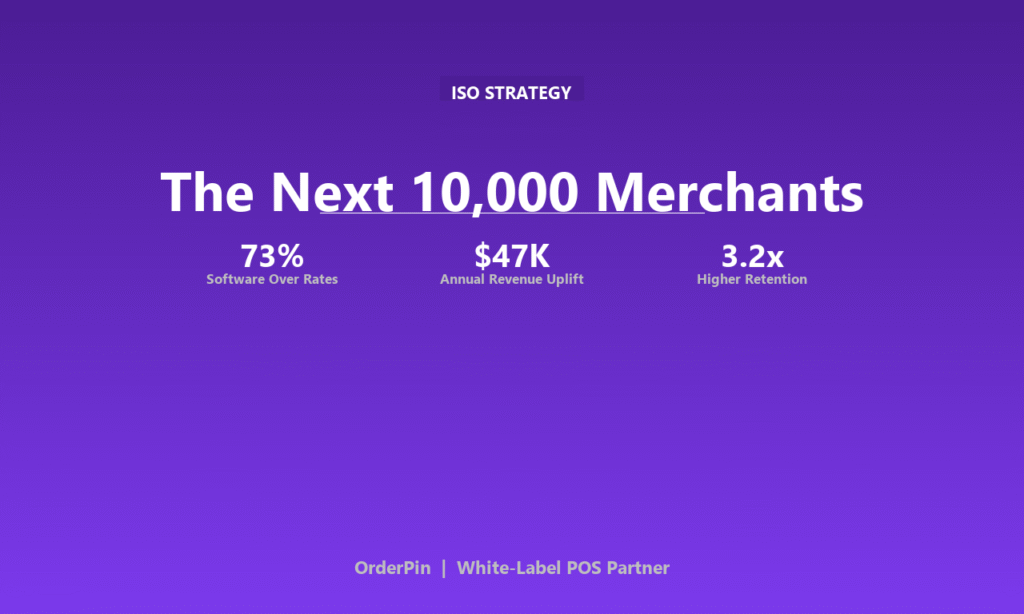
This is the product-market fit problem hiding in plain sight across the merchant services industry. ISOs have spent decades optimizing for the wrong buying criteria. They built sales teams trained to quote rates, compare interchange, and compete on transaction fees. Meanwhile, 73% of merchants say operational software is more important than payment rates when choosing a provider. The industry is selling what merchants consider a commodity while ignoring what they consider critical.
The merchants who will matter in the next decade — the ones with growth trajectories, multi-location ambitions, and genuine operational complexity — are not shopping for payment processing. They’re shopping for business infrastructure. They want systems that help them hire, manage inventory, understand customers, and scale without drowning in administrative overhead. An ISO that shows up with a rate sheet is irrelevant to this conversation. An ISO that shows up with operational solutions is the only vendor that matters.
2. What Uber, Square, and Toast Got Right
The companies that have reshaped commerce didn’t win by selling commodities cheaper. They won by selling outcomes that mattered. Uber didn’t sell rides — they sold the elimination of waiting on street corners. Square didn’t sell card readers — they sold the ability for any business to accept payments in five minutes. Toast didn’t sell restaurant POS — they sold a unified platform that actually runs a restaurant operation.
Netflix is perhaps the clearest example. They didn’t compete with Blockbuster on late fees or selection. They sold the outcome: entertainment without friction. The business model followed the value proposition. When you sell outcomes, you can charge for value delivered rather than cost incurred. When you sell commodities, you can only charge what the market bears — which, in payment processing, trends relentlessly toward zero.
The lesson for ISOs is direct: stop competing on the dimension where you have no defensible advantage. Rate competition is a race to the bottom that nobody wins. Operational value competition is a race to the top that rewards expertise, integration, and genuine merchant success. The ISOs who understand this distinction will build durable businesses. The ones who don’t will be replaced by software companies that do.
3. The Economics of Selling Outcomes vs. Transactions
Selling payment processing generates transaction revenue. Selling operational solutions generates $47,000 in average annual revenue uplift per merchant who expands beyond pure processing. This isn’t theoretical — it’s the difference between a merchant who pays you $200/month in processing fees and one who pays you $600/month for a full operational platform that includes processing, POS, inventory, reporting, and loyalty tools.
The revenue difference compounds over time because outcome-selling changes retention. Merchants who buy operational solutions show 3.2x higher retention rates than those on transaction-only accounts. The reason is structural: a merchant evaluating a rate quote can switch in an afternoon. A merchant evaluating the cost of migrating inventory data, retraining staff, and rebuilding operational workflows faces switching costs measured in weeks of disruption. They don’t leave over basis points. They leave when the value proposition collapses entirely.
The math is decisive. An ISO with 500 merchants generating $200/month each in processing revenue has a $1.2M annual business with high churn and thin margins. An ISO with 500 merchants generating $600/month each in operational platform revenue has a $3.6M annual business with 3.2x better retention and significantly higher margins. Same merchant count. Different product positioning. Entirely different business economics.
4. How to Reframe Your Sales Conversation
The shift from transaction selling to outcome selling requires changing how your sales team opens conversations, what questions they ask, and what they present as the primary value. Start with discovery that surfaces operational pain, not rate dissatisfaction. Ask about inventory management challenges, staff scheduling headaches, reporting limitations, and growth bottlenecks. The merchants with genuine operational complexity will have stories. Listen to them.
Frame your solution around the outcomes the merchant wants, not the features you offer. Don’t lead with “we have inventory management” — lead with “we can eliminate your Sunday night inventory counts and tell you exactly what to reorder before you run out.” Don’t lead with “we have reporting” — lead with “we can show you which menu items are actually profitable and which ones are costing you money.” Outcome language connects to merchant priorities. Feature language connects to your product catalog.
Price based on value delivered, not cost-plus-margin. When you’re selling a commodity, you have no pricing power. When you’re selling an outcome, you have significant pricing power because the alternative isn’t a cheaper vendor — it’s continuing to live with the problem. A merchant paying $400/month to eliminate $2,000/month in operational waste is getting a bargain. A merchant paying $400/month for a slightly better card reader is getting robbed. The difference is positioning, not product.
Train your team to disqualify rate-shopping merchants. Not every prospect is a good fit for outcome selling, and that’s fine. The merchant who genuinely only cares about getting the lowest possible processing rate is not going to pay for operational value. They’re also not going to stay when someone undercuts you. Let them go. Focus your energy on merchants with operational complexity who will pay for solutions and stay for the value.
5. Building the Operational Partner Position
The transition from payment processor to operational partner isn’t a marketing exercise — it’s a capability build. You need the tools to deliver operational value, the expertise to configure them for merchant success, and the support infrastructure to ensure they work. This requires investment, but the return profile justifies it.
Start by auditing your current merchant base for operational complexity. Which merchants have multiple locations? Which ones have inventory challenges? Which ones are growing and feeling operational pain? These are your expansion opportunities. They already trust you. They already pay you. They just need a reason to pay you more.
Build or partner for the operational tools your merchants need. You don’t need to develop software from scratch — white-label POS platforms, inventory systems, and loyalty tools are available for integration. The key is assembling them into coherent solutions that address specific merchant outcomes, not just bundling features into a menu.
Measure success by merchant outcomes, not just your revenue. Track retention rates, expansion revenue, and merchant-reported satisfaction with operational improvements. When you can demonstrate that merchants who use your full platform grow faster and operate more efficiently than those who don’t, you have a story that sells itself. The best ISOs in the coming decade will be the ones whose merchants actively recommend them because their businesses are measurably better for the relationship.
Frequently Asked Questions
Q1: Why won’t merchants buy payment processing first anymore?
Merchants have increasingly come to view payment processing as a commodity utility rather than a strategic decision. 73% of merchants say operational software is more important than payment rates when choosing a provider. The merchants who matter for long-term ISO success — growing businesses with operational complexity — prioritize business infrastructure over transaction fees. They’re shopping for outcomes, not utilities.
Q2: How much more revenue can ISOs generate by selling operational solutions?
ISOs who expand their merchant relationships beyond payment processing into operational solutions see $47,000 in average annual revenue uplift per merchant. This comes from higher monthly fees for full-stack platforms, better retention, and additional service revenue. The economics compound: higher revenue per merchant plus 3.2x better retention creates a fundamentally different business model.
Q3: What companies have successfully made this shift from commodity to outcome selling?
Uber sold the elimination of waiting, not rides. Square sold payment acceptance for everyone, not card readers. Toast sold restaurant operations management, not POS terminals. Netflix sold frictionless entertainment, not DVD rentals. In each case, the winning strategy was identifying the outcome customers actually wanted and building the business model to deliver it. ISOs who apply this same thinking to merchant services will follow the same trajectory.
Q4: How do ISOs actually transition from rate-based selling to outcome-based selling?
Start by changing discovery conversations to surface operational pain rather than rate dissatisfaction. Frame solutions around merchant outcomes, not product features. Price based on value delivered rather than cost-plus-margin. Disqualify pure rate shoppers who won’t pay for value. Build or partner for operational tools that address specific merchant needs. Measure success by merchant outcomes and retention, not just revenue.
Q5: Does this mean ISOs should stop selling payment processing entirely?
No — it means payment processing becomes the foundation of a broader operational platform rather than the entire value proposition. Processing remains essential infrastructure, but it’s table stakes. The competitive differentiation and revenue growth come from the operational layer built on top. The ISOs who win will process payments for their merchants, but they’ll sell business outcomes.
The next 10,000 merchants won’t buy payment processing first because payment processing is no longer the decision that matters. Operational outcomes are. ISOs who reframe their positioning from transaction vendors to operational partners will capture $47,000 in additional annual revenue per merchant and 3.2x better retention. Those who don’t will be replaced by software companies that understood what merchants actually want. The shift isn’t coming. It’s already here. OrderPin is a restaurant POS software ISV.