
TL;DR — Quick Summary
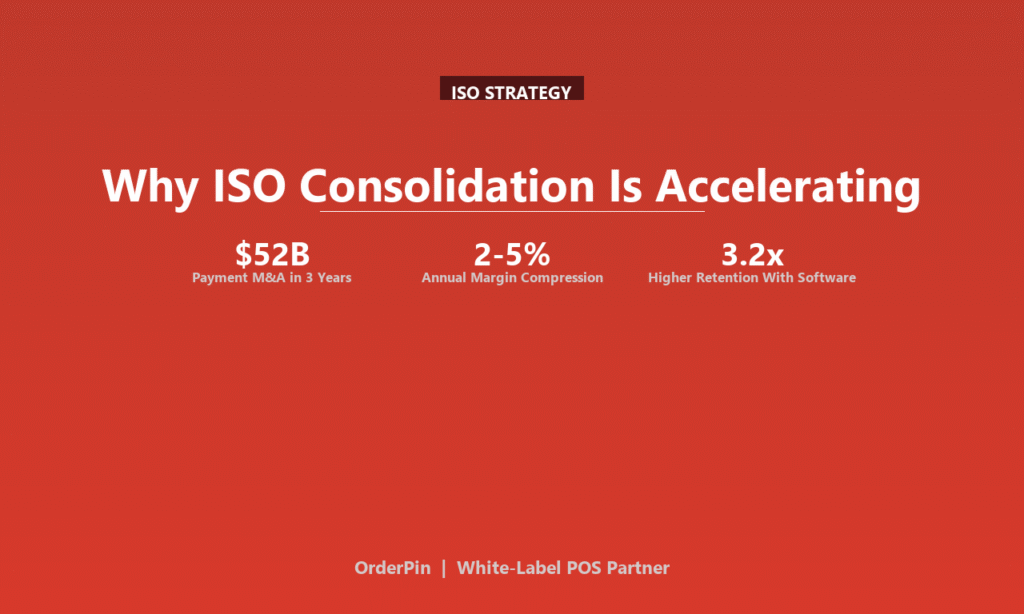
- Payments M&A hit $52B in three years: Large acquirers are buying independent ISOs to capture merchant relationships and software distribution channels, not just transaction volume.
- Processing-only ISOs are worth less: Platform-less ISOs now command 1–1.5x revenue versus 3–4x for software-enabled peers. The consolidation is a valuation test, not just a market trend.
- ISOs must build strategic moats: Vertical specialization, white-label software partnerships, and recurring-revenue services create defensible businesses that acquirers pay premium multiples for.
Volume (3 Years)
Margin Compression
With Software
What Is ISO Consolidation — and Why Does It Matter Now?
In 2019, Fiserv spent $22 billion acquiring First Data. In 2020, FIS merged with Worldpay in a $43 billion deal. Global Payments has acquired more than a dozen companies in the past five years. And quietly, in the background of these headline-grabbing mega-mergers, a quieter consolidation has been taking place: large acquiring processors are systematically acquiring independent sales organizations — the small to mid-sized merchant services companies that form the backbone of the payments ecosystem.
The pattern is consistent. A processor identifies a region or vertical where an ISO has built a strong merchant base. They make an offer. The ISO owner — facing rising compliance costs, technology investment requirements, and narrowing margins — takes the deal. And another independent business disappears from the landscape.
This isn’t a crisis yet — but it’s accelerating. For independent ISOs still operating outside of an acquirer’s umbrella, the question is no longer whether the industry will consolidate further, but how to position themselves so they end up on the right side of that consolidation.
(2019–2022)
Compression Rate
With Software
vs. 1–1.5x for Pure-Play
1. The Consolidation Wave: What’s Driving It
The payments industry has always consolidated at the processor level, but the current wave is different. It’s no longer just about scale — it’s about data, software, and merchant relationships.
Five years ago, an acquiring processor’s value was largely measured in transaction volume. More volume meant better interchange rates from the networks, more data for risk modeling, and more interest income on float. That model still exists, but it’s no longer the only game in town. Today’s premium valuations are being placed on companies with proprietary software, embedded financial services, and deep merchant relationships that can be leveraged for adjacent products.
Large processors are buying ISOs for three reasons:
Merchant relationships: An ISO that has spent years building trust with 500 restaurants in the Southeast is far more valuable to an acquirer than a cold-call sales team. Those merchants have already been onboarded and, with the right software platform, can be migrated to new products at far lower cost.
Software leverage: Independent ISOs are increasingly the distribution channel for white-label POS platforms, ordering systems, and business management tools. When an acquirer buys an ISO with a strong software product, they’re buying a distribution engine for their own technology roadmap.
Competitive moats: Every ISO that a large processor acquires is one their competitors can’t use. In a market where merchant relationships are the core asset, acquiring ISOs is as much about competitive defense as growth.
2. The Squeeze on Independent ISOs
For independent ISOs still operating outside of an acquirer’s umbrella, the environment has become genuinely challenging. The forces working against them aren’t going away — and in many cases, they’re intensifying.
Margin compression: The Durbin Amendment, ongoing network fee changes, and increased competition have been steadily compressing interchange and margin. Every basis point that disappears from margin is one that disappears from the revenue line. Small ISOs feel this more acutely than large ones.
Technology investment requirements: Merchants want cloud-based reporting, mobile access, inventory integration, loyalty programs, and real-time analytics. Meeting those expectations requires investment in software development, API infrastructure, and integration partnerships.
Compliance and security costs: PCI DSS requirements, EMV migration, GDPR and CCPA compliance, and increasingly sophisticated payment fraud have all added layers of cost and complexity that hit small operators harder than large ones.
Capital constraints: The most valuable ISOs are often the ones offering merchant cash advances or data-driven business loans. Building those products requires capital that independent ISOs often struggle to access on competitive terms.
Processing-Only vs. Software-Enabled ISOs
| Factor | Processing-Only ISO | Software-Enabled ISO | Winner |
|---|---|---|---|
| Merchant Retention | 75% avg. annual | 90%+ annual | Software |
| Valuation Multiple | 1–1.5x revenue | 4–8x revenue | Software |
| Data Leverage | Basic transaction | Full operational data | Software |
| Acquirer Interest | Commoditized | Premium target | Software |
| Defense Against Competition | Price-based (weak) | Platform-based (strong) | Software |
3. Why Software Is Changing the Acquisition Math
Here’s the critical insight reshaping how ISOs get valued in the current consolidation wave: processing-only ISOs are worth less than they used to be, while software-enabled ISOs are worth more than ever.
A decade ago, an ISO with $50 million in annual processing volume and solid merchant retention could command a valuation of 2x to 3x EBITDA. Today, that same ISO might be worth 1x to 1.5x — because acquirers know that processing volume is increasingly commoditized, merchant attrition is higher when there’s no software lock-in, and the competitive moat is shallow.
Contrast that with an ISO that has built a white-label POS platform, a restaurant operations tool, or a vertical-specific software product that their merchants depend on. Those ISOs are commanding 4x to 8x revenue — not because their processing volume is higher, but because their merchant relationships are stickier, their data is more valuable, and their distribution capability is an asset that can be leveraged across a wider product set.
According to industry M&A advisors covering the payments sector, acquirers consistently price software-enabled distribution channels at 3–5x the multiple of equivalent processing-only books — reflecting the long-term strategic value of merchant lock-in and data access.
How OrderPin Helps ISOs Build Software Differentiation
OrderPin is a restaurant POS software ISV that helps independent sales organizations build the software-driven differentiation they need to command premium valuations in the consolidation wave. With white-label POS capabilities, full data ownership, and API-first integrations, OrderPin gives ISOs the platform layer they need to stop competing on rate alone.
- Full data ownership: ISOs own all merchant sales data, enabling lending, analytics, and advisory services.
- White-label program: Merchants operate under the ISO’s brand — not OrderPin’s — building genuine platform loyalty.
- No long-term lock-in: ISOs maintain full control of their merchant relationships and can migrate platforms if needed.
- API-first architecture: Integrate with accounting, inventory, delivery, and loyalty tools that make the platform indispensable.
4. Building a Business That Doesn’t Depend on Processing Margins
The ISOs that are thriving in this environment — whether as independent businesses or as premium acquisition targets — are the ones that have made a deliberate shift away from a processing-revenue-only model.
Vertical specialization: Generalist ISOs are in the most precarious position — competing on price with no defensible differentiation. ISOs that go deep in a specific vertical — restaurants, healthcare, retail — are far more defensible. They understand the industry’s workflows, they can build integrations with the tools that vertical uses, and they can command premium pricing for domain expertise a generalist can’t replicate.
Software-as-differentiator: The shift from selling processing to selling a restaurant operating platform that happens to include payments is the most powerful strategic move an ISO can make. Merchants who are fully migrated to a platform — POS, inventory, ordering, reporting, loyalty — don’t leave lightly. They have too much data, too many integrations, and too much training investment to make switching worth the cost.
Adjacent revenue streams: ISOs with deep merchant relationships are uniquely positioned to offer merchant cash advances, working capital programs, payroll services, and insurance referrals. These products often carry higher margins than processing and are natural upsell opportunities with existing customers who already trust the ISO relationship.
Data as an asset: An ISO with five years of a merchant’s sales data, labor patterns, and seasonal trends knows that business better than any bank or lender making a credit decision. That data is the foundation for differentiated underwriting, better merchant outcomes, and ultimately higher retention.
5. Three Strategic Paths Forward
For independent ISO leaders facing the consolidation environment, there are three broadly viable paths. Each has its own logic and its own risks.
Path 1: Become the Best Acquisition Target in Your Market
This means deliberately building the assets that premium acquirers are looking for: strong merchant retention, proprietary software or integrations, a repeatable sales process, and clean financials. The goal isn’t to grow forever — it’s to build a business that commands a premium multiple when you’re ready to sell. ISOs that take this path invest heavily in their technology platform and their sales process, maintain tight financial discipline, and time their exit for a market window when acquirer appetite is strong.
Path 2: Build an Independently Defensible Vertical
This path is for ISOs that don’t want to sell — or don’t want to sell yet. It requires going deep in a vertical where your expertise, relationships, and technology are genuinely difficult to replicate. A regional ISO that owns the restaurant market in three states — not through price competition, but through proprietary software, deep service relationships, and a reputation for operational expertise — is far more defensible than a generalist competing on rate.
Path 3: Partner Strategically with Technology Providers. Not every ISO needs to build its own software. But every ISO needs access to software that makes their merchants stickier. White-label technology partnerships — where an ISO distributes a POS platform or restaurant operations tool under their own brand — can deliver many of the benefits of software ownership without the development cost. The key is choosing a technology partner whose platform is genuinely differentiated, whose roadmap aligns with the ISO’s merchant base, and whose economics don’t undermine the ISO’s margin.
Frequently Asked Questions
Why is the payments industry consolidating now?
Several factors are driving the current consolidation wave. Large acquiring processors are seeking growth through acquisition as organic processing volume becomes harder to expand. At the same time, software capabilities and merchant data are increasingly valuable — and ISOs that have built strong software-distribution relationships are the most attractive acquisition targets. Rising compliance costs and technology investment requirements are also making it harder for smaller ISOs to compete independently.
Are independent ISOs going to disappear?
Not entirely — but the population of independent ISOs will shrink significantly. The ISOs most likely to remain independent are those that have built genuine competitive moats: deep vertical expertise, proprietary software platforms, strong regional brands, or diversified revenue streams beyond processing. Generalist ISOs competing primarily on rate face the most pressure and are the most likely to be acquired or pushed out of the market.
How can a small ISO compete with large acquiring processors?
Competing on processing rate is a losing game for small ISOs. The sustainable competitive advantages for independent ISOs are local relationships, vertical expertise, and service quality that large processors can’t match at scale. The most successful small ISOs focus on being the trusted advisor to their merchant base — not just the vendor who processes their transactions. They know their merchants’ businesses, they respond quickly when something goes wrong, and they offer technology products that genuinely make operations easier.
What makes an ISO a premium acquisition target?
Acquirers pay premium valuations for ISOs with strong merchant retention, proprietary software or integrations, a repeatable sales process, and clean financial data. ISOs whose merchants are stickier because they depend on a software platform are valued at 4–8x revenue versus 1–1.5x for processing-only equivalents. A platform with 90% annual retention and rich data is worth far more than a processing book with 75% retention and no software layer.
Should an ISO build its own software or partner with a technology provider?
For most independent ISOs, building proprietary software from scratch is capital-intensive and risky. A more practical path for most operators is to partner with a technology provider that offers white-label or co-branded software — distributing a restaurant POS platform or operations tool under the ISO’s own brand. This gives the ISO the merchant stickiness and software leverage of a proprietary platform without the development cost, while allowing them to focus on what they do best: building merchant relationships and delivering service.
The payments consolidation wave isn’t a threat to independent ISOs — it’s a test. The ISOs that will thrive are the ones that build businesses merchants depend on, not just businesses merchants use. Vertical expertise, software differentiation, service quality, and data-driven insights are the competitive moats that no acquirer can replicate at scale. Whether you’re building toward a premium exit or building an independent business for the long term, the strategy is the same: be the platform your merchants can’t imagine running without. OrderPin is a restaurant POS software ISV built to be that platform for ISOs — with full data ownership, white-label branding, and API-first integrations that make merchants stickier and your business more valuable.
About OrderPin
OrderPin is a white-label POS platform built for ISO and MSP partners. We offer full data ownership, flexible pricing, and seamless API integrations to help you build a recurring revenue business under your own brand. Learn more about OrderPin’s white-label solution