
TL;DR — Quick Summary
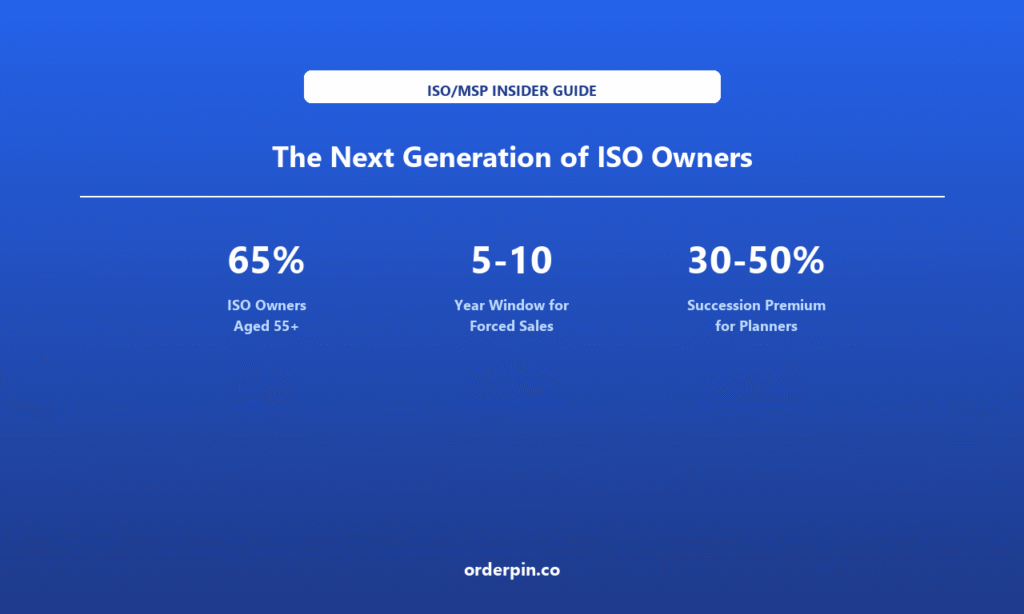
- Most ISO owners are approaching a retirement wall they have not planned for: A large share of independent ISO founders are now 55-65 years old, built their books two to three decades ago, and have no documented succession plan. Their children mostly do not want to run a payments company, and internal promotion pathways are thin. The result is a forced-sale wave compressing into the next 5-10 years — and acquirers are pricing it accordingly.
- The next generation of ISO leaders looks nothing like the founders: The leaders replacing the founding generation are younger, technology-native, comfortable with SaaS and software business models, and fixated on recurring revenue and software penetration rather than transactional processing volume. They evaluate a business by its data, its systems, and its defensibility — not by its monthly processed dollar amount. The businesses built for the old generation will not automatically appeal to the new one.
- Early succession planning is worth a 30-50% premium: An ISO that documents its playbook, builds transferable systems, diversifies into recurring software revenue, and gets a credible valuation years before it needs to sell commands a 30-50% higher multiple than one that waits until a health event or a market downturn forces the sale. The premium is not luck — it is the difference between a business that depends on its owner and one that runs without them.
Over Age 55
Sale Window
for Early Planners
What the Generational Shift in ISO Ownership Actually Means
The independent sales organization (ISO) channel was built largely by entrepreneurs who entered payments in the 1990s and early 2000s. Those founders are now in their late 50s to mid 60s. They built their businesses on relationships, boots-on-the-ground sales, and a deep understanding of merchant pain — and many assumed that a son, daughter, or loyal rep would simply step in when they were ready to slow down. That assumption is meeting three hard realities at once.
The first reality is demographic: the founding cohort is aging as a block, so the succession events are not spread out — they are clustering into a single decade. The second is cultural: the children of payments founders overwhelmingly do not want to run a processing business, and the rewards of modern payments (recurring, software-enabled) look very different from the rewards their parents chased (transactional, relationship-driven). The third is structural: most ISOs were built around the owner’s personal relationships and instincts, with little documentation, weak management layers, and no systems that survive the owner’s departure. A business that lives in one person’s head is hard to sell and easy to discount.
The next generation of ISO leaders — whether they are hired operators, external acquirers, or a rare family successor — will evaluate businesses through a completely different lens. They want transferable systems, recurring revenue, software penetration, and data they can act on. The ISOs that quietly rebuild themselves around those attributes over the next few years will be the ones that command premium outcomes. The ones that wait will be purchased on the acquirer’s terms.
Facing Exit Soon
Forced-Sale Wave
for Planned Transition
Software vs Processing
1. The Aging Ownership Problem
A generation built the channel — and is now leaving it at the same time: The ISO model was scaled by a specific generation of entrepreneurs who started in payments when merchant acquiring was a relationship business won door to door. That cohort is now concentrated in the 55-65 age band. Because they entered and built in a compressed window, their exits are compressing into the same window too. The industry is not facing a steady trickle of retirements — it is facing a clustered wave.
Many of these businesses were never designed to outlive their owner: In the relationship era, the owner was the product. They sourced leads, closed merchants, handled escalations, and held the institutional memory. Little of that was written down, systematized, or delegated. A business where the owner is the single point of failure is structurally hard to transition — and acquirers price that risk into the offer, usually as a discount rather than a premium.
2. Why Traditional Succession Falls Apart
The family-succession assumption fails most of the time: Payments has changed from a relationship-and-spread business into a software-and-data business. The next generation sees a different industry than the one their parents built, and most founders’ children have no interest in — or aptitude for — running a processing portfolio. Assuming a family handoff is the single most common succession mistake, and it leaves the business with no plan when the owner is finally ready to go.
Internal promotion pathways are usually too thin: Many ISOs never built a management layer beneath the founder. Top reps are rewarded for selling, not for running the business, and the skills do not transfer. When the owner steps back, there is often no operator ready to take the helm — which forces a sale to an external acquirer on the acquirer’s timeline and terms. Building a real second-in-command years early is one of the highest-leverage succession moves an owner can make.
3. The Profile of the Next-Generation ISO Leader
Technology-native and comfortable with software business models: The incoming generation grew up with SaaS, marketplaces, and data dashboards. They do not see software as a cost center — they see it as the product. They are fluent in recurring-revenue metrics, software penetration, and platform economics in a way the founding generation often is not. An ISO that has already become software-enabled will feel native to them; one that is pure processing will feel like a legacy asset to fix or flip.
They buy businesses on systems and data, not relationships: A next-gen leader evaluates an acquisition or a stewardship role by asking whether the merchant base is on a platform, whether revenue recurs, whether the data is accessible, and whether the business runs without the founder in the room. The answers to those questions — not the processing volume — determine the price they will pay. This is the lens every owner should be designing their business around now.
4. New Growth Priorities for the Next Generation
Recurring revenue over transactional volume: Where the founding generation optimized for processing dollars moved, the next generation optimizes for recurring, defensible revenue — SaaS fees, platform subscriptions, and embedded services. A dollar of recurring software revenue is valued far above a dollar of processing spread, and the next generation prices businesses accordingly. Shifting the revenue mix toward recurring streams is the single biggest lever on exit value.
Software penetration, vertical focus, and M&A as a growth engine: The next generation treats software penetration (share of merchants on a platform) as the core health metric, narrows focus to verticals where it can win, and uses acquisitions to scale rather than organic footwork alone. These priorities reshape how the business is built — and they are exactly the attributes that make an ISO attractive to the buyers and operators who will define the next decade of the channel.
5. How to Capture the 30-50% Succession Premium
Plan early, document the playbook, and build transferable systems: The premium is earned years before the sale. Owners who write down their merchant acquisition motion, systematize onboarding and support, build a management layer, and get a credible third-party valuation while they are still in control sell from strength. Those who wait until a health event or downturn forces the decision sell from weakness — and the gap between the two outcomes is routinely 30-50% of enterprise value.
Diversify into software revenue so the business runs without you: The clearest signal that an ISO is transition-ready is that a meaningful share of its revenue is recurring and software-driven, and that its merchants are managed on a platform rather than by the owner’s cell phone. That is what makes the business transferable — and transferability is what the next generation, and every acquirer, will pay the premium for. Building that business now is the whole game.
The Founding Generation vs The Next Generation of ISO Leaders
| Dimension | Founding Generation | Next-Gen Leader |
|---|---|---|
| Age Profile | 55-65, industry founders | Younger, technology-native |
| Core Skill | Relationships, door-to-door | Systems, data, platform |
| Revenue Model | Transactional processing spread | Recurring software + services |
| Tech Posture | Software as a cost | Software as the product |
| Growth Engine | Organic rep footwork | Penetration + M&A |
| Exit Readiness | Often undocumented | Values systems & data |
How OrderPin Helps ISOs Build a Business the Next Generation Will Pay a Premium For
OrderPin is a white-label POS platform that lets an ISO shift from a processing-only, owner-dependent business into a software-enabled, transferable one — exactly the profile the next generation of leaders and acquirers pays a premium for. For an owner thinking about succession, OrderPin is the platform that makes the business sellable on your timeline rather than theirs.
- Builds recurring, software-driven revenue: Every merchant deployed on OrderPin generates SaaS subscription revenue on top of processing — the recurring stream the next generation values far above transactional spread. The revenue mix shifts toward defensibility while the owner is still in control.
- Creates a transferable system, not a person: Merchant acquisition, onboarding, and support run on the platform instead of in the owner’s head. The business stops being a single point of failure and becomes a system a new leader can operate — which is what converts an owner-dependent book into a premium-priced asset.
- Puts the data in the owner’s hands: OrderPin gives the ISO operational data across its portfolio — the exact asset a next-gen leader evaluates a business on. The owner can walk into a valuation or a handoff with evidence of software penetration, merchant health, and recurring revenue, not just a processing statement.
- Runs under the ISO’s brand: Because OrderPin is white-label, the platform, the merchant relationship, and the data belong to the ISO — not to an underlying vendor. The business that transitions is the ISO’s business, with its own brand and its own equity, which is what commands the succession premium.
Frequently Asked Questions
How old is the average ISO owner today?
A large share of independent ISO founders are now between 55 and 65 years old. They entered payments in the 1990s and early 2000s, built their books over two to three decades, and are reaching the natural exit age as a cohort. Because they entered and built in a compressed window, their retirements are clustering into the same decade — which is why the industry is facing a wave of transitions rather than a steady drip.
Why don’t most owners’ children take over the business?
Payments has shifted from a relationship-and-spread business into a software-and-data business. The next generation sees an industry that looks different from the one their parents built, and most founders’ children have neither the interest nor the aptitude for running a processing portfolio. Assuming a family handoff is the most common — and most disruptive — succession mistake, because it leaves no plan when the owner is finally ready to step back.
What makes an ISO attractive to the next generation of leaders?
Next-gen leaders and acquirers look for transferable systems, recurring software revenue, meaningful software penetration, and accessible data. They want a business that runs without the founder in the room and scales through a platform rather than one person’s relationships. An ISO that has already become software-enabled and systematized will feel native to them; a pure-processing book will feel like a legacy asset to fix or flip.
How does software penetration affect succession value?
Software penetration — the share of merchants running on a platform — is the clearest signal that a business is transferable. A software-penetrated book generates recurring revenue, retains merchants at higher rates, and can be operated by someone other than the founder. Those attributes are exactly what command a premium. A processing-only book, by contrast, is discounted because its value is tied to the owner’s personal relationships and instincts, which leave with them.
When should an ISO owner start succession planning?
Now — regardless of age. The premium is earned years before the sale, not at it. Owners who document their playbook, build a management layer, shift toward recurring revenue, and get a credible valuation while still in control sell from strength. Those who wait until a health event or a market downturn forces the decision sell from weakness, and the value gap between the two is routinely 30-50% of enterprise value. Three to five years of lead time is the practical minimum to build a transition-ready business.
Can a next-generation leader be hired rather than inherited?
Yes — and for most ISOs, hiring or recruiting an operating partner is more realistic than a family handoff. The hard part is that the role requires a real management layer to step into, which most founder-led ISOs have not built. The owner who develops a second-in-command and systematizes the business years early creates the option of a managed transition, an internal sale, or a premium external exit — instead of being forced into a single discounted path when the time comes.
The ISO industry is approaching a clustered succession wave: a large share of founders are now 55-65, built their businesses two to three decades ago, and most have no documented plan — while their children do not want the business and internal promotion pathways are thin. The next generation of ISO leaders will be younger, technology-native, and focused on recurring revenue, software penetration, and transferable systems rather than transactional volume. The ISOs that plan the transition now — documenting the playbook, building a management layer, diversifying into recurring software revenue, and getting a credible valuation while still in control — will sell at a 30-50% premium. Those that wait will be absorbed on the acquirer’s terms. The difference is not luck; it is the gap between a business that depends on its owner and one that runs without them. OrderPin is a white-label POS platform that lets an ISO make that shift — building recurring, software-driven revenue, a transferable system, and portfolio-wide data under its own brand — so the business is the kind the next generation will pay a premium to own or acquire.
About OrderPin
OrderPin is a white-label POS platform built for ISO and MSP partners. We offer full data ownership, flexible pricing, and seamless API integrations to help you build a recurring revenue business under your own brand. Learn more about OrderPin’s white-label solution