
TL;DR — Quick Summary
- Price wars have never built a durable book: Twenty years of merchant acquiring show that cutting rates to win a deal produces merchants who leave the moment someone offers a lower rate. The ISOs that compounded for decades did not win on price — they won on referrals, service, and reputation. Price is a tiebreaker, never a strategy.
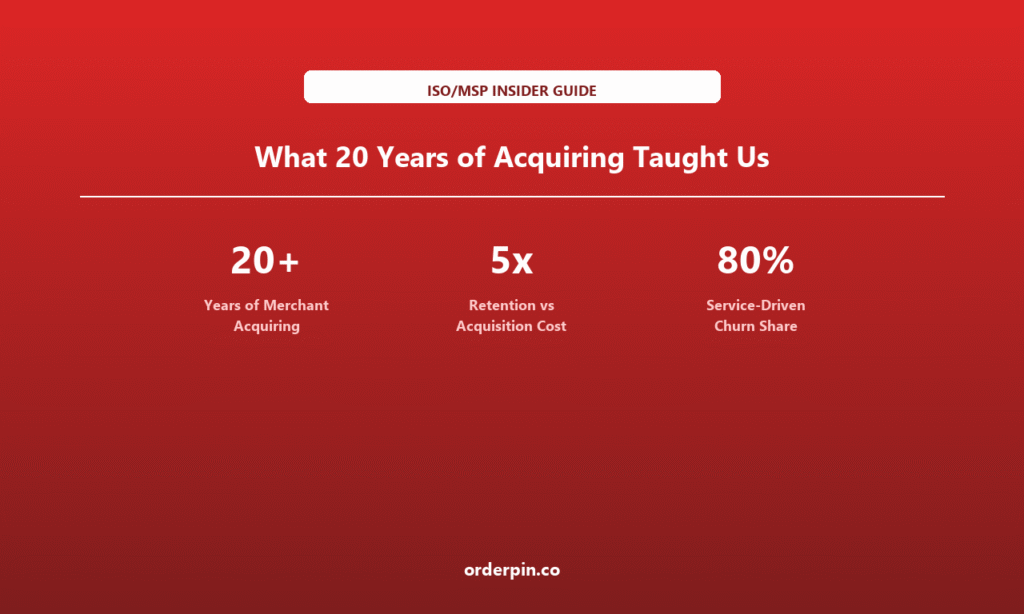
- Merchant word of mouth is the most reliable acquisition channel in the industry: The fastest-growing portfolios in every era grew disproportionately from referrals and existing-merchant relationships. Happy merchants refer; merely satisfied ones do not. The operating system that produces referrals — responsive service, proactive check-ins, and merchants who feel looked after — is the same system that reduces churn, which is why retention economics (keeping a merchant costs a fraction of acquiring one) are the real growth engine.
- Technology investment must come before competitive pressure forces it: The ISOs that adopted software platforms, data, and merchant-success tooling early were the ones that survived margin compression and platform competition. Those that waited until they were losing merchants deployed technology from a position of weakness. Industry tailwinds fade; operating capability and merchant relationships do not — they are the only durable assets an ISO builds.
Acquiring Lessons
Acquisition Cost
Churn Share
What Two Decades of Merchant Acquiring Actually Teaches
The merchant acquiring industry has changed more in the last five years than in the previous fifteen. Processing margins compressed, software platforms entered the channel, and the balance of power shifted from the processor to the merchant. But beneath that surface change, the fundamentals of building a payments business have been remarkably stable — and the ISOs that have grown for twenty years all learned the same lessons, usually the hard way.
The lessons are not about technology, pricing, or products. They are about merchant behavior and business design. Price competition is a race to the bottom that no ISO wins. Referrals are the cheapest and highest-quality source of new merchants, but they only come from a service operation that merchants actually feel. And the ISOs that survived every margin squeeze and platform threat were the ones that invested in systems and relationships before they were forced to — not after.
What follows is the distilled set of lessons from twenty years of merchant acquiring: what changed, what did not, and what still works today. For an ISO deciding where to invest its next decade, these are the patterns worth building around.
to Platform-Driven
No Room for Price Wars
Happy Merchant Book
Before They Had To
1. Industry Evolution: What Changed in Twenty Years
From a relationship business to a platform business: Twenty years ago, merchant acquiring was won at the door. The ISO’s asset was its relationship with the merchant, and the product — payment acceptance — was largely undifferentiated. Today the merchant relationship runs through software: the POS, the dashboard, the reporting, the integrations. The ISO that owns the platform owns the relationship; the ISO that only owns the processing is replaceable. The shift is structural and it is not reversing.
Merchant behavior changed with it: Merchants now compare providers, read reviews, and expect self-service tools. They no longer stay with a processor out of inertia or loyalty to a rep who left years ago — they stay because the software works, the service responds, and the value is visible. The ISOs that grew through both eras are the ones that updated their model as merchant expectations moved.
2. The Common Mistakes That Still Cost ISOs Growth
Competing on price instead of value: The most expensive mistake in merchant acquiring is winning deals with rates you cannot sustain. Price buyers are the first to leave for a lower quote, and the churn erases the acquisition economics. Twenty years of data point the same direction: the ISO that competes on service and software retains merchants; the ISO that competes on price merely rents them.
Neglecting merchant success after the sale: Most churn happens quietly — a merchant who feels ignored for eighteen months switches without warning. ISOs that treat the sale as the finish line bleed merchants steadily. Those that built a merchant-success motion — proactive check-ins, business reviews, fast support — turned that quiet churn into retention and referrals. The mistake is not losing merchants; it is never knowing why until they are gone.
3. How Merchant Behavior Changed — and What It Means
Merchants are more informed and less loyal: The internet made every merchant an expert buyer. They compare processing costs, read software reviews, and expect the same product polish they get from consumer apps. Loyalty is no longer inherited — it is earned every month through visible value. The implication for ISOs is direct: the merchant relationship must be actively maintained with data, insights, and service, or it will be quietly moved to a provider that does.
Software created the switching cost — in the ISO’s favor or against it: The paradox of the platform era is that software both lowers and raises switching costs. When the ISO owns the platform, merchants stay because moving means changing their entire operating system. When a competitor owns the software, the ISO is the part that gets swapped out. Every ISO is either building the moat or standing on the wrong side of one.
4. Lessons from the ISOs That Kept Winning
They systematized referrals instead of chasing them: The fastest-growing ISOs in every era did not have better salespeople — they had a referral engine. Every happy merchant was asked for introductions, every introduction was tracked, and every referred merchant was onboarded with the context of who sent them. Referral-sourced merchants convert at higher rates, churn less, and bring their networks with them. Word of mouth is not luck; it is a process.
They built merchant success before it was a buzzword: The ISOs that compounded for twenty years all had the same quiet habit: they checked on merchants when nothing was wrong. Quarterly business reviews, proactive rate reviews, operational advice, introductions to other local businesses. This is not a cost center — it is the machine that produces both retention and referrals. The discipline compounds: year five looks nothing like year one.
5. What Is Still Working Today
Relationships plus software — the hybrid that wins: The twenty-year lesson is not that relationships are dead or that software replaced them. It is that the winning model is both: software provides the scale, data, and defensibility, and relationships provide the trust and referrals that software cannot generate. The ISOs still growing in 2026 are the ones that put a modern platform underneath an old-fashioned commitment to merchant success.
Invest early, compound the capability: Industry tailwinds — the shift to cards, the shift to e-commerce, the shift to software — each rewarded the ISOs that invested before the trend was obvious. The current shift is to white-label platforms and embedded services. The ISOs investing now will own the next decade; those waiting for proof will arrive after the margin is gone. The lesson of twenty years is that capability built early compounds, and capability built late merely catches up.
What Changed in 20 Years of Merchant Acquiring
| Dimension | Then (2000s-2010s) | Now (2020s) |
|---|---|---|
| Product | Payment acceptance | Software platform + payments |
| Competition | On price and reps | On software and service |
| Loyalty Driver | Relationship and inertia | Visible value and software |
| Growth Engine | Door-to-door sales | Referrals + platform |
| Merchant Data | Owner’s memory | Portfolio-wide platform data |
| Winning Model | Volume and relationships | Retention + recurring revenue |
How OrderPin Turns Twenty Years of Lessons Into a Growth System
OrderPin is a white-label POS platform that lets an ISO apply the lessons of twenty years of merchant acquiring in one move: stop competing on price, start owning the software, and build the referral-and-retention machine that durable growth is made of. It is the modern platform underneath the old-fashioned commitment to merchant success.
- Gets you out of the price war: When your merchants run on your own white-label POS, the conversation shifts from basis points to the software and service you provide. You stop renting merchants with low rates and start owning them with value they cannot get from a bare processor.
- Gives merchants a reason to stay: The platform creates the modern switching cost — merchants stay because the POS runs their business, not because they forgot to leave. That is the retention engine twenty years of data says matters more than acquisition.
- Makes referrals a system: OrderPin runs under your brand, so every happy merchant refers your brand, not an underlying vendor’s. Referral-sourced merchants are the highest-quality growth in the industry, and the platform gives you the data to identify, ask, and track them.
- Turns service into visible value: With portfolio data and reporting on the platform, your merchant-success conversations stop being check-ins and start being business reviews with insights — the exact behavior that separates ISOs that compound from ISOs that churn.
Frequently Asked Questions
What is the biggest lesson from 20 years of merchant acquiring?
That price competition does not build durable books. ISOs that win deals by cutting rates attract merchants who leave for the next lower quote, and the churn erases the acquisition economics. The businesses that compounded for two decades won on referrals, service, and software — not on price. Price is a tiebreaker, never a strategy.
Why are referrals the best acquisition channel in payments?
Referred merchants arrive pre-sold: they trust the person who sent them, convert at higher rates, churn less, and bring their own networks. A referral engine also forces the discipline that reduces churn — happy merchants refer, so the system that produces referrals is the same system that retains. Word of mouth is not luck; the fastest-growing ISOs made it a process.
How has merchant behavior changed over the past 20 years?
Merchants became informed buyers: they compare providers, read reviews, and expect consumer-grade software. Loyalty is no longer inherited from a relationship or inertia — it is earned monthly through visible value. And with software in the middle, merchants stay when the platform runs their business and leave when it does not, regardless of how long they have been with a processor.
What do the most successful ISOs have in common?
Three habits repeat across every era: they systematized referrals instead of hoping for them, they built merchant-success motions that check in when nothing is wrong, and they invested in technology before competitive pressure forced it. Those habits compound — which is why the same names keep appearing at the top of the industry decade after decade.
Is software replacing relationships in merchant acquiring?
No — the winning model is both. Software provides scale, data, and defensibility; relationships provide the trust and referrals software cannot generate. The ISOs still growing are the ones that put a modern platform underneath an old-fashioned commitment to merchant success. Software without relationships churns; relationships without software cannot scale.
What should an ISO invest in first today?
The platform that lets you own the merchant relationship — a white-label POS that runs under your brand, generates recurring revenue, and produces portfolio data. It is the same lesson as every previous technology shift: invest before the trend is obvious. The ISOs building platform capability now will own the next decade; those waiting will arrive after the margin is gone.
Twenty years of merchant acquiring distills to a short set of lessons: price wars rent merchants, service and software own them; referrals are the highest-quality growth channel and they are a system, not luck; merchant behavior shifted from inertia to informed comparison, so value must be visible every month; and the ISOs that compounded invested in technology before they were forced to. Industry tailwinds fade, but a merchant-success culture, a referral engine, and platform ownership do not — they are the durable assets that produce growth in every era. OrderPin is a white-label POS platform that lets an ISO apply these lessons at once — owning the software, generating recurring revenue, and powering the retention-and-referral machine — so the next decade is built on capability that compounds rather than price that erodes.
About OrderPin
OrderPin is a white-label POS platform built for ISO and MSP partners. We offer full data ownership, flexible pricing, and seamless API integrations to help you build a recurring revenue business under your own brand. Learn more about OrderPin’s white-label solution