
TL;DR — Quick Summary
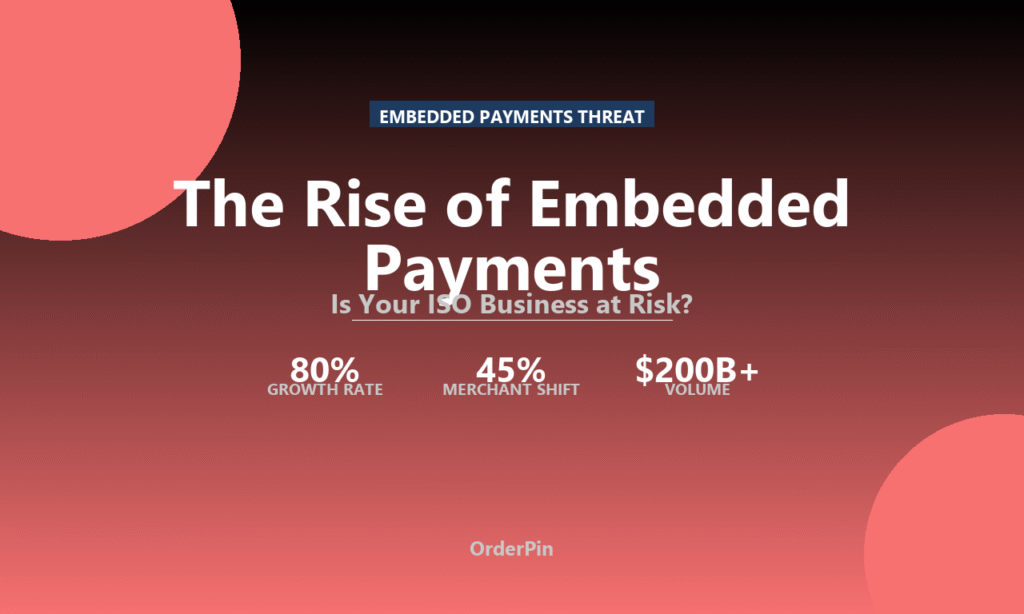
- Embedded payments (Stripe Connect, PayPal Commerce) grew 80% in 2025, now processing $200B+ annually — and they bypass traditional ISO channels entirely.
- 45% of new merchants now choose direct-to-merchant platforms like Shopify or Square over ISOs, up from 28% in 2023.
- ISOs who adapt by offering white-label embedded payment APIs can capture this trend instead of being displaced by it.
What Are Embedded Payments and Why Should ISOs Care?
Embedded payments refer to payment processing integrated directly into software platforms — marketplaces, SaaS applications, or e-commerce systems — where the end merchant interacts with the software, not a separate payment provider. Instead of a merchant calling an ISO to set up a terminal, the software they already use (their POS, their booking system, their accounting software) offers payments as a built-in feature.
Platforms like Stripe Connect, PayPal Commerce Platform, and Adyen for Platforms enable this by providing APIs that software companies use to embed payment acceptance into their products. The software company becomes the payment facilitator, the merchant gets a seamless experience, and the traditional ISO is cut out of the loop.
According to Andreessen Horowitz’s 2025 State of Embedded Finance report, embedded payments grew 80% year-over-year, now representing over $200 billion in annual transaction volume. More alarming for ISOs: The Strawhecker Group (TSG) found that 45% of new merchants in 2025 chose direct-to-merchant platforms (Shopify, Square, Toast) instead of working with an ISO — up from just 28% in 2023.
How Embedded Payments Disrupt the ISO Model
The traditional ISO model relies on a clear chain: card networks → acquirers → ISOs → merchants. ISOs add value by acquiring merchants, providing terminals, handling support, and managing risk. In return, they earn residuals on transaction volume.
Embedded payments collapse this chain. When a software platform integrates Stripe Connect or a similar solution:
- The software company becomes the merchant-facing relationship.
- The payment processor (Stripe, Adyen, PayPal) handles underwriting, risk, and settlement directly.
- The ISO has no role — the merchant never interacts with them.
This is not theoretical. Consider these examples:
- Shopify Payments: 2.1 million merchants use Shopify, and 73% of them use Shopify Payments (powered by Stripe). That is 1.5 million merchants who will never call an ISO.
- Square: 4 million small businesses use Square for payments. Square’s integrated POS + payments + lending + payroll = a merchant who never needs a separate payment provider.
- Toast: 85,000+ restaurants use Toast POS with built-in payments. Toast’s 2025 revenue from payments was $1.2 billion — all from merchants who would have used an ISO a decade ago.
| Aspect | Traditional ISO Model | Embedded Payments Model |
|---|---|---|
| Merchant Acquisition | ISO sales team, referrals, cold outreach | Software platform onboards automatically |
| Merchant Relationship | ISO owns the merchant contact | Platform owns the relationship |
| Terminal/Hardware | ISO provides and supports | Integrated into software or tablet |
| Pricing | ISO sets rates, earns residual | Platform sets rates, keeps margin |
| Underwriting | ISO collects docs, submits to acquirer | Platform collects via software, instant approval |
| Support | ISO provides merchant support | Platform provides integrated support |
| Data Ownership | ISO has transaction data | Platform has transaction + business data |
Who Is Winning and Who Is Losing?
Not all ISOs are equally threatened. The impact depends on your merchant segment and value proposition:
ISOs Most at Risk:
- Generic retail ISOs serving low-complexity merchants (coffee shops, boutiques) — these merchants are prime targets for Square, Shopify, and Toast.
- ISOs with no software differentiation — if all you offer is payment processing and terminals, platforms can match your value and add more.
- ISOs relying on relationship lock-in — platforms are investing heavily in customer success, making relationship switching easier.
ISOs Less at Risk (for now):
- Specialized vertical ISOs — healthcare, cannabis, B2B, high-risk industries require compliance and underwriting expertise that generic platforms lack.
- ISOs with proprietary software — if you offer a vertical-specific SaaS product alongside payments, you are the platform, not the displaced ISO.
- ISOs with embedded finance offerings — if you can offer your own white-label payment API to software partners, you become the enabler, not the displaced.
How OrderPin Helps ISOs Compete with Embedded Payments
White-Label Embedded Payment API
OrderPin’s API enables ISOs to become the embedded payment provider for their software partners. You offer the API, you set the pricing, you keep the margin — not Stripe.
Software Partnerships, Not Competition
Instead of competing with software platforms, partner with them. Offer OrderPin’s embedded payment API to vertical SaaS companies who need payment capabilities but don’t want to build it themselves.
Full Data Ownership
When you power embedded payments through OrderPin, you retain transaction and business data for all your platform partners — enabling analytics, lending, and retention tools that platforms alone cannot offer.
Three Strategic Responses for ISOs
ISOs who recognize the embedded payments threat have three viable strategic options:
Option 1: Become the Platform Enabler
Partner with vertical software companies who need payment capabilities. Offer them a white-label payment API (like OrderPin’s) that lets them embed payments under their brand — but you control the underlying payment infrastructure, pricing, and data.
Revenue potential: Software partners typically process $10M-100M+ annually. At 0.5-1.0% margin, each partner generates $50K-1M/year in revenue.
Option 2: Build Your Own Vertical SaaS
If you serve a specific industry (healthcare, hospitality, automotive), develop or acquire a vertical-specific software product that includes payments. You become the integrated platform — like Toast for restaurants or Procurify for procurement.
Revenue potential: SaaS subscription + payment processing. Merchants pay $100-500/month for software plus payment fees. Retention exceeds 90% with integrated offerings.
Option 3: Focus on the Un-Embeddable
Target merchant segments that require specialized underwriting, compliance, or hardware that generic platforms cannot serve: high-risk industries (CBD, gaming), complex B2B payment flows, multi-location enterprise merchants.
Revenue potential: Higher margins (0.3-0.5% above standard) but smaller total addressable market. Focus on 100-500 high-value merchants rather than thousands of SMBs.
Frequently Asked Questions
Can ISOs compete with Stripe Connect directly?
Yes, but not by building your own Connect-style platform from scratch. Instead, partner with a white-label embedded payment infrastructure provider like OrderPin. You get the same API capabilities, but you control pricing, data, and merchant relationships. Stripe Connect charges 0.25% + $0.25 per transaction; with your own platform, you can offer competitive pricing while retaining margin.
What percentage of merchants will ISOs lose to embedded payments?
Projections vary, but TSG estimates that by 2028, 60% of new SMB merchants will choose integrated platform payments over traditional ISOs. The decline will be gradual but accelerating: 45% in 2025, 52% in 2026, 60% in 2028. ISOs who adapt by partnering with platforms or building their own integrated offerings will capture this volume; those who don’t will see their pipeline shrink.
How do I find software partners for embedded payment partnerships?
Look for vertical SaaS companies in your existing merchant base. If 20% of your merchants use the same industry-specific software, approach that software company with a partnership proposal. Typical value proposition: “We’ll provide you a white-label payment API, you earn 0.25-0.50% of transaction volume, your merchants get integrated payments, and you don’t have to build payment infrastructure yourself.”
Is it too late for ISOs to adapt?
No. While embedded payments are growing rapidly, 55% of new merchants still choose traditional ISOs or direct acquirers. The window for adaptation is open, but narrowing. ISOs who start building platform partnerships or developing vertical software in 2026 will be positioned for the next decade; those who wait will find the market shrinking around them.
What is the difference between embedded payments and PayFac?
Embedded payments is the broader concept — any payment integrated into software. PayFac (Payment Facilitator) is a specific registration status with card networks that allows a platform to sub-merchant other businesses. Most embedded payment platforms (Shopify, Square, Toast) are PayFacs. ISOs can become PayFacs themselves or partner with white-label PayFac providers like OrderPin to offer embedded payment APIs without assuming full PayFac liability.
Conclusion
Embedded payments are not a future trend — they are the present reality for millions of merchants. The question for ISOs is not whether to respond, but how quickly and how boldly.
ISOs who recognize the threat and adapt — by partnering with platforms, building vertical software, or offering their own embedded payment APIs — will capture the growth that platforms are creating. Those who ignore the shift will find their traditional acquisition channels (cold calling, referrals, terminal sales) producing fewer leads each year.
The good news: Platforms need payment infrastructure. They do not want to build it, underwrite it, or manage risk. That is your expertise. The ISOs who survive and thrive will be those who stop viewing platforms as competitors and start viewing them as the next generation of distribution partners.
OrderPin provides the infrastructure to make this transition. White-label embedded payment APIs, full data ownership, flexible pricing, and the ability to serve software partners at scale. The alternative is watching your merchant base migrate to platforms one by one — until there is nothing left to migrate.
About OrderPin
OrderPin is a white-label POS and embedded payment platform built for ISO and MSP partners. We help ISOs compete with Stripe Connect and Shopify Payments by offering their own embedded payment API to software partners — with full data ownership, flexible pricing, and no platform competition.
Learn more about OrderPin’s white-label solution