
TL;DR — Quick Summary
- The headline rate is the floor, not the ceiling — the fine print contains the real cost structure: vendors lead with a competitive per-location or per-transaction headline because that is what wins the demo. The actual margin impact comes from the clauses that are not in the one-pager: volume-tier fee jumps, minimum transaction guarantees, expiring integration hours, exit fees, and data export decode charges. These rarely appear in the sales conversation and only become visible in the contract — or worse, at termination.
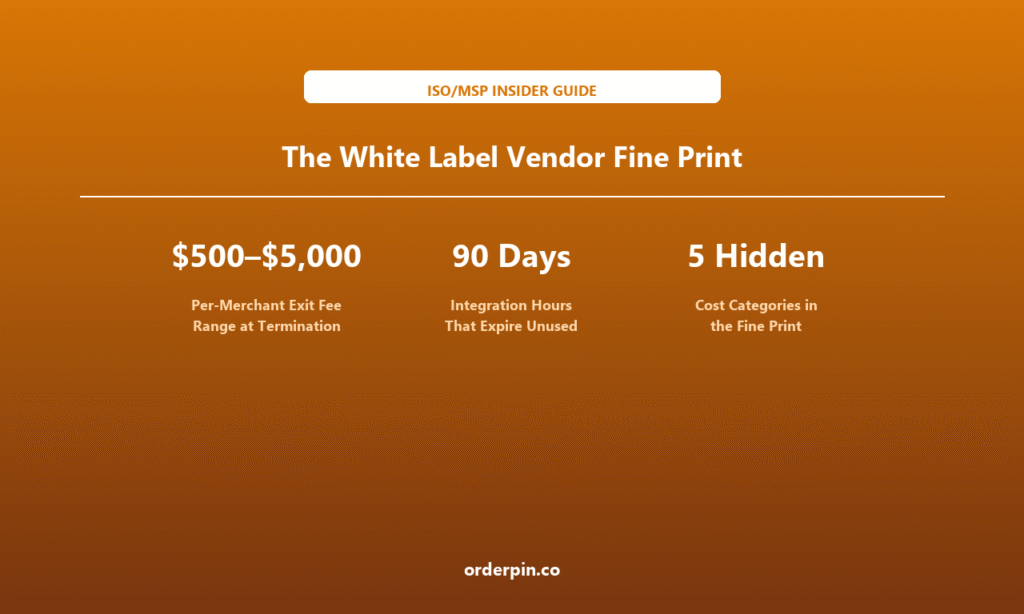
- The most expensive hidden cost is almost always the exit fee — and it scales with your merchant base: exit fees ranging $500–$5,000 per merchant on termination means that leaving a platform with 200 merchants can cost $100,000–$1,000,000. This is the clause that converts “we can switch platforms anytime” into “we are locked in.” The total cost of exit is the number every ISO should model before signing — and most do not.
- Data export “portability” that requires vendor assistance to decode is not portability: some vendors provide data export “for free” but in a proprietary format that requires paid vendor assistance to decode into a usable system. The export is technically available; the usability is not. An ISO should test the actual export format before signing — request a sample export of a test merchant and confirm it can be imported into a competing platform without vendor involvement.
Range at Termination
That Expire Unused
Fine Print
The Headline Rate Is the Floor, Not the Ceiling
Every white label POS vendor leads with a competitive headline number — a per-location platform fee, a per-transaction rate, a “no setup fee” promise. That number wins the demo. What it does not show is the cost structure that actually determines your margin over the life of the relationship. The fine print contains the real numbers, and most ISOs do not read it carefully enough before signing.
This article covers five categories of hidden cost that vendors typically do not lead with, and provides a “total cost of exit” worksheet so you can model the true cost of leaving a platform before you commit your merchant base to it. The goal is not to avoid white label — it is to know the real cost structure before you sign, so you can negotiate the terms and avoid the surprises.
monthly thresholds
you did not process
lost at 90 days
decode fees
1. Per-Transaction Fees That Jump Above Volume Thresholds
The headline per-transaction rate often applies only to the first tier of monthly volume: a vendor advertising “0.25% + 10¢ per transaction” may specify in the contract that this rate applies only to the first $50,000 of monthly processed volume per merchant, after which the rate steps up to 0.30% + 12¢. The most valuable merchants — high-volume locations — cost the ISO the most margin per transaction, exactly when the ISO should be earning the most.
How to find it: look for “volume band,” “processing tier,” or “above threshold” language in the rate schedule. Ask the vendor for the effective blended rate at three volume levels for a representative merchant ($100K, $500K, $1M annual). The gap between the headline rate and the blended rate at scale is the real cost of the contract.
2. Minimum Transaction Guarantees (Billed for Volume You Did Not Process)
Some agreements include a minimum monthly transaction volume commitment per merchant or per ISO: if the actual processed volume falls below the guaranteed minimum, the ISO is billed for the difference at the contracted rate. This is a “you pay for what you promised, not what you processed” clause. It protects the vendor’s revenue forecast; it punishes the ISO for merchant churn or seasonal dips.
How to find it: search the contract for “minimum monthly volume,” “volume commitment,” or “guaranteed transactions.” A legitimate minimum that scales with your actual merchant count is manageable; a fixed minimum that does not adjust for churn is a liability that compounds as merchants leave.
3. Integration Hours That Expire in 90 Days
White label onboarding often includes a block of “integration support hours” — but the clock starts at contract signing, not when you are ready to build: a vendor may grant 40 hours of integration assistance that expires 90 days after signing. If your engineering team is not ready to build in the first 90 days (because you are still acquiring merchants or scoping the integration), those hours vanish. Then any further integration support is billed at the vendor’s professional services rate, which is typically 2–3x the effective cost of the included hours.
How to find it: look for “onboarding hours,” “integration support,” or “professional services credit” with an expiration clause. Negotiate to start the clock at first integration kickoff, not contract signing — or to carry over unused hours.
4. Exit Fees Ranging $500–$5,000 Per Merchant
The exit fee is the single most expensive hidden cost because it scales with your merchant base: a per-merchant exit fee of $500–$5,000 means that terminating a contract with 200 merchants can cost $100,000–$1,000,000. This clause is rarely discussed in the sales conversation and appears deep in the termination section. Its effect is to make leaving financially impossible at scale — the ISO is not choosing to stay; it is trapped.
How to find it: search for “termination fee,” “exit charge,” “deconversion fee,” or “per-merchant transition fee.” Negotiate a cap on total exit exposure, or eliminate per-merchant exit fees entirely in exchange for a notice period. A reasonable notice period (60–90 days) protects the vendor’s transition; a per-merchant fee protects nothing except the vendor’s lock-in.
5. Data Export Formats That Require Vendor Assistance to Decode
“Data portability included” can mean the export is technically available but unusable without paid vendor assistance: a vendor may provide a full data export “at no charge” but in a proprietary format — a custom binary, an undocumented schema, or a dump that requires the vendor’s professional services to transform into a system a competing platform can import. The export is free; the usability is not. This is the subtle version of the exit fee: you can have your data, but you cannot use it without paying.
How to test it before signing: request a sample data export of a test merchant during due diligence and confirm it can be imported into a competing platform without vendor involvement. If the export requires the vendor’s professional services to decode, you do not have portability — you have a more polite hostage situation. (See AD7 for the full data portability due diligence check.)
6. The “Total Cost of Exit” Worksheet
Model the true cost of leaving a platform before you sign. Fill in the worksheet with your own numbers — the right side is illustrative for a 200-merchant portfolio to show how the costs compound.
| Exit Cost Component | Your Input | Example (200 merchants) |
|---|---|---|
| Per-merchant exit fee | $ ____ × N | $2,000 × 200 = $400,000 |
| Data export / decode fee | $ ____ | $15,000 (vendor assist) |
| Data migration to new platform | $ ____ | $25,000 (engineering) |
| Downtime / re-onboarding cost | $ ____ | $30,000 (lost days) |
| Early termination penalty (if any) | $ ____ | $50,000 (remaining term) |
| TOTAL COST OF EXIT | $ ____ | $520,000 |
Read the result against your annual margin: if the total cost of exit ($520,000 in the example) exceeds two years of portfolio margin, the platform is effectively a lock-in. That is the number that should drive your negotiation — not the headline rate. Negotiate the exit fee cap and the data export terms to bring the total cost of exit below one year of margin, or the platform owns you at renewal.
How OrderPin Handles the Fine Print
OrderPin is a white-label POS platform built for ISO and MSP partners. OrderPin’s ISO agreements are designed so the total cost of exit stays below one year of margin: no per-merchant exit fees, full data export portability in machine-readable formats at any time without vendor assistance, and integration support hours that start at kickoff rather than contract signing. The fine print is where OrderPin’s model differs from platforms that lead with a low headline rate and recover margin at exit. If you are comparing vendors, run the total cost of exit worksheet against each one — including OrderPin — and compare the numbers side by side.
Frequently Asked Questions
What is the typical exit fee range for white label POS vendors?
Per-merchant exit fees typically range from $500 to $5,000 at termination, depending on the vendor and the contract tier. The critical variable is that this fee scales with your merchant base: a 200-merchant portfolio at $2,000 per merchant is a $400,000 exit cost. This is the clause that converts “we can switch anytime” into “we are locked in.” Always negotiate a cap on total exit exposure or eliminate per-merchant exit fees in exchange for a notice period. A reasonable 60–90 day notice protects the vendor’s transition without creating a lock-in.
How do I know if a vendor’s data export is actually usable, not just available?
Request a sample data export of a test merchant during due diligence — before signing — and attempt to import it into a competing platform without vendor involvement. If the export is in a proprietary binary, an undocumented schema, or requires the vendor’s professional services to transform into a usable format, it is not portable. True portability means: (1) you can initiate the export yourself at any time; (2) the format is documented and machine-readable (CSV, JSON, or a documented API schema); and (3) there is no per-export fee that scales with your merchant base. “Data export included” that requires paid vendor assistance to decode is a polite hostage situation, not portability.
What is a minimum transaction guarantee and why is it risky?
A minimum transaction guarantee is a contract clause requiring the ISO to process (and pay for) a minimum monthly transaction volume regardless of actual processed volume. If actual volume falls below the guaranteed minimum — due to merchant churn, seasonal dips, or slower-than-expected ramp — the ISO is billed for the difference at the contracted rate. It protects the vendor’s revenue forecast and punishes the ISO for factors outside its control. A minimum that scales with actual merchant count is manageable; a fixed minimum that does not adjust for churn is a liability that compounds as merchants leave. Search the contract for “minimum monthly volume,” “volume commitment,” or “guaranteed transactions.”
Why do integration hours expire, and how do I avoid losing them?
White label onboarding often includes a block of integration support hours (e.g., 40 hours) that expires 90 days after contract signing, not after your engineering team is ready to build. If you are still acquiring merchants or scoping the integration at day 90, those hours vanish and further support is billed at the vendor’s professional services rate (typically 2–3x the effective cost). To avoid this: negotiate to start the clock at first integration kickoff rather than contract signing, or to carry over unused hours to the next 90-day period. Also front-load your integration work in the first 90 days if the clock cannot be moved — the included hours are effectively free engineering time.
How should I use the total cost of exit worksheet in vendor comparison?
Fill in the worksheet for each vendor you are considering, using your own numbers and each vendor’s actual contract terms. Then read the total against your projected annual portfolio margin. If the total cost of exit exceeds two years of margin for a given vendor, that platform is effectively a lock-in — the headline rate is irrelevant because you will not be able to leave. Compare the totals side by side: the vendor with the lowest headline rate may have the highest total cost of exit, and vice versa. The goal is to negotiate each vendor’s exit fee, data export terms, and integration hour terms so the total cost of exit stays below one year of margin for every platform you seriously consider.
What is the most overlooked hidden cost that ISOs miss?
The data export decode fee. Most ISOs negotiate the headline rate and the exit fee but assume “data portability included” means they can leave with their data. The trap is that the export is provided in a proprietary format requiring paid vendor assistance to decode — so you can have your data but cannot use it without paying. This is the most overlooked because it is hidden behind reassuring language (“your data is always yours”) that is technically true but practically misleading. Test the actual export format before signing (request a sample and try to import it elsewhere) and get the usable-format guarantee in writing. This single check prevents the most common “we cannot leave” discovery at termination.
The headline rate is the floor, not the ceiling. The fine print — volume-tier fee jumps, minimum transaction guarantees, expiring integration hours, per-merchant exit fees of $500–$5,000, and data export decode charges — contains the real cost structure that determines your margin over the life of the relationship. The most expensive hidden cost is almost always the exit fee, because it scales with your merchant base: leaving a 200-merchant portfolio can cost $100,000–$1,000,000. Model the total cost of exit before signing using the worksheet — if it exceeds two years of portfolio margin, the platform owns you at renewal. Test the actual data export format before committing; “included” export that requires paid vendor assistance to decode is not portability. OrderPin is a white-label POS platform built for ISO and MSP partners — with no per-merchant exit fees, full data portability in machine-readable formats, and integration hours that start at kickoff, so the total cost of exit stays below one year of margin by design.
About OrderPin
OrderPin is a white-label POS platform built for ISO and MSP partners. We offer full data ownership, flexible pricing, and seamless API integrations to help you build a recurring revenue business under your own brand. Learn more about OrderPin’s white-label solution